
Geometry - GMAT Quantitative
Card 1 of 6760
What is the area of a rectangle given the length of  and width of
  ?
?
What is the area of a rectangle given the length of
Tap to reveal answer
To find the area of a rectangle, you must use the following formula:


To find the area of a rectangle, you must use the following formula:
← Didn't Know|Knew It →
Find the perimeter of a rectangle whose width is  and length is
  .
.
Find the perimeter of a rectangle whose width is
Tap to reveal answer
To solve, simply use the formula for the perimeter of a rectangle:

To solve, simply use the formula for the perimeter of a rectangle:
← Didn't Know|Knew It →
Determine whether  and
and 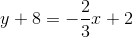 are parallel lines.
Determine whether
Tap to reveal answer
Parallel lines have the same slope. Therefore, we need to find the slope once both equations are in slope intercept form  :
:


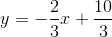

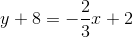
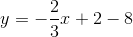
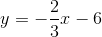

The lines are parallel because the slopes are the same.
Parallel lines have the same slope. Therefore, we need to find the slope once both equations are in slope intercept form
The lines are parallel because the slopes are the same.
← Didn't Know|Knew It →
What polynomial represents the area of a rectangle with length  and width
  ?
?
What polynomial represents the area of a rectangle with length
Tap to reveal answer
The area of a rectangle is the product of the length and the width. The expression  can be multplied by noting that this is the product of the sum and the difference of the same two terms; its product is the difference of the squares of the terms, or

The area of a rectangle is the product of the length and the width. The expression
← Didn't Know|Knew It →
What is the length of the diagonal of a cube if its side length is  ?
?
What is the length of the diagonal of a cube if its side length is
Tap to reveal answer
The diagonal of a cube extends from one of its corners diagonally through the cube to the opposite corner, so it can be thought of as the hypotenuse of a right triangle formed by the height of the cube and the diagonal of its base. First we must find the diagonal of the base, which will be the same as the diagonal of any face of the cube, by applying the Pythagorean theorem:



Now that we know the length of the diagonal of any face on the cube, we can use the Pythagorean theorem again with this length and the height of the cube, whose hypotenuse is the length of the diagonal for the cube:



The diagonal of a cube extends from one of its corners diagonally through the cube to the opposite corner, so it can be thought of as the hypotenuse of a right triangle formed by the height of the cube and the diagonal of its base. First we must find the diagonal of the base, which will be the same as the diagonal of any face of the cube, by applying the Pythagorean theorem:
Now that we know the length of the diagonal of any face on the cube, we can use the Pythagorean theorem again with this length and the height of the cube, whose hypotenuse is the length of the diagonal for the cube:
← Didn't Know|Knew It →
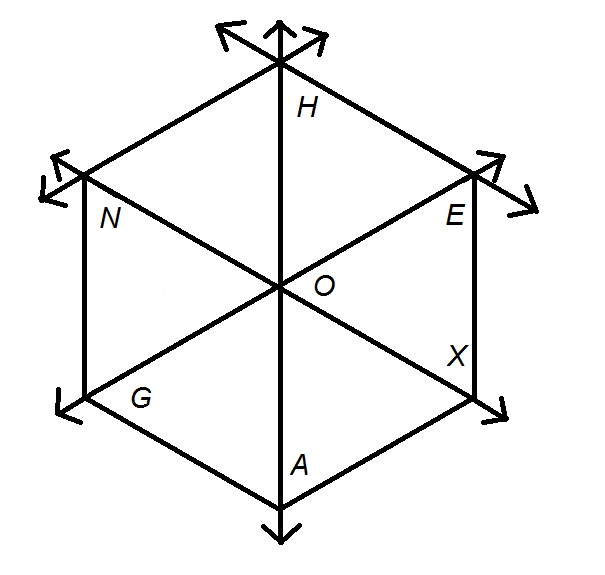
In the above figure, give the union of  and
and  .
.
In the above figure, give the union of
Tap to reveal answer
 can be seen to be completely contained in
  - that is,
  . The union of a set and its subset is the containing set, so the correct response is
  .
.
← Didn't Know|Knew It →
Find the equation of the line that is perpendicular to the line connecting the points  .
.
Find the equation of the line that is perpendicular to the line connecting the points
Tap to reveal answer
Lines are perpendicular if their slopes are negative reciprocals of each other. First we need to find the slope of the line in the question stem.

The negative reciprocal of 3 is  , so our answer will have a slope of
  . Let's go through the answer choices and see.
 : This line is of the form
  , where
  is the slope. The slope is 3, so this line is parallel, not perpendicular, to our line in question.
 : The slope here is
  , also wrong.
 : The slope of this line is
  . This is the reciprocal, but not the negative reciprocal, so this is also incorrect.
The line between the points  :
: .
.
This is the correct answer! Let's check the last answer choice as well.
The line between points  :
: , which is incorrect.
Lines are perpendicular if their slopes are negative reciprocals of each other. First we need to find the slope of the line in the question stem.
The negative reciprocal of 3 is
The line between the points
This is the correct answer! Let's check the last answer choice as well.
The line between points
← Didn't Know|Knew It →
In the above figure, give the intersection of  and
and  .
.
In the above figure, give the intersection of
Tap to reveal answer
 can be seen to be completely contained in
  - that is,
  . The intersection of a set and its subset is the subset, so the correct response is
  .
.
← Didn't Know|Knew It →
What is the measure of one exterior angle of a regular twenty-four sided polygon?
What is the measure of one exterior angle of a regular twenty-four sided polygon?
Tap to reveal answer
The sum of the measures of the exterior angles of any polygon, one at each vertex, is  . Since a regular polygon with twenty-four sides has twenty-four congruent angles, and therefore, congruent exterior angles, just divide:

The sum of the measures of the exterior angles of any polygon, one at each vertex, is
← Didn't Know|Knew It →
Which of the following figures would have exterior angles none of whose degree measures is an integer?
Which of the following figures would have exterior angles none of whose degree measures is an integer?
Tap to reveal answer
The sum of the degree measures of any polygon is  . A regular polygon with
  sides has exterior angles of degree measure
  . For this to be an integer, 360 must be divisible by
  .
.
We can test each of our choices to see which one fails this test.


Only the eighty-sided regular polygon fails this test, making this the correct choice.
The sum of the degree measures of any polygon is
We can test each of our choices to see which one fails this test.
Only the eighty-sided regular polygon fails this test, making this the correct choice.
← Didn't Know|Knew It →
You are given Pentagon  such that:

and

Calculate 
You are given Pentagon
and
Calculate
Tap to reveal answer
Let  be the common measure of
  ,
,  ,
,  , and
, and 
Then

The sum of the measures of the angles of a pentagon is  degrees; this translates to the equation

or


Let
Then
The sum of the measures of the angles of a pentagon is
or
← Didn't Know|Knew It →

The above diagram shows a regular pentagon and a regular hexagon sharing a side. What is the measure of  ?
?
The above diagram shows a regular pentagon and a regular hexagon sharing a side. What is the measure of
Tap to reveal answer
The measure of each interior angle of a regular pentagon is

The measure of each interior angle of a regular hexagon is

The measure of  is the difference of the two, or
  .
.
The measure of each interior angle of a regular pentagon is
The measure of each interior angle of a regular hexagon is
The measure of
← Didn't Know|Knew It →

The above diagram shows a regular pentagon and a regular hexagon sharing a side. Give  .
.
The above diagram shows a regular pentagon and a regular hexagon sharing a side. Give
Tap to reveal answer
This can more easily be explained if the shared side is extended in one direction, and the new angles labeled.
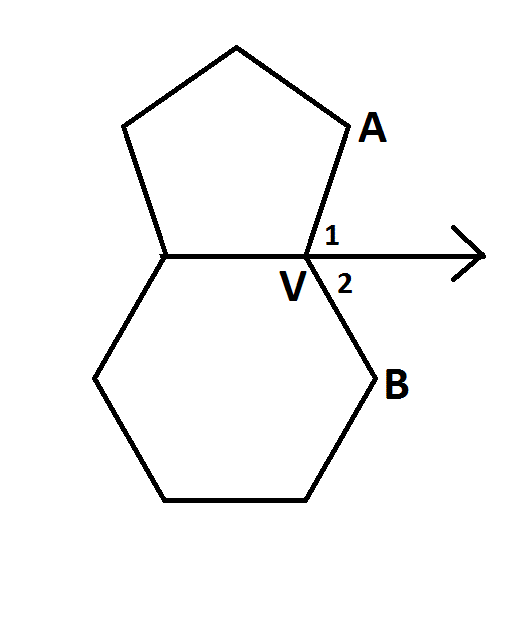
 and
and  are exterior angles of the regular polygons. Also, the measures of the exterior angles of any polygon, one at each vertex, total
  . Therefore,


Add the measures of the angles to get  :
:

This can more easily be explained if the shared side is extended in one direction, and the new angles labeled.
Add the measures of the angles to get
← Didn't Know|Knew It →

Note: Figure NOT drawn to scale
The figure above shows a square inside a regular pentagon. Give  .
.
Note: Figure NOT drawn to scale
The figure above shows a square inside a regular pentagon. Give
Tap to reveal answer
Each angle of a square measures  ; each angle of a regular pentagon measures
  . To get
  , subtract:
 .
.
Each angle of a square measures
← Didn't Know|Knew It →
Which of the following cannot be the measure of an exterior angle of a regular polygon?
Which of the following cannot be the measure of an exterior angle of a regular polygon?
Tap to reveal answer
The sum of the measures of the exterior angles of any polygon, one per vertex, is  . In a regular polygon of
  sides , then all
  of these exterior angles are congruent, each measuring
  .
.
If  is the measure of one of these angles, then
  , or, equivalently,
  . Therefore, for
  to be a possible measure of an exterior angle, it must divide evenly into 360. We divide each in turn:


Since 16 is the only one of the choices that does not divide evenly into 360, it cannot be the measure of an exterior angle of a regular polygon.
The sum of the measures of the exterior angles of any polygon, one per vertex, is
If
Since 16 is the only one of the choices that does not divide evenly into 360, it cannot be the measure of an exterior angle of a regular polygon.
← Didn't Know|Knew It →
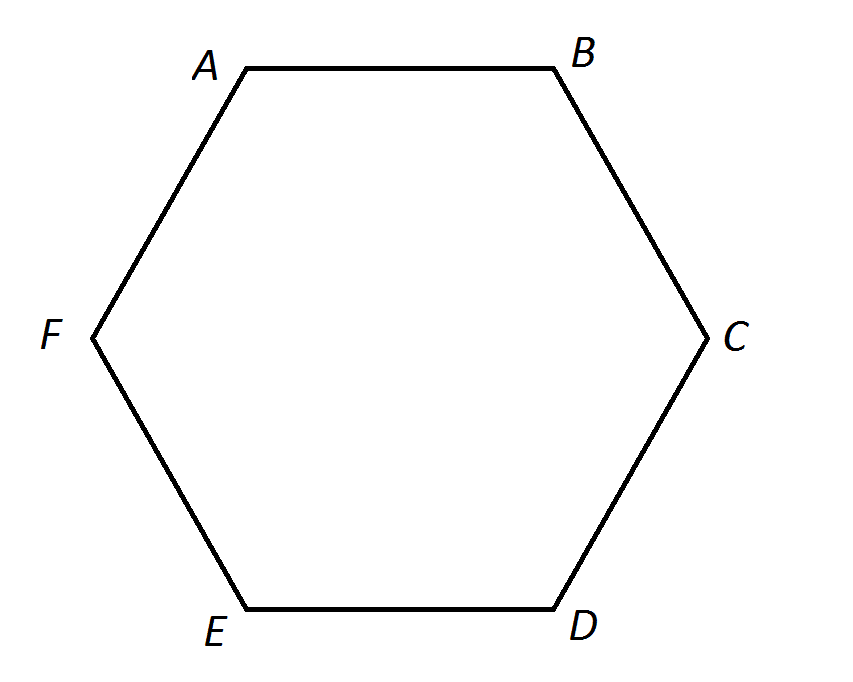
Note: Figure NOT drawn to scale.
Given:


Evaluate  .
.
Note: Figure NOT drawn to scale.
Given:
Evaluate
Tap to reveal answer
Call  the measure of

 , and
, and 
so

The sum of the measures of the angles of a hexagon is  , so
, so


 , which is the measure of
  .
.
Call
so
The sum of the measures of the angles of a hexagon is
← Didn't Know|Knew It →
What is the arithmetic mean of the measures of the angles of a nonagon (a nine-sided polygon)?
What is the arithmetic mean of the measures of the angles of a nonagon (a nine-sided polygon)?
Tap to reveal answer
The sum of the measures of the nine angles of any nonagon is calculated as follows:

Divide this number by nine to get the arithmetic mean of the measures:

The sum of the measures of the nine angles of any nonagon is calculated as follows:
Divide this number by nine to get the arithmetic mean of the measures:
← Didn't Know|Knew It →
You are given a quadrilateral and a pentagon. What is the mean of the measures of the interior angles of the two polygons?
You are given a quadrilateral and a pentagon. What is the mean of the measures of the interior angles of the two polygons?
Tap to reveal answer
The mean of the measures of the four angles of the quadrilateral and the five angles of of the pentagon is their sum divided by 9.
The sum of the measures of the interior angles of any quadrilateral is  . The sum of the measures of the interior angles of any pentagon is
  .
.
The sum of the measures of the interior angles of both polygons is therefore  . Divide by 9:

The mean of the measures of the four angles of the quadrilateral and the five angles of of the pentagon is their sum divided by 9.
The sum of the measures of the interior angles of any quadrilateral is
The sum of the measures of the interior angles of both polygons is therefore
← Didn't Know|Knew It →

Note: Figure NOT drawn to scale.
Given Regular Pentagon  . What is
  ?
?
Note: Figure NOT drawn to scale.
Given Regular Pentagon
Tap to reveal answer
Quadrilateral  is a trapezoid, so
  .
.
 , so
, so


Quadrilateral
← Didn't Know|Knew It →
The angles of a pentagon measure  .
.
Evaluate  .
.
The angles of a pentagon measure
Evaluate
Tap to reveal answer
The sum of the degree measures of the angles of a (five-sided) pentagon is  , so we can set up and solve the equation:


The sum of the degree measures of the angles of a (five-sided) pentagon is
← Didn't Know|Knew It →