
Quadrilaterals - GMAT Quantitative
Card 1 of 1104
The area of a square that has sides with a length of 12 inches is equal to the area of a rectangle. If the rectangle has a width of 3 inches, what is the length of the rectangle?
The area of a square that has sides with a length of 12 inches is equal to the area of a rectangle. If the rectangle has a width of 3 inches, what is the length of the rectangle?
Tap to reveal answer
If the area of the rectangle is equal to the area of the square, then it must have an area of 
 . If the rectangle has an area of
  and a side with a lenth of 3 inches, then the equation to solve the problem would be
  , where
  is the length of the rectangle. The solution:
 .
.
If the area of the rectangle is equal to the area of the square, then it must have an area of
← Didn't Know|Knew It →
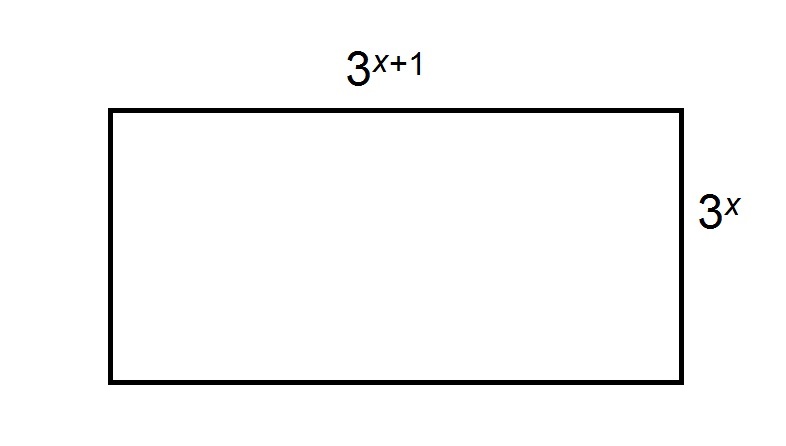
Note: figure NOT drawn to scale
Give the area of the above rectangle.
Note: figure NOT drawn to scale
Give the area of the above rectangle.
Tap to reveal answer
The area of a rectangle is the product of its length and width;

The area of a rectangle is the product of its length and width;
← Didn't Know|Knew It →
A rectangle twice as long as it is wide has perimeter  . Write its area in terms of
  .
.
A rectangle twice as long as it is wide has perimeter
Tap to reveal answer
Let  be the width of the rectangle; then its length is
  , and its perimeter is

Set this equal to  and solve for
  :
:


The width is  and the length is
  , so multiply these expressions to get the area:

Let
Set this equal to
The width is
← Didn't Know|Knew It →
A rectangle has its vertices at  . What part, in percent, of the rectangle is located in Quadrant III?
A rectangle has its vertices at
Tap to reveal answer
A rectangle with vertices  has width
  and height
  , thereby having area
  .
.
The portion of the rectangle in Quadrant III is a rectangle with vertices
 .
.
It has width  and height
  , thereby having area
  .
.
Therefore,  of the rectangle is in Quadrant III; this is equal to

A rectangle with vertices
The portion of the rectangle in Quadrant III is a rectangle with vertices
It has width
Therefore,
← Didn't Know|Knew It →
A rectangle has its vertices at  . What percentage of the rectangle is located in Quadrant IV?
A rectangle has its vertices at
Tap to reveal answer
A rectangle with vertices has width and height ; it follows that its area is .
The portion of the rectangle in Quadrant IV has vertices  . Its width is
  , and its height is
  , so its area is
  .
.
Therefore,  , or
, or  , of this rectangle is in Quadrant IV.
A rectangle with vertices
The portion of the rectangle in Quadrant IV has vertices
Therefore,
← Didn't Know|Knew It →
What is the area of a rectangle given the length of  and width of
  ?
?
What is the area of a rectangle given the length of
Tap to reveal answer
To find the area of a rectangle, you must use the following formula:


To find the area of a rectangle, you must use the following formula:
← Didn't Know|Knew It →
What polynomial represents the area of a rectangle with length  and width
  ?
?
What polynomial represents the area of a rectangle with length
Tap to reveal answer
The area of a rectangle is the product of the length and the width. The expression  can be multplied by noting that this is the product of the sum and the difference of the same two terms; its product is the difference of the squares of the terms, or

The area of a rectangle is the product of the length and the width. The expression
← Didn't Know|Knew It →
The perimeter of a rectangle is  and its length is
  times the width. What is the area?
The perimeter of a rectangle is
Tap to reveal answer
The perimeter of a rectangle is the sum of all four sides, that is: 
since  , we can rewrite the equation as:


We are being asked for the area so we still aren't done. The area of a rectangle is the product of the width and length. We know what the width is so we can find the length and then take their product.


The perimeter of a rectangle is the sum of all four sides, that is:
since
We are being asked for the area so we still aren't done. The area of a rectangle is the product of the width and length. We know what the width is so we can find the length and then take their product.
← Didn't Know|Knew It →
Find the area of a rectangle whose side lengths are  .
.
Find the area of a rectangle whose side lengths are
Tap to reveal answer
To calculate area, multiply width times height. Thus,

To calculate area, multiply width times height. Thus,
← Didn't Know|Knew It →
Mark is building a garden with raised beds. One side of the garden will be 10 feet long and the other will be 5 less than three times the first side. What area of will Mark's garden be?
Mark is building a garden with raised beds. One side of the garden will be 10 feet long and the other will be 5 less than three times the first side. What area of will Mark's garden be?
Tap to reveal answer
Mark is building a garden with raised beds. One side of the garden will be 10 feet long and the other will be 5 less than three times the first side. What area of will Mark's garden be?
This problem asks us to find the area of a rectangle. We are given one side and asked to find the other. To find the other, we need to use the provided clues.
"...five less..." 
"...three times the first side..."  or
or 
So put it together:

Next, find the area via the following formula:

So our answer is:

Mark is building a garden with raised beds. One side of the garden will be 10 feet long and the other will be 5 less than three times the first side. What area of will Mark's garden be?
This problem asks us to find the area of a rectangle. We are given one side and asked to find the other. To find the other, we need to use the provided clues.
"...five less..."
"...three times the first side..."
So put it together:
Next, find the area via the following formula:
So our answer is:
← Didn't Know|Knew It →
Find the area of a rectangle whose width is  and length is
  .
.
Find the area of a rectangle whose width is
Tap to reveal answer
To find area, simply multiply length times width. Thus

To find area, simply multiply length times width. Thus
← Didn't Know|Knew It →
Write, in terms of  , the perimeter of a square whose area is
Write, in terms of
Tap to reveal answer
To find the perimeter of a square given its area, take the square root of the area to find its sidelength; then, multiply that sidelength by 4.
 is a perfect square trinomial, since
so its square root is  , the sidelength.
Multiply this by 4 to get the perimeter: 
To find the perimeter of a square given its area, take the square root of the area to find its sidelength; then, multiply that sidelength by 4.
so its square root is
Multiply this by 4 to get the perimeter:
← Didn't Know|Knew It →
If the diagonal of a square room is  . What is the area of the room?
If the diagonal of a square room is
Tap to reveal answer
Cutting the triangle in half yields a right triangle with the diagonal becoming the hypotenuse and the other two legs being the sides of the square. Using the Pythagorean Theorem, we can solve for the other legs of the triangle.

Since both sides of the square are equal to eachother,  , therefore:


To find the area of the square:
 with leg
  being one of the sides


Cutting the triangle in half yields a right triangle with the diagonal becoming the hypotenuse and the other two legs being the sides of the square. Using the Pythagorean Theorem, we can solve for the other legs of the triangle.
Since both sides of the square are equal to eachother,
To find the area of the square:
← Didn't Know|Knew It →
A square plot of land has perimeter 1,200 feet. Give its area in square yards.
A square plot of land has perimeter 1,200 feet. Give its area in square yards.
Tap to reveal answer
The length of one side of the square is  feet, or
  yards. Square this to get the area in square yards:
 square yards.
The length of one side of the square is
← Didn't Know|Knew It →
What polynomial represents the area of Square  if
if  ?
?
What polynomial represents the area of Square
Tap to reveal answer
As a square,  is also a rhombus. The area of a rhombus is half the product of the lengths of its diagonals, one of which is
  . Since the diagonals are congruent, this is equal to half the square of
  :
:


As a square,
← Didn't Know|Knew It →
Six squares have sidelengths 8 inches, 1 foot, 15 inches, 20 inches, 2 feet, and 25 inches. What is the sum of their areas?
Six squares have sidelengths 8 inches, 1 foot, 15 inches, 20 inches, 2 feet, and 25 inches. What is the sum of their areas?
Tap to reveal answer
The areas of the squares are the squares of the sidelengths, so add the squares of the sidelengths. Since 1 foot is equal to 12 inches and 2 feet are equal to 24 inches, the sum of the areas is:


 square inches
The areas of the squares are the squares of the sidelengths, so add the squares of the sidelengths. Since 1 foot is equal to 12 inches and 2 feet are equal to 24 inches, the sum of the areas is:
← Didn't Know|Knew It →
A square, a regular pentagon, and a regular hexagon have the same sidelength. The sum of their perimeters is one mile. What is the area of the square?
A square, a regular pentagon, and a regular hexagon have the same sidelength. The sum of their perimeters is one mile. What is the area of the square?
Tap to reveal answer
The square, the pentagon, and the hexagon have a total of 15 sides, all of which are of equal length; the sum of the lengths is one mile, or 5,280 feet, so the length of one side of any of these polygons is
 feet.
feet.
The square has area equal to the square of this sidelength:

The square, the pentagon, and the hexagon have a total of 15 sides, all of which are of equal length; the sum of the lengths is one mile, or 5,280 feet, so the length of one side of any of these polygons is
The square has area equal to the square of this sidelength:
← Didn't Know|Knew It →
A square and a regular pentagon have the same perimeter. The length of one side of the pentagon is 60 centimeters. What is the area of the square?
A square and a regular pentagon have the same perimeter. The length of one side of the pentagon is 60 centimeters. What is the area of the square?
Tap to reveal answer
The regular perimeter has sidelength 60 centimeters and therefore perimeter  centimeters. The square has as its sidelength
  centimeters and area
  square centimeters.
The regular perimeter has sidelength 60 centimeters and therefore perimeter
← Didn't Know|Knew It →
Given square FGHI, answer the following
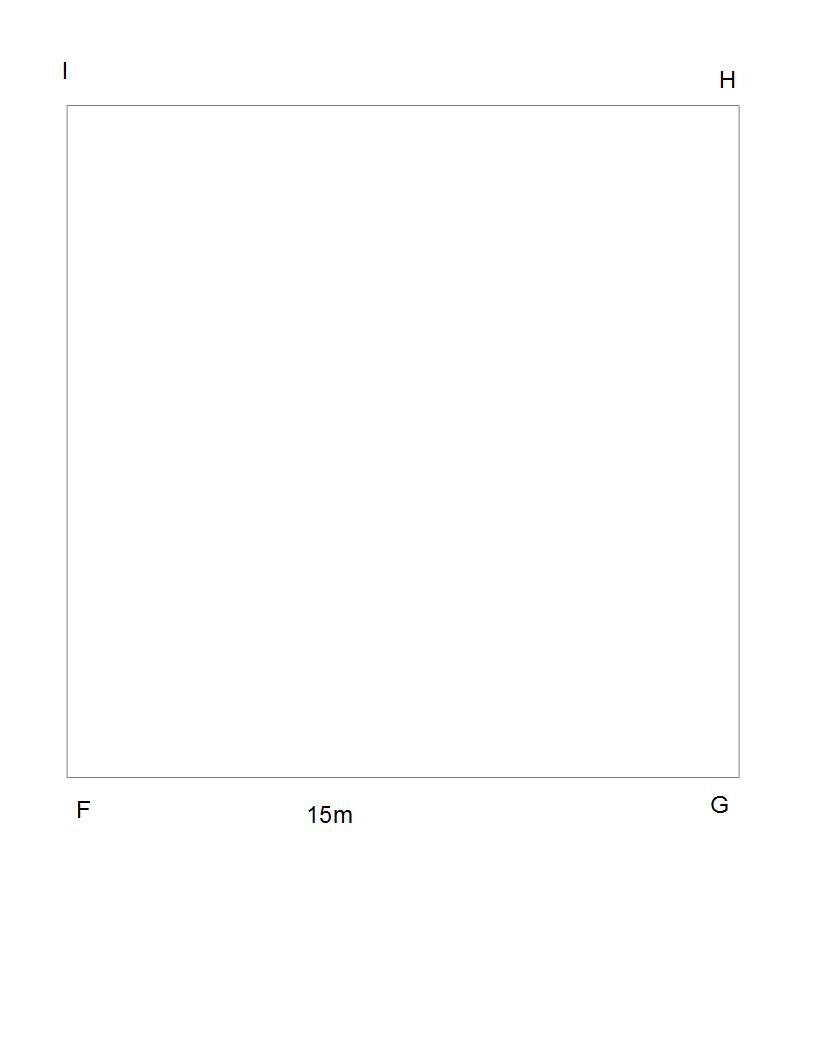
If square  represents the surface of an ancient arena discovered by archaeologists, what is the area of the arena?
Given square FGHI, answer the following
If square
Tap to reveal answer
This problem requires us to find the area of a square. Don't let the story behind it distract you, it is simply an area problem. Use the following equation to find our answer:

 is the length of one side of the square; in this case we are told that it is
  , so we can solve accordingly!
This problem requires us to find the area of a square. Don't let the story behind it distract you, it is simply an area problem. Use the following equation to find our answer:
← Didn't Know|Knew It →
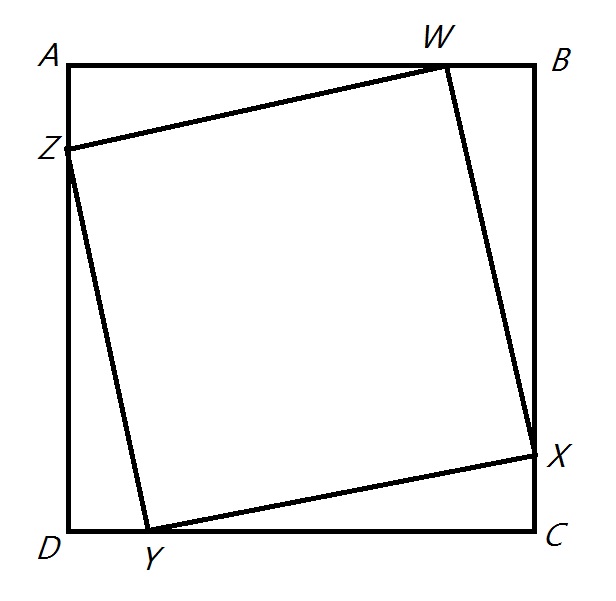
Note: Figure NOT drawn to scale
Refer to the above figure, which shows Square  and Square
  .
.  and Square
  has area 49. Give the area of Square
  .
.
Note: Figure NOT drawn to scale
Refer to the above figure, which shows Square
Tap to reveal answer
Square  has area 49, so each of its sides has as its length the square root of 49, or 7. Each side of Square
  is therefore a hypotenuse of a right triangle with legs 1 and
  , so each sidelength, including
  , can be found using the Pythagorean Theorem:


The square of this, which is 37, is the area of Square  .
.
Square
The square of this, which is 37, is the area of Square
← Didn't Know|Knew It →