
Polygons - GMAT Quantitative
Card 1 of 360
Calculate the length of the diagonal for a regular pentagon with a side length of  .
.
Calculate the length of the diagonal for a regular pentagon with a side length of
Tap to reveal answer
A regular pentagon has five diagonals of equal length, each formed by a line going from one vertex of the pentagon to another. We can see that for one of these diagonals, an isosceles triangle is formed where the two equal side lengths between the vertices joined by the diagonal are the other two sides. If we draw a line bisecting the angle between those two sides perpendicular with the diagonal that forms the other side of the triangle, we will have two congruent right triangles whose hypotenuse is the side length,  , and whose adjacent angle is half the measure of one interior angle of a pentagon. Using these two values, we can solve for the length of the opposite side, which is half of the diagonal, so we can them multiply the result by
  to calculate the full length of the diagonal. We start by determining the sum of the interior angles of a pentagon using the following formula, where
  is the number of sides of the polygon:

So to get the measure of each of the five angles in a pentagon, we divide the result by  :
:

So each interior angle of a regular pentagon has a measure of  . As explained earlier, we can find the length of half the diagonal by bisecting this angle to form two right triangles. If the hypotenuse is
  and the adjacent angle is half of an interior angle, or
  , then the length of the opposite side will be the hypotenuse times the sine of that angle. This only gives half of the diagonal, however, as there are two of these congruent right triangles, so we multiply the result by
  and we get the full length of the diagonal of a pentagon as follows:

A regular pentagon has five diagonals of equal length, each formed by a line going from one vertex of the pentagon to another. We can see that for one of these diagonals, an isosceles triangle is formed where the two equal side lengths between the vertices joined by the diagonal are the other two sides. If we draw a line bisecting the angle between those two sides perpendicular with the diagonal that forms the other side of the triangle, we will have two congruent right triangles whose hypotenuse is the side length,
So to get the measure of each of the five angles in a pentagon, we divide the result by
So each interior angle of a regular pentagon has a measure of
← Didn't Know|Knew It →
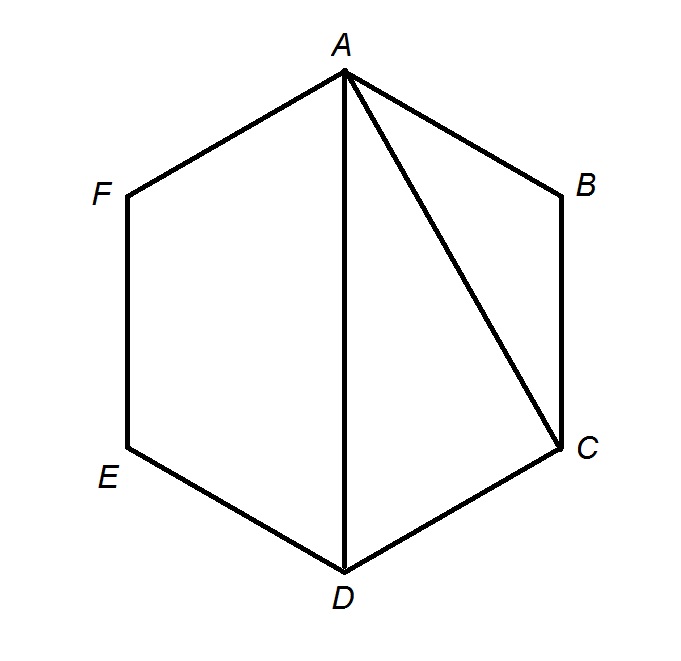
The hexagon in the above diagram is regular. If  has length 12, which of the following expressions is equal to the length of
  ?
?
The hexagon in the above diagram is regular. If
Tap to reveal answer
 is a diameter of the regular hexagon. Examine the diagram below, which shows the hexagon with all three diameters:

Each interior angle of a hexagon measures  , so, by symmetry, each base angle of the triangle formed is
  ; also, each central angle measures one sixth of
  , or
, or  . Each triangle is equilateral, so if
  , it follows that
  , and
, and  .
.
Each interior angle of a hexagon measures
← Didn't Know|Knew It →

The octagon in the above diagram is regular. If  has length 8, which of the following expressions is equal to the length of
  ?
?
The octagon in the above diagram is regular. If
Tap to reveal answer
Construct two other diagonals as shown.

Each of the interior angles of a regular octagon have measure  , so it can be shown that
  is a 45-45-90 triangle. Its hypotenuse is
  , whose length is 8, so, by the 45-45-90 Triangle Theorem, the length of
  is 8 divided by
  :
:

Likewise,  .
.
Since Quadrilateral  is a rectangle,
  .
.

Construct two other diagonals as shown.
Each of the interior angles of a regular octagon have measure
Likewise,
Since Quadrilateral
← Didn't Know|Knew It →

Note: Figure NOT drawn to scale.
Which of the following statements is true of the length of  ?
?
Note: Figure NOT drawn to scale.
Which of the following statements is true of the length of
Tap to reveal answer
By dividing the figure into rectangles and taking advantage of the fact that opposite sides of rectangles are congruent, we have the following sidelengths:

 is the hypotenuse of a triangle with legs of lengths 8 and 16, so its length can be calculated using the Pythagorean Theorem:

The question can now be answered by noting that  and
and  .
.
 ,
,
so  falls between 17 and 18.
By dividing the figure into rectangles and taking advantage of the fact that opposite sides of rectangles are congruent, we have the following sidelengths:
The question can now be answered by noting that
so
← Didn't Know|Knew It →

Note: Figure NOT drawn to scale.
Refer to the above diagram. What is the length of  in terms of
  ?
?
Note: Figure NOT drawn to scale.
Refer to the above diagram. What is the length of
Tap to reveal answer
Extend sides  and
and  as shown to divide the polygon into three rectangles:

Taking advantage of the fact that opposite sides of a rectangle are congruent, we can find  and
and  :
:


 is right, so by the Pythagorean Theorem,


Extend sides
Taking advantage of the fact that opposite sides of a rectangle are congruent, we can find
← Didn't Know|Knew It →
Each side of convex Pentagon  has length 12. Also,
 .
.
Construct diagonal  . What is its length?
Each side of convex Pentagon
Construct diagonal
Tap to reveal answer
The measures of the interior angles of a convex pentagon total
 ,
,
so


The pentagon referenced is the one below. Note that the diagonal  , along with congruent sides
  and
and  , form an isosceles triangle
  .
.

Now construct the altitude from  to :
to :

 bisects
  and to form two 30-60-90 triangles. Therefore,
  ,
,
and  .
.

The measures of the interior angles of a convex pentagon total
so
The pentagon referenced is the one below. Note that the diagonal
Now construct the altitude from
and
← Didn't Know|Knew It →
A pentagon with a perimeter of one mile has three congruent sides; one of the other sides is 100 feet longer than any of those three congruent sides, and the remaining side is 100 feet longer than that fourth side. What is the length of that longest side?
A pentagon with a perimeter of one mile has three congruent sides; one of the other sides is 100 feet longer than any of those three congruent sides, and the remaining side is 100 feet longer than that fourth side. What is the length of that longest side?
Tap to reveal answer
If each of the five congruent sides has measure  , then the other two sides have measures
  and
and  . Add the sides to get the perimeter, which is equal to 5,280 feet, the solve for
  :
:






Each of the shortest sides is 996 feet long; the longest side is  feet long.
If each of the five congruent sides has measure
Each of the shortest sides is 996 feet long; the longest side is
← Didn't Know|Knew It →
The perimeter of a regular hexagon is one-half of a mile. Give the sidelength in inches.
The perimeter of a regular hexagon is one-half of a mile. Give the sidelength in inches.
Tap to reveal answer
One mile is 5,280 feet. The perimeter of the hexagon is one-half of this, or 2,640 feet. Since each side of a regular hexagon is congruent, the length of one side is one-sixth of this, or  feet.
feet.
Multiply by 12 to convert to inches:  inches.
One mile is 5,280 feet. The perimeter of the hexagon is one-half of this, or 2,640 feet. Since each side of a regular hexagon is congruent, the length of one side is one-sixth of this, or
Multiply by 12 to convert to inches:
← Didn't Know|Knew It →
The perimeter of a regular pentagon is one-fifth of a mile. Give its sidelength in feet.
The perimeter of a regular pentagon is one-fifth of a mile. Give its sidelength in feet.
Tap to reveal answer
One mile is 5,280 feet. The perimeter of the pentagon is one-fifth of this, or  feet. Since each side of a regular pentagon is congruent, the length of one side is one fifth-of this, or
 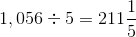 feet.
feet.
One mile is 5,280 feet. The perimeter of the pentagon is one-fifth of this, or
← Didn't Know|Knew It →
The perimeter of a regular octagon is two kilometers. Give its sidelength in meters.
The perimeter of a regular octagon is two kilometers. Give its sidelength in meters.
Tap to reveal answer
One kilometer is equal to 1,000 meters, so two kilometers comprise 2,000 meters. A regular octagon has eight sides of equal length, so divide by 8 to get the sidelength:  meters.
One kilometer is equal to 1,000 meters, so two kilometers comprise 2,000 meters. A regular octagon has eight sides of equal length, so divide by 8 to get the sidelength:
← Didn't Know|Knew It →
The perimeter of a regular pentagon is three kilometers. Give its sidelength in meters.
The perimeter of a regular pentagon is three kilometers. Give its sidelength in meters.
Tap to reveal answer
One kilometer is equal to 1,000 meters, so two kilometers comprise 3,000 meters. A regular pentagon has five sides of equal length, so divide by 5 to get the sidelength:  meters.
One kilometer is equal to 1,000 meters, so two kilometers comprise 3,000 meters. A regular pentagon has five sides of equal length, so divide by 5 to get the sidelength:
← Didn't Know|Knew It →
Six regular polygons each have perimeter one mile. The polygons are an equilateral triangle, a square, a pentagon, a hexagon, an octagon, and a decagon (ten-sided polygon). What is the mean of their sidelengths?
Six regular polygons each have perimeter one mile. The polygons are an equilateral triangle, a square, a pentagon, a hexagon, an octagon, and a decagon (ten-sided polygon). What is the mean of their sidelengths?
Tap to reveal answer
The sidelength of a regular polygon is the perimeter of one mile, or 5,280 feet, divided by the number of sides. Therefore, the sidelengths of the six shapes are:
Triangle: 
Square: 
Pentagon: 
Hexagon: 
Octagon: 
Decagon: 
The mean of the six sidelengths:
 feet
feet
The sidelength of a regular polygon is the perimeter of one mile, or 5,280 feet, divided by the number of sides. Therefore, the sidelengths of the six shapes are:
Triangle:
Square:
Pentagon:
Hexagon:
Octagon:
Decagon:
The mean of the six sidelengths:
← Didn't Know|Knew It →
If the shape  is a regular hexagon with side length of
  and a perimeter of
  meters, what is the length of one side?
If the shape
Tap to reveal answer
Perimeter is the total distance around a shape. Here we have a regular (all sides are equal) hexagon with side distance 2x+6. Multiplying this expression by 6 gives us our perimeter.




But we are not done yet. We need to plug this back in to get the side length

so 15 meters
Alternatively, we could divide 72 by 6 to get 12 meters.
Perimeter is the total distance around a shape. Here we have a regular (all sides are equal) hexagon with side distance 2x+6. Multiplying this expression by 6 gives us our perimeter.
But we are not done yet. We need to plug this back in to get the side length
so 15 meters
Alternatively, we could divide 72 by 6 to get 12 meters.
← Didn't Know|Knew It →
A regular hexagon has perimeter  . Which of the following is equal to the length of one side?
A regular hexagon has perimeter
Tap to reveal answer
A hexagon has six sides of equal length, so divide the perimeter by 6, which is the product of 2 and 3:

A hexagon has six sides of equal length, so divide the perimeter by 6, which is the product of 2 and 3:
← Didn't Know|Knew It →
A regular octagon has perimeter  . Give the length of one of its sides.
A regular octagon has perimeter
Tap to reveal answer
A regular octagon has eight sides of equal length, so divide the perimeter by 8, or equivalently,  :
:
 .
.
A regular octagon has eight sides of equal length, so divide the perimeter by 8, or equivalently,
← Didn't Know|Knew It →
What is the measure of one exterior angle of a regular twenty-four sided polygon?
What is the measure of one exterior angle of a regular twenty-four sided polygon?
Tap to reveal answer
The sum of the measures of the exterior angles of any polygon, one at each vertex, is  . Since a regular polygon with twenty-four sides has twenty-four congruent angles, and therefore, congruent exterior angles, just divide:

The sum of the measures of the exterior angles of any polygon, one at each vertex, is
← Didn't Know|Knew It →
Which of the following figures would have exterior angles none of whose degree measures is an integer?
Which of the following figures would have exterior angles none of whose degree measures is an integer?
Tap to reveal answer
The sum of the degree measures of any polygon is  . A regular polygon with
  sides has exterior angles of degree measure
  . For this to be an integer, 360 must be divisible by
  .
.
We can test each of our choices to see which one fails this test.


Only the eighty-sided regular polygon fails this test, making this the correct choice.
The sum of the degree measures of any polygon is
We can test each of our choices to see which one fails this test.
Only the eighty-sided regular polygon fails this test, making this the correct choice.
← Didn't Know|Knew It →
You are given Pentagon  such that:

and

Calculate 
You are given Pentagon
and
Calculate
Tap to reveal answer
Let  be the common measure of
  ,
,  ,
,  , and
, and 
Then

The sum of the measures of the angles of a pentagon is  degrees; this translates to the equation

or


Let
Then
The sum of the measures of the angles of a pentagon is
or
← Didn't Know|Knew It →

The above diagram shows a regular pentagon and a regular hexagon sharing a side. What is the measure of  ?
?
The above diagram shows a regular pentagon and a regular hexagon sharing a side. What is the measure of
Tap to reveal answer
The measure of each interior angle of a regular pentagon is

The measure of each interior angle of a regular hexagon is

The measure of  is the difference of the two, or
  .
.
The measure of each interior angle of a regular pentagon is
The measure of each interior angle of a regular hexagon is
The measure of
← Didn't Know|Knew It →

The above diagram shows a regular pentagon and a regular hexagon sharing a side. Give  .
.
The above diagram shows a regular pentagon and a regular hexagon sharing a side. Give
Tap to reveal answer
This can more easily be explained if the shared side is extended in one direction, and the new angles labeled.
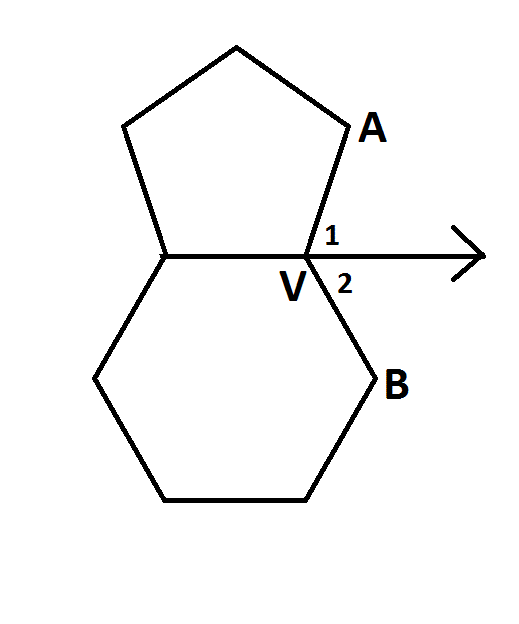
 and
and  are exterior angles of the regular polygons. Also, the measures of the exterior angles of any polygon, one at each vertex, total
  . Therefore,


Add the measures of the angles to get  :
:

This can more easily be explained if the shared side is extended in one direction, and the new angles labeled.
Add the measures of the angles to get
← Didn't Know|Knew It →