
Coordinate Geometry - GMAT Quantitative
Card 1 of 1283
Let  be a positive integer.
Evaluate  .
.
Statement 1:  is a multiple of 3.
Statement 2:  is a multiple of 7.
Let
Evaluate
Statement 1:
Statement 2:
Tap to reveal answer
Assume that both statements are true. The value of  ,
,  a positive integer, is equal to
  , where
  is the remainder of the division of
  by 4, so we can use this fact to show that insufficient information is provided.
Case 1:  .
.
 , so
, so

Case 2:  .
.
 , so
, so

In both cases, both statements are true, but the value of  differs.
Assume that both statements are true. The value of
Case 1:
Case 2:
In both cases, both statements are true, but the value of
← Didn't Know|Knew It →
The equations of two lines are:


Are these lines perpendicular?
Statement 1: 
Statement 2: 
The equations of two lines are:
Are these lines perpendicular?
Statement 1:
Statement 2:
Tap to reveal answer
The lines of the two equations must have slopes that are the opposites of each others reciprocals.
Write each equation in slope-intercept form:


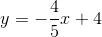



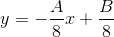

As can be seen, knowing the value of  is necessary and sufficient to answer the question. The value of
  is irrelevant.
The answer is that Statement 1 alone is sufficient to answer the question, but Statement 2 alone is not sufficient to answer the question.
The lines of the two equations must have slopes that are the opposites of each others reciprocals.
Write each equation in slope-intercept form:
As can be seen, knowing the value of
The answer is that Statement 1 alone is sufficient to answer the question, but Statement 2 alone is not sufficient to answer the question.
← Didn't Know|Knew It →
Data Sufficiency Question
Is Line A perpendicular to the following line?
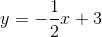
Statement 1: The slope of Line A is 3.
Statement 2: Line A passes through the point (2,3).
Data Sufficiency Question
Is Line A perpendicular to the following line?
Statement 1: The slope of Line A is 3.
Statement 2: Line A passes through the point (2,3).
Tap to reveal answer
To determine if two lines are perpendicular, only the slope needs to be considered. The slopes of perpendicular lines are the negative reciprocals of each other. Knowing a single point on the line is not sufficient, as an infinite number of lines can pass through and individual point.
To determine if two lines are perpendicular, only the slope needs to be considered. The slopes of perpendicular lines are the negative reciprocals of each other. Knowing a single point on the line is not sufficient, as an infinite number of lines can pass through and individual point.
← Didn't Know|Knew It →
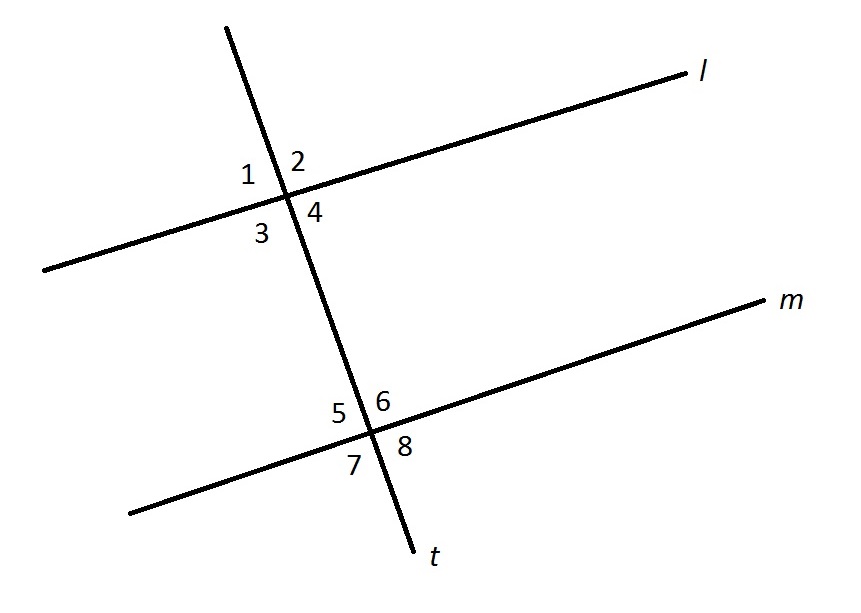
Refer to the above figure.
True or false: 
Statement 1: 
Statement 2: 
Refer to the above figure.
True or false:
Statement 1:
Statement 2:
Tap to reveal answer
Statement 1 alone establishes by definition that  , but does not establish any relationship between
  and
and  .
.
By Statement 2 alone, since alternating interior angles are congruent,  , but no conclusion can be drawn about the relationship of
  , since the actual measures of the angles are not given.
Assume both statements are true. By Statement 2,  .
.  and
and  are corresponding angles formed by a transversal across parallel lines, so
  .
.  is not a right angle, so
  .
.
Statement 1 alone establishes by definition that
By Statement 2 alone, since alternating interior angles are congruent,
Assume both statements are true. By Statement 2,
← Didn't Know|Knew It →
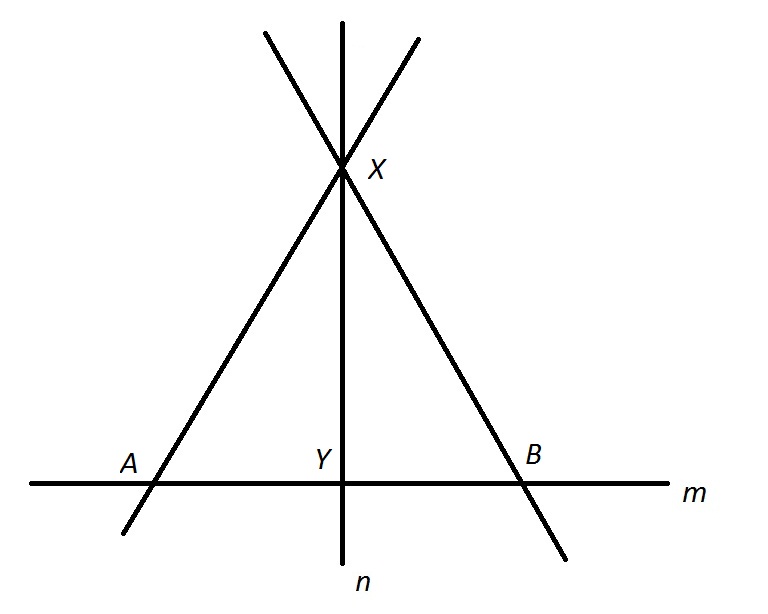
Refer to the above figure. True or false: 
Statement 1:  is equilateral.
Statement 2: Line  bisects
  .
.
Refer to the above figure. True or false:
Statement 1:
Statement 2: Line
Tap to reveal answer
Statement 1 alone establishes nothing about the angle  makes with
  , as it is not part of the triangle. Statement 2 alone only establishes that
  .
.
Assume both statements are true. Then  is an altitude of an equilateral triangle, making it - and
  - perpendicular with the base
  - and
- and  .
.
Statement 1 alone establishes nothing about the angle
Assume both statements are true. Then
← Didn't Know|Knew It →
Refer to the above figure. True or false: 
Statement 1: 
Statement 2: Line  bisects
  .
.
Refer to the above figure. True or false:
Statement 1:
Statement 2: Line
Tap to reveal answer
Assume Statement 1 alone. Then, as a consequence of congruence,  and
and  are congruent. They form a linear pair of angles, so they are also supplementary. Two angles that are both congruent and supplementary must be right angles, so
  .
.
Assume Statement 2 alone. Then  , but without any other information about the angles that
  or
or  make with
  , it cannot be determined whether
  or not.
Assume Statement 1 alone. Then, as a consequence of congruence,
Assume Statement 2 alone. Then
← Didn't Know|Knew It →
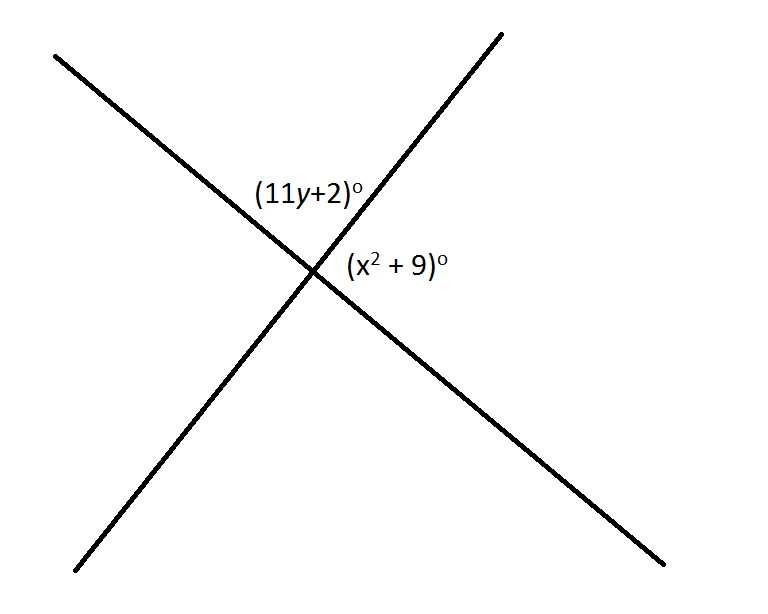 Statement 1:
Refer to the above figure. Are the lines perpendicular?
Statement 1: 
Statement 2: 
Statement 1:
Refer to the above figure. Are the lines perpendicular?
Statement 1:
Statement 2:
Tap to reveal answer
Assume Statement 1 alone. The measure of one of the angles formed is
 degrees.
Assume Statement 2 alone.
By substituting  for
for  , one angle measure becomes

The marked angles are a linear pair and thus their angle measures add up to 180 degrees; therefore, we can set up an equation:




 or
or 
 yields illegal angle measures - for example,

 yields angle measures
  for both angles; the angles are right and the lines are perpendicular.
Assume Statement 1 alone. The measure of one of the angles formed is
Assume Statement 2 alone.
By substituting
The marked angles are a linear pair and thus their angle measures add up to 180 degrees; therefore, we can set up an equation:
← Didn't Know|Knew It →
Find the graph of the linear function  .
.
I)  passes through the points
  and
and  .
.
II)  intercepts the
  -axis at
  .
.
Find the graph of the linear function
I)
II)
Tap to reveal answer
Find the graph of the linear function  .
.
I)  passes through the points
  and
and  .
.
II)  intercepts the
  -axis at .
Using I), we can find the slope of the function, and then we can start at either point and extend the slope in either direction to find our graph:
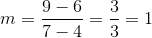
So, using I) we are able to find the slope, from which we can find our graph
II) gives us one point, but without any more information, we cannot use II) by itself to find the rest of the graph
So:
Statement I is sufficient to answer the question, but statement II is not sufficient to answer the question.
Find the graph of the linear function
I)
II)
Using I), we can find the slope of the function, and then we can start at either point and extend the slope in either direction to find our graph:
So, using I) we are able to find the slope, from which we can find our graph
II) gives us one point, but without any more information, we cannot use II) by itself to find the rest of the graph
So:
Statement I is sufficient to answer the question, but statement II is not sufficient to answer the question.
← Didn't Know|Knew It →
Find the graph of  .
.
I)  is a linear equation which passes through the point
  .
.
II)  crosses the y-axis at 1300.
Find the graph of
I)
II)
Tap to reveal answer
Find the graph of  .
.
I)  is a linear equation which passes through the point
  .
.
II)  crosses the y-axis at 1300.
To graph a linear equation, we need some combination of slope, y-intercept, or two points.
Statement I tells us  is linear and gives us one point.
Statement II gives us the y-intercept of  .
.
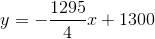
We can use Statement I and Statement II to find the slope of  . Then, we can plot the given points and continue the line in either direction to get our graph.
Slope:
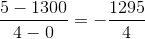
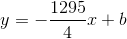
Plugging in the provided value of  , 1300, we have the equation of the line
  :
:
Find the graph of
I)
II)
To graph a linear equation, we need some combination of slope, y-intercept, or two points.
Statement I tells us
Statement II gives us the y-intercept of
We can use Statement I and Statement II to find the slope of
Slope:
Plugging in the provided value of
← Didn't Know|Knew It →
Graph a line, if possible.
Statement 1: The slope is 4.
Statement 2: The y-intercept is 4.
Graph a line, if possible.
Statement 1: The slope is 4.
Statement 2: The y-intercept is 4.
Tap to reveal answer
Statement 1): The slope is 4.
Write the slope-intercept form, and substitute the slope.


The point and the y-intercept are unknown. Either of these will be needed to solve for the graph of this line.
Statement 1) by itself is not sufficient to graph a line.
Statement 2): The y-intercept is 4.
Substitute the y-intercept into the incomplete formula.
The function  can then be graphed on the x-y coordinate plane.
Therefore:

Statement 1): The slope is 4.
Write the slope-intercept form, and substitute the slope.
The point and the y-intercept are unknown. Either of these will be needed to solve for the graph of this line.
Statement 1) by itself is not sufficient to graph a line.
Statement 2): The y-intercept is 4.
Substitute the y-intercept into the incomplete formula.
The function
Therefore:
← Didn't Know|Knew It →
Define a function  as follows:

for nonzero real numbers  .
.
Give the equation of the vertical asymptote of the graph of  .
.
Statement 1: 
Statement 2: 
Define a function
for nonzero real numbers
Give the equation of the vertical asymptote of the graph of
Statement 1:
Statement 2:
Tap to reveal answer
Only positive numbers have logarithms, so:


Therefore, the vertical asymptote must be the vertical line of the equation
 .
.
Statement 1 alone gives that  .
.  is the reciprocal of this, or
  , and
, and  , so the vertical asymptote is
  .
.
Statement 2 alone gives no clue about either  ,
,  , or their relationship.
Only positive numbers have logarithms, so:
Therefore, the vertical asymptote must be the vertical line of the equation
Statement 1 alone gives that
Statement 2 alone gives no clue about either
← Didn't Know|Knew It →
Define a function  as follows:

for nonzero real numbers  .
.
Give the equation of the vertical asymptote of the graph of  .
.
Statement 1: 
Statement 2: 
Define a function
for nonzero real numbers
Give the equation of the vertical asymptote of the graph of
Statement 1:
Statement 2:
Tap to reveal answer
Since a logarithm of a nonpositive number cannot be taken,


Therefore, the vertical asymptote must be the vertical line of the equation
 .
.
Each of Statement 1 and Statement 2 gives us only one of  and
and  . However, the two together tell us that

making the vertical asymptote
 .
.
Since a logarithm of a nonpositive number cannot be taken,
Therefore, the vertical asymptote must be the vertical line of the equation
Each of Statement 1 and Statement 2 gives us only one of
making the vertical asymptote
← Didn't Know|Knew It →
Define a function  as follows:

for nonzero real numbers  .
.
Does the graph of  have a
  -intercept?
Statement 1:  .
.
Statement 2:  .
.
Define a function
for nonzero real numbers
Does the graph of
Statement 1:
Statement 2:
Tap to reveal answer
The  -intercept of the graph of the function
  , if there is one, occurs at the point with
  -coordinate 0. Therefore, we find
  :
:

This expression is defined if and only if  is a positive value. Statement 1 gives
  as positive, so it follows that the graph indeed has a
  -intercept. Statement 2, which only gives
  , is irrelevant.
The
This expression is defined if and only if
← Didn't Know|Knew It →
Define a function  as follows:

for nonzero real numbers  .
.
Does the graph of  have a
  -intercept?
Statement 1:  .
.
Statement 2:  and
and  have different signs.
Define a function
for nonzero real numbers
Does the graph of
Statement 1:
Statement 2:
Tap to reveal answer
The  -intercept of the graph of the function
  , if there is one, occurs at the point with
  -coordinate 0. Therefore, we find
  :
:

This expression is defined if and only if  is a positive value. However, the two statements together do not give this information; the values of
  and
and  from Statement 1 are irrelevant, and Statement 2 does not reveal which of
  and
and  is positive and which is negative.
The
This expression is defined if and only if
← Didn't Know|Knew It →
Define a function  as follows:

for nonzero real numbers  .
.
Where is the vertical asymptote of the graph of  in relation to the
  -axis - is it to the left of it, to the right of it, or on it?
Statement 1:  and
and  are both positive.
Statement 2:  and
and  are of opposite sign.
Define a function
for nonzero real numbers
Where is the vertical asymptote of the graph of
Statement 1:
Statement 2:
Tap to reveal answer
Since only positive numbers have logarithms,


Therefore, the vertical asymptote must be the vertical line of the equation
 .
.
Statement 1 gives irrelevant information. But Statement 2 alone gives sufficient information; since  and
and  are of opposite sign, their quotient
  is negative, and
  is positive. This locates the vertical asymptote on the right side of the
  -axis.
Since only positive numbers have logarithms,
Therefore, the vertical asymptote must be the vertical line of the equation
Statement 1 gives irrelevant information. But Statement 2 alone gives sufficient information; since
← Didn't Know|Knew It →
Define a function  as follows:

for nonzero real numbers  .
.
Where is the vertical asymptote of the graph of  in relation to the
  -axis - is it to the left of it, to the right of it, or on it?
Statement 1:  and
and  are both positive.
Statement 2:  and
and  are of opposite sign.
Define a function
for nonzero real numbers
Where is the vertical asymptote of the graph of
Statement 1:
Statement 2:
Tap to reveal answer
Since only positive numbers have logarithms, the expression  must be positive, so


Therefore, the vertical asymptote must be the vertical line of the equation
 .
.
In order to determine which side of the  -axis the vertical asymptote falls, it is necessary to find the sign of
  ; if it is negative, it is on the left side, if it is positive, it is on the right side.
Assume both statements are true. By Statement 1,  is positive. If
  is positive, then
  is negative, and vice versa. However, Statement 2, which mentions
  , does not give its actual sign - just the fact that its sign is the opposite of that of
  , which we are not given either. The two statements therefore give insufficient information.
Since only positive numbers have logarithms, the expression
Therefore, the vertical asymptote must be the vertical line of the equation
In order to determine which side of the
Assume both statements are true. By Statement 1,
← Didn't Know|Knew It →
Define a function  as follows:

for nonzero real numbers  .
.
Give the equation of the vertical asymptote of the graph of  .
.
Statement 1: 
Statement 2: 
Define a function
for nonzero real numbers
Give the equation of the vertical asymptote of the graph of
Statement 1:
Statement 2:
Tap to reveal answer
Since only positive numbers have logarithms,
Therefore, the vertical asymptote must be the vertical line of the equation
.
Assume both statements to be true. We need two numbers  and
and  whose sum is 7 and whose product is 12; by trial and error, we can find these numbers to be 3 and 4. However, without further information, we have no way of determining which of
  and
and  is 3 and which is 4, so the asymptote can be either
  or
or  .
.
Since only positive numbers have logarithms,
Therefore, the vertical asymptote must be the vertical line of the equation
Assume both statements to be true. We need two numbers
← Didn't Know|Knew It →
Define a function  as follows:

for nonzero real numbers  .
.
What is the equation of the vertical asymptote of the graph of  ?
?
Statement 1:  and
and  are of opposite sign.
Statement 2: 
Define a function
for nonzero real numbers
What is the equation of the vertical asymptote of the graph of
Statement 1:
Statement 2:
Tap to reveal answer
Since only positive numbers have logarithms,
Therefore, the vertical asymptote must be the vertical line of the equation
.
In order to determine which side of the  -axis the vertical asymptote falls, it is necessary to find the sign of
  ; if it is negative, it is on the left side, and if it is positive, it is on the right side.
Statement 1 alone only gives us that  is a different sign from
  ; without any information about the sign of
  , we cannot answer the question.
Statement 2 alone gives us that  , and, consequently,
  . This means that
  and
and  are of opposite sign. But again, with no information about the sign of
  , we cannot answer the question.
Assume both statements to be true. Since, from the two statements, both  and
and  are of the opposite sign from
  ,
,  and
and  are of the same sign. Their quotient
  is positive, and
  is negative, so the vertical asymptote
  is to the left of the
  -axis.
Since only positive numbers have logarithms,
Therefore, the vertical asymptote must be the vertical line of the equation
In order to determine which side of the
Statement 1 alone only gives us that
Statement 2 alone gives us that
Assume both statements to be true. Since, from the two statements, both
← Didn't Know|Knew It →
Define a function  as follows:

for nonzero real numbers  .
.
Where is the vertical asymptote of the graph of  in relation to the
  -axis - is it to the left of it, to the right of it, or on it?
Statement 1: 
Statement 2: 
Define a function
for nonzero real numbers
Where is the vertical asymptote of the graph of
Statement 1:
Statement 2:
Tap to reveal answer
Only positive numbers have logarithms, so:
Therefore, the vertical asymptote must be the vertical line of the equation
.
In order to determine which side of the  -axis the vertical asymptote falls, it is necessary to find out whether the signs of
  and
and  are the same or different. If
  and
and  are of the same sign, then their quotient
  is positive, and
  is negative, putting
  on the left side of the
  -axis. If
  and
and  are of different sign, then their quotient
  is negative, and
  is positive, putting
  on the right side of the
  -axis.
Statement 1 alone does not give us enough information to determine whether  and
and  have different signs.
  , for example, but
  , also.
From Statement 2, since the product of  and
and  is negative, they must be of different sign. Therefore,
  is positive, and
  falls to the right of the
  -axis.
Only positive numbers have logarithms, so:
Therefore, the vertical asymptote must be the vertical line of the equation
In order to determine which side of the
Statement 1 alone does not give us enough information to determine whether
From Statement 2, since the product of
← Didn't Know|Knew It →
In which quadrant is the point  located: I, II, III, or IV?
Statement 1: 
Statement 2: 
In which quadrant is the point
Statement 1:
Statement 2:
Tap to reveal answer
Assume Statement 1 alone. The set of points that satisfy the equation is the set of all points on the line of the equation

which will pass through at least two quadrants on the coordinate plane. Therefore, Statement 1 provides insufficient information.
Now assume Statement 2 alone. The set of points that satisfy the equation is the set of all points of the circle of the equation

This circle has  as its center and
  as its radius. Since its center is
  , which is 5 units away from its closest axis, and the radius is less than 5 units, the circle never intersects an axis, so it is contained entirely within the same quadrant as its center. The center has negative
  - and
- and  -coordinates, placing it, and the entire circle, in Quadrant III.
Assume Statement 1 alone. The set of points that satisfy the equation is the set of all points on the line of the equation
which will pass through at least two quadrants on the coordinate plane. Therefore, Statement 1 provides insufficient information.
Now assume Statement 2 alone. The set of points that satisfy the equation is the set of all points of the circle of the equation
This circle has
← Didn't Know|Knew It →