
Circles - GMAT Quantitative
Card 1 of 712
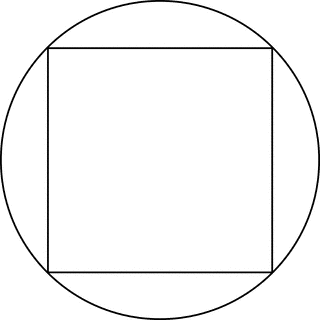
Square S is inscribed in circle C as in the figure above. What is the circumference of C?
(1) The perimeter of S is 16.
(2) The area of S is 36.
Square S is inscribed in circle C as in the figure above. What is the circumference of C?
(1) The perimeter of S is 16.
(2) The area of S is 36.
Tap to reveal answer
From statement (1), we know that the side of S is 4, and then we can calculate the diagonal of S using the Pythagorean theorem:  . The diagonal of S is the diameter of C. Therefore, we can calculate the circumference by using
  . From statement (2), we know that the side of S is 6, and then we can calculate the diagonal of S using the Pythagorean theorem:

The diagonal of S is the diameter of C. Therefore, we can calculate the circumference by using  .
.
From statement (1), we know that the side of S is 4, and then we can calculate the diagonal of S using the Pythagorean theorem:
The diagonal of S is the diameter of C. Therefore, we can calculate the circumference by using
← Didn't Know|Knew It →
What is the circumference of circle J?
I) Circle J has an area of  .
.
II) Circle J has a diameter of  .
.
What is the circumference of circle J?
I) Circle J has an area of
II) Circle J has a diameter of
Tap to reveal answer
We are given the area and diameter of a circle and asked to find the circumference. We know that diameter is twice the length of a radius, so we also have our radius.
Given the following equations:


We can see that knowing either diameter or area will allow us to find the circumference.
Thus: Each statement alone is enough to solve the question.
We are given the area and diameter of a circle and asked to find the circumference. We know that diameter is twice the length of a radius, so we also have our radius.
Given the following equations:
We can see that knowing either diameter or area will allow us to find the circumference.
Thus: Each statement alone is enough to solve the question.
← Didn't Know|Knew It →
What is the circumference of the circle given by:

I)  .
.
II) The slope of the tangent to the circle at  is undefined.
What is the circumference of the circle given by:
I)
II) The slope of the tangent to the circle at
Tap to reveal answer
All we need to find circumference is the radius.
I) Gives us the radius squared, so we could find circumference with I.
II) Tells us the slope of the tangent line at a given point is undefined. Only vertical lines have undefined slope. The tangent line is perpendicular to the radius, so we can find our radius by drawing a picture and comparing the location of the center to the location of the tangent line.
So either statement will be sufficient.
All we need to find circumference is the radius.
I) Gives us the radius squared, so we could find circumference with I.
II) Tells us the slope of the tangent line at a given point is undefined. Only vertical lines have undefined slope. The tangent line is perpendicular to the radius, so we can find our radius by drawing a picture and comparing the location of the center to the location of the tangent line.
So either statement will be sufficient.
← Didn't Know|Knew It →
What is the circumference of Circle  ?
?
1.) The diameter of the circle is  .
.
2.) The area of the circle is  .
.
What is the circumference of Circle
1.) The diameter of the circle is
2.) The area of the circle is
Tap to reveal answer
We are asked to find the circumference  of Circle
  and are given the diameter and the area. We also know that
  . Taking each statement individually:
1.) The diameter  is
is  and we know that the radius
  , so
, so  . Therefore, Statement 1 is sufficient to solve for the circumference of the circle by itself.
2.) The area  of Circle
  is
is  , so we can determine that the radius
  . Since the circumference
  , Statement 2 is is sufficient to solve for the circumference of the circle by itself.
We are asked to find the circumference
1.) The diameter
2.) The area
← Didn't Know|Knew It →
What is the circumference of Circle  ?
?
1.) The radius of the circle is  .
.
2.) The circle is inside another circle of area  .
.
What is the circumference of Circle
1.) The radius of the circle is
2.) The circle is inside another circle of area
Tap to reveal answer
We are asked to find the circumference  of Circle
  and are given the diameter and the area. We also know that
  . Taking each statement individually:
1.) The radius  is
is  and we know that
  . Therefore, Statement 1 is sufficient to solve for the circumference of the circle by itself.
2.) The area  of the outside circle is
  , but we cannot use this to determine the circumference of Circle
  because we don't know where
  is inside the larger outside circle.
We are asked to find the circumference
1.) The radius
2.) The area
← Didn't Know|Knew It →
Data Sufficiency Question
Calculate the area of a circle.
1. The radius of the circle is 4.
2. The circumference of the circle is 24.
Data Sufficiency Question
Calculate the area of a circle.
1. The radius of the circle is 4.
2. The circumference of the circle is 24.
Tap to reveal answer
The area of a circle can be calcuated using the equation:

and the circumference calculated using:

The radius is the only information required for calculating the area of a circle and that can be obtained from the circumference, therefore, either statement is sufficient.
The area of a circle can be calcuated using the equation:
and the circumference calculated using:
The radius is the only information required for calculating the area of a circle and that can be obtained from the circumference, therefore, either statement is sufficient.
← Didn't Know|Knew It →
You are given a circle and a square. Which one has the larger area?
Statement 1: The radius of the circle is two-thirds the sidelength of the square.
Statement 2: The circumference of the circle is  times the perimeter of the square.
You are given a circle and a square. Which one has the larger area?
Statement 1: The radius of the circle is two-thirds the sidelength of the square.
Statement 2: The circumference of the circle is
Tap to reveal answer
Let  be the sidelength of the square. Then its area is
  .
.
From Statement 1, it follows that the radius of the circle is  .
.
From Statement 2, it follows that , since the perimeter of the square is  , the circumference of the circle is
 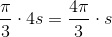 , and the radius is
  - the same fact given in Statement 1.
Either way, it follows that the area of the circle in terms of  is
is
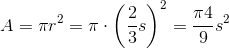 ,
,
so all we have to do is compare  to 1 in order to determine whether the square or the circle is larger in area.
Let
From Statement 1, it follows that the radius of the circle is
From Statement 2, it follows that , since the perimeter of the square is
Either way, it follows that the area of the circle in terms of
so all we have to do is compare
← Didn't Know|Knew It →
You are given a circle and an equilateral triangle. Which one has the greater area?
Statement 1: The sidelength of the triangle is three times the radius of the circle.
Statement 2: The perimeter of the triangle is 99 inches.
You are given a circle and an equilateral triangle. Which one has the greater area?
Statement 1: The sidelength of the triangle is three times the radius of the circle.
Statement 2: The perimeter of the triangle is 99 inches.
Tap to reveal answer
From Statement 2, we can calculate the area of the triangle, but we are given no clues about the area of the circle, actual or relative.
From Statement 1, we know that if we call the radius of the circle  , we know the sidelength of the triangle is
  .
.
The area of the circle is  .
.
The area of the triangle is  .
.
All we have to do is compare  to
to  to determine whether the circle or the triangle has the greater area.
From Statement 2, we can calculate the area of the triangle, but we are given no clues about the area of the circle, actual or relative.
From Statement 1, we know that if we call the radius of the circle
The area of the circle is
The area of the triangle is
All we have to do is compare
← Didn't Know|Knew It →
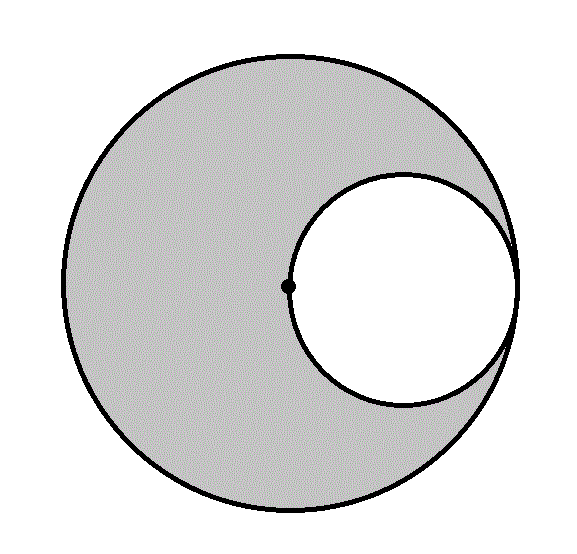
What is the area of the gray region in the above figure?
Statement 1: The diameter of the larger circle is one mile.
Statement 2: The radius of the smaller circle is 1,320 feet.
What is the area of the gray region in the above figure?
Statement 1: The diameter of the larger circle is one mile.
Statement 2: The radius of the smaller circle is 1,320 feet.
Tap to reveal answer
The radius of the larger circle is equal to the diameter of the smaller, and, subsequently, twice the radius of the smaller. If one radius is known, then the other can be calculated, and the areas of the two circles can be as well; the difference between their areas is the area of the gray region. Statement 1 tells us the diameter of the large circle, from which its radius can be determined by dividing by 2; Statement 2 tells us the radius of the radius of the smaller circle. From either, the radius of the other circle can be calculated.
The radius of the larger circle is equal to the diameter of the smaller, and, subsequently, twice the radius of the smaller. If one radius is known, then the other can be calculated, and the areas of the two circles can be as well; the difference between their areas is the area of the gray region. Statement 1 tells us the diameter of the large circle, from which its radius can be determined by dividing by 2; Statement 2 tells us the radius of the radius of the smaller circle. From either, the radius of the other circle can be calculated.
← Didn't Know|Knew It →
Two circles are constructed; one is inscribed inside a given regular hexagon, and the other is circumscribed about the same hexagon.
What is the area of the inscribed circle?
Statement 1: The area of the circumscribed circle is 
Statement 2: The perimeter of the hexagon is 30.
Two circles are constructed; one is inscribed inside a given regular hexagon, and the other is circumscribed about the same hexagon.
What is the area of the inscribed circle?
Statement 1: The area of the circumscribed circle is
Statement 2: The perimeter of the hexagon is 30.
Tap to reveal answer
Examine the diagram below, which shows the hexagon, segments from its center to two vertices and the midpoint of a side, and the two circles.
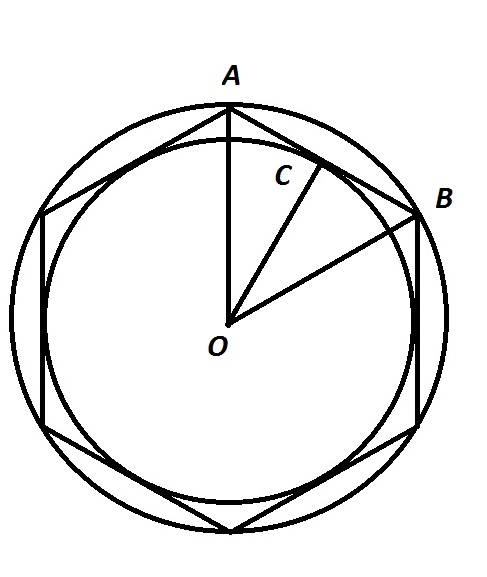
From Statement 1 alone, the radius  of the circumscribed circle can be calculated using the area formula. From Statement 2 alone, the perimeter can be divided by 6 to obtain
  ; since two consecutive radii and one side of a hexagon can be proved to form an equilateral triangle,
  . As a consequence, from either statement alone,
  can be calculated.
 can be proved a 30-60-90 triangle, so the 30-60-90 Theorem can be used to calculate
  , the radius of the inscribed circle. From this, the area of the inscribed circle can be calculated.
Examine the diagram below, which shows the hexagon, segments from its center to two vertices and the midpoint of a side, and the two circles.
From Statement 1 alone, the radius
← Didn't Know|Knew It →
The equation of a given circle is
 .
.
What is the radius of the circle?
Statement 1: 
Statement 2: The circle passes through the origin.
The equation of a given circle is
What is the radius of the circle?
Statement 1:
Statement 2: The circle passes through the origin.
Tap to reveal answer
The standard form of the equation of a circle is
 ,
,
where the radius is  and the center is
  .
.
The equation given is this same form, with  replacing
  ,
,  replacing
  , and
, and  replacing
  , so to find the radius, we need to find
  .
.
Statement 1 alone tells us that the center is  but it tells us nothing about the radius. Statement 2 alone tells us only that the circle passes through
  .
.
The two together, however, reveal enough information to give the radius. The radius is the distance from the center to a point on the circle, so we can use the distance formula to find the distance between  and
and  . This is the radius.
The standard form of the equation of a circle is
where the radius is
The equation given is this same form, with
Statement 1 alone tells us that the center is
The two together, however, reveal enough information to give the radius. The radius is the distance from the center to a point on the circle, so we can use the distance formula to find the distance between
← Didn't Know|Knew It →
Find the radius of circle B
I) Circle B has a circumference of  .
.
II) Circle B has an area of  .
.
Find the radius of circle B
I) Circle B has a circumference of
II) Circle B has an area of
Tap to reveal answer
We are given the area and circumference of a circle and asked to find the radius.
Given the following equations:


We can use either equation to work backwards and find our radius, therefore; Each statement alone is enough to solve the question.
We are given the area and circumference of a circle and asked to find the radius.
Given the following equations:
We can use either equation to work backwards and find our radius, therefore; Each statement alone is enough to solve the question.
← Didn't Know|Knew It →
Let circle  represent the base of a lamp. Find its radius.
I) The ratio of circle  diameter to circumference is approximately
  .
.
II) The base of the lamp will cover an area of  square inches.
Let circle
I) The ratio of circle
II) The base of the lamp will cover an area of
Tap to reveal answer
To find the radius of a cricle, we need its circumference, diameter, or area.
I) Seems to be helpful, but it is really just giving us pi, so it is not sufficient.
II) Gives us the area of the circle, which we can use to work backward to find the radius.

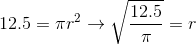
So II is sufficient to answer the question, but I is not.
To find the radius of a cricle, we need its circumference, diameter, or area.
I) Seems to be helpful, but it is really just giving us pi, so it is not sufficient.
II) Gives us the area of the circle, which we can use to work backward to find the radius.
So II is sufficient to answer the question, but I is not.
← Didn't Know|Knew It →
Calculate the length of the radius of a circle.
Statement 1): The circumference of the circle is  .
.
Statement 2): 
Calculate the length of the radius of a circle.
Statement 1): The circumference of the circle is
Statement 2):
Tap to reveal answer
Statement 1) gives the circumference of a circle. The formula for finding the circumference of a circle is  . The radius can be solved by using this formula.
Statement 2) gives the standard form of a circle, where  is the center of the circle:

The radius is also given in the equation.
Therefore, either statement alone is enough to solve for the radius of a circle.
Statement 1) gives the circumference of a circle. The formula for finding the circumference of a circle is
Statement 2) gives the standard form of a circle, where
The radius is also given in the equation.
Therefore, either statement alone is enough to solve for the radius of a circle.
← Didn't Know|Knew It →
An equilateral triangle  is inscribed inside a circle;
  is the midpoint of
  . What is the radius of the circle?
Statement 1:  has area
  .
.
Statement 2:  .
.
An equilateral triangle
Statement 1:
Statement 2:
Tap to reveal answer
First, locate the other midpoints of the sides of the triangle and construct the segments from each vertex to the opposite midpoint.

Since  is equilateral,
  ,
,  , and
, and  are all altitudes that insersect at the center of the circumscribed circle,
  , so that
  .
.  is the radius of the circumscribed circle.
Assume Statement 1 alone. The length of one side of an equilateral triangle can be calculated using the formula
 , or, equivalently,

Once  is calculated, then, since
  is also a perpendicular bisector of
  and a bisector of
  , making
  a 30-60-90 triangle,
  can be calculated to be one half of
  ;
;  can be multiplied by
  to yield
  , and, since the three altitudes of an equilateral triangle divide one another into segments whose lengths have ratio 2:1,
  can be multiplied by
  to obtain radius .
Statement 2 gives us  explicitly, so we can take two thirds of this to get the radius
 .
.
First, locate the other midpoints of the sides of the triangle and construct the segments from each vertex to the opposite midpoint.
Since
Assume Statement 1 alone. The length of one side of an equilateral triangle can be calculated using the formula
Once
Statement 2 gives us
← Didn't Know|Knew It →
Right triangle  is inscribed inside a circle. What is the radius of the circle?
Statement 1: 
Statement 2: 
Right triangle
Statement 1:
Statement 2:
Tap to reveal answer
If a right triangle is inscribed inside a circle, the hypotenuse of the triangle is a diameter of the circle; therefore, its length is the diameter, and half this is the radius. However, from the two statements, it cannot be determined which segment is the hypotenuse.
If  is the hypotenuse, then the radius is half its length; since , the radius is 10.
If  is the hypotenuse, then, since the hypotenuse is the longest side of a right triangle,
  - that is,
  . The radius is greater than 10.
Therefore, the radius depends on which side is the hypotenuse; since that is not clear, the radius cannot be determined.
If a right triangle is inscribed inside a circle, the hypotenuse of the triangle is a diameter of the circle; therefore, its length is the diameter, and half this is the radius. However, from the two statements, it cannot be determined which segment is the hypotenuse.
If
If
Therefore, the radius depends on which side is the hypotenuse; since that is not clear, the radius cannot be determined.
← Didn't Know|Knew It →
Rectangle  is inscribed inside a circle. What is the radius of the circle?
Statement 1: 
Statement 2: 
Rectangle
Statement 1:
Statement 2:
Tap to reveal answer
The diameter of a circle with an inscribed rectangle is equal to the length of the diagonal of the rectangle; once this diameter is found, it can be divided by 2 to yield the radius.
Statement 1 alone gives this length, from which the radius can be found to be  . Statement 2 alone gives only the length of one set of opposite sides, from which the length of the diagonal cannot be determined.
The diameter of a circle with an inscribed rectangle is equal to the length of the diagonal of the rectangle; once this diameter is found, it can be divided by 2 to yield the radius.
Statement 1 alone gives this length, from which the radius can be found to be
← Didn't Know|Knew It →
A polygon is inscribed inside a circle. What is the radius of the circle?
Statement 1: Each side of the polygon measures 10.
Statement 2: The inscribed polygon is a regular hexagon.
A polygon is inscribed inside a circle. What is the radius of the circle?
Statement 1: Each side of the polygon measures 10.
Statement 2: The inscribed polygon is a regular hexagon.
Tap to reveal answer
Statement 1 alone yields insufficient information, since, as seen in the diagram below, the circles that circumscribe a square and a triangle with the same sidelength have different sizes:

Statement 2 is insufficient since it gives no hints about the size of the hexagon.
Assume both statements. The six radii of a regular hexagon divide it into six equilateral triangles, by symmetry; therefore, the radius of a regular hexagon is equal to its sidelength, which is given in Statement 1 as 10. Since the radius of a regular hexagon is equal to that of the circle in which it is inscribed, the circle has radius 10.
This can be seen by examining the figure below:

Statement 1 alone yields insufficient information, since, as seen in the diagram below, the circles that circumscribe a square and a triangle with the same sidelength have different sizes:
Statement 2 is insufficient since it gives no hints about the size of the hexagon.
Assume both statements. The six radii of a regular hexagon divide it into six equilateral triangles, by symmetry; therefore, the radius of a regular hexagon is equal to its sidelength, which is given in Statement 1 as 10. Since the radius of a regular hexagon is equal to that of the circle in which it is inscribed, the circle has radius 10.
This can be seen by examining the figure below:
← Didn't Know|Knew It →
Square  is inscribed inside a circle. What is the radius of the circle?
Statement 1: Square  has area 100.
Statement 2:  .
.
Square
Statement 1: Square
Statement 2:
Tap to reveal answer
From Statement 2 alone,  , a diagonal of the square, measures
  . The diameter of the circle is equal to the length of a diagonal of an inscribed square, so the radius of the circle is equal to half this, or
  .
.
From Statement 1 alone, since the area of the square is 100, its sidelength is the square root of this, or 10. By the 45-45-90 Theorem, a diagonal of the square measures  times this, or
  , which makes Statement 2 a consequence of Statement 1. Therefore, it follows again that the circle has radius
  .
.
From Statement 2 alone,
From Statement 1 alone, since the area of the square is 100, its sidelength is the square root of this, or 10. By the 45-45-90 Theorem, a diagonal of the square measures
← Didn't Know|Knew It →
A circle is inscribed inside an equilateral triangle  .
.  ,
,  , and
, and  are tangent to the circle at the points
  ,
,  , and
, and  , respectively. What is the radius of the circle?
Statement 1: The length of arc  is
is  .
.
Statement 2: The degree measure of arc  is
is  .
.
A circle is inscribed inside an equilateral triangle
Statement 1: The length of arc
Statement 2: The degree measure of arc
Tap to reveal answer
The figure referenced is below:

By symmetry,  is one third of a circle. Therefore, its length is one third of the circumference, so, if Statement 1 alone is assumed, the circumference can be determined to be
  ; this can be divided by
  to yield radius
  .
.
Statement 2 yields no helpful information; from the body of the problem,  can already be deduced to be two thirds of a circle, or, equivalently, an arc of measure
 .
.
The figure referenced is below:
By symmetry,
Statement 2 yields no helpful information; from the body of the problem,
← Didn't Know|Knew It →