
DSQ: Calculating an angle in a polygon - GMAT Quantitative
Card 1 of 104
How many sides does a regular polygon have?
-
Each of the angles measures 140 degrees.
-
Each of the sides has measure 8.
How many sides does a regular polygon have?
-
Each of the angles measures 140 degrees.
-
Each of the sides has measure 8.
Tap to reveal answer
The relationship between the number of sides of a regular polygon  and the measure of a single angle
  is
is
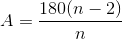
If we are given that  , then we can substitute and solve for
  :
:
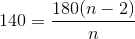
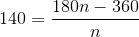




making the figure a nine-sided polygon.
Knowing only the measure of each side is neither necessary nor helpful; for example, it is possible to construct an equilateral triangle with sidelength 8 or a square with sidelength 8.
The correct answer is that Statement 1 alone is sufficient to answer the question, but not Statement 2 alone.
The relationship between the number of sides of a regular polygon
If we are given that
making the figure a nine-sided polygon.
Knowing only the measure of each side is neither necessary nor helpful; for example, it is possible to construct an equilateral triangle with sidelength 8 or a square with sidelength 8.
The correct answer is that Statement 1 alone is sufficient to answer the question, but not Statement 2 alone.
← Didn't Know|Knew It →
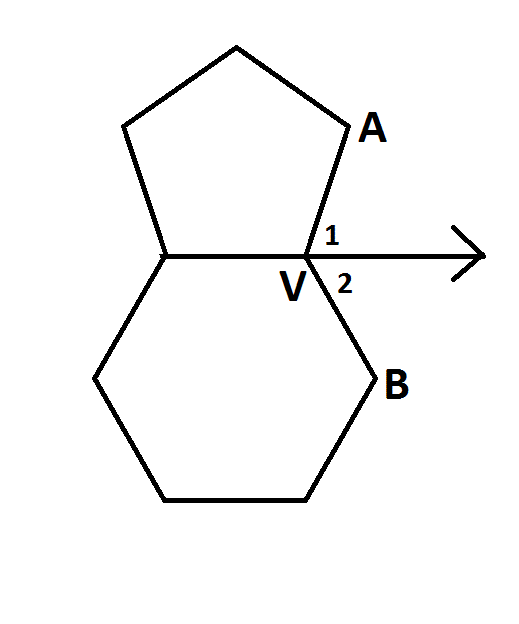
Note: Figure NOT drawn to scale.
Is the pentagon in the diagram above a regular pentagon?
Statement 1: 
Statement 2: The hexagon in the diagram is not a regular hexagon.
Note: Figure NOT drawn to scale.
Is the pentagon in the diagram above a regular pentagon?
Statement 1:
Statement 2: The hexagon in the diagram is not a regular hexagon.
Tap to reveal answer
Information about the hexagon is irrelevant, so Statement 2 has no bearing on the answer to the question.
The measures of the exterior angles of any pentagon, one per vertex, total  , and they are congruent if the pentagon is regular, so if this is the case, each would measure
  . But if Statement 1 is true, then an exterior angle of the pentagon measures
  . Therefore, Statement 1 is enough to answer the question in the negative.
Information about the hexagon is irrelevant, so Statement 2 has no bearing on the answer to the question.
The measures of the exterior angles of any pentagon, one per vertex, total
← Didn't Know|Knew It →
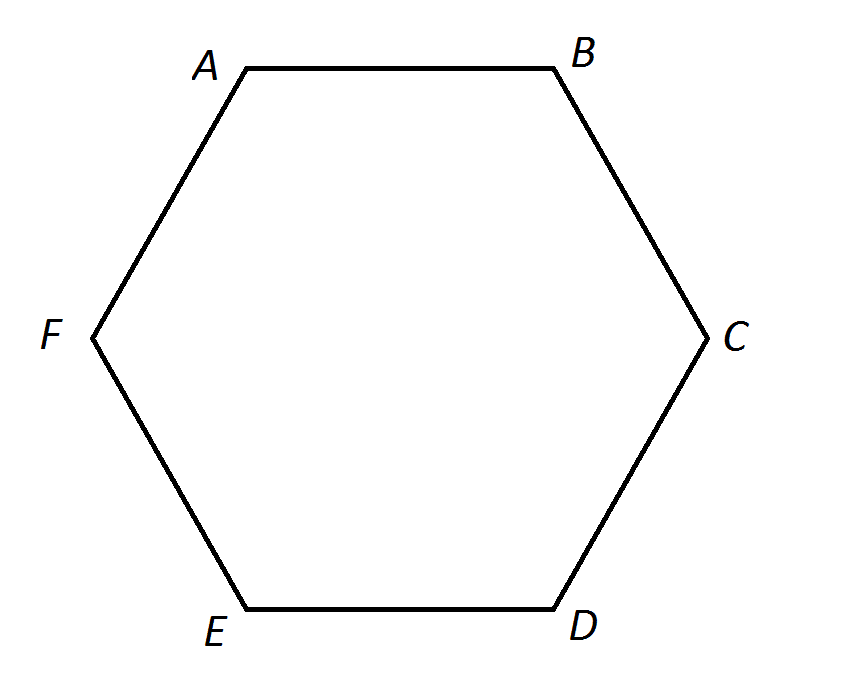
Note: Figure NOT drawn to scale.

What is  ?
?
Statement 1:  ,
,  , and
, and  are the first three terms, in order, of an arithmetic sequence.
Statement 2: 
Note: Figure NOT drawn to scale.
What is
Statement 1:
Statement 2:
Tap to reveal answer
The sum of the measures of the angles of a hexagon is 
Therefore,




Suppose we only know that  ,
,  , and
, and  are the first three terms of an arithmetic sequence, in order. Then for some common difference
  ,
,





Suppose we only know that  . Then



With no further information, we cannot determine  .
.
The sum of the measures of the angles of a hexagon is
Therefore,
Suppose we only know that
Suppose we only know that
With no further information, we cannot determine
← Didn't Know|Knew It →
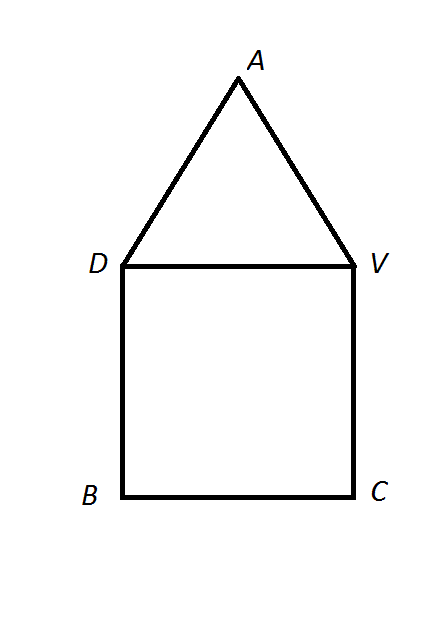
Note: Figure NOT drawn to scale.
The diagram above shows a triangle and a rhombus sharing a side. Is that rhombus a square?
Statement 1: The triangle is not equilateral.
Statement 2: 
Note: Figure NOT drawn to scale.
The diagram above shows a triangle and a rhombus sharing a side. Is that rhombus a square?
Statement 1: The triangle is not equilateral.
Statement 2:
Tap to reveal answer
To show that the rhombus is a square, you need to demonstrate that one of its angles is a right angle - that is,  . Both statements together are insufficent - if
  , you would need to demonstrate that
  is true or false, and the fact that the triangle is not equilateral is not enough to prove or to disprove this.
To show that the rhombus is a square, you need to demonstrate that one of its angles is a right angle - that is,
← Didn't Know|Knew It →
What is the measure of an interior angle of a regular polygon?
Statement 1: The polygon has 20 sides.
Statement 2: An exterior angle of the polygon measures  .
.
What is the measure of an interior angle of a regular polygon?
Statement 1: The polygon has 20 sides.
Statement 2: An exterior angle of the polygon measures
Tap to reveal answer
From Statement 1, you can calculate the measure of an interior angle as follows:

From Statement 2, since an interior angle and an exterior angle at the same vertex form a linear pair, they are supplementary, so you can subtract 18 from 180:

From Statement 1, you can calculate the measure of an interior angle as follows:
From Statement 2, since an interior angle and an exterior angle at the same vertex form a linear pair, they are supplementary, so you can subtract 18 from 180:
← Didn't Know|Knew It →
Is  a regular pentagon?
Statement 1: 
Statement 2: 
Is
Statement 1:
Statement 2:
Tap to reveal answer
All of the interior angles of a regular polygon are congruent, as are all of its sides. Statement 1 violates the former condition; statement 2 violates the latter.
All of the interior angles of a regular polygon are congruent, as are all of its sides. Statement 1 violates the former condition; statement 2 violates the latter.
← Didn't Know|Knew It →
Is the degree measure of an exterior angle of a regular polygon an integer?
Statement 1: The number of sides of the polygon is divisible by 7.
Statement 2: The number of sides of the polygon is divisible by 10.
Is the degree measure of an exterior angle of a regular polygon an integer?
Statement 1: The number of sides of the polygon is divisible by 7.
Statement 2: The number of sides of the polygon is divisible by 10.
Tap to reveal answer
The sum of the degree measures of the exterior angles, one per vertex, of any polygon is 360, so each exterior angle of a regular polygon with  sides measures
  .
.
For  to be an integer, every factor of
  must be a factor of 360. This does not happen if 7 is a factor of
  , so Statement 1 disproves this. This may or may not happen if 10 is a factor of
  -
-  , but
, but  , so Statement 2 does not provide an answer.
The sum of the degree measures of the exterior angles, one per vertex, of any polygon is 360, so each exterior angle of a regular polygon with
For
← Didn't Know|Knew It →
Is the degree measure of an exterior angle of a regular polygon an integer?
Statement 1: The number of sides of the polygon is a factor of 30.
Statement 2: The number of sides of the polygon is a factor of 40.
Is the degree measure of an exterior angle of a regular polygon an integer?
Statement 1: The number of sides of the polygon is a factor of 30.
Statement 2: The number of sides of the polygon is a factor of 40.
Tap to reveal answer
The sum of the degree measures of the exterior angles, one per vertex, of any polygon is 360, so each exterior angle of a regular polygon with  sides measures
  . Therefore, the measure of one exterior angle of a regular polygon is an integer if and only if
  is a factor of 360.
If  is a factor of a factor of 360, however, then
  is a factor of 360. 30 and 40 are both factors of 360:
  and
and  . Therefore, it follows from either statement that the number of sides is a factor of 360, and each exterior angle has a degree measure that is an integer.
The sum of the degree measures of the exterior angles, one per vertex, of any polygon is 360, so each exterior angle of a regular polygon with
If
← Didn't Know|Knew It →
What is the measure of  ?
?
Statement 1: is an exterior angle of an equilateral triangle.
Statement 2: is an interior angle of a regular hexagon.
What is the measure of
Statement 1:
Statement 2:
Tap to reveal answer
An exterior angle of an equilateral triangle measures  . An interior angle of a regular hexagon measures
  . Either statement is sufficient.
An exterior angle of an equilateral triangle measures
← Didn't Know|Knew It →
A nonagon is a nine-sided polygon.
Is Nonagon  regular?
Statement 1: 
Statement 2: 
A nonagon is a nine-sided polygon.
Is Nonagon
Statement 1:
Statement 2:
Tap to reveal answer
Each angle of a regular nonagon measures 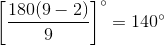
Therefore, each of the two statements proves that the nonagon is not regular.
Each angle of a regular nonagon measures
Therefore, each of the two statements proves that the nonagon is not regular.
← Didn't Know|Knew It →
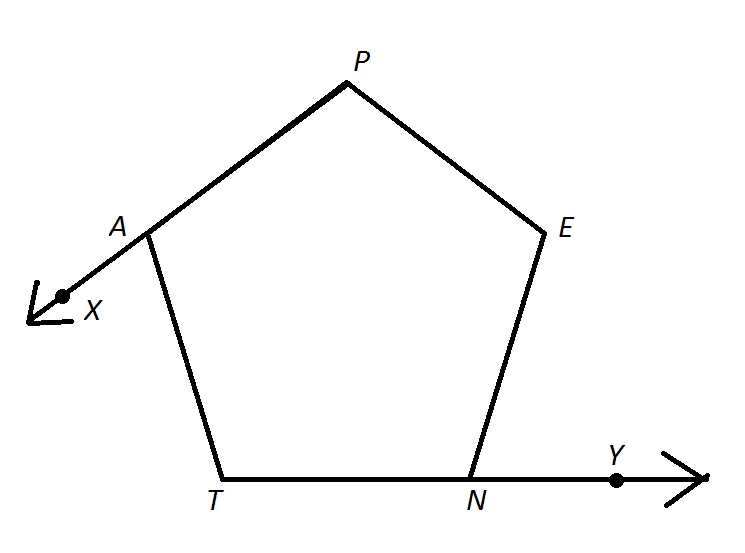
Note: Figure NOT drawn to scale.
Refer to the above figure. Is Pentagon  regular?
Statement 1: 
Statement 2: 
Note: Figure NOT drawn to scale.
Refer to the above figure. Is Pentagon
Statement 1:
Statement 2:
Tap to reveal answer
If a shape is regular, that means that all of its sides are equal. It also means that all of its interior angles are equal. Finally, if all of the interior angles are equal, then the exterior angles will all be equal to each other as well.
In a regular polygon, we can find the measure of ANY exterior angle by using the formula

where  is equal to the number of sides.
Each exterior angle of a regular (five-sided) pentagon measures
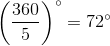
Statement 1 alone neither proves nor disproves that the pentagon is regular. We now know that one exterior angle is  , but we do not know if any of the other exterior angles are also
  .
.
Statement 2, however, proves that the pentagon is not regular, as it has at least one exterior angle that does not have measure  .
.
If a shape is regular, that means that all of its sides are equal. It also means that all of its interior angles are equal. Finally, if all of the interior angles are equal, then the exterior angles will all be equal to each other as well.
In a regular polygon, we can find the measure of ANY exterior angle by using the formula
where
Each exterior angle of a regular (five-sided) pentagon measures
Statement 1 alone neither proves nor disproves that the pentagon is regular. We now know that one exterior angle is
Statement 2, however, proves that the pentagon is not regular, as it has at least one exterior angle that does not have measure
← Didn't Know|Knew It →
How many sides does a regular polygon have?
-
Each of the angles measures 140 degrees.
-
Each of the sides has measure 8.
How many sides does a regular polygon have?
-
Each of the angles measures 140 degrees.
-
Each of the sides has measure 8.
Tap to reveal answer
The relationship between the number of sides of a regular polygon and the measure of a single angle is
If we are given that , then we can substitute and solve for :
making the figure a nine-sided polygon.
Knowing only the measure of each side is neither necessary nor helpful; for example, it is possible to construct an equilateral triangle with sidelength 8 or a square with sidelength 8.
The correct answer is that Statement 1 alone is sufficient to answer the question, but not Statement 2 alone.
The relationship between the number of sides of a regular polygon
If we are given that
making the figure a nine-sided polygon.
Knowing only the measure of each side is neither necessary nor helpful; for example, it is possible to construct an equilateral triangle with sidelength 8 or a square with sidelength 8.
The correct answer is that Statement 1 alone is sufficient to answer the question, but not Statement 2 alone.
← Didn't Know|Knew It →
Note: Figure NOT drawn to scale.
Is the pentagon in the diagram above a regular pentagon?
Statement 1:
Statement 2: The hexagon in the diagram is not a regular hexagon.
Note: Figure NOT drawn to scale.
Is the pentagon in the diagram above a regular pentagon?
Statement 1:
Statement 2: The hexagon in the diagram is not a regular hexagon.
Tap to reveal answer
Information about the hexagon is irrelevant, so Statement 2 has no bearing on the answer to the question.
The measures of the exterior angles of any pentagon, one per vertex, total , and they are congruent if the pentagon is regular, so if this is the case, each would measure . But if Statement 1 is true, then an exterior angle of the pentagon measures . Therefore, Statement 1 is enough to answer the question in the negative.
Information about the hexagon is irrelevant, so Statement 2 has no bearing on the answer to the question.
The measures of the exterior angles of any pentagon, one per vertex, total
← Didn't Know|Knew It →
Note: Figure NOT drawn to scale.
What is ?
Statement 1: , , and are the first three terms, in order, of an arithmetic sequence.
Statement 2:
Note: Figure NOT drawn to scale.
What is
Statement 1:
Statement 2:
Tap to reveal answer
The sum of the measures of the angles of a hexagon is
Therefore,
Suppose we only know that , , and are the first three terms of an arithmetic sequence, in order. Then for some common difference ,
Suppose we only know that . Then
With no further information, we cannot determine .
The sum of the measures of the angles of a hexagon is
Therefore,
Suppose we only know that
Suppose we only know that
With no further information, we cannot determine
← Didn't Know|Knew It →
Note: Figure NOT drawn to scale.
The diagram above shows a triangle and a rhombus sharing a side. Is that rhombus a square?
Statement 1: The triangle is not equilateral.
Statement 2:
Note: Figure NOT drawn to scale.
The diagram above shows a triangle and a rhombus sharing a side. Is that rhombus a square?
Statement 1: The triangle is not equilateral.
Statement 2:
Tap to reveal answer
To show that the rhombus is a square, you need to demonstrate that one of its angles is a right angle - that is, . Both statements together are insufficent - if , you would need to demonstrate that is true or false, and the fact that the triangle is not equilateral is not enough to prove or to disprove this.
To show that the rhombus is a square, you need to demonstrate that one of its angles is a right angle - that is,
← Didn't Know|Knew It →
What is the measure of an interior angle of a regular polygon?
Statement 1: The polygon has 20 sides.
Statement 2: An exterior angle of the polygon measures .
What is the measure of an interior angle of a regular polygon?
Statement 1: The polygon has 20 sides.
Statement 2: An exterior angle of the polygon measures
Tap to reveal answer
From Statement 1, you can calculate the measure of an interior angle as follows:
From Statement 2, since an interior angle and an exterior angle at the same vertex form a linear pair, they are supplementary, so you can subtract 18 from 180:
From Statement 1, you can calculate the measure of an interior angle as follows:
From Statement 2, since an interior angle and an exterior angle at the same vertex form a linear pair, they are supplementary, so you can subtract 18 from 180:
← Didn't Know|Knew It →
Is a regular pentagon?
Statement 1:
Statement 2:
Is
Statement 1:
Statement 2:
Tap to reveal answer
All of the interior angles of a regular polygon are congruent, as are all of its sides. Statement 1 violates the former condition; statement 2 violates the latter.
All of the interior angles of a regular polygon are congruent, as are all of its sides. Statement 1 violates the former condition; statement 2 violates the latter.
← Didn't Know|Knew It →
Is the degree measure of an exterior angle of a regular polygon an integer?
Statement 1: The number of sides of the polygon is divisible by 7.
Statement 2: The number of sides of the polygon is divisible by 10.
Is the degree measure of an exterior angle of a regular polygon an integer?
Statement 1: The number of sides of the polygon is divisible by 7.
Statement 2: The number of sides of the polygon is divisible by 10.
Tap to reveal answer
The sum of the degree measures of the exterior angles, one per vertex, of any polygon is 360, so each exterior angle of a regular polygon with sides measures .
For to be an integer, every factor of must be a factor of 360. This does not happen if 7 is a factor of , so Statement 1 disproves this. This may or may not happen if 10 is a factor of - , but , so Statement 2 does not provide an answer.
The sum of the degree measures of the exterior angles, one per vertex, of any polygon is 360, so each exterior angle of a regular polygon with
For
← Didn't Know|Knew It →
Is the degree measure of an exterior angle of a regular polygon an integer?
Statement 1: The number of sides of the polygon is a factor of 30.
Statement 2: The number of sides of the polygon is a factor of 40.
Is the degree measure of an exterior angle of a regular polygon an integer?
Statement 1: The number of sides of the polygon is a factor of 30.
Statement 2: The number of sides of the polygon is a factor of 40.
Tap to reveal answer
The sum of the degree measures of the exterior angles, one per vertex, of any polygon is 360, so each exterior angle of a regular polygon with sides measures . Therefore, the measure of one exterior angle of a regular polygon is an integer if and only if is a factor of 360.
If is a factor of a factor of 360, however, then is a factor of 360. 30 and 40 are both factors of 360: and . Therefore, it follows from either statement that the number of sides is a factor of 360, and each exterior angle has a degree measure that is an integer.
The sum of the degree measures of the exterior angles, one per vertex, of any polygon is 360, so each exterior angle of a regular polygon with
If
← Didn't Know|Knew It →
What is the measure of ?
Statement 1: is an exterior angle of an equilateral triangle.
Statement 2: is an interior angle of a regular hexagon.
What is the measure of
Statement 1:
Statement 2:
Tap to reveal answer
An exterior angle of an equilateral triangle measures . An interior angle of a regular hexagon measures . Either statement is sufficient.
An exterior angle of an equilateral triangle measures
← Didn't Know|Knew It →