
Median - GMAT Quantitative
Card 1 of 91
What is the median number of students assigned per workshop at School R?
(1) 30% of the workshops at School R have 6 or more students assigned to each workshop.
(2) 40% of the workshops at School R have 4 or fewer students assigned to each workshop.
What is the median number of students assigned per workshop at School R?
(1) 30% of the workshops at School R have 6 or more students assigned to each workshop.
(2) 40% of the workshops at School R have 4 or fewer students assigned to each workshop.
Tap to reveal answer
Looking at statements (1) and (2) separately, we cannot get the median number since we don’t know the 50th percentile. However, putting the two statements together, we know that the 50th percentile is 5. So the median is 5.
Looking at statements (1) and (2) separately, we cannot get the median number since we don’t know the 50th percentile. However, putting the two statements together, we know that the 50th percentile is 5. So the median is 5.
← Didn't Know|Knew It →
On Monday, 40 people are asked to rate the quality of product A on a seven point scale (1=very poor, 2=poor.....6=very good, 7=excellent).
On Tuesday, a different group of 40 is asked to rate the quality of product B using the same seven point scale.
The results for product A:
7 votes for category 1 (very poor);
8 votes for category 2;
10 votes for 3;
6 vote for 4;
4 votes for 5;
3 votes for 6;
2 votes for 7;
The results for product B:
2 votes for category 1 (very poor);
3 votes for category 2;
4 votes for 3;
6 vote for 4;
10 votes for 5;
8 votes for 6;
7 votes for 7;
It appears that B is the superior product.
Which one of the following statements is true?
On Monday, 40 people are asked to rate the quality of product A on a seven point scale (1=very poor, 2=poor.....6=very good, 7=excellent).
On Tuesday, a different group of 40 is asked to rate the quality of product B using the same seven point scale.
The results for product A:
7 votes for category 1 (very poor);
8 votes for category 2;
10 votes for 3;
6 vote for 4;
4 votes for 5;
3 votes for 6;
2 votes for 7;
The results for product B:
2 votes for category 1 (very poor);
3 votes for category 2;
4 votes for 3;
6 vote for 4;
10 votes for 5;
8 votes for 6;
7 votes for 7;
It appears that B is the superior product.
Which one of the following statements is true?
Tap to reveal answer
Median of A = 3
Mean of A = 3.2
Median of B = 5
Mean of B = 4.8
Median of A = 3
Mean of A = 3.2
Median of B = 5
Mean of B = 4.8
← Didn't Know|Knew It →
The median of the numbers  ,
,  ,
,  , and
, and  is
is  . What is
  equal to?
The median of the numbers
Tap to reveal answer
The four numbers  appear in ascending order, so their median
  must be the arithmetic mean of the middle two numbers. Therefore,

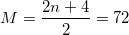


The four numbers
← Didn't Know|Knew It →
What is the median of a data set comprising nineteen elements?
Statement 1: When arranged in ascending order, the ninth element is 72.
Statement 2: When arranged in descending order, the ninth element is 72.
What is the median of a data set comprising nineteen elements?
Statement 1: When arranged in ascending order, the ninth element is 72.
Statement 2: When arranged in descending order, the ninth element is 72.
Tap to reveal answer
In a data set of 19 elements, 19 being odd, the median is the element that occurs in the 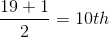 position when they are arranged in ascending (or descending) order. Neither statement alone tells us what that middle element is. But put together, they tell us what the ninth and eleventh elements would be when arranged in ascending (or descending) order. Since both are 72, the element between them - the tenth element, and, thus, the median - must be 72.
The answer is that both statements together are sufficient to answer the question, but neither statement alone is sufficient to answer the question.
In a data set of 19 elements, 19 being odd, the median is the element that occurs in the
The answer is that both statements together are sufficient to answer the question, but neither statement alone is sufficient to answer the question.
← Didn't Know|Knew It →
Data Sufficiency Question
The mean of 8 numbers is 17. Is the median also 17?
1. The range of the numbers is 11.
2. The mode is 17.
Data Sufficiency Question
The mean of 8 numbers is 17. Is the median also 17?
1. The range of the numbers is 11.
2. The mode is 17.
Tap to reveal answer
The range tells us the difference between the maximum and the minimum values, but provides no information about the median. The mode indicates the number that appears most frequently in the data set. While it is possible that the median is 17, it is impossible to determine the median from the data provided.
The range tells us the difference between the maximum and the minimum values, but provides no information about the median. The mode indicates the number that appears most frequently in the data set. While it is possible that the median is 17, it is impossible to determine the median from the data provided.
← Didn't Know|Knew It →
What is the median of the following numbers?
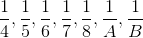
Statement 1: 
Statement 2:  and
and 
What is the median of the following numbers?
Statement 1:
Statement 2:
Tap to reveal answer
Statement 1 alone would not be helpful.
Example 1: If  and
and  , the list, in descending order, is
 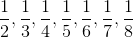 and the median would be
  .
.
Example 2: If  and
and  , the list, in descending order, is
 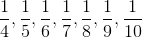 and the median would be
  .
.
In contrast, if Statement 2 is true, since  and
and  ,
,  and
and  . Regardless of their relationship, this makes
  the fourth-highest number, and, therefore, the median.
Statement 1 alone would not be helpful.
Example 1: If
Example 2: If
In contrast, if Statement 2 is true, since
← Didn't Know|Knew It →
Given five distinct positive integers -  - which of them is the median?
Statement 1: 
Statement 2: 
Given five distinct positive integers -
Statement 1:
Statement 2:
Tap to reveal answer
Assume Statement 1 alone. The median of five numbers (an odd number) is the number in the middle when they are arranged in ascending order. By Statement 1, this number is  , so the question is answered.
Statement 2 alone, however, gives that the mean is  . It is possible that the mean and the median can be one and the same or two different numbers.
Case 1: 
The mean is

making this consistent with Statement 2.
The median is the middle element,  .
.
Case 2: 

again, making this consistent with Statement 2.
The median is the middle element,  .
.
Assume Statement 1 alone. The median of five numbers (an odd number) is the number in the middle when they are arranged in ascending order. By Statement 1, this number is
Statement 2 alone, however, gives that the mean is
Case 1:
The mean is
making this consistent with Statement 2.
The median is the middle element,
Case 2:
again, making this consistent with Statement 2.
The median is the middle element,
← Didn't Know|Knew It →
Given five distinct positive integers - - which of them is the median?
Statement 1: 
Statement 1: 
Given five distinct positive integers -
Statement 1:
Statement 1:
Tap to reveal answer
Assume Statement 1 alone. By the Addition Property of Inequality, if
 ,
,
then  can be added to each quantity to give an equivalent inequality:

 .
.
By extension, the continued inequality in Statement 1 is equivalent to
 .
.
A similar argument holds for Statement 2. By the Multiplication Property of Inequality, if
 , then

and  .
.
By extension, the continued inequality in Statement 2 is also equivalent to
 .
.
The median of five numbers (an odd number) is the number in the middle when they are arranged in ascending order. Therefore, it can be established from either statement alone that of the five, the median is  .
.
Assume Statement 1 alone. By the Addition Property of Inequality, if
then
By extension, the continued inequality in Statement 1 is equivalent to
A similar argument holds for Statement 2. By the Multiplication Property of Inequality, if
and
By extension, the continued inequality in Statement 2 is also equivalent to
The median of five numbers (an odd number) is the number in the middle when they are arranged in ascending order. Therefore, it can be established from either statement alone that of the five, the median is
← Didn't Know|Knew It →
Given five distinct positive integers - - which of them is the median?
Statement 1: 
Statement 2: 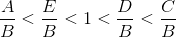
Given five distinct positive integers -
Statement 1:
Statement 2:
Tap to reveal answer
Both statements can be shown to be equivalent to the continued inequality

by way of the Multiplication Property of Inequality. We will demonstrate this as follows:
Multiply each expression in

(Statement 1)
by  :
:

 .
.
Multiply each expression in
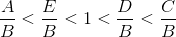
(Statement 2)
by  :
:


The median of five numbers (an odd number) is the number in the middle when they are arranged in ascending order. Therefore, it can be established from either statement alone that of the five, the median is  .
.
Both statements can be shown to be equivalent to the continued inequality
by way of the Multiplication Property of Inequality. We will demonstrate this as follows:
Multiply each expression in
(Statement 1)
by
Multiply each expression in
(Statement 2)
by
The median of five numbers (an odd number) is the number in the middle when they are arranged in ascending order. Therefore, it can be established from either statement alone that of the five, the median is
← Didn't Know|Knew It →
What is the mean of this set?

-

-

What is the mean of this set?
Tap to reveal answer
If  , then
  .
.
If  , then



The two statements are equivalent. This is enough to allow the mean to be found:


The answer is that either statement alone is sufficient to answer the question.
If
If
The two statements are equivalent. This is enough to allow the mean to be found:
The answer is that either statement alone is sufficient to answer the question.
← Didn't Know|Knew It →
A data set comprises eleven elements, the median of which is 60. Two new elements are added to the data set.
Does the median change?
Statement 1: One of the elements added to the set is 50.
Statement 2: One of the elements added to the set is 70.
A data set comprises eleven elements, the median of which is 60. Two new elements are added to the data set.
Does the median change?
Statement 1: One of the elements added to the set is 50.
Statement 2: One of the elements added to the set is 70.
Tap to reveal answer
If we only assume Statement 1, then by examining these two cases, we show that we do not know whether the median changes.
Suppose the original set is

If we only know that one of the elements added is 50, then it is possible that the median does not change - this happens if the other element added is 70:

has median 60.
It is also possible that the median does change - this happens if the other element added is 50.

has median 55.
A similar argument can be used to demonstrate that Statement 2 is insufficient.
However, suppose we know both. 60 is the sixth-highest element of the old data set, and, since one element greater than 60 and one less than 60 are added, 60 is the seventh-highest element of the new thirteen-element set. We therefore know the median did not change.
If we only assume Statement 1, then by examining these two cases, we show that we do not know whether the median changes.
Suppose the original set is
If we only know that one of the elements added is 50, then it is possible that the median does not change - this happens if the other element added is 70:
has median 60.
It is also possible that the median does change - this happens if the other element added is 50.
has median 55.
A similar argument can be used to demonstrate that Statement 2 is insufficient.
However, suppose we know both. 60 is the sixth-highest element of the old data set, and, since one element greater than 60 and one less than 60 are added, 60 is the seventh-highest element of the new thirteen-element set. We therefore know the median did not change.
← Didn't Know|Knew It →
A data set comprises thirteen elements, the median of which is 75. Two new elements are added to the data set. Does the median change?
Statement 1: One of the elements added to the data set is 30.
Statement 2: One of the elements added to the data set is 40.
A data set comprises thirteen elements, the median of which is 75. Two new elements are added to the data set. Does the median change?
Statement 1: One of the elements added to the data set is 30.
Statement 2: One of the elements added to the data set is 40.
Tap to reveal answer
The median of a data set with thirteen elements is the seventh-highest element; the median of a data set with fifteen elements is the eighth-highest.
The two statements together provide insufficient information, as we show with two examples.
The data set

has thirteen elements and median 75; after 30 and 40 are added, the set is
 ,
,
which has median 75.
By contrast, the data set

has thirteen elements and median 75; after 30 and 40 are added, the set is

which has median 74.
Both sets started out with median 75, but the addition of 30 and 40 changed one median and not the other.
The median of a data set with thirteen elements is the seventh-highest element; the median of a data set with fifteen elements is the eighth-highest.
The two statements together provide insufficient information, as we show with two examples.
The data set
has thirteen elements and median 75; after 30 and 40 are added, the set is
which has median 75.
By contrast, the data set
has thirteen elements and median 75; after 30 and 40 are added, the set is
which has median 74.
Both sets started out with median 75, but the addition of 30 and 40 changed one median and not the other.
← Didn't Know|Knew It →
Consider the data set

What is the value of  ?
?
Statement 1: The data set is bimodal.
Statement 2: The median of the data set is 7.
Consider the data set
What is the value of
Statement 1: The data set is bimodal.
Statement 2: The median of the data set is 7.
Tap to reveal answer
Statement 1 is sufficient to prove that  . If
. If  , then each of 6 and 7 occurs four times, more than any other element, making the set bimodal. If
  , then no element other than 6 occurs more than three times, giving the set only one mode.
Statement 2 is insufficient. The median of this data set, which has fifteen elements, is its eighth-greatest element. This happens if  .
.
For example, if  , the set becomes

If  , the set becomes

The median of both sets is 7.
Statement 1 is sufficient to prove that
Statement 2 is insufficient. The median of this data set, which has fifteen elements, is its eighth-greatest element. This happens if
For example, if
If
The median of both sets is 7.
← Didn't Know|Knew It →
Data Sufficiency Question
The mean of 8 numbers is 17. Is the median also 17?
1. The range of the numbers is 11.
2. The mode is 17.
Data Sufficiency Question
The mean of 8 numbers is 17. Is the median also 17?
1. The range of the numbers is 11.
2. The mode is 17.
Tap to reveal answer
The range tells us the difference between the maximum and the minimum values, but provides no information about the median. The mode indicates the number that appears most frequently in the data set. While it is possible that the median is 17, it is impossible to determine the median from the data provided.
The range tells us the difference between the maximum and the minimum values, but provides no information about the median. The mode indicates the number that appears most frequently in the data set. While it is possible that the median is 17, it is impossible to determine the median from the data provided.
← Didn't Know|Knew It →
What is the median of the following numbers?
Statement 1:
Statement 2: and
What is the median of the following numbers?
Statement 1:
Statement 2:
Tap to reveal answer
Statement 1 alone would not be helpful.
Example 1: If and , the list, in descending order, is and the median would be .
Example 2: If and , the list, in descending order, is and the median would be .
In contrast, if Statement 2 is true, since and , and . Regardless of their relationship, this makes the fourth-highest number, and, therefore, the median.
Statement 1 alone would not be helpful.
Example 1: If
Example 2: If
In contrast, if Statement 2 is true, since
← Didn't Know|Knew It →
What is the median number of students assigned per workshop at School R?
(1) 30% of the workshops at School R have 6 or more students assigned to each workshop.
(2) 40% of the workshops at School R have 4 or fewer students assigned to each workshop.
What is the median number of students assigned per workshop at School R?
(1) 30% of the workshops at School R have 6 or more students assigned to each workshop.
(2) 40% of the workshops at School R have 4 or fewer students assigned to each workshop.
Tap to reveal answer
Looking at statements (1) and (2) separately, we cannot get the median number since we don’t know the 50th percentile. However, putting the two statements together, we know that the 50th percentile is 5. So the median is 5.
Looking at statements (1) and (2) separately, we cannot get the median number since we don’t know the 50th percentile. However, putting the two statements together, we know that the 50th percentile is 5. So the median is 5.
← Didn't Know|Knew It →
Given five distinct positive integers - - which of them is the median?
Statement 1:
Statement 1:
Given five distinct positive integers -
Statement 1:
Statement 1:
Tap to reveal answer
Assume Statement 1 alone. By the Addition Property of Inequality, if
,
then can be added to each quantity to give an equivalent inequality:
.
By extension, the continued inequality in Statement 1 is equivalent to
.
A similar argument holds for Statement 2. By the Multiplication Property of Inequality, if
, then
and .
By extension, the continued inequality in Statement 2 is also equivalent to
.
The median of five numbers (an odd number) is the number in the middle when they are arranged in ascending order. Therefore, it can be established from either statement alone that of the five, the median is .
Assume Statement 1 alone. By the Addition Property of Inequality, if
then
By extension, the continued inequality in Statement 1 is equivalent to
A similar argument holds for Statement 2. By the Multiplication Property of Inequality, if
and
By extension, the continued inequality in Statement 2 is also equivalent to
The median of five numbers (an odd number) is the number in the middle when they are arranged in ascending order. Therefore, it can be established from either statement alone that of the five, the median is
← Didn't Know|Knew It →
On Monday, 40 people are asked to rate the quality of product A on a seven point scale (1=very poor, 2=poor.....6=very good, 7=excellent).
On Tuesday, a different group of 40 is asked to rate the quality of product B using the same seven point scale.
The results for product A:
7 votes for category 1 (very poor);
8 votes for category 2;
10 votes for 3;
6 vote for 4;
4 votes for 5;
3 votes for 6;
2 votes for 7;
The results for product B:
2 votes for category 1 (very poor);
3 votes for category 2;
4 votes for 3;
6 vote for 4;
10 votes for 5;
8 votes for 6;
7 votes for 7;
It appears that B is the superior product.
Which one of the following statements is true?
On Monday, 40 people are asked to rate the quality of product A on a seven point scale (1=very poor, 2=poor.....6=very good, 7=excellent).
On Tuesday, a different group of 40 is asked to rate the quality of product B using the same seven point scale.
The results for product A:
7 votes for category 1 (very poor);
8 votes for category 2;
10 votes for 3;
6 vote for 4;
4 votes for 5;
3 votes for 6;
2 votes for 7;
The results for product B:
2 votes for category 1 (very poor);
3 votes for category 2;
4 votes for 3;
6 vote for 4;
10 votes for 5;
8 votes for 6;
7 votes for 7;
It appears that B is the superior product.
Which one of the following statements is true?
Tap to reveal answer
Median of A = 3
Mean of A = 3.2
Median of B = 5
Mean of B = 4.8
Median of A = 3
Mean of A = 3.2
Median of B = 5
Mean of B = 4.8
← Didn't Know|Knew It →
The median of the numbers , , , and is . What is equal to?
The median of the numbers
Tap to reveal answer
The four numbers appear in ascending order, so their median must be the arithmetic mean of the middle two numbers. Therefore,
The four numbers
← Didn't Know|Knew It →
What is the median of a data set comprising nineteen elements?
Statement 1: When arranged in ascending order, the ninth element is 72.
Statement 2: When arranged in descending order, the ninth element is 72.
What is the median of a data set comprising nineteen elements?
Statement 1: When arranged in ascending order, the ninth element is 72.
Statement 2: When arranged in descending order, the ninth element is 72.
Tap to reveal answer
In a data set of 19 elements, 19 being odd, the median is the element that occurs in the position when they are arranged in ascending (or descending) order. Neither statement alone tells us what that middle element is. But put together, they tell us what the ninth and eleventh elements would be when arranged in ascending (or descending) order. Since both are 72, the element between them - the tenth element, and, thus, the median - must be 72.
The answer is that both statements together are sufficient to answer the question, but neither statement alone is sufficient to answer the question.
In a data set of 19 elements, 19 being odd, the median is the element that occurs in the
The answer is that both statements together are sufficient to answer the question, but neither statement alone is sufficient to answer the question.
← Didn't Know|Knew It →