
Word Problems - GMAT Quantitative
Card 1 of 920
A lawn-mower is initially listed at  . Its price is discounted off the full price some unknown amount,
  . An employee uses their
  discount at the register and is charged
  .
.
What is the unknown initial discount, ?
?
A lawn-mower is initially listed at
What is the unknown initial discount,
Tap to reveal answer
The relationship between the list price,  , sale price,
  , and the employee's discount,
  , is
, is

Inserting values and re-organizing:

The relationship between the list price,
Inserting values and re-organizing:
← Didn't Know|Knew It →
Data sufficiency question- do not actually solve the question
How many hours did it take to drive from city A to city B without stopping?
1. The drive started at 10 am.
2. The average speed during the trip is 65 miles/hour.
Data sufficiency question- do not actually solve the question
How many hours did it take to drive from city A to city B without stopping?
1. The drive started at 10 am.
2. The average speed during the trip is 65 miles/hour.
Tap to reveal answer
The total time is calculated by the equation 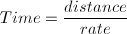 . Statement 2 provides the rate, but we have no information regarding distance, therefore, the quesiton is impossible to solve without more information.
The total time is calculated by the equation
← Didn't Know|Knew It →
Cassie and Derek must decorate 60 cupcakes. It takes them 150 minutes to complete the task together. How long would it take Derek to decorate the cupcakes by himself?
Statement 1: It would take Cassie 240 minutes to decorate the cupcakes by herself.
Statement 2: Derek can decorate 9 cupcakes in 1 hour.
Cassie and Derek must decorate 60 cupcakes. It takes them 150 minutes to complete the task together. How long would it take Derek to decorate the cupcakes by himself?
Statement 1: It would take Cassie 240 minutes to decorate the cupcakes by herself.
Statement 2: Derek can decorate 9 cupcakes in 1 hour.
Tap to reveal answer
From the first statement, we can calculate the number of cupcakes Cassie can decorate in 150 minutes. From there, we can calculate the rate at which Derek decorates. Therefore, Statement 1 alone is sufficient to answer the question.
The second statement gives the rate at which Derek decorates cupcakes. Therefore, Statement 2 alone is also sufficient to answer the question.
From the first statement, we can calculate the number of cupcakes Cassie can decorate in 150 minutes. From there, we can calculate the rate at which Derek decorates. Therefore, Statement 1 alone is sufficient to answer the question.
The second statement gives the rate at which Derek decorates cupcakes. Therefore, Statement 2 alone is also sufficient to answer the question.
← Didn't Know|Knew It →
The route from Tom's house to his mother's house involves traveling for 55 miles along Interstate 10, then 20 miles along State Route 34. How long does it take for Tom to travel between the two houses, if he drives at precisely the speed limit on each highway?
Statement 1: The speed limit on Interstate 10 is 70 miles per hour for the entire stretch.
Statement 2: The speed limit on State Route 34 is 50 miles per hour for the first half of the distance Tom drives on it, and 40 miles per hour for the second half.
The route from Tom's house to his mother's house involves traveling for 55 miles along Interstate 10, then 20 miles along State Route 34. How long does it take for Tom to travel between the two houses, if he drives at precisely the speed limit on each highway?
Statement 1: The speed limit on Interstate 10 is 70 miles per hour for the entire stretch.
Statement 2: The speed limit on State Route 34 is 50 miles per hour for the first half of the distance Tom drives on it, and 40 miles per hour for the second half.
Tap to reveal answer
The rate formula  - or, actually, the equivalent equation
  - will help.
Let  be the speed limits along the interstate, the first half of the state route, and the second half of the state route, respectively.
Then Tom can drive I-10 in  hours; the first half of SR 34,
  ; the second half of SR 34,
  .
.
The time  it takes, in hours, for Tom to make the entire trip is the sum of these fractions:
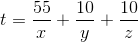 .
.
To calculate  , we need
  . Statement 1 only tells us
  ; Statement 2 only tells us
  and
and  . Therefore, both together, but neither alone, are enough to allow us to calculate
  .
.
The rate formula
Let
Then Tom can drive I-10 in
The time
To calculate
← Didn't Know|Knew It →
Machines A,B and C working together take 12 minutes to complete a watch.
What is the rate of both machines B and C working together?
(1) Machines A and B together can complete a watch in 20 minutes.
(2) Machines A and C together can complete a watch in 15 minutes.
Machines A,B and C working together take 12 minutes to complete a watch.
What is the rate of both machines B and C working together?
(1) Machines A and B together can complete a watch in 20 minutes.
(2) Machines A and C together can complete a watch in 15 minutes.
Tap to reveal answer
Firstly we should set up an equation for this problem: 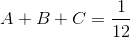 where
where  are the respective rates of machines A, B and C. We need to find
  .
.
Statement 1 tells us that  .
.
This alone is not suffient since we will have no precise information on machine B. Similarly, with statement 2 We can find the value of the rate for machine B but we cannot know what is the rate of machine C, from what we are told. However, taking both statements together, with statement 1 we can find the value for  and with statement 2 we can find the value for
  and thereby we can find the value of
  .
.
Firstly we should set up an equation for this problem:
Statement 1 tells us that
This alone is not suffient since we will have no precise information on machine B. Similarly, with statement 2 We can find the value of the rate for machine B but we cannot know what is the rate of machine C, from what we are told. However, taking both statements together, with statement 1 we can find the value for
← Didn't Know|Knew It →
Two trains (Train A and Train B) leave their stations at exactly 6 pm, travelling towards each other from stations exactly 60 miles apart. There are no other stops between these two stations. What time does Train B arrive at its destination?
1. Train A travels twice as fast as Train B.
2. At 6:40 pm, the two trains pass each other.
Two trains (Train A and Train B) leave their stations at exactly 6 pm, travelling towards each other from stations exactly 60 miles apart. There are no other stops between these two stations. What time does Train B arrive at its destination?
1. Train A travels twice as fast as Train B.
2. At 6:40 pm, the two trains pass each other.
Tap to reveal answer
Statement 1 alone does not tell us enough about the speed of train B to answer the question. Statement 2 alone does not tell us about the rates of either individual train, so it is also not sufficient by itself to answer the question.
But can we figure out the answer using both pieces of information? Yes, we can! If we know that the trains meet at 6:40, then their combined rate of travel is 60 total miles in 40 minutes. Statement 1 says that Train A travels twice as fast as Train B, so we can determine the distances covered by the two trains in those 40 minutes. From there, we can find rates for both trains and then answer the question. Thus, both statements together are sufficient to answer the question, but neither statement alone is sufficient.
Note: We didn't actually answer the question of Train B's arrival time. For data sufficiency questions, don't waste time trying to find the specific answer. All that is necessary is determining whether or not it is POSSIBLE to answer the question with the information given.
Statement 1 alone does not tell us enough about the speed of train B to answer the question. Statement 2 alone does not tell us about the rates of either individual train, so it is also not sufficient by itself to answer the question.
But can we figure out the answer using both pieces of information? Yes, we can! If we know that the trains meet at 6:40, then their combined rate of travel is 60 total miles in 40 minutes. Statement 1 says that Train A travels twice as fast as Train B, so we can determine the distances covered by the two trains in those 40 minutes. From there, we can find rates for both trains and then answer the question. Thus, both statements together are sufficient to answer the question, but neither statement alone is sufficient.
Note: We didn't actually answer the question of Train B's arrival time. For data sufficiency questions, don't waste time trying to find the specific answer. All that is necessary is determining whether or not it is POSSIBLE to answer the question with the information given.
← Didn't Know|Knew It →
Jake and Colin are painting a house together. How long would it take Colin to paint the house alone?
(1) Jake and Colin can paint the house together in 6 hours, working at the same rate.
(2) Jake can paint the house alone in 12 hours
Jake and Colin are painting a house together. How long would it take Colin to paint the house alone?
(1) Jake and Colin can paint the house together in 6 hours, working at the same rate.
(2) Jake can paint the house alone in 12 hours
Tap to reveal answer
Here we can see that there are two people painting the house, so we should set the following equation :  , where
  is the rate for Jake and where
  is the rate for Colin,
  stands for their rate together. Statement one gives us a value for
  and even though it doesn't tell us what is
  or
or  it tells us that
  which allow us to answer the question.
For Statement 2, we are left with two other unknowns in our equation and we can clearly see that (2) is not sufficient.
Here we can see that there are two people painting the house, so we should set the following equation :
For Statement 2, we are left with two other unknowns in our equation and we can clearly see that (2) is not sufficient.
← Didn't Know|Knew It →
Celine and Jack are painting a house together at their respective rates. After working 1 hour together, Jack starts to feel tired and stops. How long does it take Celine to finish the work?
(1) Celine could have painted the house alone in 3 hours.
(2) It would have taken Jack 5 hours to paint the house alone.
Celine and Jack are painting a house together at their respective rates. After working 1 hour together, Jack starts to feel tired and stops. How long does it take Celine to finish the work?
(1) Celine could have painted the house alone in 3 hours.
(2) It would have taken Jack 5 hours to paint the house alone.
Tap to reveal answer
We should start by setting equations  and
and  , these are the two equation we should be able to solve. Where
  is the amount of the work they did togetherm
  is the amount of work left,
  is Celine's rate and
  is the rate of Celine and Jack together. So with
  we can see that we would need both Jack and Celine's rate. Since they work at a different rate, we shoud only be able to answer this problem taking both statements together.
We should start by setting equations
← Didn't Know|Knew It →
Machine X and machine Y both produce screwdrives at their respective rates. What is the rate of the machines working together?
(1) Machine X can produce 200 screwdrivers in an hour and machine Y can produce as many in 2 more hours.
(2) Machine Y can produce 200 screwdrivers in 3 hours. Machine X is three times as fast as machine Y.
Machine X and machine Y both produce screwdrives at their respective rates. What is the rate of the machines working together?
(1) Machine X can produce 200 screwdrivers in an hour and machine Y can produce as many in 2 more hours.
(2) Machine Y can produce 200 screwdrivers in 3 hours. Machine X is three times as fast as machine Y.
Tap to reveal answer
To be able to solve this problem, we need to figure out  where
where  is the rate of machine X and
  is the rate of machine Y. Statement 1 tells us the rate for machine X, but tells us as well that it takes 2 more hours for machine Y to produce the same amount of screwdrivers. Therefore, we are told that
  and
and  , which is sufficient to answer the question. Statement 2 tells us that the rate of machine Y is
  and also that that rate of machine X is 3 times as fast as machine Y:
  so
so  .
.
Each statement alone is therefore sufficient.
To be able to solve this problem, we need to figure out
Each statement alone is therefore sufficient.
← Didn't Know|Knew It →
Machine O working together with machine P produces telephones at a rate of 1056 per hour. How many telephones can machine O produce in an hour?
(1) It takes machine P four hours longer than machine O to produce 880 telephones.
(2) Machine P produces telephones at a rate of 176 telephones per hour.
Machine O working together with machine P produces telephones at a rate of 1056 per hour. How many telephones can machine O produce in an hour?
(1) It takes machine P four hours longer than machine O to produce 880 telephones.
(2) Machine P produces telephones at a rate of 176 telephones per hour.
Tap to reveal answer
To solve this problem we first have to set up an equation for our variables: 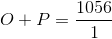 where
where  is the rate of machine O and
  is the rate of machine P.
The first statement tells us that  and
and  , where
  is the time it takes machine O to produce 880 telephones.
At first it might look insufficient but, by pluging in the values for  and
and  in our first equation we get :
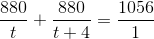 , this gives us a quadratic equation, in which we can solve and find t, and therefore find the number of telephones O can produce in 1 hour.
The second statement tell us that  , therefore, we can plug in this value in our first equation to find the rate for machine O and this will allow us to answer the question.
To solve this problem we first have to set up an equation for our variables:
The first statement tells us that
At first it might look insufficient but, by pluging in the values for
The second statement tell us that
← Didn't Know|Knew It →
16 very precise machines, working at the same constant rate, can produce a luxury necklace working together. How many machines should we add in order for the necklace to be produced in an hour.
(1) It takes 5 hours for these machines to produce the necklace
(2) A single machine produces a necklace in 80 hours.
16 very precise machines, working at the same constant rate, can produce a luxury necklace working together. How many machines should we add in order for the necklace to be produced in an hour.
(1) It takes 5 hours for these machines to produce the necklace
(2) A single machine produces a necklace in 80 hours.
Tap to reveal answer
We know that there are 16 machines and we are looking for how many we should add. Let us set an equation representing the number of machines in use  , where
  is the total number of machines we need and
  is the rate of an individual machine. We should therefore find a rate for a single machine to be able to solve this problem, since we can then calculate
  .
.
Statement 1 tells us that for 16 machines, it takes 5 hours to produce a necklace. From this we can find the rate of a single machine.
Statement 2 tells us direclty the rate of a single machine, therefore both these statements allow us to answer the problem.
We know that there are 16 machines and we are looking for how many we should add. Let us set an equation representing the number of machines in use
Statement 1 tells us that for 16 machines, it takes 5 hours to produce a necklace. From this we can find the rate of a single machine.
Statement 2 tells us direclty the rate of a single machine, therefore both these statements allow us to answer the problem.
← Didn't Know|Knew It →
Train A and Train B are moving toward one another. How long does it takes for train A to pass by train B?
(1) The distance between train A and train B is 180 miles.
(2) Train A's rate is 45 mph and train B's rate is 60 mph.
Train A and Train B are moving toward one another. How long does it takes for train A to pass by train B?
(1) The distance between train A and train B is 180 miles.
(2) Train A's rate is 45 mph and train B's rate is 60 mph.
Tap to reveal answer
Since the problem doesn't tell us anything about the rates and the distance between the two train, there is not much we can say. Statement one tells us that there is 180 miles between the two trains. This is not sufficient, since we don't know how fast the trains are.
Statement 2 alone tells us the rates of the trains, but we don't know how far away they are, this statement alone doesn't help us answer the question.
If we take both statements together however, we can see that the distance that each train would have made when both trains meet, is a total of 180 miles, since both trains were 180 miles away.
We can create the following equation  , where
  is the time it takes for both train to meet at a given point and
  and
and  are the trains A and B respective rates. The information we have allows us to solve the equation for
  and therefore we can answer the problem.
Since the problem doesn't tell us anything about the rates and the distance between the two train, there is not much we can say. Statement one tells us that there is 180 miles between the two trains. This is not sufficient, since we don't know how fast the trains are.
Statement 2 alone tells us the rates of the trains, but we don't know how far away they are, this statement alone doesn't help us answer the question.
If we take both statements together however, we can see that the distance that each train would have made when both trains meet, is a total of 180 miles, since both trains were 180 miles away.
We can create the following equation
← Didn't Know|Knew It →
A train makes roundtrips between two cities at an average speed of 75 mph. What is the distance between the two cities, taking into consideration that the train does not travel at the same speed for both trips?
(1) The train takes 50 minutes to do one way.
(2) The train takes 60 minutes to do the other way, which is uphill.
A train makes roundtrips between two cities at an average speed of 75 mph. What is the distance between the two cities, taking into consideration that the train does not travel at the same speed for both trips?
(1) The train takes 50 minutes to do one way.
(2) The train takes 60 minutes to do the other way, which is uphill.
Tap to reveal answer
Firstly, we should remember that the average rate is given by the following formula  , where
  is the total distance and
  is the total time. So to answer this question we should find a value for
  .
.  can only be found by adding the two times for both trips. By pluging in the values we can find a value for
  , therefore we need both statements.
Firstly, we should remember that the average rate is given by the following formula
← Didn't Know|Knew It →
How long does it take train A to reach a town which is 500 miles away, knowing that the entire portion of the rails are damaged?
(1) The train usually goes 500 miles in 675 minutes.
(2) Since the rails are damaged it typically takes train A twice the usual time.
How long does it take train A to reach a town which is 500 miles away, knowing that the entire portion of the rails are damaged?
(1) The train usually goes 500 miles in 675 minutes.
(2) Since the rails are damaged it typically takes train A twice the usual time.
Tap to reveal answer
To solve this problem, we need to find the rate of the train considering the fact that the rails are damaged. The first statement tells us only the usual rate of the train and is therefore not sufficient because we don't know how fast the train will be going on the damaged portions of the railroad.
Statement two only tells us that the train must progress at a rate half as slow as its usual rate.
Using statements 1 and 2 we can easily find the rate which is given by  . Note that this rate is given in miles per minutes but we don't have to calculate it, we just need to know that we can calculate it.
To solve this problem, we need to find the rate of the train considering the fact that the rails are damaged. The first statement tells us only the usual rate of the train and is therefore not sufficient because we don't know how fast the train will be going on the damaged portions of the railroad.
Statement two only tells us that the train must progress at a rate half as slow as its usual rate.
Using statements 1 and 2 we can easily find the rate which is given by
← Didn't Know|Knew It →
A plane makes a round trip at an average speed of 650 mph.
What was the speed of the plane on the second portion of the flight?
(1) It took the plane twice as long to do the first portion of the flight
(2) The plane flew at a speed of 750mph on the second portion of the flight
A plane makes a round trip at an average speed of 650 mph.
What was the speed of the plane on the second portion of the flight?
(1) It took the plane twice as long to do the first portion of the flight
(2) The plane flew at a speed of 750mph on the second portion of the flight
Tap to reveal answer
Since we are told an average speed for a round trip we should be able to set the following equation  , where
  is the distance of a one way and
  is the total time of the round trip and
  is the average speed of the plane.
Statement 1 tells us that it took the plane twice as long to do the first portion of the round trip, therefore we can figure out  from this statement, indeed,
  where
where  is the time it took to do the second portion of the trip. Therefore,
  . Since
  is the rate for the second portion of the trip, we can figure it out by pluging in the values
  , which is sufficient to answer the problem.
Statement 2 tells us that the plane was flying at a speed of  , this alone answers the question.
Since we are told an average speed for a round trip we should be able to set the following equation
Statement 1 tells us that it took the plane twice as long to do the first portion of the round trip, therefore we can figure out
Statement 2 tells us that the plane was flying at a speed of
← Didn't Know|Knew It →
Car A drives on road 66 at a rate of 50 mph, how long does it take for car B to catch up?
(1) Car A is 20 miles ahead of car B.
(2) Car B has a rate of 60 mph.
Car A drives on road 66 at a rate of 50 mph, how long does it take for car B to catch up?
(1) Car A is 20 miles ahead of car B.
(2) Car B has a rate of 60 mph.
Tap to reveal answer
For these types of problems, asking us how long it takes for a vehicle to catch up to another one, we should keep in mind that we can calculate the rate at which the other vehicle is catching up, by doing the difference of the two rates.
From this we can see that we will need both rates for the vehicles as well as the distance between the two vehicles:  , where
  and
and  are the respective rates of vehicles B and A, and
  is the distance between the two cars and
  is the time it would take for car B to catch up
Statement 1 only tells us the distance between the two vehicle and therefore we don't know how fast car B is catching up and therefore this statement alone is insufficient.
Statement 2 only tells us how fast is the second car going, but here we don't know what is the distance between the two cars.
Therefore, both statements must be taken together to answer this question.
For these types of problems, asking us how long it takes for a vehicle to catch up to another one, we should keep in mind that we can calculate the rate at which the other vehicle is catching up, by doing the difference of the two rates.
From this we can see that we will need both rates for the vehicles as well as the distance between the two vehicles:
Statement 1 only tells us the distance between the two vehicle and therefore we don't know how fast car B is catching up and therefore this statement alone is insufficient.
Statement 2 only tells us how fast is the second car going, but here we don't know what is the distance between the two cars.
Therefore, both statements must be taken together to answer this question.
← Didn't Know|Knew It →
Train A takes 3 more hours than train B to go 180 miles, what is the average speed of train A?
(1) Train B's rate is 20 mph less than train A.
(2) Train A takes 4 hours to travel from city A to city B.
Train A takes 3 more hours than train B to go 180 miles, what is the average speed of train A?
(1) Train B's rate is 20 mph less than train A.
(2) Train A takes 4 hours to travel from city A to city B.
Tap to reveal answer
First of all, we should notice that we are looking for a rate and therefore, we should be able to find both a distance and a time for the train to travel that distance.
From statement 1, we can say that  and that
  where
where  is train A's rate and
  is the time it takes train B to travel 180 miles. If we manipulate our equations we get :
  , since 180 are in both equations. But there are two unknowns and neither cancel out. So statement 1 alone is not sufficient.
Statement 2 gives us a rate for train A for an unknown distance, therefore this information is not useful.
We can see that after using our statements, even together, we still could not find an answer to the problem, therefore statements 1 and 2 together are insufficient.
First of all, we should notice that we are looking for a rate and therefore, we should be able to find both a distance and a time for the train to travel that distance.
From statement 1, we can say that
Statement 2 gives us a rate for train A for an unknown distance, therefore this information is not useful.
We can see that after using our statements, even together, we still could not find an answer to the problem, therefore statements 1 and 2 together are insufficient.
← Didn't Know|Knew It →
Jenna needs 
 years from today to start a business. After talking to an investment banker, Jenna is assured to gain an annually compounded interest of
  .
.
What amount of money does Jenna need to invest today?
(1) 
(2) 
Jenna needs
What amount of money does Jenna need to invest today?
(1)
(2)
Tap to reveal answer
Using statement (1), the value of i cannot be determined because t is not specified.
Therefore Statement (1) ALONE is not sufficient.
Using statement (2), the value of i can be determined:
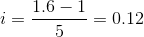
We can then set the following equation with X being the amount of money Jenna has to invest today:

We calculate X as follows:

Using statement (1), the value of i cannot be determined because t is not specified.
Therefore Statement (1) ALONE is not sufficient.
Using statement (2), the value of i can be determined:
We can then set the following equation with X being the amount of money Jenna has to invest today:
We calculate X as follows:
← Didn't Know|Knew It →
You are given a metal cube whose volume can be given by a whole number of cubic meters. What is its volume?
Statement 1: Each edge of the cube has length between 160 and 180 centimeters, inclusive.
Statement 2: The surface area of the cube is between 1,350 square decimeters and 1,944 square decimeters, inclusive.
You are given a metal cube whose volume can be given by a whole number of cubic meters. What is its volume?
Statement 1: Each edge of the cube has length between 160 and 180 centimeters, inclusive.
Statement 2: The surface area of the cube is between 1,350 square decimeters and 1,944 square decimeters, inclusive.
Tap to reveal answer
Assume Statement 1 alone. Each edge of the cube has length between 160 centimeters and 180 centimeters; since one meter is equal to 100 centimeters, the length of one edge falls between 1.6 meters and 1.8 meters. Its volume therefore falls between
 cubic meters
and
 cubic meters.
The only whole number of meters that falls between these boundaries is 5 meters, so the question is answered.
Assume Statement 2 alone. The minimum surface area of the cube is 1,350 square decimeters, so, to find the minumum length of an edge, use the surface area formula, setting  :
:


 decimeters; divide by 10 (decimeters per meter) to convert to 1.5 meters.
Similarly, to get the maximum edge length, set  :
:


 decimeters; divide by 10 to get 1.8 meters.
The volume of the cube therefore falls between
 cubic meters
and
 cubic meters.
This leaves us with two possible whole number answers, 4 and 5, so the question is not answered.
Assume Statement 1 alone. Each edge of the cube has length between 160 centimeters and 180 centimeters; since one meter is equal to 100 centimeters, the length of one edge falls between 1.6 meters and 1.8 meters. Its volume therefore falls between
and
The only whole number of meters that falls between these boundaries is 5 meters, so the question is answered.
Assume Statement 2 alone. The minimum surface area of the cube is 1,350 square decimeters, so, to find the minumum length of an edge, use the surface area formula, setting
Similarly, to get the maximum edge length, set
The volume of the cube therefore falls between
and
This leaves us with two possible whole number answers, 4 and 5, so the question is not answered.
← Didn't Know|Knew It →
At the beginning of January of 2015, Olga invested one half of the money she earned in December of 2014 in a certificate of deposit that pays 3.15% annual interest, compounded monthly. At the end of six years, how much will that certificate of deposit be worth?
Statement 1: Olga earned $63,000 in 2014.
Stateent 2: Olga earned the same amount of money each month in 2013.
At the beginning of January of 2015, Olga invested one half of the money she earned in December of 2014 in a certificate of deposit that pays 3.15% annual interest, compounded monthly. At the end of six years, how much will that certificate of deposit be worth?
Statement 1: Olga earned $63,000 in 2014.
Stateent 2: Olga earned the same amount of money each month in 2013.
Tap to reveal answer
In order to know how much money is in an account after compound interest is accrued, one thing that must be known is the principal, or amount invested.
Statement 2 is unhelpful, since information from 2013 is not relevant to information for 2014.
From Statement 1 we only know her 2014 earnings, not her December earnings (it is not given that she earned the same per month in 2014). Therefore, the two statements together provide insufficient information.
In order to know how much money is in an account after compound interest is accrued, one thing that must be known is the principal, or amount invested.
Statement 2 is unhelpful, since information from 2013 is not relevant to information for 2014.
From Statement 1 we only know her 2014 earnings, not her December earnings (it is not given that she earned the same per month in 2014). Therefore, the two statements together provide insufficient information.
← Didn't Know|Knew It →