
Arithmetic - GMAT Quantitative
Card 1 of 2420
How many subsets does set  have?
have?
Statement 1:  has eight elements.
Statement 2:  is the set of all prime numbers between 1 and 20.
How many subsets does set
Statement 1:
Statement 2:
Tap to reveal answer
The number of subsets of any set can be calculated by raising 2 to the power of the number of elements in the set. The first statement gives you that information immediately. The second gives you enough information to find the number of elements, as there are eight primes between 1 and 20: 2, 3, 5, 7, 11, 13, 17, and 19. From either statement alone, you can deduce the answer to be  .
.
The number of subsets of any set can be calculated by raising 2 to the power of the number of elements in the set. The first statement gives you that information immediately. The second gives you enough information to find the number of elements, as there are eight primes between 1 and 20: 2, 3, 5, 7, 11, 13, 17, and 19. From either statement alone, you can deduce the answer to be
← Didn't Know|Knew It →
Let  be the set of all of the multiples of 3 between 29 and 50. How many subsets of
  can be formed?
Let
Tap to reveal answer
The multiples of 3 between 29 and 50 are 30, 33, 36, 39, 42, 45, and 48 - therefore,  has seven elements total.
The number of subsets in a set can be calculated by raising 2 to the power of the number of elements. Therefore, the answer to our question is  .
.
The multiples of 3 between 29 and 50 are 30, 33, 36, 39, 42, 45, and 48 - therefore,
The number of subsets in a set can be calculated by raising 2 to the power of the number of elements. Therefore, the answer to our question is
← Didn't Know|Knew It →
Data sufficiency question- do not actually solve the question
A bag of marbles consist of a mixture of black and red marbles. What is the probability of choosing a red marble followed by a black marble?
1. The probability of choosing a black marble first is  .
.
2. There are 10 black marbles in the bag.
Data sufficiency question- do not actually solve the question
A bag of marbles consist of a mixture of black and red marbles. What is the probability of choosing a red marble followed by a black marble?
1. The probability of choosing a black marble first is
2. There are 10 black marbles in the bag.
Tap to reveal answer
From statement 1, we know the probabilty of choosing the first marble. However, since the marble is not replaced, it is impossible to calculate the probability of choosing the second marble. By knowing the information in statement 2 combined with statement 1, we can calculate the total number of marbles initially present.
From statement 1, we know the probabilty of choosing the first marble. However, since the marble is not replaced, it is impossible to calculate the probability of choosing the second marble. By knowing the information in statement 2 combined with statement 1, we can calculate the total number of marbles initially present.
← Didn't Know|Knew It →
A certain major league baseball player gets on base 25% of the time (once every 4 times at bat).
For any game where he comes to bat 5 times, what is the probability that he will get on base either 3 or 4 times? - Hint – add the probability of 3 to the probability of 4.
A certain major league baseball player gets on base 25% of the time (once every 4 times at bat).
For any game where he comes to bat 5 times, what is the probability that he will get on base either 3 or 4 times? - Hint – add the probability of 3 to the probability of 4.
Tap to reveal answer



Binomial Table
Binomial Table
← Didn't Know|Knew It →
Assume that we are the immortal gods of statistics and we know the following population statistics:
-
average driving speed for women=50 mph with a standard deviation of 12
-
average driving speed for men=45 mph with a standard deviation of 11
We look down from our statistical Mount Olympus and notice that the Earth mortals have randomly sampled 60 women and 65 men in an attempt to detect a significant difference in the average driving speed.
What is the probability that the Earth mortals will properly reject the assumption (i.e. the null hypothesis) that there is no significant difference between the average driving speeds. The Earth mortals have decided to use a 2-tailed 95% confidence test.
Assume that we are the immortal gods of statistics and we know the following population statistics:
-
average driving speed for women=50 mph with a standard deviation of 12
-
average driving speed for men=45 mph with a standard deviation of 11
We look down from our statistical Mount Olympus and notice that the Earth mortals have randomly sampled 60 women and 65 men in an attempt to detect a significant difference in the average driving speed.
What is the probability that the Earth mortals will properly reject the assumption (i.e. the null hypothesis) that there is no significant difference between the average driving speeds. The Earth mortals have decided to use a 2-tailed 95% confidence test.
Tap to reveal answer
standard deviation of the difference between the sample means =

 at 95% (2-tailed) = 1.96

the sample difference must be 4 or greater
(note: the probability of the sample difference being -4 or less is so small (4.5 standard deviations) that it will be ignored and we will only consider the probability that the difference is 4 or more.)
the probablity of the sample difference being 4 or greater (knowing that the population difference is 5) =

the table shows that .3156 lies below -.48, so, .6844 lies above -.48
In English - there is a .6844 probability that the 2 sample means will yield a sample difference that is 1.96 or more standard deviations above 0.
standard deviation of the difference between the sample means =
the sample difference must be 4 or greater
(note: the probability of the sample difference being -4 or less is so small (4.5 standard deviations) that it will be ignored and we will only consider the probability that the difference is 4 or more.)
the probablity of the sample difference being 4 or greater (knowing that the population difference is 5) =
the table shows that .3156 lies below -.48, so, .6844 lies above -.48
In English - there is a .6844 probability that the 2 sample means will yield a sample difference that is 1.96 or more standard deviations above 0.
← Didn't Know|Knew It →
In a popular state lottery game, a player selects 5 numbers (on 1 ticket) out of a possible 39 numbers. There are 575,757 possible 5 number combinations.
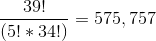
So, the odds are 575,757 to 1 against winning.
What are the odds of getting 4 of the 5 numbers correct on 1 ticket?
In a popular state lottery game, a player selects 5 numbers (on 1 ticket) out of a possible 39 numbers. There are 575,757 possible 5 number combinations.
So, the odds are 575,757 to 1 against winning.
What are the odds of getting 4 of the 5 numbers correct on 1 ticket?
Tap to reveal answer
575,757 must be divided by -

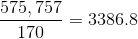
575,757 must be divided by -
← Didn't Know|Knew It →
One card from another deck is added to a standard deck of fifty-two cards. The cards are shuffled and one card is removed.
A card is then drawn at random. What is the probability that that card is an ace?
Statement 1: The card that was added was a spade.
Statetment 2: The card that was removed was a jack.
One card from another deck is added to a standard deck of fifty-two cards. The cards are shuffled and one card is removed.
A card is then drawn at random. What is the probability that that card is an ace?
Statement 1: The card that was added was a spade.
Statetment 2: The card that was removed was a jack.
Tap to reveal answer
You need to know two things to answer this question - the rank of the added card, and the rank of the removed card. The second statement is useful but not sufficient; the first is irrelevant to the question.
You need to know two things to answer this question - the rank of the added card, and the rank of the removed card. The second statement is useful but not sufficient; the first is irrelevant to the question.
← Didn't Know|Knew It →
Your friend at work submits a bold hypothesis. He suggests that the number of sales per day follow the pattern - Monday-10%, Tuesday-10%, Wednesday-10%, Thursday 35% and Friday 35%.
You and he then record the number of sales for the following week: Monday-120, Tuesday-85, Wednesday-105, Thursday-325 and Friday-365.
After viewing the observed data, your friend expresses serious concern regarding his hypothesis.
You can help; you can tell him the probability of the observed data occuring if the hypothesis is true. Hint - Excel ChiTest.
Your friend at work submits a bold hypothesis. He suggests that the number of sales per day follow the pattern - Monday-10%, Tuesday-10%, Wednesday-10%, Thursday 35% and Friday 35%.
You and he then record the number of sales for the following week: Monday-120, Tuesday-85, Wednesday-105, Thursday-325 and Friday-365.
After viewing the observed data, your friend expresses serious concern regarding his hypothesis.
You can help; you can tell him the probability of the observed data occuring if the hypothesis is true. Hint - Excel ChiTest.
Tap to reveal answer
Use Excel ChiTest to get the .063 probability. If you are old-fashioned, you can also obtain the Chi-Squared number (8.928) by using ChiInv; but, it is not needed
Use Excel ChiTest to get the .063 probability. If you are old-fashioned, you can also obtain the Chi-Squared number (8.928) by using ChiInv; but, it is not needed
← Didn't Know|Knew It →
A certain tutor boasts that his 2 week training program will increase a student's score on a 2400 point exam by at least 100 points (4.167%). A 10 student 'before-and-after' study was conducted to validate the claim. The following results were obtained - the 3 columns represent the before, afer and increase numbers for each of the 10 students:
1300 1340 40
1670 1790 120
1500 1710 210
1360 1660 300
1580 1730 150
1160 1320 160
1910 2100 190
1410 1490 80
1710 1880 170
1990 2060 70
Assume the null Hypothesis:
'The average increase is less than 100 points'
What is the highest level of significance (p-value) at which the null hypothesis will be rejected?
A certain tutor boasts that his 2 week training program will increase a student's score on a 2400 point exam by at least 100 points (4.167%). A 10 student 'before-and-after' study was conducted to validate the claim. The following results were obtained - the 3 columns represent the before, afer and increase numbers for each of the 10 students:
1300 1340 40
1670 1790 120
1500 1710 210
1360 1660 300
1580 1730 150
1160 1320 160
1910 2100 190
1410 1490 80
1710 1880 170
1990 2060 70
Assume the null Hypothesis:
'The average increase is less than 100 points'
What is the highest level of significance (p-value) at which the null hypothesis will be rejected?
Tap to reveal answer
Using Excel, the average increase (column 3) is 149 and Standard Deviation of the increases is 76.37


Using Excel - a t value of 2.03 for 9 degrees of freedom = .036
Using Excel, the average increase (column 3) is 149 and Standard Deviation of the increases is 76.37
Using Excel - a t value of 2.03 for 9 degrees of freedom = .036
← Didn't Know|Knew It →
A test for a new drug was conducted. In the control or placebo group, 7 of 210 participants experienced positive results. The group that took the drug experienced 27 out of 374 positive resluts.
The placebo group had a sucess rate of .0333 and the drug group had a success rate of .0722. The difference is .0389 and the overall percentage (for both groups combined) is .0582
At what level is the difference of .0389 significant? Asked another way - what is the p-value for .0389?
A test for a new drug was conducted. In the control or placebo group, 7 of 210 participants experienced positive results. The group that took the drug experienced 27 out of 374 positive resluts.
The placebo group had a sucess rate of .0333 and the drug group had a success rate of .0722. The difference is .0389 and the overall percentage (for both groups combined) is .0582
At what level is the difference of .0389 significant? Asked another way - what is the p-value for .0389?
Tap to reveal answer
The standard error of the difference (.0389) =

test statistic -

from the table (or excel NormsDist) - Z=1.9245 translates to .9729

The standard error of the difference (.0389) =
test statistic -
from the table (or excel NormsDist) - Z=1.9245 translates to .9729
← Didn't Know|Knew It →
A type 1 error (False Alarm or 'Convicting the innocent man') occurs when we incorrectly reject a true null hypothesis.
A type 2 error (failure to detect) occurs when we fail to reject a false null hypothesis.
Which one of the following 5 statements is false?
Note - only 1 of the statements is false.
A) For a given sample size (n=100), decreasing the significane level (from .05 to .01) will decrease the chance of a type 1 error.
B) For a given sample size (n=100), increasing the significane level (from .01 to .05) will decrease the chance of a type 2 error.
C) The ability to correctly detect a false null hypothesis is called the 'Power' of a test.
D) Increasing sample size (from 100 to 120) will always decrease the chance of both a type 1 error and a type 2 error.
E) None of the above statements are true.
A type 1 error (False Alarm or 'Convicting the innocent man') occurs when we incorrectly reject a true null hypothesis.
A type 2 error (failure to detect) occurs when we fail to reject a false null hypothesis.
Which one of the following 5 statements is false?
Note - only 1 of the statements is false.
A) For a given sample size (n=100), decreasing the significane level (from .05 to .01) will decrease the chance of a type 1 error.
B) For a given sample size (n=100), increasing the significane level (from .01 to .05) will decrease the chance of a type 2 error.
C) The ability to correctly detect a false null hypothesis is called the 'Power' of a test.
D) Increasing sample size (from 100 to 120) will always decrease the chance of both a type 1 error and a type 2 error.
E) None of the above statements are true.
Tap to reveal answer
Statements A, B, C, and D are all true - so -
The only false statement is E (the statement that declares that A and B and C and D are all false)
Statements A, B, C, and D are all true - so -
The only false statement is E (the statement that declares that A and B and C and D are all false)
← Didn't Know|Knew It →
Four coins - a fair penny, a loaded penny, a fair nickel, and a loaded nickel - are tossed. What is the probability that all four will come up heads?
Statement 1: Yesterday, out of 100 tosses, the loaded penny came up heads 70 times.
Statement 2: Yesterday, out of 100 tosses, the loaded nickel came up heads 40 times.
Four coins - a fair penny, a loaded penny, a fair nickel, and a loaded nickel - are tossed. What is the probability that all four will come up heads?
Statement 1: Yesterday, out of 100 tosses, the loaded penny came up heads 70 times.
Statement 2: Yesterday, out of 100 tosses, the loaded nickel came up heads 40 times.
Tap to reveal answer
While experiments such as repeated tossings can give an idea of the probability that a coin will come up heads or tails, they do not provide a definitive answer, so neither statement is helpful here.
While experiments such as repeated tossings can give an idea of the probability that a coin will come up heads or tails, they do not provide a definitive answer, so neither statement is helpful here.
← Didn't Know|Knew It →
Jerry is a Cardinal fan and he and his family live on a street with 9 other families that are all Cardinal fans. One block to the north, there are 11 families and they are all Cub fans. These 21 households all buy their lawn fertilizer from Ben's Lawn and Garden Shop. Jerry suspects that Ben (who is originally from Chicago) is a Cub fan and that he provides better fertilizer to the Cub fans than to the Cardinal fans, while charging the same price for all.
Last Saturday everyone in town mowed their lawn. At 2:00 AM Sunday morning, Jerry snuck around town and weighed all of the grass clippings for the 21 households in question.
The weights (in lbs) of the grass clippings for the 10 Cardinal homes were:
82, 85, 90, 74, 80, 89, 75, 81, 93, 75
The weights (in lbs) of the grass clippings for the 11 Cub homes were:
90, 87, 93, 75, 88, 96, 90, 82, 95, 97, 78
The Cardinal average was 82.4; the Cub average was 88.27.
At what level is the 5.87 lb difference significant? - Asked another way - what is the p value for the 5.87 lb difference.
Jerry is a Cardinal fan and he and his family live on a street with 9 other families that are all Cardinal fans. One block to the north, there are 11 families and they are all Cub fans. These 21 households all buy their lawn fertilizer from Ben's Lawn and Garden Shop. Jerry suspects that Ben (who is originally from Chicago) is a Cub fan and that he provides better fertilizer to the Cub fans than to the Cardinal fans, while charging the same price for all.
Last Saturday everyone in town mowed their lawn. At 2:00 AM Sunday morning, Jerry snuck around town and weighed all of the grass clippings for the 21 households in question.
The weights (in lbs) of the grass clippings for the 10 Cardinal homes were:
82, 85, 90, 74, 80, 89, 75, 81, 93, 75
The weights (in lbs) of the grass clippings for the 11 Cub homes were:
90, 87, 93, 75, 88, 96, 90, 82, 95, 97, 78
The Cardinal average was 82.4; the Cub average was 88.27.
At what level is the 5.87 lb difference significant? - Asked another way - what is the p value for the 5.87 lb difference.
Tap to reveal answer
Cub variance = 53.218; Cardinal variance = 45.378.
The standard deviation of the difference (5.87) is:


TDIST of 1.918 with 19 Degrees of Freedom = .035
So, we would reject the null hypothesis (the hypothesis that claims that the means are equal) at 95% confidence (p=.05) and not reject at 99% (p=.01)
Cub variance = 53.218; Cardinal variance = 45.378.
The standard deviation of the difference (5.87) is:
TDIST of 1.918 with 19 Degrees of Freedom = .035
So, we would reject the null hypothesis (the hypothesis that claims that the means are equal) at 95% confidence (p=.05) and not reject at 99% (p=.01)
← Didn't Know|Knew It →
A marble is selected at random from a box of red, yellow, and blue marbles. What is the probability that the marble is yellow?
-
There are ten blue marbles in the box.
-
There are eight red marbles in the box.
A marble is selected at random from a box of red, yellow, and blue marbles. What is the probability that the marble is yellow?
-
There are ten blue marbles in the box.
-
There are eight red marbles in the box.
Tap to reveal answer
To determine the probability that the marble is yellow we need to know two things: the number of yellow marbles, and the number of marbles total. The first quantity divided by the last quantity is our probablility.
But the two given statements together only tell us that eighteen marbles are not yellow. This is not enough information. For example, if there are two yellow marbles, the probability of drawing a yellow marble is  . But if there are twenty-two yellow marbles, the probability of drawing a yellow marble is
Therefore, the answer is that both statements together are insufficient to answer the question.
To determine the probability that the marble is yellow we need to know two things: the number of yellow marbles, and the number of marbles total. The first quantity divided by the last quantity is our probablility.
But the two given statements together only tell us that eighteen marbles are not yellow. This is not enough information. For example, if there are two yellow marbles, the probability of drawing a yellow marble is
Therefore, the answer is that both statements together are insufficient to answer the question.
← Didn't Know|Knew It →
Several decks of playing cards are shuffled together. One card is drawn, shown, and put aside. Another card is dealt. What is the probability that the dealt card is red, assuming the first card is known?
-
The card removed before the deal was red.
-
The cards were shuffled again between the draw and the deal.
Several decks of playing cards are shuffled together. One card is drawn, shown, and put aside. Another card is dealt. What is the probability that the dealt card is red, assuming the first card is known?
-
The card removed before the deal was red.
-
The cards were shuffled again between the draw and the deal.
Tap to reveal answer
To answer this question you need to know two things: the number of red cards left and the number of total cards left. The second statement is irrelevant, as a reshuffle does not change the composition of the deck. The first statement tells you that there is one fewer red card than black cards, but it does not tell you how many of each there are, as you do not know how many decks of cards there were.
And that information, which is not given, affects the answer. For example, if there were four decks, there were 103 red cards out of 207; if there were six decks, there were 155 red cards out of 311. The probabilities would be, respectively,

and
 ,
,
a small difference, but nonetheless, a difference.
The correct answer is that both statements together are insufficient to answer the question.
To answer this question you need to know two things: the number of red cards left and the number of total cards left. The second statement is irrelevant, as a reshuffle does not change the composition of the deck. The first statement tells you that there is one fewer red card than black cards, but it does not tell you how many of each there are, as you do not know how many decks of cards there were.
And that information, which is not given, affects the answer. For example, if there were four decks, there were 103 red cards out of 207; if there were six decks, there were 155 red cards out of 311. The probabilities would be, respectively,
and
a small difference, but nonetheless, a difference.
The correct answer is that both statements together are insufficient to answer the question.
← Didn't Know|Knew It →
Data sufficiency question
What is the probability of choosing a red marble at random from a bag filled with marbles?
1. There are only red and black marbles in the bag
2.  of the marbles are black
Data sufficiency question
What is the probability of choosing a red marble at random from a bag filled with marbles?
1. There are only red and black marbles in the bag
2.
Tap to reveal answer
From statement 1, we learn that there are only two different colored marbles in the bag. From statement 2, we learn that  are black which tells us that
  are red. Without statement 1, it is impossible to determine if there is another color of marble in the bag.
From statement 1, we learn that there are only two different colored marbles in the bag. From statement 2, we learn that
← Didn't Know|Knew It →
A pair of dice - one fair, one loaded, but each with the usual numbers 1-6 on their faces - are rolled. What is the probability that one die will show a 5 and the other will show a 6?
Statement 1: The probability of rolling a 5 on the loaded die is  .
.
Statement 2: The probability of rolling a 6 on the loaded die is  .
.
A pair of dice - one fair, one loaded, but each with the usual numbers 1-6 on their faces - are rolled. What is the probability that one die will show a 5 and the other will show a 6?
Statement 1: The probability of rolling a 5 on the loaded die is
Statement 2: The probability of rolling a 6 on the loaded die is
Tap to reveal answer
The probability of rolling a 5 and the probability of rolling a 6 on the fair die are both  .
.
Let the probabilities of rolling a 5 and a 6 on the loaded die be  and
and  , respectively.
The probability of rolling a 6 on the fair die and a 5 on the loaded die is  .
.
The probability of rolling a 5 on the fair die and a 6 on the loaded die is  .
.
Therefore, the probability of rolling a 5-6 one way or the other is their sum:
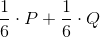
which is dependent on both probabilites given in the two statements.
The probability of rolling a 5 and the probability of rolling a 6 on the fair die are both
Let the probabilities of rolling a 5 and a 6 on the loaded die be
The probability of rolling a 6 on the fair die and a 5 on the loaded die is
The probability of rolling a 5 on the fair die and a 6 on the loaded die is
Therefore, the probability of rolling a 5-6 one way or the other is their sum:
which is dependent on both probabilites given in the two statements.
← Didn't Know|Knew It →
Two fair dice are rolled. What is the probability that each die (not the sum of the dice) will come up a composite number?
Two fair dice are rolled. What is the probability that each die (not the sum of the dice) will come up a composite number?
Tap to reveal answer
There are two composite numbers on each die, 4 and 6. On one die, the probability of rolling a 4 or a 6 is  ; the probabililty of rolling two composite numbers is
  .
.
There are two composite numbers on each die, 4 and 6. On one die, the probability of rolling a 4 or a 6 is
← Didn't Know|Knew It →
Four cards are removed from a standard deck of fifty-two cards. Did the probability that a randomly drawn card will be a club increase, decrease, or stay the same?
Statement 1: The four cards that were removed were all kings.
Statement 2: One card of each suit was removed.
Four cards are removed from a standard deck of fifty-two cards. Did the probability that a randomly drawn card will be a club increase, decrease, or stay the same?
Statement 1: The four cards that were removed were all kings.
Statement 2: One card of each suit was removed.
Tap to reveal answer
Thirteen of the fifty-two cards in a standard deck - one-fourth - are clubs, so the probability of drawing a club is  .
.
Either statement tells us that one card of each suit was removed (there is one king of each suit), leaving twelve clubs out of forty-eight cards - one fourth of them. This keeps the probability of drawing a club at  .
.
Thirteen of the fifty-two cards in a standard deck - one-fourth - are clubs, so the probability of drawing a club is
Either statement tells us that one card of each suit was removed (there is one king of each suit), leaving twelve clubs out of forty-eight cards - one fourth of them. This keeps the probability of drawing a club at
← Didn't Know|Knew It →
Four cards are removed from a standard deck of fifty-two cards. Did the probability that a randomly drawn card will be a heart increase, decrease, or stay the same?
Statement 1: At least three of the cards are spades.
Statement 2: At least one of the cards is a club.
Four cards are removed from a standard deck of fifty-two cards. Did the probability that a randomly drawn card will be a heart increase, decrease, or stay the same?
Statement 1: At least three of the cards are spades.
Statement 2: At least one of the cards is a club.
Tap to reveal answer
One-fourth of the cards in a standard deck are hearts; in order to know whether the probability of drawing a heart increased, decreased, or stayed the same, we need to know whether fewer than, exactly, or more than one-fourth of the cards remaining are hearts. Therefore, we need to know whether no hearts, one heart, or more than one heart was removed.
Neither statement alone allows this question to be answered definitively, as we know nothing about the suit(s) of the other card(s). But both statements together tell us that no hearts were removed, so thirteen of the forty-eight cards remaining are hearts. This raises the probability from  to
to  .
.
One-fourth of the cards in a standard deck are hearts; in order to know whether the probability of drawing a heart increased, decreased, or stayed the same, we need to know whether fewer than, exactly, or more than one-fourth of the cards remaining are hearts. Therefore, we need to know whether no hearts, one heart, or more than one heart was removed.
Neither statement alone allows this question to be answered definitively, as we know nothing about the suit(s) of the other card(s). But both statements together tell us that no hearts were removed, so thirteen of the forty-eight cards remaining are hearts. This raises the probability from
← Didn't Know|Knew It →