
Algebra - GMAT Quantitative
Card 1 of 1488
If  and
and  are positive, what is the value of
  ?
?
(1) 
(2) 
If
(1)
(2)
Tap to reveal answer
For statement (1), we can factor the equation as following:  . Obviously we cannot figure out
  since we have no information about the value of
  .
.
From statement (2) only, we have no idea what  is by knowing the value of
  . However, putting the two statements together, we will get
  .
.
For statement (1), we can factor the equation as following:
From statement (2) only, we have no idea what
← Didn't Know|Knew It →
Willy's teacher challenged him to write two whole numbers in the square and circle in the diagram below in order to make a polynomial that could be factored.

Did Willy succeed?
Statement 1: The number Willy wrote in the square is a multple of 4.
Statement 2: The number Willy wrote in the circle is a multiple of 9.
Willy's teacher challenged him to write two whole numbers in the square and circle in the diagram below in order to make a polynomial that could be factored.
Did Willy succeed?
Statement 1: The number Willy wrote in the square is a multple of 4.
Statement 2: The number Willy wrote in the circle is a multiple of 9.
Tap to reveal answer
Assume both statements are true.
If Willy wrote a 4 in the circle and a 9 in the square, both statements are satisfied, and the resulting polynomial can be factored as the difference of squares:

If Willy wrote a 4 in the circle and a 27 in the square, both statements are satisfied. However, the resulting polynomial

is prime; no greatest common factor can be taken out, and the only possible pattern, the difference of squares, does not fit, since the square root of 27 is irrational.
The two statements together are insufficient.
Assume both statements are true.
If Willy wrote a 4 in the circle and a 9 in the square, both statements are satisfied, and the resulting polynomial can be factored as the difference of squares:
If Willy wrote a 4 in the circle and a 27 in the square, both statements are satisfied. However, the resulting polynomial
is prime; no greatest common factor can be taken out, and the only possible pattern, the difference of squares, does not fit, since the square root of 27 is irrational.
The two statements together are insufficient.
← Didn't Know|Knew It →
Chad's teacher challenged him to write two whole numbers in the square and circle in the diagram below in order to make a polynomial that could be factored.

Did Chad succeed?
Statement 1: The cube root of the number Chad wrote in the square is a whole number.
Statement 2: The cube root of the number Chad wrote in the circle is an irrational number.
Chad's teacher challenged him to write two whole numbers in the square and circle in the diagram below in order to make a polynomial that could be factored.
Did Chad succeed?
Statement 1: The cube root of the number Chad wrote in the square is a whole number.
Statement 2: The cube root of the number Chad wrote in the circle is an irrational number.
Tap to reveal answer
Assume both statements are true. To try to factor the polynomial, we have one of two possibilities - the difference of cubes, or a greatest common factor. But since the number in the circle is not a perfect cube, this leaves us with factoring by GCF.
The polynomial  fits both statements;
  , so it cannot be factored.
The polynomial  fits both statements;
  , so it can be factored:

Assume both statements are true. To try to factor the polynomial, we have one of two possibilities - the difference of cubes, or a greatest common factor. But since the number in the circle is not a perfect cube, this leaves us with factoring by GCF.
The polynomial
The polynomial
← Didn't Know|Knew It →
Julia's teacher challenged her to write two whole numbers in the square and circle in the diagram below in order to make a polynomial that could be factored.

Did Julia succeed?
Statement 1: The cube root of the number Julia wrote in the circle is a whole number.
Statement 2: The number Julia wrote in the square is ten times the number Julia wrote in the circle.
Julia's teacher challenged her to write two whole numbers in the square and circle in the diagram below in order to make a polynomial that could be factored.
Did Julia succeed?
Statement 1: The cube root of the number Julia wrote in the circle is a whole number.
Statement 2: The number Julia wrote in the square is ten times the number Julia wrote in the circle.
Tap to reveal answer
A binomial of the form  can be factored out as the sum of cubes if and only if both
  and
and  are perfect cubes, and it can be factored out by taking out a GCF if the GCF of
  and
and  is not 1.
Assume both statements to be true.
 - which is equal to
  - fits the conditions. But the polynomial cannot be factored using the sum of cubes property (10 is not a cube, but 1 is), nor can a greatest common factor be taken out (the greatest common factor of the terms is 1).
 fits the conditions, and can be factored out as

A binomial of the form
Assume both statements to be true.
← Didn't Know|Knew It →
Karen's teacher challenged her to write two whole numbers in the square and circle in the diagram below in order to make a polynomial that could be factored.

Assuming both numbers are whole numbers, did Karen succeed?
Statement 1: The cube root of the number Julia wrote in the circle is a whole number.
Statement 2: The number Julia wrote in the square is twenty-seven times the number Julia wrote in the circle.
Karen's teacher challenged her to write two whole numbers in the square and circle in the diagram below in order to make a polynomial that could be factored.
Assuming both numbers are whole numbers, did Karen succeed?
Statement 1: The cube root of the number Julia wrote in the circle is a whole number.
Statement 2: The number Julia wrote in the square is twenty-seven times the number Julia wrote in the circle.
Tap to reveal answer
A binomial of the form can be factored out as the sum of cubes if and only if both and are perfect cubes, and it can be factored out by taking out a GCF if the GCF of and is not 1.
Statement 1 alone gives no clue as to the number that was placed in the square. The polynomials  and
and  fit the statement, but neither can be factored as the sum of cubes, and only the latter can have a greatest common factor (4) factored out.
Assume Statement 2 alone. There are two possible cases:
Case 1: Julia wrote a 1 in the circle.
The polynomial is  , which, as the sum of cubes, is factorable.
Case 2: Julia wrote a different whole number in the circle.
Since the number in the square is 27 times the number in the circle, at the very least, the polynomial can be factored by distributing out the number in the circle. For example,

A binomial of the form
Statement 1 alone gives no clue as to the number that was placed in the square. The polynomials
Assume Statement 2 alone. There are two possible cases:
Case 1: Julia wrote a 1 in the circle.
The polynomial is
Case 2: Julia wrote a different whole number in the circle.
Since the number in the square is 27 times the number in the circle, at the very least, the polynomial can be factored by distributing out the number in the circle. For example,
← Didn't Know|Knew It →
Don's teacher challenged him to write two whole numbers in the square and circle in the diagram below in order to make a polynomial that could be factored.

Assuming that Don wrote two whole numbers, did he succeed?
Statement 1: The number Don wrote in the circle is the square of half the number he wrote in the square.
Statement 2: The sum of the numbers Don wrote in the square and in the circle is 15.
Don's teacher challenged him to write two whole numbers in the square and circle in the diagram below in order to make a polynomial that could be factored.
Assuming that Don wrote two whole numbers, did he succeed?
Statement 1: The number Don wrote in the circle is the square of half the number he wrote in the square.
Statement 2: The sum of the numbers Don wrote in the square and in the circle is 15.
Tap to reveal answer
By Statement 1 alone, if we call the number in the square  , then the number in the circle is the square of half this, or
  ; the polynomial is therefore
 ,
,
which is the pattern of a perfect square trinomial. The polynomial can be factored, and Don succeeded.
Assume Statement 2 alone. The polynomials

and

fit the conditions of Statement 2.
Some trinomial of the pattern  can be factored as
  , where
  and
and  have product
  and sum
  .
.
 , since 3 and 3 have sum 6 and product 9.
However,
 cannot be factored; no two integers exist with product 10 and sum 5.
By Statement 1 alone, if we call the number in the square
which is the pattern of a perfect square trinomial. The polynomial can be factored, and Don succeeded.
Assume Statement 2 alone. The polynomials
and
fit the conditions of Statement 2.
Some trinomial of the pattern
However,
← Didn't Know|Knew It →
Theresa's teacher challenged her to write whole numbers in the circle and the square in the diagram below in order to make a polynomial that could be factored.

Assuming Theresa wrote two whole numbers, did she succeed?
Statement 1: Theresa wrote a 64 in the circle.
Statement 2: Theresa wrote a multiple of 6 in the square.
Theresa's teacher challenged her to write whole numbers in the circle and the square in the diagram below in order to make a polynomial that could be factored.
Assuming Theresa wrote two whole numbers, did she succeed?
Statement 1: Theresa wrote a 64 in the circle.
Statement 2: Theresa wrote a multiple of 6 in the square.
Tap to reveal answer
The template fits the difference of squares pattern, which may be used only if all coefficients are perfect squares and all exponents are even (making the powers of the variables perfect squares). Each statement only answers the question of one of these qualifications; the two together answer both.
The template fits the difference of squares pattern, which may be used only if all coefficients are perfect squares and all exponents are even (making the powers of the variables perfect squares). Each statement only answers the question of one of these qualifications; the two together answer both.
← Didn't Know|Knew It →
Consider function  .
.
I)  has zeroes at
  and
and  .
.
II)  is a second degree polynomial.
Find the equation that models  .
.
Consider function
I)
II)
Find the equation that models
Tap to reveal answer
If we consider statement II, we know f(x) must be of the form
 .
.
Due to the zero product property and statement I, we know that f(x) CAN look like this
 .
.
However, it could also look like this
 .
.
Or this
 .
.
So with what we are given it is impossible to find the true equation for f(x).
If we consider statement II, we know f(x) must be of the form
Due to the zero product property and statement I, we know that f(x) CAN look like this
However, it could also look like this
Or this
So with what we are given it is impossible to find the true equation for f(x).
← Didn't Know|Knew It →
Simplify: 
Simplify:
Tap to reveal answer
In order to simplify, we must first pull out the largest common factor of each term in the numerator, -3:
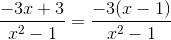
We then recognize that the denominator is a difference of squares:

We can therefore cancel the (x-1) terms and are left with:

In order to simplify, we must first pull out the largest common factor of each term in the numerator, -3:
We then recognize that the denominator is a difference of squares:
We can therefore cancel the (x-1) terms and are left with:
← Didn't Know|Knew It →
Of distinct integers  , which is the greatest of the three?
Statement 1: 
Statement 2:  and
and  are negative.
Of distinct integers
Statement 1:
Statement 2:
Tap to reveal answer
Statement 1 alone gives insufficient information.
Case 1: 


 , which is true.
Case 2: 


 , which is true.
But in the first case,  is the greatest of the three. In the second,
  is the greatest.
Statement 2 gives insuffcient information, since no information is given about the sign of  .
.
Assume both statements to be true.  , and from Statement 1,
  ; by transitivity,
  . From Statement 2,
  . This makes
  the greatest of the three.
Statement 1 alone gives insufficient information.
Case 1:
Case 2:
But in the first case,
Statement 2 gives insuffcient information, since no information is given about the sign of
Assume both statements to be true.
← Didn't Know|Knew It →
Is 
(1) 
(2) 
Is
(1)
(2)
Tap to reveal answer
For statement (1), since we don’t know the value of  and
and  , we have no idea about the value of
  and
and  .
.
For statement (2), since we don’t know the sign of  and
and  , we cannot compare
  and
and  .
.
Putting the two statements together, if  and
and  , then
  .
.
But if  and
and  , then
  .
.
Therefore, we cannot get the only correct answer for the questions, suggesting that the two statements together are not sufficient. For this problem, we can also plug in actual numbers to check the answer.
For statement (1), since we don’t know the value of
For statement (2), since we don’t know the sign of
Putting the two statements together, if
But if
Therefore, we cannot get the only correct answer for the questions, suggesting that the two statements together are not sufficient. For this problem, we can also plug in actual numbers to check the answer.
← Didn't Know|Knew It →
Given that  , evaluate
  .
.
-

-

Given that
Tap to reveal answer
 ,
,
so, if we know  and
and  , then the above becomes

and 
If we know  and
and  , then we need two numbers whose sum is 10 and whose product is 21; by inspection, these are 3 and 7. However, we do not know whether
  and
and  or vice versa just by knowing their sum and product. Therefore, either
  , or
, or  .
.
The answer is that Statement 1 alone is sufficient, but not Statement 2.
so, if we know
and
If we know
The answer is that Statement 1 alone is sufficient, but not Statement 2.
← Didn't Know|Knew It →
Using the following statements, Solve for  .
.
 (read as
  equals the absolute value of
  minus
minus  )
)
1. 
2. 
Using the following statements, Solve for
1.
2.
Tap to reveal answer
This question tests your understanding of absolute value. You should know that
 since we are finding the absolute value of the difference. We can prove this easily. Since
  , we know their absolute values have to be the same.
Therefore, statement 1 alone is enough to solve for  . and we get
  .
.
This question tests your understanding of absolute value. You should know that
Therefore, statement 1 alone is enough to solve for
← Didn't Know|Knew It →
Is nonzero number  positive or negative?
Statement 1: 
Statement 2: 
Is nonzero number
Statement 1:
Statement 2:
Tap to reveal answer
If we assume that  , then it follows that:


Since we know  , we know
  is positive, and
  and
and  are negative.
If we assume that  , then it follows that:


Since we know  , we know
  is positive.
  is also positive and
  is negative; since
  is less than a negative number,
  is also negative.
If we assume that
Since we know
If we assume that
Since we know
← Didn't Know|Knew It →
 is a real number. True or false:
Statement 1: 
Statement 2: 
Statement 1:
Statement 2:
Tap to reveal answer
Statement 1 and Statement 2 are actually equivalent.
If  , then either
  or
or  by definition.
If  , then either
  or
or  .
.
The correct answer is that the two statements together are not enough to answer the question.
Statement 1 and Statement 2 are actually equivalent.
If
If
The correct answer is that the two statements together are not enough to answer the question.
← Didn't Know|Knew It →
 is a real number. True or false:
Statement 1: 
Statement 2: 
Statement 1:
Statement 2:
Tap to reveal answer
If  , then we can deduce only that either
  or
or  . Statement 1 alone does not answer the question.
If  , then
  must be positive, as no negative number can have a positive cube. The positive numbers whose cubes are greater than 125 are those greater than 5. Therefore, Statement 2 alone proves that
  .
.
If
If
← Didn't Know|Knew It →
True or false: 
Statement 1: 
Statement 2: 
True or false:
Statement 1:
Statement 2:
Tap to reveal answer
Statement 1 and Statement 2 are actually equivalent.
If  , then either
  by definition.
If  , then either
  .
.
From either statement alone, it can be deduced that  .
.
Statement 1 and Statement 2 are actually equivalent.
If
If
From either statement alone, it can be deduced that
← Didn't Know|Knew It →
 is a real number. True or false:
Statement 1: 
Statement 2: 
Statement 1:
Statement 2:
Tap to reveal answer
If  , then, by definition,
  .
.
If Statement 1 is true, then


 ,
,
so  must be in the desired range.
If Statement 2 is true, then


and  is not necessarily in the desired range.
If
If Statement 1 is true, then
so
If Statement 2 is true, then
and
← Didn't Know|Knew It →
 is a real number. True or false:
Statement 1: 
Statement 2: 
Statement 1:
Statement 2:
Tap to reveal answer
If  , then, by definition,
  .
.
If Statement 1 holds, that is, if  , one of two things happens:
If  is positive, then
  .
.
If  is negative, then
  .
.
 is a false statement.
If Statement 2 holds, that is, if  , we know that
  is positive, and

 is a false statement.
If
If Statement 1 holds, that is, if
If
If
If Statement 2 holds, that is, if
← Didn't Know|Knew It →
 is a real number. True or false:
Statement 1: 
Statement 2: 
Statement 1:
Statement 2:
Tap to reveal answer
If  , then, by definition,
  - that is, both
  and
and  .
.
If Statement 1 is true, then


Statement 1 alone does not answer the question, as  follows, but not necessarily
  .
.
If Statement 2 is true, then


Statement 2 alone does not answer the question, as  follows, but not necessarily
  .
.
If both statements are true, then  and
and  both follow, and
  , meaning that .
If
If Statement 1 is true, then
Statement 1 alone does not answer the question, as
If Statement 2 is true, then
Statement 2 alone does not answer the question, as
If both statements are true, then
← Didn't Know|Knew It →