
Data-Sufficiency Questions - GMAT Quantitative
Card 1 of 10527
Set T is a finite set of positive consecutive multiples of 14. How many of these integers are also multiples of 21?
- Set T consists of 30 integers.
- The smallest integer in Set T is a multiple of 21.
Set T is a finite set of positive consecutive multiples of 14. How many of these integers are also multiples of 21?
- Set T consists of 30 integers.
- The smallest integer in Set T is a multiple of 21.
Tap to reveal answer
This is a question that may initially seem to require more information to solve than it actually does, requiring you to leverage assets in order to “move up” the data sufficiency ladder. For this problem, be wary of "Both statements (1) and (2) TOGETHER are sufficient to answer the question asked; but NEITHER statement ALONE is sufficient". Multiples tend to follow set patterns, so if you can find one of those patterns, you should be able to use small sets of smaller numbers to prove a rule, meaning that you need less information than you think you do.
From the information given, you know that T contains only multiples of 14. Based on your knowledge of factors and multiples, you should recognize that you can break up your numbers into factors to make them more manageable. If you are looking for multiples of 21, you should recognize that each multiple of 21 must also be a multiple of 3 and 7, since those are the prime factors of 21. Similarly, every multiple of 14 will also be a multiple of 2 and 7. Leverage what you know here: since every multiple of 14 is already a multiple of 7, that means that you are looking for how many multiples of 14 are also multiples of 3 so that you can satisfy the factors of 21 (3 and 7).
Statement (1) may at first seem insufficient since so little information is given. If there are 30 integers in the set, you should ask yourself: does the number of multiples of 3 depend more on where the set starts or how many items are in the set? You can come to a conclusion by using your printing press. Multiples of 14 start with 0 and continue:
0, 14, 28, 42, 56, 70, 84, 98… etc.
Notice that every third number (0, 42, 84, etc.) is a multiple of 3. Based on this, you should recognize that, as long as the number of terms in the set is divisible by 3, it doesn’t matter where you start. If you need to prove this to yourself, you can take 3 sets:
Set 1: 0, 14, 28 Set 2: 14, 28, 42 Set 3: 28, 42, 56
You can see that, although you start at different points in the pattern, because each set has three consecutive terms, you are guaranteed to have a single multiple of 3 in each set (remember that 0 is a multiple of all numbers). If you extrapolate from here, you should see that a set of 30 numbers would have ten times as many multiples of 3, or 10 multiples of 3 (and therefore of 21).
Statement (1) is therefore sufficient; eliminate "Statement (2) ALONE is sufficient, but statement (1) alone is not sufficient to answer the question asked", "Both statements (1) and (2) TOGETHER are sufficient to answer the question asked; but NEITHER statement ALONE is sufficient", and "Statements (1) and (2) TOGETHER are NOT sufficient to answer the question asked, and additional data specific to the problem are needed". Statement 2 gives only a starting point for the Set and no end point. Thus, the Set could have 1 multiple of 21 or an infinite number of multiples of 21. There is no way of telling. Therefore (2) is insufficient, eliminating answer choice "EACH statement ALONE is sufficient to answer the question asked".
Notice that if you hadn’t done the work to leverage statement (1) you may have concluded that you needed to know the starting point of the set in order to come to a conclusion and might have chosen "Both statements (1) and (2) TOGETHER are sufficient to answer the question asked; but NEITHER statement ALONE is sufficient". Remember that, especially for harder questions like this one, to be leery of choosing any “easy” answer – generally the correct answer is going to require you to put in some work to make your answer choices work.
Choice "Statement (1) ALONE is sufficient, but statement (2) alone is not sufficient to answer the question asked" is correct.
This is a question that may initially seem to require more information to solve than it actually does, requiring you to leverage assets in order to “move up” the data sufficiency ladder. For this problem, be wary of "Both statements (1) and (2) TOGETHER are sufficient to answer the question asked; but NEITHER statement ALONE is sufficient". Multiples tend to follow set patterns, so if you can find one of those patterns, you should be able to use small sets of smaller numbers to prove a rule, meaning that you need less information than you think you do.
From the information given, you know that T contains only multiples of 14. Based on your knowledge of factors and multiples, you should recognize that you can break up your numbers into factors to make them more manageable. If you are looking for multiples of 21, you should recognize that each multiple of 21 must also be a multiple of 3 and 7, since those are the prime factors of 21. Similarly, every multiple of 14 will also be a multiple of 2 and 7. Leverage what you know here: since every multiple of 14 is already a multiple of 7, that means that you are looking for how many multiples of 14 are also multiples of 3 so that you can satisfy the factors of 21 (3 and 7).
Statement (1) may at first seem insufficient since so little information is given. If there are 30 integers in the set, you should ask yourself: does the number of multiples of 3 depend more on where the set starts or how many items are in the set? You can come to a conclusion by using your printing press. Multiples of 14 start with 0 and continue:
0, 14, 28, 42, 56, 70, 84, 98… etc.
Notice that every third number (0, 42, 84, etc.) is a multiple of 3. Based on this, you should recognize that, as long as the number of terms in the set is divisible by 3, it doesn’t matter where you start. If you need to prove this to yourself, you can take 3 sets:
Set 1: 0, 14, 28 Set 2: 14, 28, 42 Set 3: 28, 42, 56
You can see that, although you start at different points in the pattern, because each set has three consecutive terms, you are guaranteed to have a single multiple of 3 in each set (remember that 0 is a multiple of all numbers). If you extrapolate from here, you should see that a set of 30 numbers would have ten times as many multiples of 3, or 10 multiples of 3 (and therefore of 21).
Statement (1) is therefore sufficient; eliminate "Statement (2) ALONE is sufficient, but statement (1) alone is not sufficient to answer the question asked", "Both statements (1) and (2) TOGETHER are sufficient to answer the question asked; but NEITHER statement ALONE is sufficient", and "Statements (1) and (2) TOGETHER are NOT sufficient to answer the question asked, and additional data specific to the problem are needed". Statement 2 gives only a starting point for the Set and no end point. Thus, the Set could have 1 multiple of 21 or an infinite number of multiples of 21. There is no way of telling. Therefore (2) is insufficient, eliminating answer choice "EACH statement ALONE is sufficient to answer the question asked".
Notice that if you hadn’t done the work to leverage statement (1) you may have concluded that you needed to know the starting point of the set in order to come to a conclusion and might have chosen "Both statements (1) and (2) TOGETHER are sufficient to answer the question asked; but NEITHER statement ALONE is sufficient". Remember that, especially for harder questions like this one, to be leery of choosing any “easy” answer – generally the correct answer is going to require you to put in some work to make your answer choices work.
Choice "Statement (1) ALONE is sufficient, but statement (2) alone is not sufficient to answer the question asked" is correct.
← Didn't Know|Knew It →
What is the value of z?
Statement 1: 
Statement 2: 
What is the value of z?
Statement 1:
Statement 2:
Tap to reveal answer
To solve for three variables, you must have three equations. Statements 1 and 2 together only give two equations, so the statements together are not sufficient.
To solve for three variables, you must have three equations. Statements 1 and 2 together only give two equations, so the statements together are not sufficient.
← Didn't Know|Knew It →
Is the equation linear?
Statement 1: 
Statement 2:  is a constant
Is the equation linear?
Statement 1:
Statement 2:
Tap to reveal answer
If we only look at statement 1, we might think the equation is not linear because of the  term. But statement 2 tells us the
  is a constant. Then the equation is linear. We need both statements to answer this question.
If we only look at statement 1, we might think the equation is not linear because of the
← Didn't Know|Knew It →
Data sufficiency question- do not actually solve the question
Solve for  :
:

1. 
2. 
Data sufficiency question- do not actually solve the question
Solve for
1.
2.
Tap to reveal answer
When solving an equation with 2 variables, a second equation or the solution of 1 variable is necessary to solve.
When solving an equation with 2 variables, a second equation or the solution of 1 variable is necessary to solve.
← Didn't Know|Knew It →
Data Sufficiency Question
Solve for  and
and  .
.

1. 
2. Both  and
and  are positive integers
Data Sufficiency Question
Solve for
1.
2. Both
Tap to reveal answer
Using statement 1 we can set up a series of equations and solve for both  and
and  .
. 
Additionally, the information in statement 2 indicates that there is only one possible solution that satisfies the requirement that both are positive integers.
Using statement 1 we can set up a series of equations and solve for both
Additionally, the information in statement 2 indicates that there is only one possible solution that satisfies the requirement that both are positive integers.
← Didn't Know|Knew It →
Solve the following for x:
4x+7y = 169
1. x > y
2. x - y = 12
Solve the following for x:
4x+7y = 169
1. x > y
2. x - y = 12
Tap to reveal answer
To solve with 2 unknowns, we must create a system of equations with at least 2 equations. Using statement 2 as a second equation we can easily get our answer. Solve statement 2 for x or y, and plug in for the corresponding variable in the equation given by the problem.
So, solving statement 2 for x, we get x=12+y. Replacing x in the equation from the problem, we get 4(12+y) + 7y=169. We can distribute the 4, and combine terms to find 48+11y=169. Subtract 48 from both sides, we get 11y=121. So y=11. Reusing either equation and plugging in our y value gives our x value. So x - 11=12, or x=23. This shows that x > y, and statement 1 is true. But even though it's true, it is completely unneccessary information. Therefore the answer is that we only need the information from statement 2, and statement 1 is not needed.
To solve with 2 unknowns, we must create a system of equations with at least 2 equations. Using statement 2 as a second equation we can easily get our answer. Solve statement 2 for x or y, and plug in for the corresponding variable in the equation given by the problem.
So, solving statement 2 for x, we get x=12+y. Replacing x in the equation from the problem, we get 4(12+y) + 7y=169. We can distribute the 4, and combine terms to find 48+11y=169. Subtract 48 from both sides, we get 11y=121. So y=11. Reusing either equation and plugging in our y value gives our x value. So x - 11=12, or x=23. This shows that x > y, and statement 1 is true. But even though it's true, it is completely unneccessary information. Therefore the answer is that we only need the information from statement 2, and statement 1 is not needed.
← Didn't Know|Knew It →
Of Cylinder 1 and Cylinder 2, which, if either, has the greater surface area?
Statement 1: Cylinder 1 has bases with radius twice those of the bases of Cylinder 2.
Statement 2: The height of Cylinder 1 is half that of Cylinder 2.
Of Cylinder 1 and Cylinder 2, which, if either, has the greater surface area?
Statement 1: Cylinder 1 has bases with radius twice those of the bases of Cylinder 2.
Statement 2: The height of Cylinder 1 is half that of Cylinder 2.
Tap to reveal answer
We will let  and
and  stand for the radii of the bases of Cylinders 1 and 2, respectively, and
  and
and  stand for their heights.
The surface area of Cylinder1 can be calculated from radius  and height
  using the formula:
 ;
;
similarly, the surface area of Cylinder 2 is

Therefore, we are seeking to determine which, if either, is greater,  or
or  .
.
Statement 1 alone tells us that  , but without knowing anything about the heights, we cannot compare
  to
to  . Similarly, Statement 2 tells us that
 , or, equivalently,
  , but without any information about the radii, again, we cannot determine which of
  and
and  is the greater.
Now assume both statements to be true. Substituting  for
for  and
and  for
for  , Cylinder 1 has surface area:


 .
.
Cylinder 2 has surface area


 , so
, so  , and Cylinder 1 has the greater surface area.
We will let
The surface area of Cylinder1 can be calculated from radius
similarly, the surface area of Cylinder 2 is
Therefore, we are seeking to determine which, if either, is greater,
Statement 1 alone tells us that
Now assume both statements to be true. Substituting
Cylinder 2 has surface area
← Didn't Know|Knew It →
How many solutions does this system of equations have: one, none, or infinitely many?


Statement 1: 
Statement 2: 
How many solutions does this system of equations have: one, none, or infinitely many?
Statement 1:
Statement 2:
Tap to reveal answer
If the slopes of the lines are not equal, then the lines intersect at one solution; if they are equal, then they do not intersect, or the lines are the same line. Write each equation in slope-intercept form,  :
:




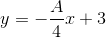



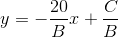
The slopes of the lines are  .
.
We need to know both  and
and  in order to determine their equality or inequality, and only if they are unequal can we answer the question.
Set  and
and  .
.
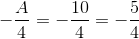
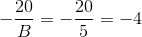
The slopes are unequal, so the lines intersect at one point; the system has exactly one solution.
If the slopes of the lines are not equal, then the lines intersect at one solution; if they are equal, then they do not intersect, or the lines are the same line. Write each equation in slope-intercept form,
The slopes of the lines are
We need to know both
Set
The slopes are unequal, so the lines intersect at one point; the system has exactly one solution.
← Didn't Know|Knew It →
Given that both  , how many solutions does this system of equations have: one, none, or infinitely many?


Statement 1: 
Statement 2: 
Given that both
Statement 1:
Statement 2:
Tap to reveal answer
If the slopes of the lines are not equal, then the lines intersect at one solution. If the slopes are equal, then there are two possibilties: either they do not intersect or they are the same line. Write each equation in slope-intercept form:




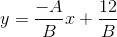




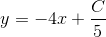
The slopes of these lines are  .
.
If Statement 1 is true, then we can rewrite the first slope as  , meaning that the lines have unequal slopes, and that there is only one solution. Statement 2 tells us the value of
  , which is irrelevant.
If the slopes of the lines are not equal, then the lines intersect at one solution. If the slopes are equal, then there are two possibilties: either they do not intersect or they are the same line. Write each equation in slope-intercept form:
The slopes of these lines are
If Statement 1 is true, then we can rewrite the first slope as
← Didn't Know|Knew It →
 is an integer. Is there a real number
  such that
  ?
?
Statement 1:  is negative
Statement 2:  is even
Statement 1:
Statement 2:
Tap to reveal answer
The equivalent question is "does  have a real
  root?"
If you know only that  is negative, you need to know whether
  is even or odd; negative numbers have real odd-numbered roots, but not real even-numbered roots.
If you know only that  is even, you need to know whether
  is negative or nonnegative; negative numbers do not have real even-numbered roots, but nonnegative numbers do.
If you know both, however, then you know that the answer is no, since as stated before, negative numbers do not have real even-numbered roots.
Therefore, the answer is that both statements together are sufficient to answer the question, but neither statement alone is sufficient to answer the question.
The equivalent question is "does
If you know only that
If you know only that
If you know both, however, then you know that the answer is no, since as stated before, negative numbers do not have real even-numbered roots.
Therefore, the answer is that both statements together are sufficient to answer the question, but neither statement alone is sufficient to answer the question.
← Didn't Know|Knew It →
Data Sufficiency Question
Solve for  and
and  :
:

1. 
2. 
Data Sufficiency Question
Solve for
1.
2.
Tap to reveal answer
In order to solve an equation set, one requires a number of equations equal to the number of variables. Therefore, either of the statements allow the problem to be solved.
In order to solve an equation set, one requires a number of equations equal to the number of variables. Therefore, either of the statements allow the problem to be solved.
← Didn't Know|Knew It →
What is the perimeter of rectangle  ?
?
(1) The area of  is 81
is 81
(2) Side 
What is the perimeter of rectangle
(1) The area of
(2) Side
Tap to reveal answer
To know the perimeter of a rectangle, we need to know length and width.
Statement (1) provides Area, which does not provide the necessary information. NOT SUFFICIENT
Statement(2) provides one side, but we still need the other to determine perimeter. NOT SUFFICIENT.
Both together are sufficent however since if we know one side and the area, we can find the remaining side using division, and then use the two side lengths to find the perimeter.
To know the perimeter of a rectangle, we need to know length and width.
Statement (1) provides Area, which does not provide the necessary information. NOT SUFFICIENT
Statement(2) provides one side, but we still need the other to determine perimeter. NOT SUFFICIENT.
Both together are sufficent however since if we know one side and the area, we can find the remaining side using division, and then use the two side lengths to find the perimeter.
← Didn't Know|Knew It →
Data Sufficiency Question
Solve for  ,
,  , and
, and  :
:

1. 
2. 
Data Sufficiency Question
Solve for
1.
2.
Tap to reveal answer
In order to solve an equation set, one requires a number of equations equal to the number of variables. Therefore, three equations are needed and both statements are required to solve the problem.
In order to solve an equation set, one requires a number of equations equal to the number of variables. Therefore, three equations are needed and both statements are required to solve the problem.
← Didn't Know|Knew It →
You are given a square and a rectangle. Which has the greater perimeter?
Statement 1: The length of the rectangle is twice the sidelength of the square,
Statement 2: The width of the rectangle is half the sidelength of the square.
You are given a square and a rectangle. Which has the greater perimeter?
Statement 1: The length of the rectangle is twice the sidelength of the square,
Statement 2: The width of the rectangle is half the sidelength of the square.
Tap to reveal answer
Let  be the sidelength of the square. Then its perimeter is
  .
.
From Statement 1 alone, the length of the rectangle is  , and, if
  is the width, the perimeter of the rectangle is
  . Therefore, we can prove that the rectangle has the greater perimeter.
From Statement 2 alone, the width of the rectangle is  , and its perimeter is at least
  - but unless we know the length, we do not know whether the total perimeter is greater than, equal to, or less than
  .
.
Let
From Statement 1 alone, the length of the rectangle is
From Statement 2 alone, the width of the rectangle is
← Didn't Know|Knew It →
Given:  and
and  , with right angles
True or false:  .
.
Statement 1: 
Statement 2: 
Given:
True or false:
Statement 1:
Statement 2:
Tap to reveal answer
Assume both statements are true. Statement 1 establishes that has two congruent legs, making it a 45-45-90 triangle. Statement 2 establishes that has a hypotenuse that has length  times that of a leg, making it also a 45-45-90 triangle. The triangles have the same angle measures, so they are similar by the Angle-Angle Postulate. However, we are not given any actual lengths or any relationship between the lengths of the corresponding sides of different triangles, so we cannot determine whether the triangles are congruent or not.
Assume both statements are true. Statement 1 establishes that
← Didn't Know|Knew It →
Let  be the set of all of the multiples of 3 between 29 and 50. How many subsets of
  can be formed?
Let
Tap to reveal answer
The multiples of 3 between 29 and 50 are 30, 33, 36, 39, 42, 45, and 48 - therefore,  has seven elements total.
The number of subsets in a set can be calculated by raising 2 to the power of the number of elements. Therefore, the answer to our question is  .
.
The multiples of 3 between 29 and 50 are 30, 33, 36, 39, 42, 45, and 48 - therefore,
The number of subsets in a set can be calculated by raising 2 to the power of the number of elements. Therefore, the answer to our question is
← Didn't Know|Knew It →
The table in a hall has a length of  feet. What is its perimeter?
I) The tabletop is exactly two and a half feet above the floor.
II) The area of the table is four times three more than the width.
The table in a hall has a length of
I) The tabletop is exactly two and a half feet above the floor.
II) The area of the table is four times three more than the width.
Tap to reveal answer
To find perimeter we need length and width. We are given the length.
I) Is irrelevant.
II) We are given a way of relating area and width. Since we know that area is length times width, we can use II to set up an equation where we substitute in the known length along with the given statement to solve for our width


Solve the second one for w and you're good to go!


 .
.
Therefore the perimeter would be:

To find perimeter we need length and width. We are given the length.
I) Is irrelevant.
II) We are given a way of relating area and width. Since we know that area is length times width, we can use II to set up an equation where we substitute in the known length along with the given statement to solve for our width
Solve the second one for w and you're good to go!
Therefore the perimeter would be:
← Didn't Know|Knew It →
Given that  , evaluate
  .
.
Statement 1: 
Statement 2: 
Given that
Statement 1:
Statement 2:
Tap to reveal answer
Solve for  in each statement.
Statement 1:





Statement 2:






From either statement alone, it can be deduced that  .
.
Solve for
Statement 1:
Statement 2:
From either statement alone, it can be deduced that
← Didn't Know|Knew It →
Set T is a finite set of positive consecutive multiples of 14. How many of these integers are also multiples of 21?
- Set T consists of 30 integers.
- The smallest integer in Set T is a multiple of 21.
Set T is a finite set of positive consecutive multiples of 14. How many of these integers are also multiples of 21?
- Set T consists of 30 integers.
- The smallest integer in Set T is a multiple of 21.
Tap to reveal answer
This is a question that may initially seem to require more information to solve than it actually does, requiring you to leverage assets in order to “move up” the data sufficiency ladder. For this problem, be wary of "Both statements (1) and (2) TOGETHER are sufficient to answer the question asked; but NEITHER statement ALONE is sufficient". Multiples tend to follow set patterns, so if you can find one of those patterns, you should be able to use small sets of smaller numbers to prove a rule, meaning that you need less information than you think you do.
From the information given, you know that T contains only multiples of 14. Based on your knowledge of factors and multiples, you should recognize that you can break up your numbers into factors to make them more manageable. If you are looking for multiples of 21, you should recognize that each multiple of 21 must also be a multiple of 3 and 7, since those are the prime factors of 21. Similarly, every multiple of 14 will also be a multiple of 2 and 7. Leverage what you know here: since every multiple of 14 is already a multiple of 7, that means that you are looking for how many multiples of 14 are also multiples of 3 so that you can satisfy the factors of 21 (3 and 7).
Statement (1) may at first seem insufficient since so little information is given. If there are 30 integers in the set, you should ask yourself: does the number of multiples of 3 depend more on where the set starts or how many items are in the set? You can come to a conclusion by using your printing press. Multiples of 14 start with 0 and continue:
0, 14, 28, 42, 56, 70, 84, 98… etc.
Notice that every third number (0, 42, 84, etc.) is a multiple of 3. Based on this, you should recognize that, as long as the number of terms in the set is divisible by 3, it doesn’t matter where you start. If you need to prove this to yourself, you can take 3 sets:
Set 1: 0, 14, 28 Set 2: 14, 28, 42 Set 3: 28, 42, 56
You can see that, although you start at different points in the pattern, because each set has three consecutive terms, you are guaranteed to have a single multiple of 3 in each set (remember that 0 is a multiple of all numbers). If you extrapolate from here, you should see that a set of 30 numbers would have ten times as many multiples of 3, or 10 multiples of 3 (and therefore of 21).
Statement (1) is therefore sufficient; eliminate "Statement (2) ALONE is sufficient, but statement (1) alone is not sufficient to answer the question asked", "Both statements (1) and (2) TOGETHER are sufficient to answer the question asked; but NEITHER statement ALONE is sufficient", and "Statements (1) and (2) TOGETHER are NOT sufficient to answer the question asked, and additional data specific to the problem are needed". Statement 2 gives only a starting point for the Set and no end point. Thus, the Set could have 1 multiple of 21 or an infinite number of multiples of 21. There is no way of telling. Therefore (2) is insufficient, eliminating answer choice "EACH statement ALONE is sufficient to answer the question asked".
Notice that if you hadn’t done the work to leverage statement (1) you may have concluded that you needed to know the starting point of the set in order to come to a conclusion and might have chosen "Both statements (1) and (2) TOGETHER are sufficient to answer the question asked; but NEITHER statement ALONE is sufficient". Remember that, especially for harder questions like this one, to be leery of choosing any “easy” answer – generally the correct answer is going to require you to put in some work to make your answer choices work.
Choice "Statement (1) ALONE is sufficient, but statement (2) alone is not sufficient to answer the question asked" is correct.
This is a question that may initially seem to require more information to solve than it actually does, requiring you to leverage assets in order to “move up” the data sufficiency ladder. For this problem, be wary of "Both statements (1) and (2) TOGETHER are sufficient to answer the question asked; but NEITHER statement ALONE is sufficient". Multiples tend to follow set patterns, so if you can find one of those patterns, you should be able to use small sets of smaller numbers to prove a rule, meaning that you need less information than you think you do.
From the information given, you know that T contains only multiples of 14. Based on your knowledge of factors and multiples, you should recognize that you can break up your numbers into factors to make them more manageable. If you are looking for multiples of 21, you should recognize that each multiple of 21 must also be a multiple of 3 and 7, since those are the prime factors of 21. Similarly, every multiple of 14 will also be a multiple of 2 and 7. Leverage what you know here: since every multiple of 14 is already a multiple of 7, that means that you are looking for how many multiples of 14 are also multiples of 3 so that you can satisfy the factors of 21 (3 and 7).
Statement (1) may at first seem insufficient since so little information is given. If there are 30 integers in the set, you should ask yourself: does the number of multiples of 3 depend more on where the set starts or how many items are in the set? You can come to a conclusion by using your printing press. Multiples of 14 start with 0 and continue:
0, 14, 28, 42, 56, 70, 84, 98… etc.
Notice that every third number (0, 42, 84, etc.) is a multiple of 3. Based on this, you should recognize that, as long as the number of terms in the set is divisible by 3, it doesn’t matter where you start. If you need to prove this to yourself, you can take 3 sets:
Set 1: 0, 14, 28 Set 2: 14, 28, 42 Set 3: 28, 42, 56
You can see that, although you start at different points in the pattern, because each set has three consecutive terms, you are guaranteed to have a single multiple of 3 in each set (remember that 0 is a multiple of all numbers). If you extrapolate from here, you should see that a set of 30 numbers would have ten times as many multiples of 3, or 10 multiples of 3 (and therefore of 21).
Statement (1) is therefore sufficient; eliminate "Statement (2) ALONE is sufficient, but statement (1) alone is not sufficient to answer the question asked", "Both statements (1) and (2) TOGETHER are sufficient to answer the question asked; but NEITHER statement ALONE is sufficient", and "Statements (1) and (2) TOGETHER are NOT sufficient to answer the question asked, and additional data specific to the problem are needed". Statement 2 gives only a starting point for the Set and no end point. Thus, the Set could have 1 multiple of 21 or an infinite number of multiples of 21. There is no way of telling. Therefore (2) is insufficient, eliminating answer choice "EACH statement ALONE is sufficient to answer the question asked".
Notice that if you hadn’t done the work to leverage statement (1) you may have concluded that you needed to know the starting point of the set in order to come to a conclusion and might have chosen "Both statements (1) and (2) TOGETHER are sufficient to answer the question asked; but NEITHER statement ALONE is sufficient". Remember that, especially for harder questions like this one, to be leery of choosing any “easy” answer – generally the correct answer is going to require you to put in some work to make your answer choices work.
Choice "Statement (1) ALONE is sufficient, but statement (2) alone is not sufficient to answer the question asked" is correct.
← Didn't Know|Knew It →
What is the value of j+k?
- mj + mk = 2m
- 5j + 5k = 10
What is the value of j+k?
- mj + mk = 2m
- 5j + 5k = 10
Tap to reveal answer
This problem heavily rewards those who "play the game" of Data Sufficiency effectively. While the two statements should look just about identical, those who Play Devil's Advocate and/or ask "Why Are You Here?" can spot the ever-important difference and avoid the trap answer.
Your inclination on both statements should be to use algebraic mirroring to factor coefficients and arrive at the expression j + k on the left hand side. For statement 1 that's:
m(j + k) = 2m
And for statement 2 that's:
5(j + k) = 10
Note that in statement 2, you can simply divide both sides by 5 and arrive at j + k = 2, making statement 2 sufficient.
Most people try to do the same thing on statement 1, dividing both sides by m. But you cannot do that! Why? Because m could equal 0, and you cannot divide by 0. You can demonstrate that by setting m equal to 0, in which case statement 1 would be:
0j + 0k = 0(2), in which case j and k could be absolutely anything.
So statement 1 is insufficient and the correct answer is "Statement (2) ALONE is sufficient, but statement (1) alone is not sufficient to answer the question asked". And the lesson: you can avoid that trap (note that most examinees choose "EACH statement ALONE is sufficient to answer the question asked.") by:
Playing Devil's Advocate - when a statement seems a little too easy, ask yourself whether negative numbers, fractions, zero, or any other "edge cases" might give a different answer.
Asking "Why Are You Here?" - when one statement is extremely easy (as statement 2 is here), that's a signal that the more-nuanced statement likely has some difficulty to it, and that the easy statement might provide a clue. The difference between the statements here is statement 1 uses a variable where statement 2 uses the coefficient 5. Why would that distinction matter? Because if you can't rule out 0 as a value of a variable, you can't divide by it.
This problem heavily rewards those who "play the game" of Data Sufficiency effectively. While the two statements should look just about identical, those who Play Devil's Advocate and/or ask "Why Are You Here?" can spot the ever-important difference and avoid the trap answer.
Your inclination on both statements should be to use algebraic mirroring to factor coefficients and arrive at the expression j + k on the left hand side. For statement 1 that's:
m(j + k) = 2m
And for statement 2 that's:
5(j + k) = 10
Note that in statement 2, you can simply divide both sides by 5 and arrive at j + k = 2, making statement 2 sufficient.
Most people try to do the same thing on statement 1, dividing both sides by m. But you cannot do that! Why? Because m could equal 0, and you cannot divide by 0. You can demonstrate that by setting m equal to 0, in which case statement 1 would be:
0j + 0k = 0(2), in which case j and k could be absolutely anything.
So statement 1 is insufficient and the correct answer is "Statement (2) ALONE is sufficient, but statement (1) alone is not sufficient to answer the question asked". And the lesson: you can avoid that trap (note that most examinees choose "EACH statement ALONE is sufficient to answer the question asked.") by:
Playing Devil's Advocate - when a statement seems a little too easy, ask yourself whether negative numbers, fractions, zero, or any other "edge cases" might give a different answer.
Asking "Why Are You Here?" - when one statement is extremely easy (as statement 2 is here), that's a signal that the more-nuanced statement likely has some difficulty to it, and that the easy statement might provide a clue. The difference between the statements here is statement 1 uses a variable where statement 2 uses the coefficient 5. Why would that distinction matter? Because if you can't rule out 0 as a value of a variable, you can't divide by it.
← Didn't Know|Knew It →