
Graphing - GMAT Quantitative
Card 1 of 400
Find the graph of the linear function  .
.
I)  passes through the points
  and
and  .
.
II)  intercepts the
  -axis at
  .
.
Find the graph of the linear function
I)
II)
Tap to reveal answer
Find the graph of the linear function  .
.
I)  passes through the points
  and
and  .
.
II)  intercepts the
  -axis at .
Using I), we can find the slope of the function, and then we can start at either point and extend the slope in either direction to find our graph:
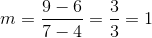
So, using I) we are able to find the slope, from which we can find our graph
II) gives us one point, but without any more information, we cannot use II) by itself to find the rest of the graph
So:
Statement I is sufficient to answer the question, but statement II is not sufficient to answer the question.
Find the graph of the linear function
I)
II)
Using I), we can find the slope of the function, and then we can start at either point and extend the slope in either direction to find our graph:
So, using I) we are able to find the slope, from which we can find our graph
II) gives us one point, but without any more information, we cannot use II) by itself to find the rest of the graph
So:
Statement I is sufficient to answer the question, but statement II is not sufficient to answer the question.
← Didn't Know|Knew It →
Find the graph of  .
.
I)  is a linear equation which passes through the point
  .
.
II)  crosses the y-axis at 1300.
Find the graph of
I)
II)
Tap to reveal answer
Find the graph of  .
.
I)  is a linear equation which passes through the point
  .
.
II)  crosses the y-axis at 1300.
To graph a linear equation, we need some combination of slope, y-intercept, or two points.
Statement I tells us  is linear and gives us one point.
Statement II gives us the y-intercept of  .
.
We can use Statement I and Statement II to find the slope of  . Then, we can plot the given points and continue the line in either direction to get our graph.
Slope:
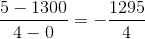
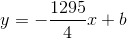
Plugging in the provided value of  , 1300, we have the equation of the line
  :
:
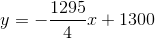
Find the graph of
I)
II)
To graph a linear equation, we need some combination of slope, y-intercept, or two points.
Statement I tells us
Statement II gives us the y-intercept of
We can use Statement I and Statement II to find the slope of
Slope:
Plugging in the provided value of
← Didn't Know|Knew It →
Graph a line, if possible.
Statement 1: The slope is 4.
Statement 2: The y-intercept is 4.
Graph a line, if possible.
Statement 1: The slope is 4.
Statement 2: The y-intercept is 4.
Tap to reveal answer
Statement 1): The slope is 4.
Write the slope-intercept form, and substitute the slope.


The point and the y-intercept are unknown. Either of these will be needed to solve for the graph of this line.
Statement 1) by itself is not sufficient to graph a line.
Statement 2): The y-intercept is 4.
Substitute the y-intercept into the incomplete formula.
The function  can then be graphed on the x-y coordinate plane.
Therefore:

Statement 1): The slope is 4.
Write the slope-intercept form, and substitute the slope.
The point and the y-intercept are unknown. Either of these will be needed to solve for the graph of this line.
Statement 1) by itself is not sufficient to graph a line.
Statement 2): The y-intercept is 4.
Substitute the y-intercept into the incomplete formula.
The function
Therefore:
← Didn't Know|Knew It →
Define a function  as follows:

for nonzero real numbers  .
.
Give the equation of the vertical asymptote of the graph of  .
.
Statement 1: 
Statement 2: 
Define a function
for nonzero real numbers
Give the equation of the vertical asymptote of the graph of
Statement 1:
Statement 2:
Tap to reveal answer
Only positive numbers have logarithms, so:


Therefore, the vertical asymptote must be the vertical line of the equation
 .
.
Statement 1 alone gives that  .
.  is the reciprocal of this, or
  , and
, and  , so the vertical asymptote is
  .
.
Statement 2 alone gives no clue about either  ,
,  , or their relationship.
Only positive numbers have logarithms, so:
Therefore, the vertical asymptote must be the vertical line of the equation
Statement 1 alone gives that
Statement 2 alone gives no clue about either
← Didn't Know|Knew It →
Define a function  as follows:

for nonzero real numbers  .
.
Give the equation of the vertical asymptote of the graph of  .
.
Statement 1: 
Statement 2: 
Define a function
for nonzero real numbers
Give the equation of the vertical asymptote of the graph of
Statement 1:
Statement 2:
Tap to reveal answer
Since a logarithm of a nonpositive number cannot be taken,


Therefore, the vertical asymptote must be the vertical line of the equation
 .
.
Each of Statement 1 and Statement 2 gives us only one of  and
and  . However, the two together tell us that

making the vertical asymptote
 .
.
Since a logarithm of a nonpositive number cannot be taken,
Therefore, the vertical asymptote must be the vertical line of the equation
Each of Statement 1 and Statement 2 gives us only one of
making the vertical asymptote
← Didn't Know|Knew It →
Define a function  as follows:

for nonzero real numbers  .
.
Does the graph of  have a
  -intercept?
Statement 1:  .
.
Statement 2:  .
.
Define a function
for nonzero real numbers
Does the graph of
Statement 1:
Statement 2:
Tap to reveal answer
The  -intercept of the graph of the function
  , if there is one, occurs at the point with
  -coordinate 0. Therefore, we find
  :
:

This expression is defined if and only if  is a positive value. Statement 1 gives
  as positive, so it follows that the graph indeed has a
  -intercept. Statement 2, which only gives
  , is irrelevant.
The
This expression is defined if and only if
← Didn't Know|Knew It →
Define a function  as follows:

for nonzero real numbers  .
.
Does the graph of  have a
  -intercept?
Statement 1:  .
.
Statement 2:  and
and  have different signs.
Define a function
for nonzero real numbers
Does the graph of
Statement 1:
Statement 2:
Tap to reveal answer
The  -intercept of the graph of the function
  , if there is one, occurs at the point with
  -coordinate 0. Therefore, we find
  :
:

This expression is defined if and only if  is a positive value. However, the two statements together do not give this information; the values of
  and
and  from Statement 1 are irrelevant, and Statement 2 does not reveal which of
  and
and  is positive and which is negative.
The
This expression is defined if and only if
← Didn't Know|Knew It →
Define a function  as follows:

for nonzero real numbers  .
.
Where is the vertical asymptote of the graph of  in relation to the
  -axis - is it to the left of it, to the right of it, or on it?
Statement 1:  and
and  are both positive.
Statement 2:  and
and  are of opposite sign.
Define a function
for nonzero real numbers
Where is the vertical asymptote of the graph of
Statement 1:
Statement 2:
Tap to reveal answer
Since only positive numbers have logarithms,


Therefore, the vertical asymptote must be the vertical line of the equation
 .
.
Statement 1 gives irrelevant information. But Statement 2 alone gives sufficient information; since  and
and  are of opposite sign, their quotient
  is negative, and
  is positive. This locates the vertical asymptote on the right side of the
  -axis.
Since only positive numbers have logarithms,
Therefore, the vertical asymptote must be the vertical line of the equation
Statement 1 gives irrelevant information. But Statement 2 alone gives sufficient information; since
← Didn't Know|Knew It →
Define a function  as follows:

for nonzero real numbers  .
.
Where is the vertical asymptote of the graph of  in relation to the
  -axis - is it to the left of it, to the right of it, or on it?
Statement 1:  and
and  are both positive.
Statement 2:  and
and  are of opposite sign.
Define a function
for nonzero real numbers
Where is the vertical asymptote of the graph of
Statement 1:
Statement 2:
Tap to reveal answer
Since only positive numbers have logarithms, the expression  must be positive, so


Therefore, the vertical asymptote must be the vertical line of the equation
 .
.
In order to determine which side of the  -axis the vertical asymptote falls, it is necessary to find the sign of
  ; if it is negative, it is on the left side, if it is positive, it is on the right side.
Assume both statements are true. By Statement 1,  is positive. If
  is positive, then
  is negative, and vice versa. However, Statement 2, which mentions
  , does not give its actual sign - just the fact that its sign is the opposite of that of
  , which we are not given either. The two statements therefore give insufficient information.
Since only positive numbers have logarithms, the expression
Therefore, the vertical asymptote must be the vertical line of the equation
In order to determine which side of the
Assume both statements are true. By Statement 1,
← Didn't Know|Knew It →
Define a function  as follows:

for nonzero real numbers  .
.
Give the equation of the vertical asymptote of the graph of  .
.
Statement 1: 
Statement 2: 
Define a function
for nonzero real numbers
Give the equation of the vertical asymptote of the graph of
Statement 1:
Statement 2:
Tap to reveal answer
Since only positive numbers have logarithms,
Therefore, the vertical asymptote must be the vertical line of the equation
.
Assume both statements to be true. We need two numbers  and
and  whose sum is 7 and whose product is 12; by trial and error, we can find these numbers to be 3 and 4. However, without further information, we have no way of determining which of
  and
and  is 3 and which is 4, so the asymptote can be either
  or
or  .
.
Since only positive numbers have logarithms,
Therefore, the vertical asymptote must be the vertical line of the equation
Assume both statements to be true. We need two numbers
← Didn't Know|Knew It →
Define a function  as follows:

for nonzero real numbers  .
.
What is the equation of the vertical asymptote of the graph of  ?
?
Statement 1:  and
and  are of opposite sign.
Statement 2: 
Define a function
for nonzero real numbers
What is the equation of the vertical asymptote of the graph of
Statement 1:
Statement 2:
Tap to reveal answer
Since only positive numbers have logarithms,
Therefore, the vertical asymptote must be the vertical line of the equation
.
In order to determine which side of the  -axis the vertical asymptote falls, it is necessary to find the sign of
  ; if it is negative, it is on the left side, and if it is positive, it is on the right side.
Statement 1 alone only gives us that  is a different sign from
  ; without any information about the sign of
  , we cannot answer the question.
Statement 2 alone gives us that  , and, consequently,
  . This means that
  and
and  are of opposite sign. But again, with no information about the sign of
  , we cannot answer the question.
Assume both statements to be true. Since, from the two statements, both  and
and  are of the opposite sign from
  ,
,  and
and  are of the same sign. Their quotient
  is positive, and
  is negative, so the vertical asymptote
  is to the left of the
  -axis.
Since only positive numbers have logarithms,
Therefore, the vertical asymptote must be the vertical line of the equation
In order to determine which side of the
Statement 1 alone only gives us that
Statement 2 alone gives us that
Assume both statements to be true. Since, from the two statements, both
← Didn't Know|Knew It →
Define a function  as follows:

for nonzero real numbers  .
.
Where is the vertical asymptote of the graph of  in relation to the
  -axis - is it to the left of it, to the right of it, or on it?
Statement 1: 
Statement 2: 
Define a function
for nonzero real numbers
Where is the vertical asymptote of the graph of
Statement 1:
Statement 2:
Tap to reveal answer
Only positive numbers have logarithms, so:
Therefore, the vertical asymptote must be the vertical line of the equation
.
In order to determine which side of the  -axis the vertical asymptote falls, it is necessary to find out whether the signs of
  and
and  are the same or different. If
  and
and  are of the same sign, then their quotient
  is positive, and
  is negative, putting
  on the left side of the
  -axis. If
  and
and  are of different sign, then their quotient
  is negative, and
  is positive, putting
  on the right side of the
  -axis.
Statement 1 alone does not give us enough information to determine whether  and
and  have different signs.
  , for example, but
  , also.
From Statement 2, since the product of  and
and  is negative, they must be of different sign. Therefore,
  is positive, and
  falls to the right of the
  -axis.
Only positive numbers have logarithms, so:
Therefore, the vertical asymptote must be the vertical line of the equation
In order to determine which side of the
Statement 1 alone does not give us enough information to determine whether
From Statement 2, since the product of
← Didn't Know|Knew It →
In which quadrant is the point  located: I, II, III, or IV?
Statement 1: 
Statement 2: 
In which quadrant is the point
Statement 1:
Statement 2:
Tap to reveal answer
Assume Statement 1 alone. The set of points that satisfy the equation is the set of all points on the line of the equation

which will pass through at least two quadrants on the coordinate plane. Therefore, Statement 1 provides insufficient information.
Now assume Statement 2 alone. The set of points that satisfy the equation is the set of all points of the circle of the equation

This circle has  as its center and
  as its radius. Since its center is
  , which is 5 units away from its closest axis, and the radius is less than 5 units, the circle never intersects an axis, so it is contained entirely within the same quadrant as its center. The center has negative
  - and
- and  -coordinates, placing it, and the entire circle, in Quadrant III.
Assume Statement 1 alone. The set of points that satisfy the equation is the set of all points on the line of the equation
which will pass through at least two quadrants on the coordinate plane. Therefore, Statement 1 provides insufficient information.
Now assume Statement 2 alone. The set of points that satisfy the equation is the set of all points of the circle of the equation
This circle has
← Didn't Know|Knew It →
In which quadrant is the point  located: I, II, III, or IV?
Statement 1: 
Statement 2: 
In which quadrant is the point
Statement 1:
Statement 2:
Tap to reveal answer
Assume Statement 1 alone. The set of points that satisfy the equation is the set of all points on the line of the equation
 ,
,
which will pass through at least two quadrants on the coordinate plane. Therefore, Statement 1 provides insufficient information. By the same argument, Statement 2 is also insuffcient.
Now assume both statements to be true. The two statements together form a system of linear equations which can be solved using the elimination method:


Now, substitute back:


The point is  , which has a positive
  -coordinate and a negative
  -coordinate and is consequently in Quadrant IV.
Assume Statement 1 alone. The set of points that satisfy the equation is the set of all points on the line of the equation
which will pass through at least two quadrants on the coordinate plane. Therefore, Statement 1 provides insufficient information. By the same argument, Statement 2 is also insuffcient.
Now assume both statements to be true. The two statements together form a system of linear equations which can be solved using the elimination method:
Now, substitute back:
The point is
← Didn't Know|Knew It →
In which quadrant is the point  located: I, II, III, or IV?
Statement 1: 
Statement 2: 
In which quadrant is the point
Statement 1:
Statement 2:
Tap to reveal answer
Assume Statement 1 alone. The points  and
and  each satisfy the condition of the statement; however, the former is in Quadrant I, having a positive
  -coordinate and a positive
  -coordinate; the latter is in Quadrant IV, having a positive
  -coordinate and a negative
  -coordinate.
Assume Statement 2 alone. The points  and
and  each satisfy the condition of the statement, since
  . However, the former is in Quadrant IV, having a positive
  -coordinate and a negative
  -coordinate; the latter is in Quadrant II, having a negative
  -coordinate and a positive
  -coordinate.
Assume both statements to be true. Statement 2 can be rewritten as  ; since
  is positive from Statement 1,
  is negative. Since the point has a positive
  -coordinate and a negative
  -coordinate, it is in Quadrant IV.
Assume Statement 1 alone. The points
Assume Statement 2 alone. The points
Assume both statements to be true. Statement 2 can be rewritten as
← Didn't Know|Knew It →
True or false:  and
and  are in the same quadrant of the rectangular coordinate plane.
Statement 1:  and
and  are of different sign.
Statement 2:  and
and  are of the same sign.
True or false:
Statement 1:
Statement 2:
Tap to reveal answer
Two points in the same quadrant have  -coordinates of the same sign and
  -coordinates of the same sign.
It is possible for two points fitting the condition of Statement 1 to be in the same quadrant;  and
and  are two such points. However, it is also possible for two such points to be in different quadrants;
  and
and  are two such points. Therefore, Statement 1 alone gives insufficient information. By the same argument, Statement 2 alone gives insufficient information.
Assume both statements are true.  and
and  are of different sign by Statement 1. By Statement 2,
  and
and  are of the same sign; therefore, they are both of the same sign as
  and the sign opposite that of
  , or vice versa. Therefore, in one ordered pair, both numbers are positive or both are negative, and in the other ordered pair, one number is positive and the other is negative. The two ordered pairs cannot represent points in the same quadrant.
Two points in the same quadrant have
It is possible for two points fitting the condition of Statement 1 to be in the same quadrant;
Assume both statements are true.
← Didn't Know|Knew It →
True or false: , , and  are collinear points.
Statement 1:  and
and 
Statement 2: 
True or false:
Statement 1:
Statement 2:
Tap to reveal answer
Assume Statement 1 alone. The equations can be rewritten as follows:


The  - and
- and  -coordinates of are the arithmetic means of those of and , so is the midpoint of the segment with those endpoints. Therefore, the three points are collinear.
Assume Statement 2 alone. The statement can be rewritten as follows:


The first expression is the slope of the line through and  ; the second expression is the slope of the line through and . Since the slopes are equal, the three points are collinear.
Assume Statement 1 alone. The equations can be rewritten as follows:
The
Assume Statement 2 alone. The statement can be rewritten as follows:
The first expression is the slope of the line through
← Didn't Know|Knew It →
True or false:  and
and  are in the same quadrant of the rectangular coordinate plane.
Statement 1:  and
and  are of different sign.
Statement 2:  and
and  are of different sign.
True or false:
Statement 1:
Statement 2:
Tap to reveal answer
Two points in the same quadrant have -coordinates of the same sign and -coordinates of the same sign; however, from Statement 1 alone, we find that the -coordinates of the points have different signs, and from Statement 2 alone, we find that this holds for the  -coordinates. Therefore, from either statement alone, the points can be proved to be in different quadrants.
Two points in the same quadrant have
← Didn't Know|Knew It →
In which quadrant is the point  located: I, II, III, or IV?
Statement 1: 
Statement 2: 
In which quadrant is the point
Statement 1:
Statement 2:
Tap to reveal answer
Assume both statements. The points  and
and  each satisfy the conditions of both statements, since
  ,
,  , and
, and  . The former is in Quadrant I, having a positive
  -coordinate and a positive
  -coordinate; the latter is in Quadrant IV, having a positive
  -coordinate and a negative
  -coordinate.
Assume both statements. The points
← Didn't Know|Knew It →
True or false: , , and are collinear points.
Statement 1: 
Statement 2:  and
and 
True or false:
Statement 1:
Statement 2:
Tap to reveal answer
Assume Statement 1 alone.
The proportion statement

can be rewritten by setting the reciprocals of the expressions equal:

The first expression is the slope of the line through and ; the second is the slope of the line through and . Since the slopes are equal, the three points are on the same line - collinear.
The three points cannot be assumed to be collinear from Statement 2 alone. For example,  ,
,  , and
, and  collectively fit the condition of Statement 2, and all three points are easily seen to be on the line of the equation
  . However,
  ,
,  , and
, and  collectively fit the condition of Statement 2, and while the line through the first two points is again
  ,
,  is off that line, so the three points are noncollinear.
Assume Statement 1 alone.
The proportion statement
can be rewritten by setting the reciprocals of the expressions equal:
The first expression is the slope of the line through
The three points cannot be assumed to be collinear from Statement 2 alone. For example,
← Didn't Know|Knew It →