
Calculating discrete probability - GMAT Quantitative
Card 1 of 624
Two coins are loaded so that each comes up heads 60% of the time when tossed. If the coins are both tossed at the same time, what is the probability that the result will be one head and one tail?
Two coins are loaded so that each comes up heads 60% of the time when tossed. If the coins are both tossed at the same time, what is the probability that the result will be one head and one tail?
Tap to reveal answer
For each coin, the probability of a head is 0.6, and the probability of a tail is 0.4.
The probability of a head coming up on the first coin and a tail coming up on the second is  ; the same holds for the reverse case. Therefore, the probability of one head and one tail is

For each coin, the probability of a head is 0.6, and the probability of a tail is 0.4.
The probability of a head coming up on the first coin and a tail coming up on the second is
← Didn't Know|Knew It →
A die is loaded so that it is equally likely to come up 1, 2, 3, 4, or 5, but twice as likely to come up 6 as it is likely to come up 5. If it is rolled twice, what is the probability that both rolls are even?
A die is loaded so that it is equally likely to come up 1, 2, 3, 4, or 5, but twice as likely to come up 6 as it is likely to come up 5. If it is rolled twice, what is the probability that both rolls are even?
Tap to reveal answer
Let  be the probability that the die will come up 1. Then
  is also the common probability for each of the rolls of 2, 3, 4, or 5, and
  is the probability of the die coming up 6. To determine the value of
  , add these six probabilities and set the sum to 1, then solve:


So 1, 2, 3, 4, and 5 each will come up with probability  and 6 will cme up with probability
  .
.
An even number will come up with probability  . Two even rolls will happen with probability
  .
.
Let
So 1, 2, 3, 4, and 5 each will come up with probability
An even number will come up with probability
← Didn't Know|Knew It →
Which of the following can be done to a standard deck of fifty-two playing cards without affecting the probability that a randomly chosen card will be a club?
Which of the following can be done to a standard deck of fifty-two playing cards without affecting the probability that a randomly chosen card will be a club?
Tap to reveal answer
The probability of drawing a club from a standard deck of cards is  , since one-fourth of the cards - thirteen out of fifty-two - are clubs.
If the two red kings are removed, thirteen out of the remaining fifty cards are clubs, and the probability is  .
.
If the thirteen hearts are removed, thirteen out of the remaining thirty-nine cards are clubs, and the probability is  .
.
If the ace of spades is removed, thirteen out of the remaining fifty-one cards are clubs, and the probability is  .
.
If the joker is added, thirteen out of the fifty-three cards are clubs, and the probability is  .
.
If the four fours are removed, this leaves twelve clubs out of forty-eight cards, so the probability is  . This is the corect choice.
The probability of drawing a club from a standard deck of cards is
If the two red kings are removed, thirteen out of the remaining fifty cards are clubs, and the probability is
If the thirteen hearts are removed, thirteen out of the remaining thirty-nine cards are clubs, and the probability is
If the ace of spades is removed, thirteen out of the remaining fifty-one cards are clubs, and the probability is
If the joker is added, thirteen out of the fifty-three cards are clubs, and the probability is
If the four fours are removed, this leaves twelve clubs out of forty-eight cards, so the probability is
← Didn't Know|Knew It →
Race cars for a particular race are numbered sequentially from 12 to 115. What is the probability that a car selected at random will have a tens digit of 1?
Race cars for a particular race are numbered sequentially from 12 to 115. What is the probability that a car selected at random will have a tens digit of 1?
Tap to reveal answer
There are 104 integers from 12 to 115 inclusive. There are 8 integers from 12 to 19 and 6 integers from 110 to 115 for a total of 14 integers with a tens digit of 1. The probability of selecting a car with a tens digit of 1 is  =
=  .
.
There are 104 integers from 12 to 115 inclusive. There are 8 integers from 12 to 19 and 6 integers from 110 to 115 for a total of 14 integers with a tens digit of 1. The probability of selecting a car with a tens digit of 1 is
← Didn't Know|Knew It →
Three friends play marbles each week. When they combine their marbles, they have 100 in total. 45 of the marbles are new and the rest are old. 30 are red, 20 are green, 25 are yellow, and the rest are white. What is the probability that a randomly chosen marble is new OR yellow?
Three friends play marbles each week. When they combine their marbles, they have 100 in total. 45 of the marbles are new and the rest are old. 30 are red, 20 are green, 25 are yellow, and the rest are white. What is the probability that a randomly chosen marble is new OR yellow?
Tap to reveal answer
Prob(new OR yellow) = P(new) + P(yellow) - P(new AND yellow)
Prob(new) = 
Prob(yellow) = 
Prob(new AND yellow) = 
so P(new OR yellow) = 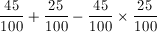


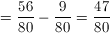
Prob(new OR yellow) = P(new) + P(yellow) - P(new AND yellow)
Prob(new) =
Prob(yellow) =
Prob(new AND yellow) =
so P(new OR yellow) =
← Didn't Know|Knew It →
Flight A is on time for 93% of flights. Flight B is on time for 89% of flights. Flight A and B are both on time 87% of the time. What is the probabiity that at least one flight is on time?
Flight A is on time for 93% of flights. Flight B is on time for 89% of flights. Flight A and B are both on time 87% of the time. What is the probabiity that at least one flight is on time?
Tap to reveal answer
P(Flight A is on time) = 0.93
P(Flight B is on time) = 0.89
P(Flights A and B are on time) = 0.87
Then P(A OR B) = P(A) + P(B) - P(A AND B) = 0.93 + 0.89 – 0.87 = 0.95
P(Flight A is on time) = 0.93
P(Flight B is on time) = 0.89
P(Flights A and B are on time) = 0.87
Then P(A OR B) = P(A) + P(B) - P(A AND B) = 0.93 + 0.89 – 0.87 = 0.95
← Didn't Know|Knew It →
At a school fair, there are 25 water balloons. 10 are yellow, 8 are red, and 7 are green. You try to pop the balloons. Given that you first pop a yellow balloon, what is the probability that the next balloon you hit is also yellow?
At a school fair, there are 25 water balloons. 10 are yellow, 8 are red, and 7 are green. You try to pop the balloons. Given that you first pop a yellow balloon, what is the probability that the next balloon you hit is also yellow?
Tap to reveal answer
At the start, there are 25 balloons and 10 of them are yellow. You hit a yellow balloon. Now there are 9 yellow balloons left out of 24 total balloons, so the probability of hitting a yellow next is
 .
.
At the start, there are 25 balloons and 10 of them are yellow. You hit a yellow balloon. Now there are 9 yellow balloons left out of 24 total balloons, so the probability of hitting a yellow next is
← Didn't Know|Knew It →
A bag has 7 blue balls and 3 red balls. 2 balls are to be drawn successively and without replacement. What is the probability that the first ball is red and the second ball is blue?
A bag has 7 blue balls and 3 red balls. 2 balls are to be drawn successively and without replacement. What is the probability that the first ball is red and the second ball is blue?
Tap to reveal answer
We first have 7 blue and 3 red out of 10, so P(1st ball is red) =  . Now, we have pulled a red ball out of the bag, leaving us with 7 blue and 2 red out of 9 total balls. Then P(2nd ball is blue) =
  . Put this together, P(1st red AND 2nd blue) =
  .
.
We first have 7 blue and 3 red out of 10, so P(1st ball is red) =
← Didn't Know|Knew It →
4 cards are to be dealt successively and without replacement from an ordinary deck of 52 cards. What is the probability of receiving, in order, a spade, a heart, a diamond, and a club?
4 cards are to be dealt successively and without replacement from an ordinary deck of 52 cards. What is the probability of receiving, in order, a spade, a heart, a diamond, and a club?
Tap to reveal answer
There are 4 suits, and each suit has 13 cards, so P(spade) =  .
.
Now there are 51 cards left: 12 spades, 13 hearts, 13 diamonds, and 13 clubs, so now P(heart) =  .
.
Once again, there are now 50 cards: 12 spades, 12 hearts, 13 diamonds, and 13 clubs, so now P(diamond) =  .
.
Before our last draw we have 49 cards left: 12 spades, 12 hearts, 12 diamonds, and 13 clubs, so P(club) =  .
.
Putting these four probabilities together gives us our answer:
P(spade AND heart AND diamond AND club) = 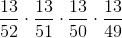
There are 4 suits, and each suit has 13 cards, so P(spade) =
Now there are 51 cards left: 12 spades, 13 hearts, 13 diamonds, and 13 clubs, so now P(heart) =
Once again, there are now 50 cards: 12 spades, 12 hearts, 13 diamonds, and 13 clubs, so now P(diamond) =
Before our last draw we have 49 cards left: 12 spades, 12 hearts, 12 diamonds, and 13 clubs, so P(club) =
Putting these four probabilities together gives us our answer:
P(spade AND heart AND diamond AND club) =
← Didn't Know|Knew It →
A red die and a white die are rolled. What is the probability of getting a 4 on the red die AND an odd sum of numbers on the two dice?
A red die and a white die are rolled. What is the probability of getting a 4 on the red die AND an odd sum of numbers on the two dice?
Tap to reveal answer
Let's first look at the two probabilities separately.
There are 36 possible combinations of the two dice: (1, 1), (1, 2), (1, 3),...,(1, 6); (2, 1), (2, 2), (2, 3),...; ....; (6, 1), ..., (6, 6). Getting a 4 on the red die can happen 6 different ways: (4, 1), (4, 2), (4, 3), (4, 4), (4, 5), and (4, 6). So P(4 on red die)
 .
.
Now, getting an odd sum on the dice can happen 18 different ways: (1, 2), (1, 4), (1, 6), (2, 1), (2, 3), (2, 5), (3, 2), (3, 4), (3, 6), (4, 1), (4, 3), (4, 5), (5, 2), (5, 4), (5, 6), (6, 1), (6, 3), and (6, 5). So P(odd sum) =
 .
.
Putting them together, P(4 on red AND odd sum) =
 .
.
Let's first look at the two probabilities separately.
There are 36 possible combinations of the two dice: (1, 1), (1, 2), (1, 3),...,(1, 6); (2, 1), (2, 2), (2, 3),...; ....; (6, 1), ..., (6, 6). Getting a 4 on the red die can happen 6 different ways: (4, 1), (4, 2), (4, 3), (4, 4), (4, 5), and (4, 6). So P(4 on red die)
Now, getting an odd sum on the dice can happen 18 different ways: (1, 2), (1, 4), (1, 6), (2, 1), (2, 3), (2, 5), (3, 2), (3, 4), (3, 6), (4, 1), (4, 3), (4, 5), (5, 2), (5, 4), (5, 6), (6, 1), (6, 3), and (6, 5). So P(odd sum) =
Putting them together, P(4 on red AND odd sum) =
← Didn't Know|Knew It →
A box contains 12 balls, of which 5 are black, 4 are red, and 3 are white. If 2 balls are randomly selected from the box, one at a time without being replaced, what is the probability that the first ball selected will be red and the second ball selected will be white?
A box contains 12 balls, of which 5 are black, 4 are red, and 3 are white. If 2 balls are randomly selected from the box, one at a time without being replaced, what is the probability that the first ball selected will be red and the second ball selected will be white?
Tap to reveal answer
The probability that the first ball selected will be red is  .
.
The probability that the second ball selected will be white is  .
.
We can solve by the multiplication principle since the two events happen together.

The probability that the first ball selected will be red is
The probability that the second ball selected will be white is
We can solve by the multiplication principle since the two events happen together.
← Didn't Know|Knew It →
What is the probability of sequentially drawing 2 diamonds from a deck of regular playing cards when the first card is not replaced?
What is the probability of sequentially drawing 2 diamonds from a deck of regular playing cards when the first card is not replaced?
Tap to reveal answer
The probability of drawing a diamond first is 
The probabilty of drawing a diamond second when the first card is not replaced is  .
.
To determine the probability of 2 INDEPENDENT events, we multiply them.
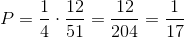
The probability of drawing a diamond first is
The probabilty of drawing a diamond second when the first card is not replaced is
To determine the probability of 2 INDEPENDENT events, we multiply them.
← Didn't Know|Knew It →
Two fair dice are tossed. What is the probability that the dice will add up to a prime number?
Two fair dice are tossed. What is the probability that the dice will add up to a prime number?
Tap to reveal answer
The prime numbers that can be rolled are 2, 3, 5, 7, and 11. The rolls that result in one of these numbers, out of a possible  rolls, are:





Therefore, there are 15 rolls out of 36 that result in a prime number, making the probability of a prime result 
The prime numbers that can be rolled are 2, 3, 5, 7, and 11. The rolls that result in one of these numbers, out of a possible
Therefore, there are 15 rolls out of 36 that result in a prime number, making the probability of a prime result
← Didn't Know|Knew It →
Two fair six-sided dice are rolled. What is the probability that the sum is either a perfect square or a perfect cube?
Two fair six-sided dice are rolled. What is the probability that the sum is either a perfect square or a perfect cube?
Tap to reveal answer
There are 36 possible rolls. The only perfect squares that can be rolled are 4 and 9; the only perfect cube that can be rolled is 8. So the roll must be one of the following:



This adds up to 12 rolls out of 36, for a probability of 
There are 36 possible rolls. The only perfect squares that can be rolled are 4 and 9; the only perfect cube that can be rolled is 8. So the roll must be one of the following:
This adds up to 12 rolls out of 36, for a probability of
← Didn't Know|Knew It →
One hundred marbles - each one red, yellow, blue, or green - are placed in a box. Forty of the marbles are green, there are twice as many blue marbles as there are red ones, and there are three times as many yellow marbles as red ones. What is the probability that a randomly drawn marble will be yellow?
One hundred marbles - each one red, yellow, blue, or green - are placed in a box. Forty of the marbles are green, there are twice as many blue marbles as there are red ones, and there are three times as many yellow marbles as red ones. What is the probability that a randomly drawn marble will be yellow?
Tap to reveal answer
Let  be the number of red marbles. Then there are
  blue marbles and
  yellow ones. Since there are 40 green marbles, and 100 marbles total, we can write this equation, simplifying and solving for
  :
:


Therefore, there are  yellow marbles, and the probability of drawing a yellow marble is
Let
Therefore, there are
← Didn't Know|Knew It →
Four coins are tossed at the same time. Three of them are fair; the fourth is loaded so that it comes up heads with probability  . In terms of
  , what is the probability that the outcome will be three heads and one tail?
Four coins are tossed at the same time. Three of them are fair; the fourth is loaded so that it comes up heads with probability
Tap to reveal answer
Call the fair coins, which come up heads or tails with probability  , Coins 1, 2, and 3; call the loaded coin, which comes up heads with probability
  and tails with probability
  , Coin 4. We are looking for the probability of one of the following four outcomes:
The probability of heads on Coins 1, 2, and 3 and tails on Coin 4:

The probability of tails on Coin 1 and heads on Coins 2, 3, and 4:

The probability of tails on Coin 2 and heads on Coins 1, 3, and 4:

The probability of tails on Coin 3 and heads on Coins 1, 2, and 4:

Add these:


Call the fair coins, which come up heads or tails with probability
The probability of heads on Coins 1, 2, and 3 and tails on Coin 4:
The probability of tails on Coin 1 and heads on Coins 2, 3, and 4:
The probability of tails on Coin 2 and heads on Coins 1, 3, and 4:
The probability of tails on Coin 3 and heads on Coins 1, 2, and 4:
Add these:
← Didn't Know|Knew It →
Three coins are tossed at the same time. One of them is fair; two are loaded so that each comes up heads with probability  . In terms of
  , what is the probability that the outcome will be three heads?
Three coins are tossed at the same time. One of them is fair; two are loaded so that each comes up heads with probability
Tap to reveal answer
The probability that all three coins will come up heads is the product of the individual probabilities:

The probability that all three coins will come up heads is the product of the individual probabilities:
← Didn't Know|Knew It →
Fifty marbles are put into a big box: ten red, ten yellow, ten green, and twenty blue. Which of the following actions would change the probability that a random draw would result in a blue marble?
Fifty marbles are put into a big box: ten red, ten yellow, ten green, and twenty blue. Which of the following actions would change the probability that a random draw would result in a blue marble?
Tap to reveal answer
The ratio of blue marbles to non-blue marbles is  . To maintain the same probability of drawing a blue marble, this ratio must remain the same after the action.
We will look at all five actions.
If three yellow marbles and two blue marbles are added, the ratio is  .
.
If fifteen green marbles and ten blue marbles are added, the ratio is  .
.
If two yellow marbles, four green marbles, and four blue marbles are removed, the ratio is  .
.
If half of the marbles of each color are removed - that is, ten blue marbles and five of each of the other three colors - the ratio is  .
.
If three marbles of each color are removed, however, the ratio is  . This is the correct choice.
The ratio of blue marbles to non-blue marbles is
We will look at all five actions.
If three yellow marbles and two blue marbles are added, the ratio is
If fifteen green marbles and ten blue marbles are added, the ratio is
If two yellow marbles, four green marbles, and four blue marbles are removed, the ratio is
If half of the marbles of each color are removed - that is, ten blue marbles and five of each of the other three colors - the ratio is
If three marbles of each color are removed, however, the ratio is
← Didn't Know|Knew It →
One hundred marbles - red, yellow, blue, or green - are placed in a box. There are an equal number of red and blue marbles, three times as many yellow marbles as green marbles, and five fewer green marbles than red marbles. What is the probability that a randomly drawn marble is NOT blue?
One hundred marbles - red, yellow, blue, or green - are placed in a box. There are an equal number of red and blue marbles, three times as many yellow marbles as green marbles, and five fewer green marbles than red marbles. What is the probability that a randomly drawn marble is NOT blue?
Tap to reveal answer
If there are  blue marbles, there are also
  red marbles,
  green marbles, and
  yellow marbles. There are 100 marbles total, so we can solve for
  in the equation:


20 of the 100 marbles are blue, so the probability that the marble is not blue is:

If there are
20 of the 100 marbles are blue, so the probability that the marble is not blue is:
← Didn't Know|Knew It →
Two eight-sided dice from a role-playing game are thrown. Each die is fair and marked with the numbers 1 through 8. What is the probability that the sum of the dice will be a prime number?
Two eight-sided dice from a role-playing game are thrown. Each die is fair and marked with the numbers 1 through 8. What is the probability that the sum of the dice will be a prime number?
Tap to reveal answer
There are  possible outcomes. The sum can be between 2 and 16 inclusive; we count the number of rolls that result in the sum being any of the possible prime numbers 2,3,5,7,11,13:


23 out of 64 rolls result in prime sums, so the probability is  .
.
There are
23 out of 64 rolls result in prime sums, so the probability is
← Didn't Know|Knew It →