
Calculating arithmetic mean - GMAT Quantitative
Card 1 of 424
Salaries for employees at ABC Company: 1 employee makes $25,000 per year, 4 employees make $40,000 per year, 2 employees make $50,000 per year and 5 employees make $75,000 per year.
What is the average (arithmetic mean) salary for the employees at ABC Company?
Salaries for employees at ABC Company: 1 employee makes $25,000 per year, 4 employees make $40,000 per year, 2 employees make $50,000 per year and 5 employees make $75,000 per year.
What is the average (arithmetic mean) salary for the employees at ABC Company?
Tap to reveal answer
The average is found by calculating the total payroll and then dividing by the total number of employees. 

The average is found by calculating the total payroll and then dividing by the total number of employees.
← Didn't Know|Knew It →
A bowler had an average (arithmetic mean) score of 215 on the first 5 games she bowled. What must she bowl on the 6th game to average 220 overall?
A bowler had an average (arithmetic mean) score of 215 on the first 5 games she bowled. What must she bowl on the 6th game to average 220 overall?
Tap to reveal answer
For the first 5 games the bowler has averaged 215. The equation to calculate the answer is
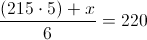
where  is the score for the sixth game. Next, to solve for the score for the 6th game
  multiply both sides by 6:

which simplifies to:

After subtracting 1,075 from each side we reach the answer:

For the first 5 games the bowler has averaged 215. The equation to calculate the answer is
where
which simplifies to:
After subtracting 1,075 from each side we reach the answer:
← Didn't Know|Knew It →
Five friends go out to a restaurant to celebrate the birthday of one of them. The cost of the meal for all of them including tax is  . They decide to leave a
  tip and to split the total amount equally. If the person celebrating his or her birthday does not pay, how much do each of the other four friends pay?
Five friends go out to a restaurant to celebrate the birthday of one of them. The cost of the meal for all of them including tax is
Tap to reveal answer
The total cost of the meal including tax and the  tip is:

They split the total amount equally between four of them, so each of those four people then pays:

Each of the four friends pays  .
.
The total cost of the meal including tax and the
They split the total amount equally between four of them, so each of those four people then pays:
Each of the four friends pays
← Didn't Know|Knew It →
Ashley averaged a score of 87 on her first 5 tests. She scored a 93 on her 6th test. What is her average test score, assuming all 6 tests are weighted equally?
Ashley averaged a score of 87 on her first 5 tests. She scored a 93 on her 6th test. What is her average test score, assuming all 6 tests are weighted equally?
Tap to reveal answer
We can't just average 87 and 93! This will give the wrong answer! The average formula is  .
.
For the first 5 tests,  . Then
  .
.
Now combine that with the 6th test to find the overall average.

We can't just average 87 and 93! This will give the wrong answer! The average formula is
For the first 5 tests,
Now combine that with the 6th test to find the overall average.
← Didn't Know|Knew It →
Sabrina made $3,000 a month for three months, $4,000 the next month, and $5,200 a month for the following two months. What was her average monthly income for the 6 month period?
Sabrina made $3,000 a month for three months, $4,000 the next month, and $5,200 a month for the following two months. What was her average monthly income for the 6 month period?
Tap to reveal answer

← Didn't Know|Knew It →
Luke counts the number of gummy bears he eats every day for 1 week: {39, 18, 24, 51, 40, 15, 23}. On average, how many gummy bears does Luke eat each day?
Luke counts the number of gummy bears he eats every day for 1 week: {39, 18, 24, 51, 40, 15, 23}. On average, how many gummy bears does Luke eat each day?
Tap to reveal answer

← Didn't Know|Knew It →
The average of 10, 25, and 70 is 10 more than the average of 15, 30, and x. What is the missing number?
The average of 10, 25, and 70 is 10 more than the average of 15, 30, and x. What is the missing number?
Tap to reveal answer
The average of 10, 25, and 70 is 35: 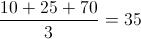
So the average of 15, 30, and the unknown number is 25 or, 10 less than the average of 10, 25, and 70 (= 35)
so 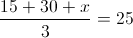



The average of 10, 25, and 70 is 35:
So the average of 15, 30, and the unknown number is 25 or, 10 less than the average of 10, 25, and 70 (= 35)
so
← Didn't Know|Knew It →
What is the average of 2_x_, 3_x_ + 2, and 7_x_ +4?
What is the average of 2_x_, 3_x_ + 2, and 7_x_ +4?
Tap to reveal answer

← Didn't Know|Knew It →
The average high temperature for the week is 85. The first six days of the week have high temperatures of 89, 76, 92, 90, 80, and 84, respectively. What is the high temperature on the seventh day of the week?
The average high temperature for the week is 85. The first six days of the week have high temperatures of 89, 76, 92, 90, 80, and 84, respectively. What is the high temperature on the seventh day of the week?
Tap to reveal answer
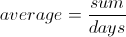



← Didn't Know|Knew It →
Jimmy's grade in his finance class is based on six equally-weighted tests. If Jimmy scored 98, 64, 82, 90, 70, and 88 on the six tests, what was his grade in the class?
Jimmy's grade in his finance class is based on six equally-weighted tests. If Jimmy scored 98, 64, 82, 90, 70, and 88 on the six tests, what was his grade in the class?
Tap to reveal answer

← Didn't Know|Knew It →

Find the mean of the sample data set.
Find the mean of the sample data set.
Tap to reveal answer
The mean of a sample data set is the sum of all of the values divided by the total number of values. In this case:

The mean of a sample data set is the sum of all of the values divided by the total number of values. In this case:
← Didn't Know|Knew It →
Sandra's grade in economics depends on seven tests - five hourly tests, a midterm, and a final exam. The midterm counts twice as much as an hourly test; the final, three times as much.
Sandra's grades on the five hourly tests are 84, 86, 76, 89, and 93; her grade on the midterm was 72. What score out of 100 must she achieve on the final exam so that her average score at the end of the term is at least 80?
Sandra's grade in economics depends on seven tests - five hourly tests, a midterm, and a final exam. The midterm counts twice as much as an hourly test; the final, three times as much.
Sandra's grades on the five hourly tests are 84, 86, 76, 89, and 93; her grade on the midterm was 72. What score out of 100 must she achieve on the final exam so that her average score at the end of the term is at least 80?
Tap to reveal answer
This is a weighted mean, with the hourly tests assigned a weight of 1, the midterm assigned a weight of 2, and the final assigned a weight of 3. The total of the weights will be
 .
.
If we let  be Sandra's final exam score, Sandra's final weighted average will be



For Sandra to get a final average of 80, then we set the above equal to 80 and calculate  :
:
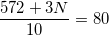



This is a weighted mean, with the hourly tests assigned a weight of 1, the midterm assigned a weight of 2, and the final assigned a weight of 3. The total of the weights will be
If we let
For Sandra to get a final average of 80, then we set the above equal to 80 and calculate
← Didn't Know|Knew It →
Consider the following set of numbers:
85, 87, 87, 82, 89
What is the mean?
Consider the following set of numbers:
85, 87, 87, 82, 89
What is the mean?
Tap to reveal answer

← Didn't Know|Knew It →
Consider the following set of numbers:
85, 87, 87, 82, 89
What is the median?
Consider the following set of numbers:
85, 87, 87, 82, 89
What is the median?
Tap to reveal answer
Reorder the values in numerical order:82, 85, 87, 87, 89
The median is the center number, 87.
Reorder the values in numerical order:82, 85, 87, 87, 89
The median is the center number, 87.
← Didn't Know|Knew It →
The average of the following 6 digits is 75. What is a possible value of  ?
?
80, 78, 78, 70, 71, 
The average of the following 6 digits is 75. What is a possible value of
80, 78, 78, 70, 71,
Tap to reveal answer

Therefore, the sum of all 6 digits must equal 450.


Subtract 377 from both sides.

Therefore, the sum of all 6 digits must equal 450.
Subtract 377 from both sides.
← Didn't Know|Knew It →
When assigning a score for the term, a professor takes the mean of all of a student's test scores except for his or her lowest score.
On the first five exams, Donna has achieved the following scores: 76, 84, 80, 65, 91. There is one more exam in the course. Assuming that 100 is the maximum possible score, what is the range of possible final averages she can achieve (nearest tenth, if applicable)?
When assigning a score for the term, a professor takes the mean of all of a student's test scores except for his or her lowest score.
On the first five exams, Donna has achieved the following scores: 76, 84, 80, 65, 91. There is one more exam in the course. Assuming that 100 is the maximum possible score, what is the range of possible final averages she can achieve (nearest tenth, if applicable)?
Tap to reveal answer
The worst-case scenario is that she will score 65 or less, in which case her score will be the mean of the scores she has already achieved.

The best-case scenario is that she will score 100, in which case the 65 will be dropped and her score will be the mean of the other five scores.

The worst-case scenario is that she will score 65 or less, in which case her score will be the mean of the scores she has already achieved.
The best-case scenario is that she will score 100, in which case the 65 will be dropped and her score will be the mean of the other five scores.
← Didn't Know|Knew It →
If  and
and  , then give the mean of
  ,
,  ,
,  ,
,  , and
, and  .
.
If
Tap to reveal answer
The mean of  ,
,  ,
,  ,
,  , and
, and  is
is 
If you add both sides of each equation:


or

Equivalently,


 ,
,
making 290 the mean.
The mean of
If you add both sides of each equation:
or
Equivalently,
making 290 the mean.
← Didn't Know|Knew It →
Julie's grade in a psychology class depends on three tests, each of which are equally weighted; one term paper, which counts half as much as a test; one midterm, which counts for one and one-half as much as a test; and one final, which counts for twice as much as the other tests.
Julie has scored 85%, 84%, and 74% on her three tests, 90% on her term paper, and 72% on her midterm. She is going for an 80% in the course; what is the minimum percent she must score on the final (assuming that 100% is the maximum possible) to achieve this average?
Julie's grade in a psychology class depends on three tests, each of which are equally weighted; one term paper, which counts half as much as a test; one midterm, which counts for one and one-half as much as a test; and one final, which counts for twice as much as the other tests.
Julie has scored 85%, 84%, and 74% on her three tests, 90% on her term paper, and 72% on her midterm. She is going for an 80% in the course; what is the minimum percent she must score on the final (assuming that 100% is the maximum possible) to achieve this average?
Tap to reveal answer
Let  be her final grade. Julie's final score is calculated as a weighted mean, so we can set up the following inequality:

Simplify and solve for  :
:


Julie must make a minimum of 82% on the final to meet her goal.
Let
Simplify and solve for
Julie must make a minimum of 82% on the final to meet her goal.
← Didn't Know|Knew It →
The mean of the following terms is 11. Solve for  .
.
15, 12, 9, 7, 17, 8, 
The mean of the following terms is 11. Solve for
15, 12, 9, 7, 17, 8,
Tap to reveal answer
The mean times the number of terms is equal to 77.

The sum of all of the terms must equal 77.


The mean times the number of terms is equal to 77.
The sum of all of the terms must equal 77.
← Didn't Know|Knew It →
Charlotte's course average in chemistry class is the average of the best five of her six hourly test scores. Going into finals week, Charlotte has scores of 88, 84, 84, 89, and 72. How much, at minimum, must Charlotte score on her sixth test in order to make an average of 85 or better for the term?
Charlotte's course average in chemistry class is the average of the best five of her six hourly test scores. Going into finals week, Charlotte has scores of 88, 84, 84, 89, and 72. How much, at minimum, must Charlotte score on her sixth test in order to make an average of 85 or better for the term?
Tap to reveal answer
If Charlotte does not take the sixth test, she will receive the average of her first five tests - this is

Charlotte is not assured of an 85 or better, so she must take the test to achieve this.
Let  be the score she makes on the sixth test. If
  , then her first five tests will stand, so let's assume that
  . Then her average will be

Since Charlotte wants an average of 85 or better, we solve this inequality:


Her sixth test must be 80, at minimum.
If Charlotte does not take the sixth test, she will receive the average of her first five tests - this is
Charlotte is not assured of an 85 or better, so she must take the test to achieve this.
Let
Since Charlotte wants an average of 85 or better, we solve this inequality:
Her sixth test must be 80, at minimum.
← Didn't Know|Knew It →