
Sets - GMAT Quantitative
Card 1 of 120
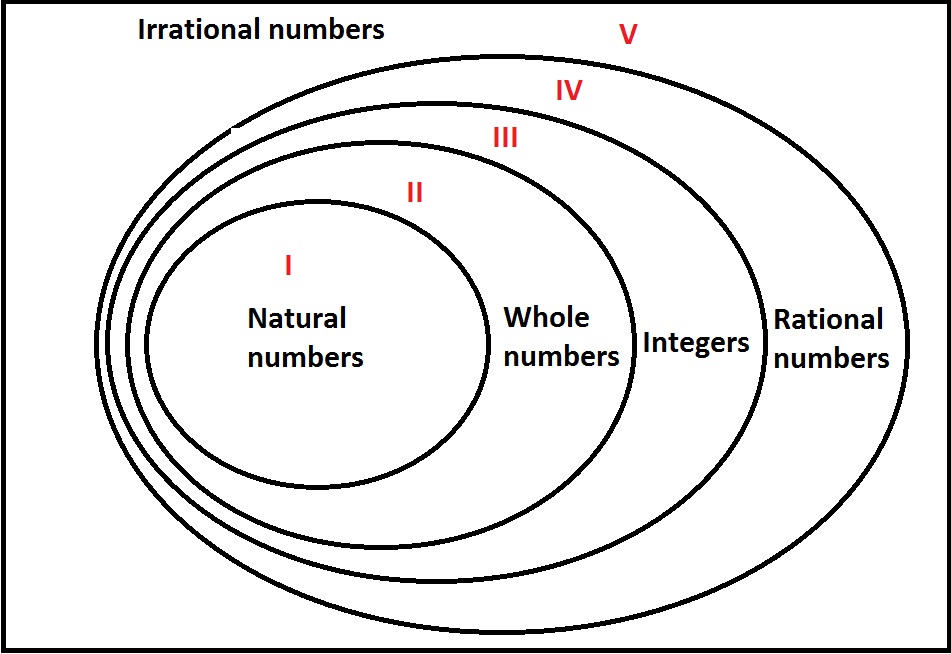
Examine the above diagram, which shows a Venn diagram representing the sets of real numbers.
If real number  were to be placed in its correct region in the diagram, which one would it be - I, II, III, IV, or V?
Statement 1: If  , then
  would be placed in Region IV.
Statement 2: If  , then
  would be placed in Region IV.
Examine the above diagram, which shows a Venn diagram representing the sets of real numbers.
If real number
Statement 1: If
Statement 2: If
Tap to reveal answer
Region IV comprises the rational numbers that are not integers. A number is rational if and only if it can be expressed as the quotient of integers.
From Statement 1 alone, it can be inferred that  is rational, and that it is not an integer. Since
  , it follows that
  . However, this is not sufficient to narrow it down completely.
For example:
If  , then
 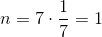 , a natural number, putting it in Region I.
If  , then
 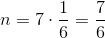 , a rational number but not an integer, putting it in Region IV.
From Statement 2 alone, it can be inferred that  is rational, and that it is not an integer. From
  , it follows that
  . The nonzero rational numbers are closed under division, so
  must be a rational number. However, since
  is not an integer,
  cannot be an integer, since the integers are closed under multiplication. Therefore, Statement 2 alone proves that
  belongs in Region IV.
Region IV comprises the rational numbers that are not integers. A number is rational if and only if it can be expressed as the quotient of integers.
From Statement 1 alone, it can be inferred that
For example:
If
If
From Statement 2 alone, it can be inferred that
← Didn't Know|Knew It →
Examine the above diagram, which shows a Venn diagram representing the sets of real numbers.
If real number  were to be placed in its correct region in the diagram, which one would it be - I, II, III, IV, or V?
Statement 1: If  , then
  would be in Region I.
Statement 2: If  , then
  would be in Region III.
Examine the above diagram, which shows a Venn diagram representing the sets of real numbers.
If real number
Statement 1: If
Statement 2: If
Tap to reveal answer
Assume Statement 1 alone. It cannot be determined what region  is in.
For example, suppose  , which is in Region I (the set of natural numbers, or positive integers). It is possible that
  , putting it in Region I, or
  , putting it in Region III (the set of integers that are not whole numbers - that is, the set of negative integers).
Assume Statement 2 alone. It cannot be determined what region is in.
For example, suppose  , which is in Region III; then
  , which is also in Region III. But suppose
  ; then
  , which, as an irrational number, is in Region V.
Now assume both statements. Then  has an integer as a square and an integer as a cube.
  must either be an integer or an irrational number. But
 , making it the quotient of integers, which is rational. Therefore,
  is an integer. Furthermore, its cube is negative, so
  is negative. The two statements together prove that
  is a negative integer, which belongs in Region III.
Assume Statement 1 alone. It cannot be determined what region
For example, suppose
Assume Statement 2 alone. It cannot be determined what region
For example, suppose
Now assume both statements. Then
← Didn't Know|Knew It →
Which, if either, is the greater number:  or
or  ?
?
Statement 1: 
Statement 2: 
Which, if either, is the greater number:
Statement 1:
Statement 2:
Tap to reveal answer
Statement 1 alone gives insufficient information. For example, if  , then:


 or
or 
Since  , it is unclear which of
  and
and  is greater, if either.
Statement 2 gives insufficient information; if  is positive,
  is negative, and vice versa.
Assume both to be true. The two statements form a system of equations that can be solved using substitution:



Case 1:



Case 2:



This equation has no solution.
Therefore, the only possible solution is  . Therefore, it can be concluded that
  .
.
Statement 1 alone gives insufficient information. For example, if
Since
Statement 2 gives insufficient information; if
Assume both to be true. The two statements form a system of equations that can be solved using substitution:
Case 1:
Case 2:
This equation has no solution.
Therefore, the only possible solution is
← Didn't Know|Knew It →
How many subsets does set  have?
have?
Statement 1:  has eight elements.
Statement 2:  is the set of all prime numbers between 1 and 20.
How many subsets does set
Statement 1:
Statement 2:
Tap to reveal answer
The number of subsets of any set can be calculated by raising 2 to the power of the number of elements in the set. The first statement gives you that information immediately. The second gives you enough information to find the number of elements, as there are eight primes between 1 and 20: 2, 3, 5, 7, 11, 13, 17, and 19. From either statement alone, you can deduce the answer to be  .
.
The number of subsets of any set can be calculated by raising 2 to the power of the number of elements in the set. The first statement gives you that information immediately. The second gives you enough information to find the number of elements, as there are eight primes between 1 and 20: 2, 3, 5, 7, 11, 13, 17, and 19. From either statement alone, you can deduce the answer to be
← Didn't Know|Knew It →
Let  be the set of all of the multiples of 3 between 29 and 50. How many subsets of
  can be formed?
Let
Tap to reveal answer
The multiples of 3 between 29 and 50 are 30, 33, 36, 39, 42, 45, and 48 - therefore,  has seven elements total.
The number of subsets in a set can be calculated by raising 2 to the power of the number of elements. Therefore, the answer to our question is  .
.
The multiples of 3 between 29 and 50 are 30, 33, 36, 39, 42, 45, and 48 - therefore,
The number of subsets in a set can be calculated by raising 2 to the power of the number of elements. Therefore, the answer to our question is
← Didn't Know|Knew It →
The senior class has 457 students. An election was held for Senior Class President between three candidates, Anderson, Benson, and Carter.
If every student voted for one of these three, and the student with the most votes was declared the winner, who won the election?
Statement 1: Benson got 251 votes.
Statement 2: Carter got 101 votes.
The senior class has 457 students. An election was held for Senior Class President between three candidates, Anderson, Benson, and Carter.
If every student voted for one of these three, and the student with the most votes was declared the winner, who won the election?
Statement 1: Benson got 251 votes.
Statement 2: Carter got 101 votes.
Tap to reveal answer
From Statement 1 alone, it can be immediately deduced that Benson won, since 251 of the 457 votes consititute a majority:
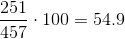
Benson got 54.9% of the vote, so there is no way that Anderson or Carter could have bested Benson.
Statement 2 tells only that Carter did not win, since either Anderson or Benson had to have won at least half, or  ; we cannot, however, tell which one it was without further information.
From Statement 1 alone, it can be immediately deduced that Benson won, since 251 of the 457 votes consititute a majority:
Benson got 54.9% of the vote, so there is no way that Anderson or Carter could have bested Benson.
Statement 2 tells only that Carter did not win, since either Anderson or Benson had to have won at least half, or
← Didn't Know|Knew It →
The senior class of Watson High School has 613 students. An election was held for Senior Class President between three candidates, Martindale, Nance, and Osgood.
If every student voted for one of these three, and the student with the most votes was declared the winner, who won the election?
Statement 1: Martindale got 240 votes.
Statement 2: Nance got 244 votes.
The senior class of Watson High School has 613 students. An election was held for Senior Class President between three candidates, Martindale, Nance, and Osgood.
If every student voted for one of these three, and the student with the most votes was declared the winner, who won the election?
Statement 1: Martindale got 240 votes.
Statement 2: Nance got 244 votes.
Tap to reveal answer
If we only know Martindale got 240 votes, since 240 is not a majority, we cannot determine the winner with certainty. For example, the following two results are possible:
Martindale: 240, Nance: 0, Osgood 373 - Osgood wins
Martindale 240, Nance 373, Osgood 0 - Nance wins.
A similar argument shows the second statement insufficient as well, since 244 is not a majority.
But the two statements together allow us a complete picture;
Martindale 240, Nance 244, Osgood 129 - Nance wins
If we only know Martindale got 240 votes, since 240 is not a majority, we cannot determine the winner with certainty. For example, the following two results are possible:
Martindale: 240, Nance: 0, Osgood 373 - Osgood wins
Martindale 240, Nance 373, Osgood 0 - Nance wins.
A similar argument shows the second statement insufficient as well, since 244 is not a majority.
But the two statements together allow us a complete picture;
Martindale 240, Nance 244, Osgood 129 - Nance wins
← Didn't Know|Knew It →
Two courses open to students in their senior year at Johnson High School are calculus and physics; students may take either or both. Of the 524 seniors enrolled at JHS, are more of them taking calculus or physics?
Statement 1: 139 students are taking neither course.
Statement 2: One-third of the students enrolled in calculus are also enrolled in physics.
Two courses open to students in their senior year at Johnson High School are calculus and physics; students may take either or both. Of the 524 seniors enrolled at JHS, are more of them taking calculus or physics?
Statement 1: 139 students are taking neither course.
Statement 2: One-third of the students enrolled in calculus are also enrolled in physics.
Tap to reveal answer
Suppose you know both statements. From the first statement, you can calculate that  seniors are taking calculus, physics, or both. However, as illustrated by these two examples, you cannot tell which course has more seniors enrolled.
Example 1: 50 seniors are enrolled in both courses.
Then  seniors are enrolled in calculus;
  seniors are enrolled in physics but not calculus;
  seniors total are enrolled in physics. This means that seniors in physics outnumber seniors in calculus.
Example 2: 100 seniors are enrolled both courses.
Then  seniors are enrolled in calculus;
  seniors are enrolled in physics but not calculus;
  seniors total are enrolled in physics. This means that seniors in calculus outnumber seniors in physics.
Suppose you know both statements. From the first statement, you can calculate that
Example 1: 50 seniors are enrolled in both courses.
Then
Example 2: 100 seniors are enrolled both courses.
Then
← Didn't Know|Knew It →
If  , what is
  ?
?
(1) 
(2) 
If
(1)
(2)
Tap to reveal answer
Statement (1) allows us to find B:
B = S + 3 = {4 , 6 , 10} Therefore:
S + B = {1+4 , 1+6 , 1+10 , 3+4 , 3+6 , 3+10 , 7+4 , 7+6 , 7+10}
S + B = {5 , 7 , 9 , 11 , 13 , 17}. SO statement (1) is sufficient to find S+B
Statement (2) does not give us enough information to find B. It could be any set between {4 , 6 , 10} and {1 , 3 , 4 , 6 , 7 , 10} if it includes the same numbers as S. Therefore Statement 2 is not sufficient.
Statement (1) allows us to find B:
B = S + 3 = {4 , 6 , 10} Therefore:
S + B = {1+4 , 1+6 , 1+10 , 3+4 , 3+6 , 3+10 , 7+4 , 7+6 , 7+10}
S + B = {5 , 7 , 9 , 11 , 13 , 17}. SO statement (1) is sufficient to find S+B
Statement (2) does not give us enough information to find B. It could be any set between {4 , 6 , 10} and {1 , 3 , 4 , 6 , 7 , 10} if it includes the same numbers as S. Therefore Statement 2 is not sufficient.
← Didn't Know|Knew It →
How many elements are in set  ?
?
Statement 1:  has exactly
  subsets.
Statement 2:  has exactly
  proper subsets.
How many elements are in set
Statement 1:
Statement 2:
Tap to reveal answer
A set with  elements has exactly
  subsets in all, and
  proper subsets (every subset except one - the set itself).
From Statement 1, since  has
has  subsets, it follows that it has 6 elements. From Statement 2, since
  has 63 proper subsets, it has 64 subsets total, and, again, 6 elements. Either statement alone is sufficient.
A set with
From Statement 1, since
← Didn't Know|Knew It →
Examine the above Venn diagram, which represents the sets of real numbers.
If real number  were to be placed in its correct region in the diagram, which one would it be - I, II, III, IV, or V?
Statement 1:  is negative.
Statement 2: If  , then
  would be placed in Region III.
Examine the above Venn diagram, which represents the sets of real numbers.
If real number
Statement 1:
Statement 2: If
Tap to reveal answer
Statement 1 alone only eliminates Regions I and II (since whole numbers are nonnegative integers); negative numbers can be found in Regions III, IV, and V.
Statement 2 alone states that  is an integer that as not a whole number - that is,
  is a negative integer. Since
  , as a consequence,
  .
.  , the product of a positive integer and a negative integer, is a negative integer, and it would be placed in Region III, which comprises exactly the negative integers.
Statement 1 alone only eliminates Regions I and II (since whole numbers are nonnegative integers); negative numbers can be found in Regions III, IV, and V.
Statement 2 alone states that
← Didn't Know|Knew It →
Let  be the set of all perfect squares and perfect cubes between 1 and 100 inclusive. How many subsets does
  have?
have?
Let
Tap to reveal answer
 , which is a set of 12 elements. A set this size has
  subsets.
← Didn't Know|Knew It →
Examine the above diagram, which shows a Venn diagram representing the sets of real numbers.
If real number  were to be placed in its correct region in the diagram, which one would it be - I, II, III, IV, or V?
Statement 1: If  , then
  would be placed in Region I.
Statement 2: If  , then
  would be placed in Region I.
Examine the above diagram, which shows a Venn diagram representing the sets of real numbers.
If real number
Statement 1: If
Statement 2: If
Tap to reveal answer
Region I comprises the natural numbers - 
From Statement 1 alone,  is a natural number; since
  , it follows that is the difference of a natural number and 7 - that is,

 could be in any of three regions - I, II, or III.
Conversely, from Statement 2 alone,  is the sum of a natural number and 7 - that is,

 must be a natural number and it must be in Region I.
Region I comprises the natural numbers -
From Statement 1 alone,
Conversely, from Statement 2 alone,
← Didn't Know|Knew It →
Given that  and
and  , is it true that positive integer
  ?
?
Statement 1: The last digit of  is a 0.
Statement 2: The second-to-last digit of  is 5.
is 5.
Given that
Statement 1: The last digit of
Statement 2: The second-to-last digit of
Tap to reveal answer
 and
and  are the sets of positive multiples of 4 and 5, respectively. For a number to be in both sets, the number must be divisible by both 4 and 5. This happens if and only if it is also divisible by
  .
.
The elements of  are precisely the mulitples of 20:

All of the numbers end in 0 and have 2, 4, 6, 8,or 0 as their second-to-last digit.
Statement 1 does not, by itself, prove or disprove that  , since there are numbers like 10 and 30 that do not fall in this set. But none of the elements of
  have 5 as their second-to-last digit, so Statement 2 proves
  to be false.
The elements of
All of the numbers end in 0 and have 2, 4, 6, 8,or 0 as their second-to-last digit.
Statement 1 does not, by itself, prove or disprove that
← Didn't Know|Knew It →
Define sets  as follows:


What is  ?
?
Statement 1: 
Statement 2:  comprises ten elements, all of which are positive integers.
Define sets
What is
Statement 1:
Statement 2:
Tap to reveal answer

 is the complement of
  - that is, the set of all elements in the universal set
  that are not in
  . To find
  given
given  , we need to know the elements in
  . Statement 1 gives us this information; Statement 2 does not.
← Didn't Know|Knew It →
How many subsets does set have?
Statement 1: has eight elements.
Statement 2: is the set of all prime numbers between 1 and 20.
How many subsets does set
Statement 1:
Statement 2:
Tap to reveal answer
The number of subsets of any set can be calculated by raising 2 to the power of the number of elements in the set. The first statement gives you that information immediately. The second gives you enough information to find the number of elements, as there are eight primes between 1 and 20: 2, 3, 5, 7, 11, 13, 17, and 19. From either statement alone, you can deduce the answer to be .
The number of subsets of any set can be calculated by raising 2 to the power of the number of elements in the set. The first statement gives you that information immediately. The second gives you enough information to find the number of elements, as there are eight primes between 1 and 20: 2, 3, 5, 7, 11, 13, 17, and 19. From either statement alone, you can deduce the answer to be
← Didn't Know|Knew It →
Let be the set of all of the multiples of 3 between 29 and 50. How many subsets of can be formed?
Let
Tap to reveal answer
The multiples of 3 between 29 and 50 are 30, 33, 36, 39, 42, 45, and 48 - therefore, has seven elements total.
The number of subsets in a set can be calculated by raising 2 to the power of the number of elements. Therefore, the answer to our question is .
The multiples of 3 between 29 and 50 are 30, 33, 36, 39, 42, 45, and 48 - therefore,
The number of subsets in a set can be calculated by raising 2 to the power of the number of elements. Therefore, the answer to our question is
← Didn't Know|Knew It →
The senior class has 457 students. An election was held for Senior Class President between three candidates, Anderson, Benson, and Carter.
If every student voted for one of these three, and the student with the most votes was declared the winner, who won the election?
Statement 1: Benson got 251 votes.
Statement 2: Carter got 101 votes.
The senior class has 457 students. An election was held for Senior Class President between three candidates, Anderson, Benson, and Carter.
If every student voted for one of these three, and the student with the most votes was declared the winner, who won the election?
Statement 1: Benson got 251 votes.
Statement 2: Carter got 101 votes.
Tap to reveal answer
From Statement 1 alone, it can be immediately deduced that Benson won, since 251 of the 457 votes consititute a majority:
Benson got 54.9% of the vote, so there is no way that Anderson or Carter could have bested Benson.
Statement 2 tells only that Carter did not win, since either Anderson or Benson had to have won at least half, or ; we cannot, however, tell which one it was without further information.
From Statement 1 alone, it can be immediately deduced that Benson won, since 251 of the 457 votes consititute a majority:
Benson got 54.9% of the vote, so there is no way that Anderson or Carter could have bested Benson.
Statement 2 tells only that Carter did not win, since either Anderson or Benson had to have won at least half, or
← Didn't Know|Knew It →
The senior class of Watson High School has 613 students. An election was held for Senior Class President between three candidates, Martindale, Nance, and Osgood.
If every student voted for one of these three, and the student with the most votes was declared the winner, who won the election?
Statement 1: Martindale got 240 votes.
Statement 2: Nance got 244 votes.
The senior class of Watson High School has 613 students. An election was held for Senior Class President between three candidates, Martindale, Nance, and Osgood.
If every student voted for one of these three, and the student with the most votes was declared the winner, who won the election?
Statement 1: Martindale got 240 votes.
Statement 2: Nance got 244 votes.
Tap to reveal answer
If we only know Martindale got 240 votes, since 240 is not a majority, we cannot determine the winner with certainty. For example, the following two results are possible:
Martindale: 240, Nance: 0, Osgood 373 - Osgood wins
Martindale 240, Nance 373, Osgood 0 - Nance wins.
A similar argument shows the second statement insufficient as well, since 244 is not a majority.
But the two statements together allow us a complete picture;
Martindale 240, Nance 244, Osgood 129 - Nance wins
If we only know Martindale got 240 votes, since 240 is not a majority, we cannot determine the winner with certainty. For example, the following two results are possible:
Martindale: 240, Nance: 0, Osgood 373 - Osgood wins
Martindale 240, Nance 373, Osgood 0 - Nance wins.
A similar argument shows the second statement insufficient as well, since 244 is not a majority.
But the two statements together allow us a complete picture;
Martindale 240, Nance 244, Osgood 129 - Nance wins
← Didn't Know|Knew It →
Two courses open to students in their senior year at Johnson High School are calculus and physics; students may take either or both. Of the 524 seniors enrolled at JHS, are more of them taking calculus or physics?
Statement 1: 139 students are taking neither course.
Statement 2: One-third of the students enrolled in calculus are also enrolled in physics.
Two courses open to students in their senior year at Johnson High School are calculus and physics; students may take either or both. Of the 524 seniors enrolled at JHS, are more of them taking calculus or physics?
Statement 1: 139 students are taking neither course.
Statement 2: One-third of the students enrolled in calculus are also enrolled in physics.
Tap to reveal answer
Suppose you know both statements. From the first statement, you can calculate that seniors are taking calculus, physics, or both. However, as illustrated by these two examples, you cannot tell which course has more seniors enrolled.
Example 1: 50 seniors are enrolled in both courses.
Then seniors are enrolled in calculus; seniors are enrolled in physics but not calculus; seniors total are enrolled in physics. This means that seniors in physics outnumber seniors in calculus.
Example 2: 100 seniors are enrolled both courses.
Then seniors are enrolled in calculus; seniors are enrolled in physics but not calculus; seniors total are enrolled in physics. This means that seniors in calculus outnumber seniors in physics.
Suppose you know both statements. From the first statement, you can calculate that
Example 1: 50 seniors are enrolled in both courses.
Then
Example 2: 100 seniors are enrolled both courses.
Then
← Didn't Know|Knew It →