
Equations - GMAT Quantitative
Card 1 of 144
Solve for 
Statement 1: 
Statement 2: 
Solve for
Statement 1:
Statement 2:
Tap to reveal answer
To solve for three unknowns, we need three equations. Here we have three equations if we use both statements 1 and 2. We don't need to solve any further. Because this is a data sufficiency question, it doesn't matter what the actual values of x, y, and z are. The important fact is the we could find them if we wanted to.
To solve for three unknowns, we need three equations. Here we have three equations if we use both statements 1 and 2. We don't need to solve any further. Because this is a data sufficiency question, it doesn't matter what the actual values of x, y, and z are. The important fact is the we could find them if we wanted to.
← Didn't Know|Knew It →
If  , what is the value of
  ?
?
(1)
(2) 
If
(1)
(2)
Tap to reveal answer

Therefore, 
(1) If  , then
  , and the value of
  can vary.
  NOT sufficient
(2) Subtracting both  and 7 from each side of
  gives
gives  .
.
The value of  can be determined.
  SUFFICIENT
Therefore,
(1) If
(2) Subtracting both
The value of
← Didn't Know|Knew It →
If  , what is the value of x?
Statement 1: 
Statement 2: 
If
Statement 1:
Statement 2:
Tap to reveal answer
We are looking for one value of x since the quesiton specifies we only want a positive solution.
Statement 1 isn't sufficient because there are an infinite number of integers greater than 1.
Statement 2 tells us that x = 2 or x = –2, and we know that we only want the positive answer. Then Statement 2 is sufficient.
We are looking for one value of x since the quesiton specifies we only want a positive solution.
Statement 1 isn't sufficient because there are an infinite number of integers greater than 1.
Statement 2 tells us that x = 2 or x = –2, and we know that we only want the positive answer. Then Statement 2 is sufficient.
← Didn't Know|Knew It →
What is the value of  ?
?
Statement 1: 
Statement 2: 
What is the value of
Statement 1:
Statement 2:
Tap to reveal answer
We know that we need 2 equations to solve for 2 variables, so it is tempting to say that both statements are needed. This is actually wrong! We aren't being asked for the individual values of x and y, instead we are being asked for the value of an expression.
 is just
  , and statement 2 gives us the value of
  . For data sufficiency questions, we don't actually have to solve the question, but if we wanted to, we would simply multiply statement 2 by 2.
 * Statement 2 =
We know that we need 2 equations to solve for 2 variables, so it is tempting to say that both statements are needed. This is actually wrong! We aren't being asked for the individual values of x and y, instead we are being asked for the value of an expression.
← Didn't Know|Knew It →
Data Sufficiency Question- do not actually solve the problem
Solve for  .
.

1. 
2. 
Data Sufficiency Question- do not actually solve the problem
Solve for
1.
2.
Tap to reveal answer
In order to solve an equation with 4 variables, you need to know either 3 of the variables or have a system of 4 equations to solve.
In order to solve an equation with 4 variables, you need to know either 3 of the variables or have a system of 4 equations to solve.
← Didn't Know|Knew It →
Solve for  .
.
Statement 1: 
Statement 2: 
Solve for
Statement 1:
Statement 2:
Tap to reveal answer
To solve for three unknowns, we need three equations. Therefore no combination of statements 1 and 2 will provide enough information to solve for  .
.
To solve for three unknowns, we need three equations. Therefore no combination of statements 1 and 2 will provide enough information to solve for
← Didn't Know|Knew It →
The volume of a fixed mass of gas varies inversely with the atmospheric pressure, in millibars, acting upon it, given that all other conditions remain constant.
At 12:00, a balloon was filled with exactly 100 cubic yards of helium. What its current volume?
Statement 1: The atmospheric pressure at 12:00 was 109 millibars.
Statement 2: The atmospheric pressure is now 105 millibars.
The volume of a fixed mass of gas varies inversely with the atmospheric pressure, in millibars, acting upon it, given that all other conditions remain constant.
At 12:00, a balloon was filled with exactly 100 cubic yards of helium. What its current volume?
Statement 1: The atmospheric pressure at 12:00 was 109 millibars.
Statement 2: The atmospheric pressure is now 105 millibars.
Tap to reveal answer
You can use the following variation equation to deduce the current volume:

or, equivalently,

To find the current volume  , you therefore need three things - the initial volume
  , which is given in the body of the question; the initial pressure
  , which you know if you are given Statement 1; and the current pressure,
  , which you know if you are given Statement 2. Just substitute, and solve.
You can use the following variation equation to deduce the current volume:
or, equivalently,
To find the current volume
← Didn't Know|Knew It →
The volume of a fixed mass of gas varies inversely with the atmospheric pressure, in millibars, acting upon it, given that all other conditions remain constant.
At 12:00, a balloon was filled with exactly 100 cubic yards of helium. What is its current volume?
Statement 1: It is now 2:00.
Statement 2: The atmospheric pressure is now 105 millibars.
The volume of a fixed mass of gas varies inversely with the atmospheric pressure, in millibars, acting upon it, given that all other conditions remain constant.
At 12:00, a balloon was filled with exactly 100 cubic yards of helium. What is its current volume?
Statement 1: It is now 2:00.
Statement 2: The atmospheric pressure is now 105 millibars.
Tap to reveal answer
The first statement is unhelpful; the time of day is irrelevant to the question.
You can use the following variation equation to deduce the current volume:

or, equivalently,

To find the current volume  , you therefore need three things - the initial volume
  , which is given in the body of the question; the current pressure
  , which you know if you use Statement 2, and the initial pressure
  , which is not given anywhere.
The first statement is unhelpful; the time of day is irrelevant to the question.
You can use the following variation equation to deduce the current volume:
or, equivalently,
To find the current volume
← Didn't Know|Knew It →
The electrical current through an object in amperes varies inversely as the object's resistance in ohms, given that all other conditions are equal.
Four batteries hooked up together run an electrical current of 3.2 amperes through John's flashlight. How much current would the same batteries run through John's radio?
Statement 1: The radio has resistance 20 ohms.
Statement 2: The flashlight has resistance 15 ohms.
The electrical current through an object in amperes varies inversely as the object's resistance in ohms, given that all other conditions are equal.
Four batteries hooked up together run an electrical current of 3.2 amperes through John's flashlight. How much current would the same batteries run through John's radio?
Statement 1: The radio has resistance 20 ohms.
Statement 2: The flashlight has resistance 15 ohms.
Tap to reveal answer
Let  be the current through and the resistance of the flashlight; let
  be the current through and the resistance of the radio.
The variation equation here would be:

or equivalently:
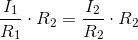

So in order to find the current in the radio, you need to know three things - the current  in the flashlight, which you know from the body of the problem; the resistance from the flashlight
  , which you know if you are given Statement 2; and the resistance from the radio
  , which you know if you are given Statement 1. Just substitute and solve.
Let
The variation equation here would be:
or equivalently:
So in order to find the current in the radio, you need to know three things - the current
← Didn't Know|Knew It →
Evaluate:

Statement 1: 
Statement 2: 
Evaluate:
Statement 1:
Statement 2:
Tap to reveal answer
The difference of two logarithms with the same base is the same-base logarithm of the quotient of the numbers. Therefore, we can simplify this expression as

We need only know the value of  , given to us in Statement 1, in order to evaluate this expression.
The difference of two logarithms with the same base is the same-base logarithm of the quotient of the numbers. Therefore, we can simplify this expression as
We need only know the value of
← Didn't Know|Knew It →
 is a positive integer
True or false?

Statement 1: 
Statement 2:  is even.
True or false?
Statement 1:
Statement 2:
Tap to reveal answer
By the zero product principle, we can solve by setting each linear binomial to zero and solving. This yields three solutions:



Neither statement alone narrows  to one of these three solutions, but the two together do.
By the zero product principle, we can solve by setting each linear binomial to zero and solving. This yields three solutions:
Neither statement alone narrows
← Didn't Know|Knew It →
Solve for  :
:

(1) 
(2) 
Solve for
(1)
(2)
Tap to reveal answer
Solution
To solve for x, we need the value of 

Therefore, we need both statements in order to solve for x.


 Or
Or 
 Or
Or 
Solution
To solve for x, we need the value of
Therefore, we need both statements in order to solve for x.
← Didn't Know|Knew It →
 is a rational number. True or false:
Statement 1: 
Statement 2: 
Statement 1:
Statement 2:
Tap to reveal answer
Assume Statement 1 alone.


Assume Statement 2 alone. If  , then either
  or
or  , so we can examine both scenarios.
Case 1:


This is identically false, so we dismiss this case.
Case 2:


Since each equation has only 7 as a solution, either statement alone is sufficient to identify  as a true statement.
Assume Statement 1 alone.
Assume Statement 2 alone. If
Case 1:
This is identically false, so we dismiss this case.
Case 2:
Since each equation has only 7 as a solution, either statement alone is sufficient to identify
← Didn't Know|Knew It →
True or false: 
Statement 1: 
Statement 2: 
True or false:
Statement 1:
Statement 2:
Tap to reveal answer
The absolute value of a positive number is that number; the absolute value of a negative number is the positive opposite.
Assume Statement 1 alone.


Either  , in which case
  , and
, and
or  , in which case
  .
.
Either  or
or  .
.
Assume Statement 2 alone.


Either  , in which case
  , and
, and
or  , in which case
  .
.
Either  or
or  .
.
Therefore, neither statement alone proves or disproves that  . But if both statements are true, then it must hold that
  , since this is the only solution of both statements. Therefore,
  can be proved false.
The absolute value of a positive number is that number; the absolute value of a negative number is the positive opposite.
Assume Statement 1 alone.
Either
or
Either
Assume Statement 2 alone.
Either
or
Either
Therefore, neither statement alone proves or disproves that
← Didn't Know|Knew It →
True or false: 
Statement 1: 
Statement 2: 
True or false:
Statement 1:
Statement 2:
Tap to reveal answer
Assume Statement 1 alone. The solutions of the equation can be found as follows:


The absolute value of a positive number is that number; the absolute value of a negative number is the positive opposite. If  , then
  . If
. If  , then
  also. Therefore, while the value of
  cannot be determined for certain,either way,
  is a true statement.
Assume Statement 2 alone. By substitution, we can see two values of  that make this true:


 , which is true.


 , which is also true.
One of these two solutions has absolute value 5, but the other does not. This makes it indefinite whether  .
.
Assume Statement 1 alone. The solutions of the equation can be found as follows:
The absolute value of a positive number is that number; the absolute value of a negative number is the positive opposite. If
Assume Statement 2 alone. By substitution, we can see two values of
One of these two solutions has absolute value 5, but the other does not. This makes it indefinite whether
← Didn't Know|Knew It →
 is a real number. True or false:
Statement 1: 
Statement 2: 
Statement 1:
Statement 2:
Tap to reveal answer
Assume Statement 1 alone. The absolute value of a positive number is that number; the absolute value of a negative number is the positive opposite. As can be seen from substitution, there are two solutions to the equation  -
-  and
and 
If  , the equation becomes


 , a true statement.
If  , the equation becomes


 , a true statement.
Therefore, that  cannot be proved or disproved.
Assume Statement 2 alone.
 can be rewritten with the decimal expression in fraction form as


Since if two powers of the same number are equal, the exponents are equal, it follows that  .
.
Assume Statement 1 alone. The absolute value of a positive number is that number; the absolute value of a negative number is the positive opposite. As can be seen from substitution, there are two solutions to the equation
If
If
Therefore, that
Assume Statement 2 alone.
Since if two powers of the same number are equal, the exponents are equal, it follows that
← Didn't Know|Knew It →
 is a real number. True or false:
  is positive.
Statement 1: 
Statement 2: The arithmetic mean of 100 and  is positive.
Statement 1:
Statement 2: The arithmetic mean of 100 and
Tap to reveal answer
Assume both statements are true. We show that we cannot determine for certain whether or not  is positive.
Case 1: 
 , satisfying the condition of Statement 1.
The arithmetic mean of 0 and 100 is half their sum, which is  , a positive number; the condition of Statement 2 is satisfied.
Case 2: 
 , satisfying the condition of Statement 1.
The arithmetic mean of 2 and 100 is half their sum, which is  , a positive number; the condition of Statement 2 is satisfied.
Therefore,  may or may not be positive.
Assume both statements are true. We show that we cannot determine for certain whether or not
Case 1:
The arithmetic mean of 0 and 100 is half their sum, which is
Case 2:
The arithmetic mean of 2 and 100 is half their sum, which is
Therefore,
← Didn't Know|Knew It →
 is a number not in the set
  .
.
Of the elements  , which is the greatest?
Statement 1:  is a negative number.
Statement 2: 
Of the elements
Statement 1:
Statement 2:
Tap to reveal answer
Assume Statement 1 alone. If  is a negative number, then of the three given powers of
  in the set, only
  (the only even power) is positive. This makes
  the greatest of the three, thereby giving an answer to the question.
We show that Statement 2 alone is inconclusive by examining two values of  whose absolute values are greater than 1 - namely,
  .
.
Case 1:  . Then
  and
and  , making
  the greatest number of the three.
Case 2:  . Then
  and
and  , making
  the greatest number of the three.
Assume Statement 1 alone. If
We show that Statement 2 alone is inconclusive by examining two values of
Case 1:
Case 2:
← Didn't Know|Knew It →
Solve for
Statement 1:
Statement 2:
Solve for
Statement 1:
Statement 2:
Tap to reveal answer
To solve for three unknowns, we need three equations. Here we have three equations if we use both statements 1 and 2. We don't need to solve any further. Because this is a data sufficiency question, it doesn't matter what the actual values of x, y, and z are. The important fact is the we could find them if we wanted to.
To solve for three unknowns, we need three equations. Here we have three equations if we use both statements 1 and 2. We don't need to solve any further. Because this is a data sufficiency question, it doesn't matter what the actual values of x, y, and z are. The important fact is the we could find them if we wanted to.
← Didn't Know|Knew It →
If , what is the value of ?
(1)
(2)
If
(1)
(2)
Tap to reveal answer
Therefore,
(1) If , then , and the value of can vary. NOT sufficient
(2) Subtracting both and 7 from each side of gives .
The value of can be determined. SUFFICIENT
Therefore,
(1) If
(2) Subtracting both
The value of
← Didn't Know|Knew It →