
Triangles - Geometry
Card 0 of 1188
An obtuse triangle has a base of  and an area of
  square units. Find the height of the triangle.
An obtuse triangle has a base of
To solve this solution, first work backwards using the formula:

Plugging in the given values we are able to solve for the height.



To solve this solution, first work backwards using the formula:
Plugging in the given values we are able to solve for the height.
Compare your answer with the correct one above
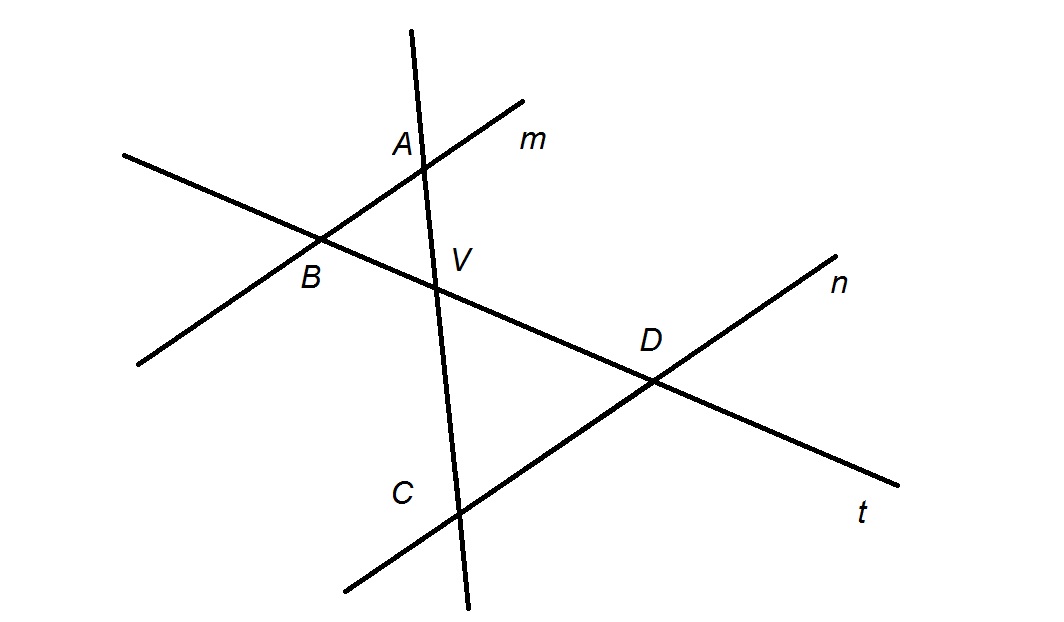
Refer to the above diagram.  .
.
True or false: From the information given, it follows that  .
.
Refer to the above diagram.
True or false: From the information given, it follows that
By the Angle-Angle Similarity Postulate, if two pairs of corresponding angles of a triangle are congruent, the triangles themselves are similar.
 and
and  are a pair of vertical angles, having the same vertex and having sides opposite each other. As such,
  .
.
 and
and  are alternating interior angles formed by two parallel lines
  and
and  cut by a transversal
  . As a consequence,
  .
.
The conditions of the Angle-Angle Similarity Postulate are satisfied, and it holds that  .
.
By the Angle-Angle Similarity Postulate, if two pairs of corresponding angles of a triangle are congruent, the triangles themselves are similar.
The conditions of the Angle-Angle Similarity Postulate are satisfied, and it holds that
Compare your answer with the correct one above
Two of the exterior angles of a triangle, taken at different vertices, measure  . Is the triangle acute, right, or obtuse?
Two of the exterior angles of a triangle, taken at different vertices, measure
At a given vertex, an exterior angle and an interior angle of a triangle form a linear pair, making them supplementary - that is, their measures total  . The measures of two interior angles can be calculated by subtracting the exterior angle measures from :

The triangle has two interior angles of measure  .
.
The measures of the interior angles of a triangle add up to . If  is the measure of the third angle, then




All three interior angles measure less than  , making them acute. The triangle is, by definition, acute.
At a given vertex, an exterior angle and an interior angle of a triangle form a linear pair, making them supplementary - that is, their measures total
The triangle has two interior angles of measure
The measures of the interior angles of a triangle add up to
All three interior angles measure less than
Compare your answer with the correct one above
Triangle one and triangle two are similar triangles. Triangle one has two sides with lengths  mm and
  mm. What are possible measurements for the corresponding sides in triangle two?
Triangle one and triangle two are similar triangles. Triangle one has two sides with lengths
Since the two triangles are similar, each triangles three corresponding sides must have the same ratio.
The ratio of triangle one is:

If we look at the possible solutions we will see that ratio that is in triangle one is also seen in the triangle with side lengths as follows:

Since the two triangles are similar, each triangles three corresponding sides must have the same ratio.
The ratio of triangle one is:
If we look at the possible solutions we will see that ratio that is in triangle one is also seen in the triangle with side lengths as follows:
Compare your answer with the correct one above
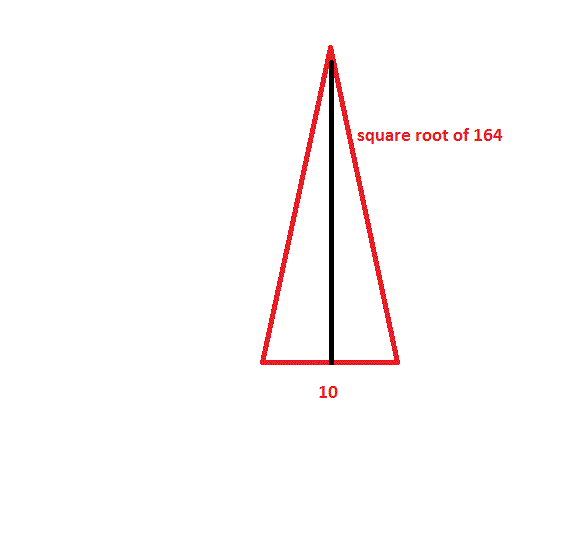
Find the height of the triangle shown above.
Find the height of the triangle shown above.
Use the Pythagorean Theorem to find the height of this triangle:  , where
  the height of the triangle.




Use the Pythagorean Theorem to find the height of this triangle:
Compare your answer with the correct one above
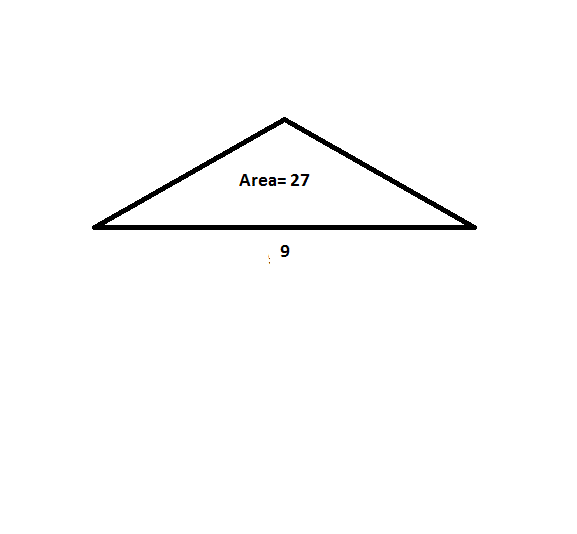
Find the height of the obtuse triangle shown above.
Find the height of the obtuse triangle shown above.
To solve this solution, first work backwards using the formula:

Plugging in the given values we are able to solve for the height.


To solve this solution, first work backwards using the formula:
Plugging in the given values we are able to solve for the height.
Compare your answer with the correct one above
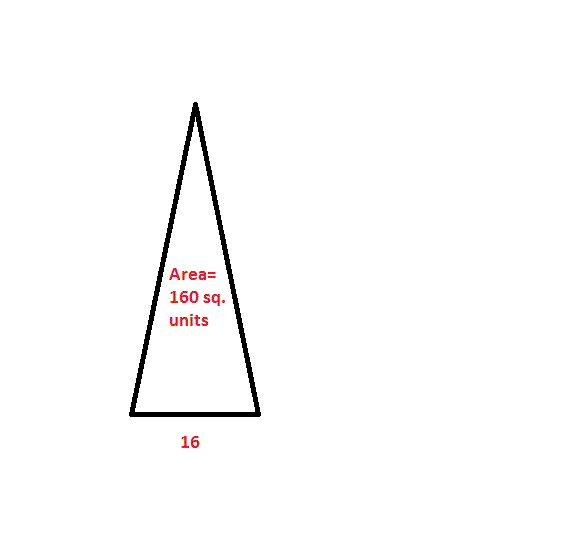
Find the height of the acute triangle shown above.
Find the height of the acute triangle shown above.
To solve this solution, work backwards using the formula:

Plugging in the given values we are able to solve for the height.



To solve this solution, work backwards using the formula:
Plugging in the given values we are able to solve for the height.
Compare your answer with the correct one above
Find the value of  if the perimeter is
  .
.

Find the value of
The dashes on the two sides of the triangle indicate that those two sides are congruent. Thus, the length of the missing side is  also.
also.
Now, use the information given about the perimeter to set up an equation to solve for  . The sum of all the sides will give the perimeter.


The dashes on the two sides of the triangle indicate that those two sides are congruent. Thus, the length of the missing side is
Now, use the information given about the perimeter to set up an equation to solve for
Compare your answer with the correct one above
 and
and  are both isosceles triangles;


True or false: from the given information, it follows that  .
.
True or false: from the given information, it follows that
As we are establishing whether or not  , then
  ,
,  , and
, and  correspond respectively to
  ,
,  , and
, and  .
.
 is an isosceles triangle, so it must have two congruent angles.
  has measure
  , so either
  has this measure,
  has this measure, or
  . If we examine the second case, it immediately follows that
  . One condition of the similarity of triangles is that all pairs of corresponding angles be congruent; since there is at least one case that violates this condition, it does not necessarily follow that
  . This makes the correct response "false".
As we are establishing whether or not
Compare your answer with the correct one above
An isoceles triangle has a vertex angle that is twenty more than twice the base angle. What is the difference between the vertex and base angles?
An isoceles triangle has a vertex angle that is twenty more than twice the base angle. What is the difference between the vertex and base angles?
A triangle has  degrees. An isoceles triangle has one vertex angle and two congruent base angles.
Let  = the base angle and
  = vertex angle
So the equation to solve becomes 
or

so the base angle is  and the vertex angle is
  and the difference is
  .
.
A triangle has
Let
So the equation to solve becomes
or
so the base angle is
Compare your answer with the correct one above
An ssosceles triangle has interior angles of  degrees and
  degrees. Find the missing angle.
An ssosceles triangle has interior angles of
Isosceles triangles always have two equivalent interior angles, and all three interior angles of any triangle always have a sum of  degrees.
Thus, the solution is:


Isosceles triangles always have two equivalent interior angles, and all three interior angles of any triangle always have a sum of
Thus, the solution is:
Compare your answer with the correct one above
The largest angle in an obtuse isosceles triangle is  degrees. Find the measurement of one of the two equivalent interior angles.
The largest angle in an obtuse isosceles triangle is
Isosceles triangles always have two equivalent interior angles, and all three interior angles of any triangle always have a sum of  degrees. Since this is an obtuse isosceles triangle, the two missing angles must be acute angles.
Thus, the solution is:


Isosceles triangles always have two equivalent interior angles, and all three interior angles of any triangle always have a sum of
Thus, the solution is:
Compare your answer with the correct one above
The two equivalent interior angles of an obtuse isosceles triangle each have a measurement of  degrees. Find the measurement of the obtuse angle.
The two equivalent interior angles of an obtuse isosceles triangle each have a measurement of
Isosceles triangles always have two equivalent interior angles, and all three interior angles of any triangle always have a sum of  degrees.
Thus, the solution is:


Isosceles triangles always have two equivalent interior angles, and all three interior angles of any triangle always have a sum of
Thus, the solution is:
Compare your answer with the correct one above
In an obtuse isosceles triangle the angle measurements are,  ,
,  , and
, and  . Find the measurement of one of the acute angles.
In an obtuse isosceles triangle the angle measurements are,
Isosceles triangles always have two equivalent interior angles, and all three interior angles of any triangle always have a sum of degrees. Since this is an obtuse isosceles triangle, the two missing angles must be acute angles.
The solution is:

However,  degrees is the measurement of both of the acute angles combined.
Each individual angle is  .
.
Isosceles triangles always have two equivalent interior angles, and all three interior angles of any triangle always have a sum of
The solution is:
However,
Each individual angle is
Compare your answer with the correct one above
In an acute isosceles triangle the two equivalent interior angles each have a measurement of  degrees. Find the missing angle.
In an acute isosceles triangle the two equivalent interior angles each have a measurement of
Isosceles triangles always have two equivalent interior angles, and all three interior angles of any triangle always have a sum of degrees. Since this is an acute isosceles triangle, all of the interior angles must be acute angles.
The solution is:


Isosceles triangles always have two equivalent interior angles, and all three interior angles of any triangle always have a sum of
The solution is:
Compare your answer with the correct one above
In an acute isosceles triangle the two equivalent interior angles are each  degrees. Find the missing angle.
In an acute isosceles triangle the two equivalent interior angles are each
Isosceles triangles always have two equivalent interior angles, and all three interior angles of any triangle always have a sum of degrees. Since this is an acute isosceles triangle, all of the interior angles must be acute angles.
The solution is:


Isosceles triangles always have two equivalent interior angles, and all three interior angles of any triangle always have a sum of
The solution is:
Compare your answer with the correct one above
The largest angle in an obtuse isosceles triangle is  degrees. Find the measurement of one of the equivalent interior angles.
The largest angle in an obtuse isosceles triangle is
Isosceles triangles always have two equivalent interior angles, and all three interior angles of any triangle always have a sum of degrees. Since this is an obtuse Isosceles triangle, the two missing angles must be acute angles.
Thus, the solution is:


Isosceles triangles always have two equivalent interior angles, and all three interior angles of any triangle always have a sum of
Thus, the solution is:
Compare your answer with the correct one above
In an obtuse isosceles triangle the largest angle is  degrees. Find the measurement of one of the acute angles.
In an obtuse isosceles triangle the largest angle is
Isosceles triangles always have two equivalent interior angles, and all three interior angles of any triangle always have a sum of degrees. Since this is an obtuse isosceles triangle, the two missing angles must be acute angles.
The solution is:


Isosceles triangles always have two equivalent interior angles, and all three interior angles of any triangle always have a sum of
The solution is:
Compare your answer with the correct one above
In an acute isosceles triangle the measurement of the non-equivalent interior angle is  degrees. Find the measurement of one of the equivalent interior angles.
In an acute isosceles triangle the measurement of the non-equivalent interior angle is
Isosceles triangles always have two equivalent interior angles, and all three interior angles of any triangle always have a sum of degrees. Since this is an acute isosceles triangle, all of the interior angles must be acute angles.
The solution is:


Isosceles triangles always have two equivalent interior angles, and all three interior angles of any triangle always have a sum of
The solution is:
Compare your answer with the correct one above
In an obtuse isosceles triangle, the largest interior angle is  degrees. What is the measurement of one of the equivalent interior angles?
In an obtuse isosceles triangle, the largest interior angle is
Isosceles triangles always have two equivalent interior angles, and all three interior angles of any triangle always have a sum of degrees. Since this is an obtuse isosceles triangle, the two missing angles must be acute angles.
The solution is:


Isosceles triangles always have two equivalent interior angles, and all three interior angles of any triangle always have a sum of
The solution is:
Compare your answer with the correct one above