
Quadrilaterals - Geometry
Card 1 of 600
If the area of a kite is  square units, and one diagonal is
  units longer than the other, what is the length of the shorter diagonal?
If the area of a kite is
Tap to reveal answer
Let  be the length of the shorter diagonal. Then the length of the longer diagonal can be represented by
  .
.
Recall how to find the area of a kite:

Plug in the given area and solve for  .
.


Since we are dealing with geometric shapes, the answer must be a positive value. Thus,  .
.
The length of the shorter diagonal is  units long.
Let
Recall how to find the area of a kite:
Plug in the given area and solve for
Since we are dealing with geometric shapes, the answer must be a positive value. Thus,
The length of the shorter diagonal is
← Didn't Know|Knew It →
If the area of a kite is  square units, and one diagonal is
  units longer than the other, what is the length of the longer diagonal?
If the area of a kite is
Tap to reveal answer
Let  be the length of the shorter diagonal. Then the length of the longer diagonal can be represented by
  .
.
Recall how to find the area of a kite:

Plug in the given area and solve for  .
.


Since we are dealing with geometric shapes, the answer must be a positive value. Thus,  .
.
To find the longer diagonal, add  .
.
The length of the longer diagonal is  units long.
Let
Recall how to find the area of a kite:
Plug in the given area and solve for
Since we are dealing with geometric shapes, the answer must be a positive value. Thus,
To find the longer diagonal, add
The length of the longer diagonal is
← Didn't Know|Knew It →
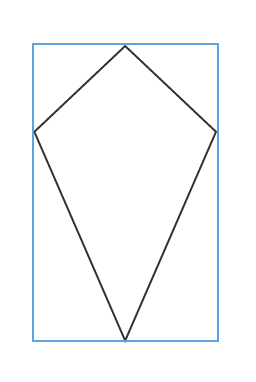
The area of the rectangle is  , what is the area of the kite?
The area of the rectangle is
Tap to reveal answer
The area of a kite is half the product of the diagonals.

The diagonals of the kite are the height and width of the rectangle it is superimposed in, and we know that because the area of a rectangle is base times height.
Therefore our equation becomes:
 .
.
We also know the area of the rectangle is  . Substituting this value in we get the following:

Thus,, the area of the kite is  .
.
The area of a kite is half the product of the diagonals.
The diagonals of the kite are the height and width of the rectangle it is superimposed in, and we know that because the area of a rectangle is base times height.
Therefore our equation becomes:
We also know the area of the rectangle is
Thus,, the area of the kite is
← Didn't Know|Knew It →
Given: Quadrilateral  such that
  ,
,  ,
,  ,
,  is a right angle, and diagonal
  has length 24.
Give the length of diagonal  .
.
Given: Quadrilateral
Give the length of diagonal
Tap to reveal answer
The Quadrilateral  is shown below with its diagonals and .
. We call the point of intersection  :
:
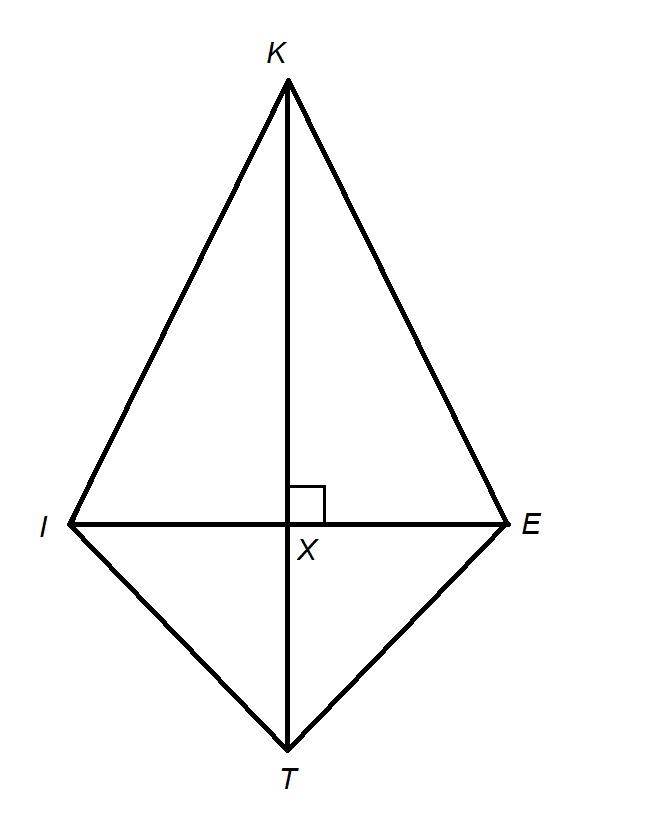
The diagonals of a quadrilateral with two pairs of adjacent congruent sides - a kite - are perpendicular; also,  bisects the
  and
and  angles of the kite. Consequently,
  is a 30-60-90 triangle and
  is a 45-45-90 triangle. Also, the diagonal that connects the common vertices of the pairs of adjacent sides bisects the other diagonal, making
  the midpoint of
  . Therefore,
 .
.
By the 30-60-90 Theorem, since  and
and  are the short and long legs of ,

By the 45-45-90 Theorem, since  and
and  are the legs of a 45-45-90 Theorem,
 .
.
The diagonal  has length
 .
.
The Quadrilateral
. We call the point of intersection
The diagonals of a quadrilateral with two pairs of adjacent congruent sides - a kite - are perpendicular; also,
By the 30-60-90 Theorem, since
By the 45-45-90 Theorem, since
The diagonal
← Didn't Know|Knew It →
A kite has two perpendicular interior diagonals. One diagonal is twice the length of the other diagonal. The total area of the kite is  . Find the length of each interior diagonal.
A kite has two perpendicular interior diagonals. One diagonal is twice the length of the other diagonal. The total area of the kite is
Tap to reveal answer
To solve this problem, apply the formula for finding the area of a kite:

However, in this problem the question only provides information regarding the exact area. The lengths of the diagonals are represented as a ratio, where

Therefore, it is necessary to plug the provided information into the area formula. Diagonal  is represented by
  and diagonal
 .
.
The solution is:


Thus, if  , then diagonal
  must equal
To solve this problem, apply the formula for finding the area of a kite:
However, in this problem the question only provides information regarding the exact area. The lengths of the diagonals are represented as a ratio, where
Therefore, it is necessary to plug the provided information into the area formula. Diagonal
The solution is:
Thus, if
← Didn't Know|Knew It →
A kite has two perpendicular interior diagonals. One diagonal has a measurement of  and the area of the kite is
  . Find the length of the other interior diagonal.
A kite has two perpendicular interior diagonals. One diagonal has a measurement of
Tap to reveal answer
This problem can be solved by applying the area formula:
Since this question provides the area of the kite and length of one diagonal, plug that information into the equation to solve for the missing diagonal.
Thus the solution is:


This problem can be solved by applying the area formula:
Since this question provides the area of the kite and length of one diagonal, plug that information into the equation to solve for the missing diagonal.
Thus the solution is:
← Didn't Know|Knew It →

Using the kite shown above, find the length of the red (vertical) diagonal.
Using the kite shown above, find the length of the red (vertical) diagonal.
Tap to reveal answer
In order to solve this problem, first observe that the red diagonal line divides the kite into two triangles that each have side lengths of  and
and  Notice, the hypotenuse of the interior triangle is the red diagonal. Therefore, use the Pythagorean theorem:
  , where
  the length of the red diagonal.
The solution is:


In order to solve this problem, first observe that the red diagonal line divides the kite into two triangles that each have side lengths of
The solution is:
← Didn't Know|Knew It →
A kite has two perpendicular interior diagonals. One diagonal has a measurement of  and the area of the kite is
  . Find the length of the other interior diagonal.
A kite has two perpendicular interior diagonals. One diagonal has a measurement of
Tap to reveal answer
This problem can be solved by applying the area formula:
Since this question provides the area of the kite and length of one diagonal, plug that information into the equation to solve for the missing diagonal.
Thus the solution is:


This problem can be solved by applying the area formula:
Since this question provides the area of the kite and length of one diagonal, plug that information into the equation to solve for the missing diagonal.
Thus the solution is:
← Didn't Know|Knew It →
A kite has two perpendicular interior diagonals. One diagonal has a measurement of  and the area of the kite is
  . Find the sum of the two perpendicular interior diagonals.
A kite has two perpendicular interior diagonals. One diagonal has a measurement of
Tap to reveal answer
First find the length of the missing diagonal before you can find the sum of the two perpendicular diagonals.
To find the missing diagonal, apply the area formula:
This question provides the area of the kite and length of one diagonal, plug that information into the equation to solve for the missing diagonal.


Therefore, the sum of the two diagonals is:

First find the length of the missing diagonal before you can find the sum of the two perpendicular diagonals.
To find the missing diagonal, apply the area formula:
This question provides the area of the kite and length of one diagonal, plug that information into the equation to solve for the missing diagonal.
Therefore, the sum of the two diagonals is:
← Didn't Know|Knew It →
A kite has two perpendicular interior diagonals. One diagonal has a measurement of  and the area of the kite is
  . Find the sum of the two perpendicular interior diagonals.
A kite has two perpendicular interior diagonals. One diagonal has a measurement of
Tap to reveal answer
You must find the length of the missing diagonal before you can find the sum of the two perpendicular diagonals.
To find the missing diagonal, apply the area formula:
This question provides the area of the kite and length of one diagonal, plug that information into the equation to solve for the missing diagonal.


Therefore, the sum of the two diagonals is:

You must find the length of the missing diagonal before you can find the sum of the two perpendicular diagonals.
To find the missing diagonal, apply the area formula:
This question provides the area of the kite and length of one diagonal, plug that information into the equation to solve for the missing diagonal.
Therefore, the sum of the two diagonals is:
← Didn't Know|Knew It →

The area of the kite shown above is  and the red diagonal has a length of
  . Find the length of the black (horizontal) diagonal.
The area of the kite shown above is
Tap to reveal answer
To find the length of the black diagonal apply the area formula:
Since this question provides the area of the kite and length of one diagonal, plug that information into the equation to solve for the missing diagonal.
Thus the solution is:


To find the length of the black diagonal apply the area formula:
Since this question provides the area of the kite and length of one diagonal, plug that information into the equation to solve for the missing diagonal.
Thus the solution is:
← Didn't Know|Knew It →
A kite has two perpendicular interior diagonals. One diagonal has a measurement of  and the area of the kite is
  . Find the length of the other interior diagonal.
A kite has two perpendicular interior diagonals. One diagonal has a measurement of
Tap to reveal answer
This problem can be solved by applying the area formula:
Since this question provides the area of the kite and length of one diagonal, plug that information into the equation to solve for the missing diagonal.
Thus the solution is:


This problem can be solved by applying the area formula:
Since this question provides the area of the kite and length of one diagonal, plug that information into the equation to solve for the missing diagonal.
Thus the solution is:
← Didn't Know|Knew It →
A kite has two perpendicular interior diagonals. One diagonal has a measurement of  and the area of the kite is
  . Find the sum of the two perpendicular interior diagonals.
A kite has two perpendicular interior diagonals. One diagonal has a measurement of
Tap to reveal answer
You must find the length of the missing diagonal before you can find the sum of the two perpendicular diagonals.
To find the missing diagonal, apply the area formula:
This question provides the area of the kite and length of one diagonal, plug that information into the equation to solve for the missing diagonal.


Therefore, the sum of the two diagonals is:

You must find the length of the missing diagonal before you can find the sum of the two perpendicular diagonals.
To find the missing diagonal, apply the area formula:
This question provides the area of the kite and length of one diagonal, plug that information into the equation to solve for the missing diagonal.
Therefore, the sum of the two diagonals is:
← Didn't Know|Knew It →
A kite has two perpendicular interior diagonals. One diagonal has a measurement of  and the area of the kite is
  . Find the length of the other interior diagonal.
A kite has two perpendicular interior diagonals. One diagonal has a measurement of
Tap to reveal answer
This problem can be solved by applying the area formula:
Since this question provides the area of the kite and length of one diagonal, plug that information into the equation to solve for the missing diagonal.
Thus the solution is:


This problem can be solved by applying the area formula:
Since this question provides the area of the kite and length of one diagonal, plug that information into the equation to solve for the missing diagonal.
Thus the solution is:
← Didn't Know|Knew It →
A kite has two perpendicular interior diagonals. One diagonal has a measurement of  and the area of the kite is
  . Find the sum of the two perpendicular interior diagonals.
A kite has two perpendicular interior diagonals. One diagonal has a measurement of
Tap to reveal answer
First find the length of the missing diagonal before you can find the sum of the two perpendicular diagonals.
To find the missing diagonal, apply the area formula:
This question provides the area of the kite and length of one diagonal, plug that information into the equation to solve for the missing diagonal.


Therefore, the sum of the two diagonals is:

First find the length of the missing diagonal before you can find the sum of the two perpendicular diagonals.
To find the missing diagonal, apply the area formula:
This question provides the area of the kite and length of one diagonal, plug that information into the equation to solve for the missing diagonal.
Therefore, the sum of the two diagonals is:
← Didn't Know|Knew It →
A kite has two perpendicular interior diagonals. One diagonal has a measurement of  and the area of the kite is
  . Find the length of the other interior diagonal.
A kite has two perpendicular interior diagonals. One diagonal has a measurement of
Tap to reveal answer
This problem can be solved by applying the area formula:
Since this question provides the area of the kite and length of one diagonal, plug that information into the equation to solve for the missing diagonal.
Thus the solution is:


This problem can be solved by applying the area formula:
Since this question provides the area of the kite and length of one diagonal, plug that information into the equation to solve for the missing diagonal.
Thus the solution is:
← Didn't Know|Knew It →
If the length of the shorter diagonal is four, what is the length of the longer diagonal of this kite?

If the length of the shorter diagonal is four, what is the length of the longer diagonal of this kite?
Tap to reveal answer
We can find the longer diagonal by adding together the altitude of the top triangle and the altitude of the bottom triangle. To find these, use Pythagorean Theorem. We can use Pythagorean Theorem because one of the properties of a kite is that the two diagonals are perpendicular.
The top triangle has two sides of length 3 \[labeled in the picture\], and a base of 4 \[provided in the written directions\]. To figure out the altitude, split this triangle into 2 right triangles. The two legs are x \[the altitude\] and 2 \[half of the base 4\], and the hypotenuse is 3:

 subtract 4 from both sides
 take the square root of both sides

We will do something similar for the bottom triangle. Consider one of the right triangles. It will have a hypotenuse of 7, one leg that we don't know, x \[the altitude\], and one leg 2 \[half the shorter diagonal\]. Set up the equation using the Pythagorean Theorem:

 subtract 4 from both sides
 take the square root of both sides

That can be simplified by considering 45 as the product of  . Since the square root of 9 is 3, we can re-write
  as
as  .
.
Adding together the first answer of  plus
plus  gives
gives  .
.
We can find the longer diagonal by adding together the altitude of the top triangle and the altitude of the bottom triangle. To find these, use Pythagorean Theorem. We can use Pythagorean Theorem because one of the properties of a kite is that the two diagonals are perpendicular.
The top triangle has two sides of length 3 \[labeled in the picture\], and a base of 4 \[provided in the written directions\]. To figure out the altitude, split this triangle into 2 right triangles. The two legs are x \[the altitude\] and 2 \[half of the base 4\], and the hypotenuse is 3:
We will do something similar for the bottom triangle. Consider one of the right triangles. It will have a hypotenuse of 7, one leg that we don't know, x \[the altitude\], and one leg 2 \[half the shorter diagonal\]. Set up the equation using the Pythagorean Theorem:
That can be simplified by considering 45 as the product of
Adding together the first answer of
← Didn't Know|Knew It →
Find the length of the diagonals of the kite.

Find the length of the diagonals of the kite.
Tap to reveal answer
-
The two diagonals are  and
and  .
.
-
To find  , use the Law of Cosines and either
  or
or  , because either angle is opposite .
-
Using  ,
,  , and the Law of Cosines is


-
To find  , use the Law of Cosines using either
 or
or  , because either angle is opposite .
-
Using  ,
,  , and the Law of Cosines is


-
The two diagonals are
-
To find
-
Using
-
To find
-
Using
← Didn't Know|Knew It →
A kite has an area of  square units, and one diagonal is
  units longer than the other. In unites, what is the length of the shorter diagonal?
A kite has an area of
Tap to reveal answer
Let  be the length of the shorter diagonal. Then the length of the longer diagonal can be represented by
  .
.
Recall how to find the area of a kite:

Plug in the given area and solve for  .
.


Since we are dealing with geometric shapes, the answer must be a positive value. Thus,  .
.
The length of the shorter diagonal is  units long.
Let
Recall how to find the area of a kite:
Plug in the given area and solve for
Since we are dealing with geometric shapes, the answer must be a positive value. Thus,
The length of the shorter diagonal is
← Didn't Know|Knew It →
If the area of a kite is  square units, and one diagonal is
  units longer than the other.
If the area of a kite is
Tap to reveal answer
Let  be the length of the shorter diagonal. Then the length of the longer diagonal can be represented by
  .
.
Recall how to find the area of a kite:

Plug in the given area and solve for  .
.


Since we are dealing with geometric shapes, the answer must be a positive value. Thus,  .
.
The length of the shorter diagonal is  units long.
Let
Recall how to find the area of a kite:
Plug in the given area and solve for
Since we are dealing with geometric shapes, the answer must be a positive value. Thus,
The length of the shorter diagonal is
← Didn't Know|Knew It →