
Hexagons - Geometry
Card 0 of 608

In the regular hexagon above, if the length of diagonal  is
is  , what is the area of the hexagon?
In the regular hexagon above, if the length of diagonal

When all the diagonals of a hexagon are drawn in, you should notice that the long diagonals, marked by solid lines, form  congruent equilateral triangles. You should also notice that the other diagonals drawn in with dashed lines are also the heights of two of the equilateral triangles.
Start by using the diagonal to find the length of a side of the hexagon.
Cut the diagonal in half so that we are just left with the height of one equilateral triangle. Notice that the height cleaves the equilateral triangle into two congruent  triangles whose sides are in the ratios of
  .
.
Set up a proportion to solve for the length of a side of the triangle.


Plug in the given diagonal to solve for the side length.

Now, recall how to find the area of a regular hexagon:

Plug in the side length that you just found in order to find the area.

Make sure to round to  places after the decimal.
When all the diagonals of a hexagon are drawn in, you should notice that the long diagonals, marked by solid lines, form
Start by using the diagonal to find the length of a side of the hexagon.
Cut the diagonal in half so that we are just left with the height of one equilateral triangle. Notice that the height cleaves the equilateral triangle into two congruent
Set up a proportion to solve for the length of a side of the triangle.
Plug in the given diagonal to solve for the side length.
Now, recall how to find the area of a regular hexagon:
Plug in the side length that you just found in order to find the area.
Make sure to round to
Compare your answer with the correct one above
In the regular hexagon above, if the length of diagonal  is
is  , what is the area of the hexagon?
In the regular hexagon above, if the length of diagonal
When all the diagonals of a hexagon are drawn in, you should notice that the long diagonals, marked by solid lines, form  congruent equilateral triangles. You should also notice that the other diagonals drawn in with dashed lines are also the heights of two of the equilateral triangles.
Start by using the diagonal to find the length of a side of the hexagon.
Cut the diagonal in half so that we are just left with the height of one equilateral triangle. Notice that the height cleaves the equilateral triangle into two congruent  triangles whose sides are in the ratios of
  .
.
Set up a proportion to solve for the length of a side of the triangle.


Plug in the given diagonal to solve for the side length.

Now, recall how to find the area of a regular hexagon:

Plug in the side length that you just found in order to find the area.

Make sure to round to  places after the decimal.
When all the diagonals of a hexagon are drawn in, you should notice that the long diagonals, marked by solid lines, form
Start by using the diagonal to find the length of a side of the hexagon.
Cut the diagonal in half so that we are just left with the height of one equilateral triangle. Notice that the height cleaves the equilateral triangle into two congruent
Set up a proportion to solve for the length of a side of the triangle.
Plug in the given diagonal to solve for the side length.
Now, recall how to find the area of a regular hexagon:
Plug in the side length that you just found in order to find the area.
Make sure to round to
Compare your answer with the correct one above
In the regular hexagon above, if the length of diagonal  is
is  , what is the area of the hexagon?
In the regular hexagon above, if the length of diagonal
When all the diagonals of a hexagon are drawn in, you should notice that the long diagonals, marked by solid lines, form  congruent equilateral triangles. You should also notice that the other diagonals drawn in with dashed lines are also the heights of two of the equilateral triangles.
Start by using the diagonal to find the length of a side of the hexagon.
Cut the diagonal in half so that we are just left with the height of one equilateral triangle. Notice that the height cleaves the equilateral triangle into two congruent  triangles whose sides are in the ratios of
  .
.
Set up a proportion to solve for the length of a side of the triangle.


Plug in the given diagonal to solve for the side length.

Now, recall how to find the area of a regular hexagon:

Plug in the side length that you just found in order to find the area.

Make sure to round to  places after the decimal.
When all the diagonals of a hexagon are drawn in, you should notice that the long diagonals, marked by solid lines, form
Start by using the diagonal to find the length of a side of the hexagon.
Cut the diagonal in half so that we are just left with the height of one equilateral triangle. Notice that the height cleaves the equilateral triangle into two congruent
Set up a proportion to solve for the length of a side of the triangle.
Plug in the given diagonal to solve for the side length.
Now, recall how to find the area of a regular hexagon:
Plug in the side length that you just found in order to find the area.
Make sure to round to
Compare your answer with the correct one above
In the regular hexagon above, if diagonal  has a length of
  , what is the area of the hexagon?
In the regular hexagon above, if diagonal
When all the diagonals of a hexagon are drawn in, you should notice that the long diagonals, marked by solid lines, form  congruent equilateral triangles. You should also notice that the other diagonals drawn in with dashed lines are also the heights of two of the equilateral triangles.
Start by using the diagonal to find the length of a side of the hexagon.
Cut the diagonal in half so that we are just left with the height of one equilateral triangle. Notice that the height cleaves the equilateral triangle into two congruent  triangles whose sides are in the ratios of
  .
.
Set up a proportion to solve for the length of a side of the triangle.


Plug in the given diagonal to solve for the side length.

Now, recall how to find the area of a regular hexagon:

Plug in the side length that you just found in order to find the area.

Make sure to round to  places after the decimal.
When all the diagonals of a hexagon are drawn in, you should notice that the long diagonals, marked by solid lines, form
Start by using the diagonal to find the length of a side of the hexagon.
Cut the diagonal in half so that we are just left with the height of one equilateral triangle. Notice that the height cleaves the equilateral triangle into two congruent
Set up a proportion to solve for the length of a side of the triangle.
Plug in the given diagonal to solve for the side length.
Now, recall how to find the area of a regular hexagon:
Plug in the side length that you just found in order to find the area.
Make sure to round to
Compare your answer with the correct one above
In the regular hexagon above, if diagonal  has a length of
  , what is the area of the hexagon?
In the regular hexagon above, if diagonal
When all the diagonals of a hexagon are drawn in, you should notice that the long diagonals, marked by solid lines, form  congruent equilateral triangles. You should also notice that the other diagonals drawn in with dashed lines are also the heights of two of the equilateral triangles.
Start by using the diagonal to find the length of a side of the hexagon.
Cut the diagonal in half so that we are just left with the height of one equilateral triangle. Notice that the height cleaves the equilateral triangle into two congruent  triangles whose sides are in the ratios of
  .
.
Set up a proportion to solve for the length of a side of the triangle.


Plug in the given diagonal to solve for the side length.

Now, recall how to find the area of a regular hexagon:

Plug in the side length that you just found in order to find the area.

Make sure to round to  places after the decimal.
When all the diagonals of a hexagon are drawn in, you should notice that the long diagonals, marked by solid lines, form
Start by using the diagonal to find the length of a side of the hexagon.
Cut the diagonal in half so that we are just left with the height of one equilateral triangle. Notice that the height cleaves the equilateral triangle into two congruent
Set up a proportion to solve for the length of a side of the triangle.
Plug in the given diagonal to solve for the side length.
Now, recall how to find the area of a regular hexagon:
Plug in the side length that you just found in order to find the area.
Make sure to round to
Compare your answer with the correct one above
In the regular hexagon above, if diagonal  has a length of
  , what is the area of the hexagon?
In the regular hexagon above, if diagonal
When all the diagonals of a hexagon are drawn in, you should notice that the long diagonals, marked by solid lines, form  congruent equilateral triangles. You should also notice that the other diagonals drawn in with dashed lines are also the heights of two of the equilateral triangles.
Start by using the diagonal to find the length of a side of the hexagon.
Cut the diagonal in half so that we are just left with the height of one equilateral triangle. Notice that the height cleaves the equilateral triangle into two congruent  triangles whose sides are in the ratios of
  .
.
Set up a proportion to solve for the length of a side of the triangle.


Plug in the given diagonal to solve for the side length.

Now, recall how to find the area of a regular hexagon:

Plug in the side length that you just found in order to find the area.

Make sure to round to  places after the decimal.
When all the diagonals of a hexagon are drawn in, you should notice that the long diagonals, marked by solid lines, form
Start by using the diagonal to find the length of a side of the hexagon.
Cut the diagonal in half so that we are just left with the height of one equilateral triangle. Notice that the height cleaves the equilateral triangle into two congruent
Set up a proportion to solve for the length of a side of the triangle.
Plug in the given diagonal to solve for the side length.
Now, recall how to find the area of a regular hexagon:
Plug in the side length that you just found in order to find the area.
Make sure to round to
Compare your answer with the correct one above
In the regular hexagon above, if diagonal  is
is  , what is the area of the hexagon?
In the regular hexagon above, if diagonal
When all the diagonals of a hexagon are drawn in, you should notice that the long diagonals, marked by solid lines, form  congruent equilateral triangles. You should also notice that the other diagonals drawn in with dashed lines are also the heights of two of the equilateral triangles.
Start by using the diagonal to find the length of a side of the hexagon.
Cut the diagonal in half so that we are just left with the height of one equilateral triangle. Notice that the height cleaves the equilateral triangle into two congruent  triangles whose sides are in the ratios of
  .
.
Set up a proportion to solve for the length of a side of the triangle.


Plug in the given diagonal to solve for the side length.

Now, recall how to find the area of a regular hexagon:

Plug in the side length that you just found in order to find the area.

Make sure to round to  places after the decimal.
When all the diagonals of a hexagon are drawn in, you should notice that the long diagonals, marked by solid lines, form
Start by using the diagonal to find the length of a side of the hexagon.
Cut the diagonal in half so that we are just left with the height of one equilateral triangle. Notice that the height cleaves the equilateral triangle into two congruent
Set up a proportion to solve for the length of a side of the triangle.
Plug in the given diagonal to solve for the side length.
Now, recall how to find the area of a regular hexagon:
Plug in the side length that you just found in order to find the area.
Make sure to round to
Compare your answer with the correct one above
In the regular hexagon above, if diagonal  has a length of
  , what is the area of the hexagon?
In the regular hexagon above, if diagonal
When all the diagonals of a hexagon are drawn in, you should notice that the long diagonals, marked by solid lines, form  congruent equilateral triangles. You should also notice that the other diagonals drawn in with dashed lines are also the heights of two of the equilateral triangles.
Start by using the diagonal to find the length of a side of the hexagon.
Cut the diagonal in half so that we are just left with the height of one equilateral triangle. Notice that the height cleaves the equilateral triangle into two congruent  triangles whose sides are in the ratios of
  .
.
Set up a proportion to solve for the length of a side of the triangle.


Plug in the given diagonal to solve for the side length.

Now, recall how to find the area of a regular hexagon:

Plug in the side length that you just found in order to find the area.

Make sure to round to  places after the decimal.
When all the diagonals of a hexagon are drawn in, you should notice that the long diagonals, marked by solid lines, form
Start by using the diagonal to find the length of a side of the hexagon.
Cut the diagonal in half so that we are just left with the height of one equilateral triangle. Notice that the height cleaves the equilateral triangle into two congruent
Set up a proportion to solve for the length of a side of the triangle.
Plug in the given diagonal to solve for the side length.
Now, recall how to find the area of a regular hexagon:
Plug in the side length that you just found in order to find the area.
Make sure to round to
Compare your answer with the correct one above
A single hexagonal cell of a honeycomb is two centimeters in diameter.

What’s the area of the cell to the nearest tenth of a centimeter?
A single hexagonal cell of a honeycomb is two centimeters in diameter.
What’s the area of the cell to the nearest tenth of a centimeter?
How do you find the area of a hexagon?
There are several ways to find the area of a hexagon.
- In a regular hexagon, split the figure into triangles.
- Find the area of one triangle.
- Multiply this value by six.
Alternatively, the area can be found by calculating one-half of the side length times the apothem.
Regular hexagons:
Regular hexagons are interesting polygons. Hexagons are six sided figures and possess the following shape:
In a regular hexagon, all sides equal the same length and all interior angles have the same measure; therefore, we can write the following expression.

One of the easiest methods that can be used to find the area of a polygon is to split the figure into triangles. Let's start by splitting the hexagon into six triangles.
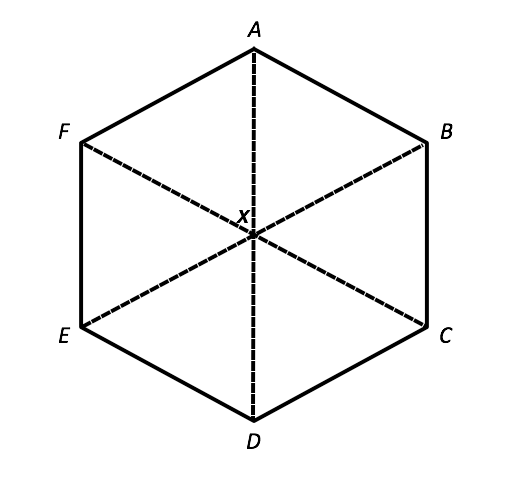
In this figure, the center point,  , is equidistant from all of the vertices. As a result, the six dotted lines within the hexagon are the same length. Likewise, all of the triangles within the hexagon are congruent by the side-side-side rule: each of the triangle's share two sides inside the hexagon as well as a base side that makes up the perimeter of the hexagon. In a similar fashion, each of the triangles have the same angles. There are
  in a circle and the hexagon in our image has separated it into six equal parts; therefore, we can write the following:
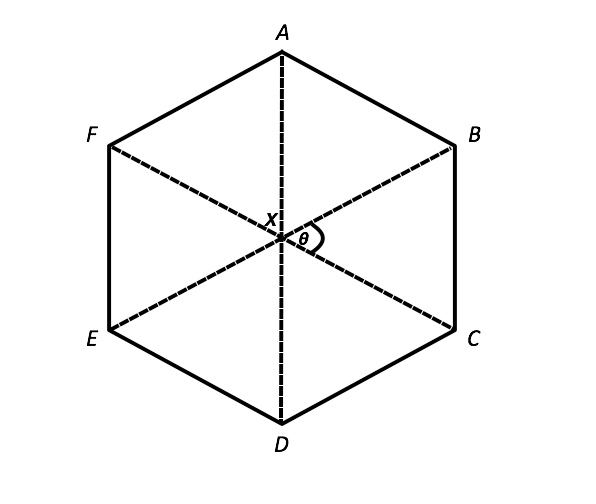


We also know the following:

Now, let's look at each of the triangles in the hexagon. We know that each triangle has two two sides that are equal; therefore, each of the base angles of each triangle must be the same. We know that a triangle has  and we can solve for the two base angles of each triangle using this information.



Each angle in the triangle equals  . We now know that all the triangles are congruent and equilateral: each triangle has three equal side lengths and three equal angles. Now, we can use this vital information to solve for the hexagon's area. If we find the area of one of the triangles, then we can multiply it by six in order to calculate the area of the entire figure. Let's start by analyzing
  . If we draw, an altitude through the triangle, then we find that we create two
  triangles.
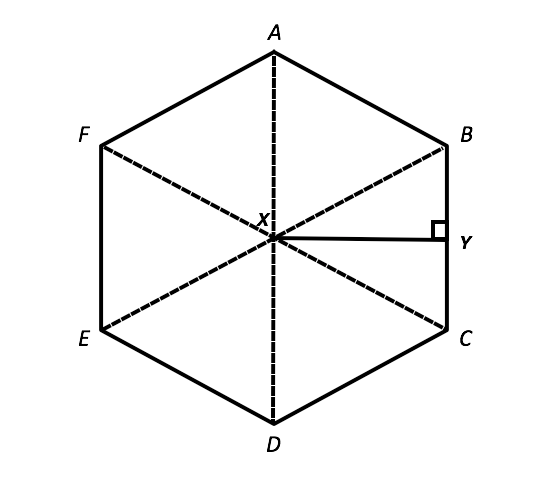
Let's solve for the length of this triangle. Remember that in  triangles, triangles possess side lengths in the following ratio:

Now, we can analyze  using the a substitute variable for side length,
  .
.
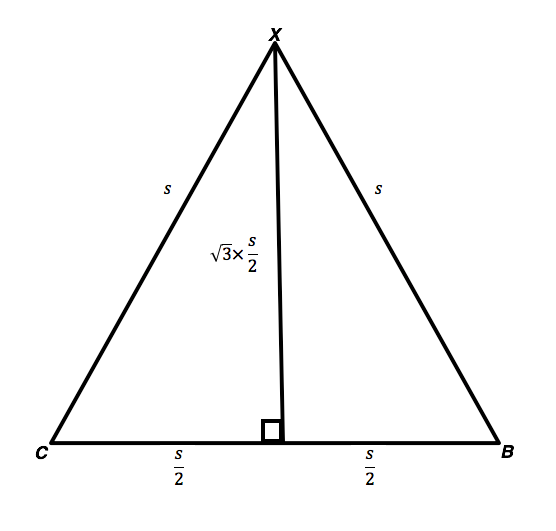
We know the measure of both the base and height of  and we can solve for its area.


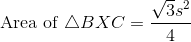
Now, we need to multiply this by six in order to find the area of the entire hexagon.



We have solved for the area of a regular hexagon with side length,  . If we know the side length of a regular hexagon, then we can solve for the area.
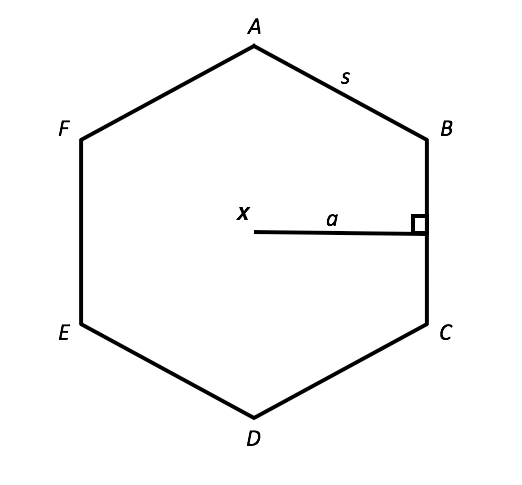
If we are not given a regular hexagon, then we an solve for the area of the hexagon by using the side length(i.e.  ) and apothem (i.e.
  ), which is the length of a line drawn from the center of the polygon to the right angle of any side. This is denoted by the variable
  in the following figure:
Alternative method:
If we are given the variables  and
and  , then we can solve for the area of the hexagon through the following formula:
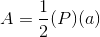
In this equation,  is the area,
  is the perimeter, and
  is the apothem. We must calculate the perimeter using the side length and the equation
  , where
  is the side length.
Solution:
In the problem we are told that the honeycomb is two centimeters in diameter. In order to solve the problem we need to divide the diameter by two. This is because the radius of this diameter equals the interior side length of the equilateral triangles in the honeycomb. Lets find the side length of the regular hexagon/honeycomb.

Substitute and solve.


We know the following information.

As a result, we can write the following:

Let's substitute this value into the area formula for a regular hexagon and solve.
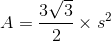

Simplify.

Solve.

Round to the nearest tenth of a centimeter.

How do you find the area of a hexagon?
There are several ways to find the area of a hexagon.
- In a regular hexagon, split the figure into triangles.
- Find the area of one triangle.
- Multiply this value by six.
Alternatively, the area can be found by calculating one-half of the side length times the apothem.
Regular hexagons:
Regular hexagons are interesting polygons. Hexagons are six sided figures and possess the following shape:
In a regular hexagon, all sides equal the same length and all interior angles have the same measure; therefore, we can write the following expression.
One of the easiest methods that can be used to find the area of a polygon is to split the figure into triangles. Let's start by splitting the hexagon into six triangles.
In this figure, the center point,
We also know the following:
Now, let's look at each of the triangles in the hexagon. We know that each triangle has two two sides that are equal; therefore, each of the base angles of each triangle must be the same. We know that a triangle has
Each angle in the triangle equals
Let's solve for the length of this triangle. Remember that in
Now, we can analyze
We know the measure of both the base and height of
Now, we need to multiply this by six in order to find the area of the entire hexagon.
We have solved for the area of a regular hexagon with side length,
If we are not given a regular hexagon, then we an solve for the area of the hexagon by using the side length(i.e.
Alternative method:
If we are given the variables
In this equation,
Solution:
In the problem we are told that the honeycomb is two centimeters in diameter. In order to solve the problem we need to divide the diameter by two. This is because the radius of this diameter equals the interior side length of the equilateral triangles in the honeycomb. Lets find the side length of the regular hexagon/honeycomb.
Substitute and solve.
We know the following information.
As a result, we can write the following:
Let's substitute this value into the area formula for a regular hexagon and solve.
Simplify.
Solve.
Round to the nearest tenth of a centimeter.
Compare your answer with the correct one above
In the regular hexagon above, if diagonal  has a length of
  , what is the area of the hexagon?
In the regular hexagon above, if diagonal
When all the diagonals of a hexagon are drawn in, you should notice that the long diagonals, marked by solid lines, form  congruent equilateral triangles. You should also notice that the other diagonals drawn in with dashed lines are also the heights of two of the equilateral triangles.
Start by using the diagonal to find the length of a side of the hexagon.
Cut the diagonal in half so that we are just left with the height of one equilateral triangle. Notice that the height cleaves the equilateral triangle into two congruent  triangles whose sides are in the ratios of
  .
.
Set up a proportion to solve for the length of a side of the triangle.


Plug in the given diagonal to solve for the side length.

Now, recall how to find the area of a regular hexagon:

Plug in the side length that you just found in order to find the area.

Make sure to round to  places after the decimal.
When all the diagonals of a hexagon are drawn in, you should notice that the long diagonals, marked by solid lines, form
Start by using the diagonal to find the length of a side of the hexagon.
Cut the diagonal in half so that we are just left with the height of one equilateral triangle. Notice that the height cleaves the equilateral triangle into two congruent
Set up a proportion to solve for the length of a side of the triangle.
Plug in the given diagonal to solve for the side length.
Now, recall how to find the area of a regular hexagon:
Plug in the side length that you just found in order to find the area.
Make sure to round to
Compare your answer with the correct one above
In the regular hexagon above, if the length of diagonal  is
is  , what is the area of the hexagon?
In the regular hexagon above, if the length of diagonal
When all the diagonals of a hexagon are drawn in, you should notice that the long diagonals, marked by solid lines, form  congruent equilateral triangles. You should also notice that the other diagonals drawn in with dashed lines are also the heights of two of the equilateral triangles.
Start by using the diagonal to find the length of a side of the hexagon.
Cut the diagonal in half so that we are just left with the height of one equilateral triangle. Notice that the height cleaves the equilateral triangle into two congruent  triangles whose sides are in the ratios of
  .
.
Set up a proportion to solve for the length of a side of the triangle.


Plug in the given diagonal to solve for the side length.

Now, recall how to find the area of a regular hexagon:

Plug in the side length that you just found in order to find the area.

Make sure to round to  places after the decimal.
When all the diagonals of a hexagon are drawn in, you should notice that the long diagonals, marked by solid lines, form
Start by using the diagonal to find the length of a side of the hexagon.
Cut the diagonal in half so that we are just left with the height of one equilateral triangle. Notice that the height cleaves the equilateral triangle into two congruent
Set up a proportion to solve for the length of a side of the triangle.
Plug in the given diagonal to solve for the side length.
Now, recall how to find the area of a regular hexagon:
Plug in the side length that you just found in order to find the area.
Make sure to round to
Compare your answer with the correct one above
In the regular hexagon above, if diagonal  has a length of
  , what is the area of the hexagon?
In the regular hexagon above, if diagonal
When all the diagonals of a hexagon are drawn in, you should notice that the long diagonals, marked by solid lines, form  congruent equilateral triangles. You should also notice that the other diagonals drawn in with dashed lines are also the heights of two of the equilateral triangles.
Start by using the diagonal to find the length of a side of the hexagon.
Cut the diagonal in half so that we are just left with the height of one equilateral triangle. Notice that the height cleaves the equilateral triangle into two congruent  triangles whose sides are in the ratios of
  .
.
Set up a proportion to solve for the length of a side of the triangle.


Plug in the given diagonal to solve for the side length.

Now, recall how to find the area of a regular hexagon:

Plug in the side length that you just found in order to find the area.

Make sure to round to  places after the decimal.
When all the diagonals of a hexagon are drawn in, you should notice that the long diagonals, marked by solid lines, form
Start by using the diagonal to find the length of a side of the hexagon.
Cut the diagonal in half so that we are just left with the height of one equilateral triangle. Notice that the height cleaves the equilateral triangle into two congruent
Set up a proportion to solve for the length of a side of the triangle.
Plug in the given diagonal to solve for the side length.
Now, recall how to find the area of a regular hexagon:
Plug in the side length that you just found in order to find the area.
Make sure to round to
Compare your answer with the correct one above

If the perimeter of the regular hexagon above is  , what is the length of diagonal
  ?
?
If the perimeter of the regular hexagon above is

When all the diagonals connecting opposite points of a regular hexagon are drawn in,  congruent equilateral triangles are created. We can also see that the length of one such diagonal is merely twice the length of a side of the hexagon.
Use the perimeter to find the length of a side of the hexagon.


Double the length of a side to get the length of the wanted diagonal.

When all the diagonals connecting opposite points of a regular hexagon are drawn in,
Use the perimeter to find the length of a side of the hexagon.
Double the length of a side to get the length of the wanted diagonal.
Compare your answer with the correct one above
Find the area of a regular hexagon with a side length of  .
.
Find the area of a regular hexagon with a side length of
Use the following formula to find the area of a regular hexagon:

Now, substitute in the value for the side length.

Use the following formula to find the area of a regular hexagon:
Now, substitute in the value for the side length.
Compare your answer with the correct one above
Find the area of a regular hexagon with a side length of  .
.
Find the area of a regular hexagon with a side length of
Use the following formula to find the area of a regular hexagon:

Now, substitute in the value for the side length.

Use the following formula to find the area of a regular hexagon:
Now, substitute in the value for the side length.
Compare your answer with the correct one above
What is the measure of one exterior angle of a regular twenty-sided polygon?
What is the measure of one exterior angle of a regular twenty-sided polygon?
The sum of the exterior angles of any polygon, one at each vertex, is  . In a regular polygon, the exterior angles all have the same measure, so divide 360 by the number of angles, which, here, is 20, the same as the number of sides.

The sum of the exterior angles of any polygon, one at each vertex, is
Compare your answer with the correct one above
Which of the following cannot be the six interior angle measures of a hexagon?
Which of the following cannot be the six interior angle measures of a hexagon?
The sum of the interior angle measures of a hexagon is 
Add the angle measures in each group.




In each case, the angle measures add up to 720, so the answer is that all of these can be the six interior angle measures of a hexagon.
The sum of the interior angle measures of a hexagon is
Add the angle measures in each group.
In each case, the angle measures add up to 720, so the answer is that all of these can be the six interior angle measures of a hexagon.
Compare your answer with the correct one above
There is a regular hexagon with a side length of  . What is the measure of an internal angle?
There is a regular hexagon with a side length of
Given that the hexagon is a regular hexagon, this means that all the side length are congruent and all internal angles are congruent. The question requires us to solve for the measure of an internal angle. Given the aforementioned definition of a regular polygon, this means that there must only be one correct answer.
In order to solve for the answer, the question provides additional information that isn't necessarily required. The measure of an internal angle can be solved for using the equation:
 where
where  is the number of sides of the polygon.
In this case,  .
.
For this problem, the information about the side length may be negated.


Given that the hexagon is a regular hexagon, this means that all the side length are congruent and all internal angles are congruent. The question requires us to solve for the measure of an internal angle. Given the aforementioned definition of a regular polygon, this means that there must only be one correct answer.
In order to solve for the answer, the question provides additional information that isn't necessarily required. The measure of an internal angle can be solved for using the equation:
In this case,
For this problem, the information about the side length may be negated.
Compare your answer with the correct one above
Find the area of a regular hexagon with a side length of  .
.
Find the area of a regular hexagon with a side length of
Use the following formula to find the area of a regular hexagon:

Now, substitute in the value for the side length.

Use the following formula to find the area of a regular hexagon:
Now, substitute in the value for the side length.
Compare your answer with the correct one above
What is the interior angle of a regular hexagon if the area is 15?
What is the interior angle of a regular hexagon if the area is 15?
The area has no relevance to find the angle of a regular hexagon.
There are 6 sides in a regular hexagon. Use the following formula to determine the interior angle.

Substitute  sides to determine the sum of all interior angles of the hexagon in degrees.

Since there are 6 sides, divide this number by 6 to determine the value of each interior angle.

The area has no relevance to find the angle of a regular hexagon.
There are 6 sides in a regular hexagon. Use the following formula to determine the interior angle.
Substitute
Since there are 6 sides, divide this number by 6 to determine the value of each interior angle.
Compare your answer with the correct one above