
How to graph a quadratic function - Geometry
Card 1 of 116
What are the possible values of  if the parabola of the quadratic function
  is concave upward and does not intersect the
  -axis?
What are the possible values of
Tap to reveal answer
If the graph of  is concave upward, then
  .
.
If the graph does not intersect the  -axis, then
  has no real solution, and the discriminant
  is negative:


For the parabola to have both characteristics, it must be true that  and
and  , but these two events are mutually exclusive. Therefore, the parabola cannot exist.
If the graph of
If the graph does not intersect the
For the parabola to have both characteristics, it must be true that
← Didn't Know|Knew It →
Which of the following is the equation of the line of symmetry of a horizontal parabola on the coordinate plane with its vertex at  ?
?
Which of the following is the equation of the line of symmetry of a horizontal parabola on the coordinate plane with its vertex at
Tap to reveal answer
The line of symmetry of a horizontal parabola is a horizontal line, the equation of which takes the form  for some
  . The line of symmetry passes through the vertex, which here is
  , so the equation must be
  .
.
The line of symmetry of a horizontal parabola is a horizontal line, the equation of which takes the form
← Didn't Know|Knew It →
Which of the following is the equation of the line of symmetry of a vertical parabola on the coordinate plane with its vertex at  ?
?
Which of the following is the equation of the line of symmetry of a vertical parabola on the coordinate plane with its vertex at
Tap to reveal answer
The line of symmetry of a vertical parabola is a vertical line, the equation of which takes the form  for some
  . The line of symmetry passes through the vertex, which here is
  , so the equation must be
  .
.
The line of symmetry of a vertical parabola is a vertical line, the equation of which takes the form
← Didn't Know|Knew It →
A vertical parabola has two  -intercepts, one at
  and one at
  .
.
Which of the following must be true about this parabola?
A vertical parabola has two
Which of the following must be true about this parabola?
Tap to reveal answer
A parabola with its -intercepts at and at has as its equation

for some nonzero  . If this is multiplied out, the equation can be rewritten as

or, simplified,

The sign of quadratic coefficient  determines whether it is concave upward or concave downward. We do not have the sign or any way of determining it.
The  -coordinate of the
  -intercept is the contant,
  , but without knowing
  , we have no way of knowing
  .
.
The  -coordinate of the vertex of
  is the value
  . since
  , this expression becomes

The  -coordinate is
 ,
,
but without knowing  , this coordinate, and the vertex itself, cannot be determined.
The line of symmetry is the line  ; this value was computed to be equal to 6, so the line can be determined to be
  .
.
A parabola with its
for some nonzero
or, simplified,
The sign of quadratic coefficient
The
The
The
but without knowing
The line of symmetry is the line
← Didn't Know|Knew It →
Give the vertex of the graph of the function
 .
.
Give the vertex of the graph of the function
Tap to reveal answer
This can be answered rewriting this expression in the form
 .
.
Once this is done, we can identify the vertex as the point  .
.


The vertex is 
This can be answered rewriting this expression in the form
Once this is done, we can identify the vertex as the point
The vertex is
← Didn't Know|Knew It →
 has as its graph a vertical parabola on the coordinate plane. You are given that
  , but you are given neither
  nor
nor  .
.
Which of the following can you determine without knowing the values of  and
and  ?
?
I) Whether the curve opens upward or opens downward
II) The location of the vertex
III) The location of the  -intercept
IV) The locations of the  -intercepts, if there are any
V) The equation of the line of symmetry
Which of the following can you determine without knowing the values of
I) Whether the curve opens upward or opens downward
II) The location of the vertex
III) The location of the
IV) The locations of the
V) The equation of the line of symmetry
Tap to reveal answer
I) The orientation of the parabola is determined solely by the value of  . Since
  , the parabola can be determined to open upward.
II and V) The  -coordinate of the vertex is
  ; since you are not given
  , you cannot find this. Also, since the line of symmetry has equation
  , for the same reason, you cannot find this either.
III) The  -intercept is the point at which
  ; by substitution, it can be found to be at
  .
.  is unknown, so the
  -intercept cannot be found.
IV) The  -intercept(s), if any, are the point(s) at which
  . This is solvable using the quadratic formula

Since all three of  and
and  must be known for this to be evaluated, and only
  is known, the
  -intercept(s) cannot be identified.
The correct response is I only.
I) The orientation of the parabola is determined solely by the value of
II and V) The
III) The
IV) The
Since all three of
The correct response is I only.
← Didn't Know|Knew It →
 has as its graph a vertical parabola on the coordinate plane. You are given that
  and
and  , but you are not given
  .
.
Which of the following can you determine without knowing the value of  ?
?
I) Whether the graph is concave upward or concave downward
II) The location of the vertex
III) The location of the  -intercept
IV) The locations of the  -intercepts, if there are any
V) The equation of the line of symmetry
Which of the following can you determine without knowing the value of
I) Whether the graph is concave upward or concave downward
II) The location of the vertex
III) The location of the
IV) The locations of the
V) The equation of the line of symmetry
Tap to reveal answer
I) The orientation of the parabola is determined solely by the sign of  . Since
  , the parabola can be determined to be concave downward.
II and V) The  -coordinate of the vertex is
  ; since you are not given
  , you cannot find this. Also, since the line of symmetry has equation
  , for the same reason, you cannot find this either.
III) The  -intercept is the point at which
  ; by substitution, it can be found to be at
  .
.  known to be equal to 9, so the
  -intercept can be determined to be
  .
.
IV) The  -intercept(s), if any, are the point(s) at which
  . This is solvable using the quadratic formula

Since all three of  and
and  must be known for this to be evaluated, and only
  is known, the
  -intercept(s) cannot be identified.
The correct response is I and III only.
I) The orientation of the parabola is determined solely by the sign of
II and V) The
III) The
IV) The
Since all three of
The correct response is I and III only.
← Didn't Know|Knew It →
 has as its graph a vertical parabola on the coordinate plane. You are given that
  and
and  , but you are not given the value of
  .
.
Which of the following can you determine without knowing the value of  ?
?
I) Whether the graph is concave upward or concave downward
II) The location of the vertex
III) The location of the  -intercept
IV) The locations of the  -intercepts, if there are any
V) The equation of the line of symmetry
Which of the following can you determine without knowing the value of
I) Whether the graph is concave upward or concave downward
II) The location of the vertex
III) The location of the
IV) The locations of the
V) The equation of the line of symmetry
Tap to reveal answer
I) The orientation of the parabola is determined solely by the sign of  . Since
  , a positive value, the parabola can be determined to be concave upward.
II) The  -coordinate of the vertex is
  ; since you given both
  and
and  , you can find this to be

The  -coordinate is equal to
  . However, you need the entire equation to determine this value; since you do not know
  , you cannot find the
  -coordinate. Therefore, you cannot find the vertex.
III) The  -intercept is the point at which
  ; by substitution, it can be found to be at
  .
.  is unknown, so the
  -intercept cannot be found.
IV) The  -intercept(s), if any, are the point(s) at which
  . This is solvable using the quadratic formula

Since all three of  and
and  must be known for this to be evaluated, and is unknown, the
  -intercept(s) cannot be identified.
V) The line of symmetry has equation  . When exploring the vertex, we found that this value is equal to
  , so the line of symmetry is the line of the equation
  .
.
The correct response is I and V only.
I) The orientation of the parabola is determined solely by the sign of
II) The
The
III) The
IV) The
Since all three of
V) The line of symmetry has equation
The correct response is I and V only.
← Didn't Know|Knew It →
 has as its graph a vertical parabola on the coordinate plane. You are given that
  , but you are given no other information about these values.
Which of the following can you determine without knowing the value of  ?
?
I) Whether the graph is concave upward or concave downward
II) The location of the vertex
III) The location of the  -intercept
IV) The locations of the  -intercepts,or whether there are any
V) The equation of the line of symmetry
Which of the following can you determine without knowing the value of
I) Whether the graph is concave upward or concave downward
II) The location of the vertex
III) The location of the
IV) The locations of the
V) The equation of the line of symmetry
Tap to reveal answer
I) The orientation of the parabola is determined solely by the sign of  . It is given in the problem that
  is negative, so it follows that the parabola is concave downward.
II) The  -coordinate of the vertex is
  ; since
  , this number is
  . The
. The  -coordinate is
  , but since we do not know the values of
  ,
,  , and
, and  , we cannot find this value. Therefore, we cannot know the vertex.
III) The  -intercept is the point at which
  ; by substitution, it can be found to be at
  .
.  is unknown, so the
  -intercept cannot be found.
IV) The  -intercept(s), if any, are the point(s) at which
  . This is solvable using the quadratic formula

Since  , this can be rewritten and simplified as follows:


However, since  has no real square root,
  has no real solutions, and its graph has no
  -intercepts.
V) The line of symmetry has equation  . When exploring the vertex, we found that this value is equal to
  , so the line of symmetry is the line of the equation
  .
.
The correct response is I, IV, and V only.
I) The orientation of the parabola is determined solely by the sign of
II) The
III) The
IV) The
Since
However, since
V) The line of symmetry has equation
The correct response is I, IV, and V only.
← Didn't Know|Knew It →
Which of the following equations has as its graph a vertical parabola with line of symmetry  ?
?
Which of the following equations has as its graph a vertical parabola with line of symmetry
Tap to reveal answer
The graph of  has as its line of symmetry the vertical line of the equation

Since  in each choice, we want to find
  such that


so the correct choice is  .
.
The graph of
Since
so the correct choice is
← Didn't Know|Knew It →
Which of the following equations can be graphed with a vertical parabola with exactly one  -intercept?
Which of the following equations can be graphed with a vertical parabola with exactly one
Tap to reveal answer
The graph of has exactly one  -intercept if and only if

has exactly one solution - or equivalently, if and only if

Since in all three equations,  , we find the value of
  that makes this statement true by substituting and solving:


The correct choice is  .
.
The graph of
has exactly one solution - or equivalently, if and only if
Since in all three equations,
The correct choice is
← Didn't Know|Knew It →
Which of the following equations has as its graph a concave-right horizontal parabola?
Which of the following equations has as its graph a concave-right horizontal parabola?
Tap to reveal answer
A horizontal parabola has as its equation, in standard form,
 ,
,
with  real,
real,  nonzero.
Its orientation depends on the sign of  . In the equation of a concave-right parabola,
  is positive, so the correct choice is
  .
.
A horizontal parabola has as its equation, in standard form,
with
Its orientation depends on the sign of
← Didn't Know|Knew It →
The graphs of the functions  and
and  have the same
  -intercept.
If we define  , which of the following is a possible definition of
  ?
?
The graphs of the functions
If we define
Tap to reveal answer
The  -coordinate of the
  -intercept of the graph of a function of the form
  - a quadratic function - is the point
  . Since
  , the
, the  -intercept is at the point
  .
.
Because of this, the graph of  has its
  -intercept at
  . Among the other choices, only
  has a graph with its
  -intercept also at
  .
.
The
Because of this, the graph of
← Didn't Know|Knew It →
The parabolas of the functions and on the coordinate plane have the same vertex.
If we define 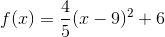 , which of the following is a possible equation for ?
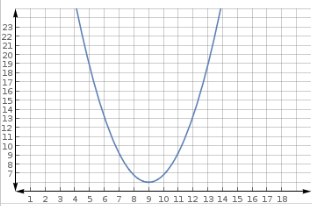
The parabolas of the functions
If we define
Tap to reveal answer
The eqiatopm of  is given in the vertex form
 ,
,
so the vertex of its parabola is  . The graphs of
  and
and  are parabolas with the same vertex, so they must have the same values for
  and
and  .
.
For the function 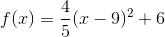 ,
,  and
and  .
.
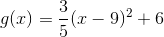
Of the five choices, the only equation of  that has these same values, and that therefore has a parabola with the same vertex, is
  .
.
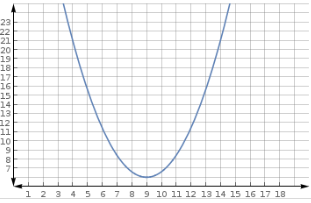
To verify, graph both functions on the same grid.
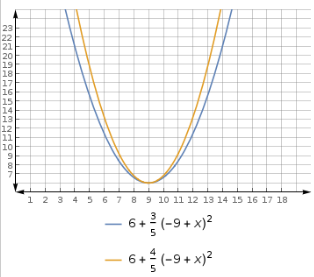
The eqiatopm of
so the vertex of its parabola is
For the function
Of the five choices, the only equation of
To verify, graph both functions on the same grid.
← Didn't Know|Knew It →
Give the  -coordinate of a point of intersection of the graphs of the functions

and
 .
.
Give the
and
Tap to reveal answer
The system of equations can be rewritten as

 .
.
We can set the two expressions in  equal to each other and solve:


We can substitute back into the equation  , and see that either
  or
or  . The latter value is the correct choice.
The system of equations can be rewritten as
We can set the two expressions in
We can substitute back into the equation
← Didn't Know|Knew It →
The graphs of the functions and have the same pair of  -intercepts.
If we define  , which of the following is a possible definition of
  ?
?
The graphs of the functions
If we define
Tap to reveal answer
The  -intercepts of the parabola

can be determined by setting  and solving for
  :
:


 or
or 
The  intercepts of the parabola are
  and
and  .
.
We can check each equation to see whether these two ordered pairs satisfy them.
 :
:


Each of these equations has a parabola that does not have  as an
as an  -intercept. However, we look at


 and
and  are also
  -intercepts of the graph of this function, so this is the correct choice.
The
can be determined by setting
The
We can check each equation to see whether these two ordered pairs satisfy them.
Each of these equations has a parabola that does not have
← Didn't Know|Knew It →
Give the  -coordinate of a point at which the graphs of the equations

and

intersect.
Give the
and
intersect.
Tap to reveal answer
We can set the two quadratic expressions equal to each other and solve for  .
.
 and
and  , so
, so


The  -coordinates of the points of intersection are 2 and 6. To find the
  -coordinates, substitute in either equation:


One point of intersection is  .
.


The other point of intersection is  .
.
1 is not among the choices, but 41 is, so this is the correct response.
We can set the two quadratic expressions equal to each other and solve for
The
One point of intersection is
The other point of intersection is
1 is not among the choices, but 41 is, so this is the correct response.
← Didn't Know|Knew It →
The graphs of the functions and have the same line of symmetry.
If we define , which of the following is a possible definition of ?
The graphs of the functions
If we define
Tap to reveal answer
The graph of a function of the form - a quadratic function - is a vertical parabola with line of symmetry  .
.
The graph of the function therefore has line of symmetry
 , or
, or 
We examine all four definitions of  to find one with this line of symmetry.
 :
:
 , or
, or 
 :
:
 , or
, or 

 , or
, or 

 , or
, or 
Since the graph of the function  has the same line of symmetry as that of the function , that is the correct choice.
The graph of a function of the form
The graph of the function
We examine all four definitions of
Since the graph of the function
← Didn't Know|Knew It →
Find the vertex and determine if the vertex is a maximum or minimum for  below.

Find the vertex and determine if the vertex is a maximum or minimum for
Tap to reveal answer
The correct answer for the vertex is found by first finding the x of the vertex:

Plug in a and b to get:

To find the y value of the vertex, plug in what was found for x above in the original f(x).


a common mistake here is the order of operations, at the beginning the 1 is squared before it is multipled by the negative out front.

Now we must consider if the vertex is a MAX or a MIN
Since the a value is negative, this means the parabola will open down, which means the vertex is the highest point on the graph.

The correct answer for the vertex is found by first finding the x of the vertex:
Plug in a and b to get:
To find the y value of the vertex, plug in what was found for x above in the original f(x).
a common mistake here is the order of operations, at the beginning the 1 is squared before it is multipled by the negative out front.
Now we must consider if the vertex is a MAX or a MIN
Since the a value is negative, this means the parabola will open down, which means the vertex is the highest point on the graph.
← Didn't Know|Knew It →
What is the range for  below?

What is the range for
Tap to reveal answer


← Didn't Know|Knew It →