
Graphing - Geometry
Card 1 of 832
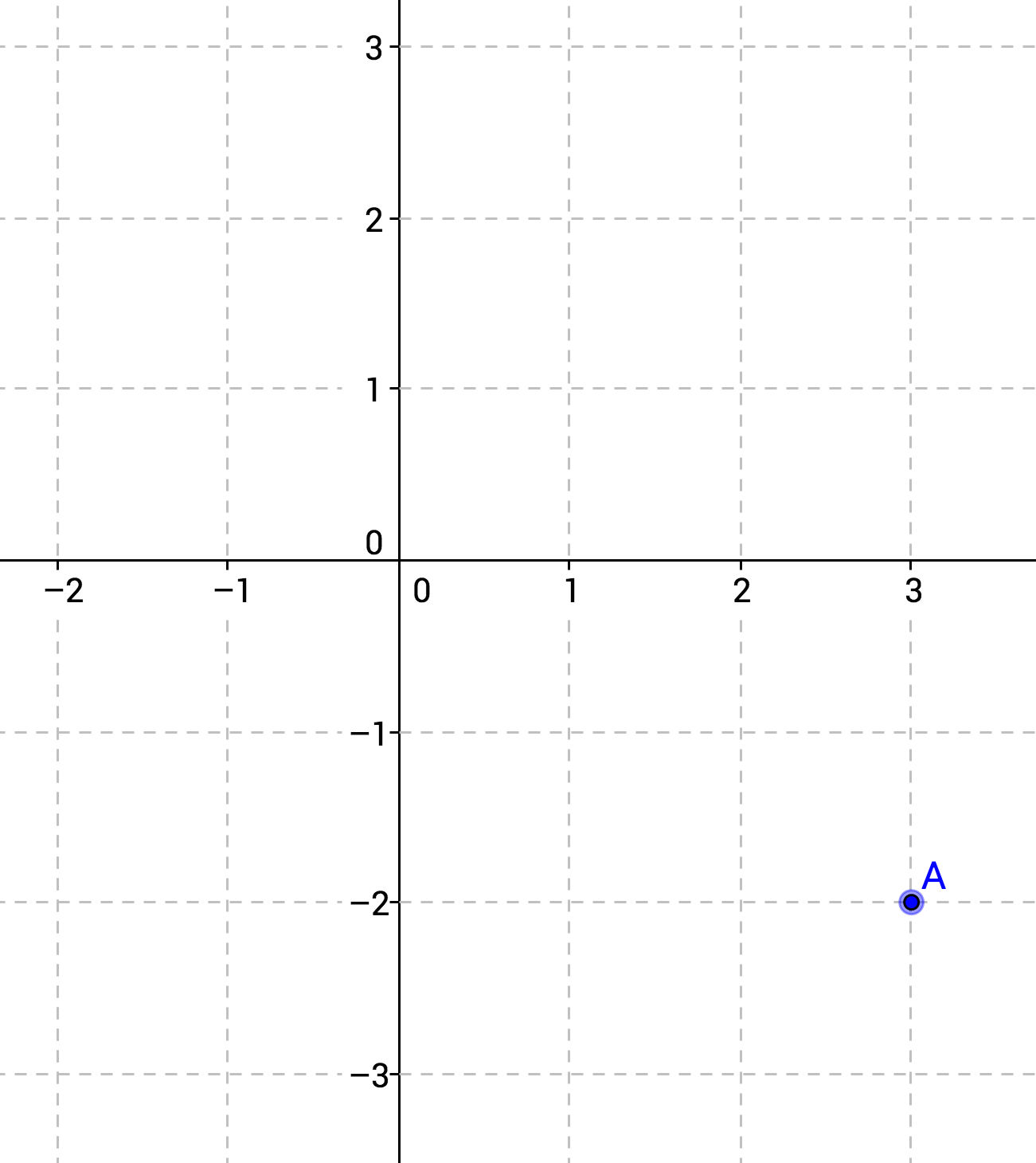
Point A represents a complex number. Its position is given by which of the following expressions?
Point A represents a complex number. Its position is given by which of the following expressions?
Tap to reveal answer
Complex numbers can be represented on the coordinate plane by mapping the real part to the x-axis and the imaginary part to the y-axis. For example, the expression  can be represented graphically by the point
  .
.
Here, we are given the graph and asked to write the corresponding expression.
 not only correctly identifies the x-coordinate with the real part and the y-coordinate with the imaginary part of the complex number, it also includes the necessary
  .
.
 correctly identifies the x-coordinate with the real part and the y-coordinate with the imaginary part of the complex number, but fails to include the necessary
  .
.
 misidentifies the y-coordinate with the real part and the x-coordinate with the imaginary part of the complex number.
 misidentifies the y-coordinate with the real part and the x-coordinate with the imaginary part of the complex number. It also fails to include the necessary
  .
.
Complex numbers can be represented on the coordinate plane by mapping the real part to the x-axis and the imaginary part to the y-axis. For example, the expression
Here, we are given the graph and asked to write the corresponding expression.
← Didn't Know|Knew It →
Which of the following graphs represents the expression  ?
?
Which of the following graphs represents the expression
Tap to reveal answer
Complex numbers can be represented on the coordinate plane by mapping the real part to the x-axis and the imaginary part to the y-axis. For example, the expression  can be represented graphically by the point
  .
.
Here, we are given the complex number  and asked to graph it. We will represent the real part,
  , on the x-axis, and the imaginary part,
  , on the y-axis. Note that the coefficient of
  is
is  ; this is what we will graph on the y-axis. The correct coordinates are
  .
.
Complex numbers can be represented on the coordinate plane by mapping the real part to the x-axis and the imaginary part to the y-axis. For example, the expression
Here, we are given the complex number
← Didn't Know|Knew It →
In which quadrant does the complex number  lie?
lie?
In which quadrant does the complex number
Tap to reveal answer
When plotting a complex number, we use a set of real-imaginary axes in which the x-axis is represented by the real component of the complex number, and the y-axis is represented by the imaginary component of the complex number. The real component is  and the imaginary component is
  , so this is the equivalent of plotting the point
  on a set of Cartesian axes. Plotting the complex number on a set of real-imaginary axes, we move
  to the left in the x-direction and
  up in the y-direction, which puts us in the second quadrant, or in terms of Roman numerals:

When plotting a complex number, we use a set of real-imaginary axes in which the x-axis is represented by the real component of the complex number, and the y-axis is represented by the imaginary component of the complex number. The real component is
← Didn't Know|Knew It →
Give the  -intercept(s) of the parabola with equation
  . Round to the nearest tenth, if applicable.
Give the
Tap to reveal answer
The  -coordinate(s) of the
  -intercept(s) are the real solution(s) to the equation
  . We can use the quadratic formula to find any solutions, setting
  - the coefficients of the expression.
An examination of the discriminant  , however, proves this unnecessary.

The discriminant being negative, there are no real solutions, so the parabola has no  -intercepts.
The
An examination of the discriminant
The discriminant being negative, there are no real solutions, so the parabola has no
← Didn't Know|Knew It →
In which quadrant does the complex number  lie?
lie?
In which quadrant does the complex number
Tap to reveal answer
If we graphed the given complex number on a set of real-imaginary axes, we would plot the real value of the complex number as the x coordinate, and the imaginary value of the complex number as the y coordinate. Because the given complex number is as follows:

We are essentially doing the same as plotting the point  on a set of Cartesian axes. We move
  units right in the x direction, and
  units down in the y direction, which puts us in the fourth quadrant, or in terms of Roman numerals:

If we graphed the given complex number on a set of real-imaginary axes, we would plot the real value of the complex number as the x coordinate, and the imaginary value of the complex number as the y coordinate. Because the given complex number is as follows:
We are essentially doing the same as plotting the point
← Didn't Know|Knew It →
In which quadrant does the complex number  lie?
lie?
In which quadrant does the complex number
Tap to reveal answer
If we graphed the given complex number on a set of real-imaginary axes, we would plot the real value of the complex number as the x coordinate, and the imaginary value of the complex number as the y coordinate. Because the given complex number is as follows:

We are essentially doing the same as plotting the point  on a set of Cartesian axes. We move
  units left of the origin in the x direction, and
  units down from the origin in the y direction, which puts us in the third quadrant, or in terms of Roman numerals:

If we graphed the given complex number on a set of real-imaginary axes, we would plot the real value of the complex number as the x coordinate, and the imaginary value of the complex number as the y coordinate. Because the given complex number is as follows:
We are essentially doing the same as plotting the point
← Didn't Know|Knew It →
In which quadrant does the complex number  lie?
lie?
In which quadrant does the complex number
Tap to reveal answer
If we graphed the given complex number on a set of real-imaginary axes, we would plot the real value of the complex number as the x coordinate, and the imaginary value of the complex number as the y coordinate. Because the given complex number is as follows:

We are essentially doing the same as plotting the point  on a set of Cartesian axes. We move
  units right of the origin in the x direction, and
  units up from the origin in the y direction, which puts us in the first quadrant, or in terms of Roman numerals:

If we graphed the given complex number on a set of real-imaginary axes, we would plot the real value of the complex number as the x coordinate, and the imaginary value of the complex number as the y coordinate. Because the given complex number is as follows:
We are essentially doing the same as plotting the point
← Didn't Know|Knew It →
In the complex plane, what number does this point represent?

In the complex plane, what number does this point represent?
Tap to reveal answer
In the complex plane, the x-axis represents the real component of the complex number, and the y-axis represents the imaginary part. The point shown is (8,3) so the real part is 8 and the imaginary part is 3, or 8+3i.
In the complex plane, the x-axis represents the real component of the complex number, and the y-axis represents the imaginary part. The point shown is (8,3) so the real part is 8 and the imaginary part is 3, or 8+3i.
← Didn't Know|Knew It →
Find,

Find,
Tap to reveal answer
The definition of Absolute Value on a coordinate plane is the distance from the origin to the point.
When graphing this complex number, you would go 3 spaces right (real axis is the x-axis) and 4 spaces down (the imaginary axis is the y-axis).
This forms a right triangle with legs of 3 and 4.
To solve, plug in each directional value into the Pythagorean Theorem.


The definition of Absolute Value on a coordinate plane is the distance from the origin to the point.
When graphing this complex number, you would go 3 spaces right (real axis is the x-axis) and 4 spaces down (the imaginary axis is the y-axis).
This forms a right triangle with legs of 3 and 4.
To solve, plug in each directional value into the Pythagorean Theorem.
← Didn't Know|Knew It →
The graph below represents which complex number?

The graph below represents which complex number?
Tap to reveal answer
For the answer we must know that the x-axis is the real axis and the y-axis is the imaginary axis. We can see that we have gone 2 spaces in the x-axis or real direction and -3 spaces in the y-axis or imaginary direction to give us the answer 2-3i.
For the answer we must know that the x-axis is the real axis and the y-axis is the imaginary axis. We can see that we have gone 2 spaces in the x-axis or real direction and -3 spaces in the y-axis or imaginary direction to give us the answer 2-3i.
← Didn't Know|Knew It →

Tap to reveal answer
In the complex plane, the imaginary axis matches the y-axis and the real axis matches the x-axis.
When graphing complex numbers, we go left or right to graph the real number and then up or down to graph the complex number.


In the complex plane, the imaginary axis matches the y-axis and the real axis matches the x-axis.
When graphing complex numbers, we go left or right to graph the real number and then up or down to graph the complex number.
← Didn't Know|Knew It →

Refer to the above diagram, which shows four points on the complex plane.
Select the point which gives the result of the subtraction
 .
.
Refer to the above diagram, which shows four points on the complex plane.
Select the point which gives the result of the subtraction
Tap to reveal answer
To subtract two complex numbers, subtract the real parts and subtract the imaginary parts:


On the complex plane, a complex number whose real part is positive is right of the imaginary (vertical) axis; a complex number whose imaginary coefficient is negative is below the real (horizontal axis).  is three units right of and five units below the origin; this is point D.
To subtract two complex numbers, subtract the real parts and subtract the imaginary parts:
On the complex plane, a complex number whose real part is positive is right of the imaginary (vertical) axis; a complex number whose imaginary coefficient is negative is below the real (horizontal axis).
← Didn't Know|Knew It →
Refer to the above diagram, which shows four points on the complex plane.
Select the point which gives the result of the addition

Refer to the above diagram, which shows four points on the complex plane.
Select the point which gives the result of the addition
Tap to reveal answer
To add two complex numbers, add the real parts and add the imaginary parts:


On the complex plane, a complex number whose real part is negative is left of the imaginary (vertical) axis; a complex number whose imaginary coefficient is positive is above the real (horizontal axis).  is three units left of and five units above the origin; this is point A.
To add two complex numbers, add the real parts and add the imaginary parts:
On the complex plane, a complex number whose real part is negative is left of the imaginary (vertical) axis; a complex number whose imaginary coefficient is positive is above the real (horizontal axis).
← Didn't Know|Knew It →

Refer to the above diagram, which shows two points on the complex plane. Let  and
and  stand for the complex numbers represented by their respective points.
Add  and
and  .
.
Refer to the above diagram, which shows two points on the complex plane. Let
Add
Tap to reveal answer
On the complex plane, the real and imaginary parts of a point are equal to the horizontal and vertical distances, respectively, from the origin to the point, with the right and upward directions representing positive quantities and the left and downward directions representing negative quantities. Refer to the diagram below, which shows the horizontal and vertical distances from the origin of both points.

 is six units right of the origin, representing real part 6, and eight units above the origin, representing imaginary part
  .
.  is two units right of the origin, representing real part 2, and five units below the origin, representing imaginary part
  . Therefore,


We are asked to find  .
.
To add two complex numbers, add the real parts and add the imaginary parts:


On the complex plane, the real and imaginary parts of a point are equal to the horizontal and vertical distances, respectively, from the origin to the point, with the right and upward directions representing positive quantities and the left and downward directions representing negative quantities. Refer to the diagram below, which shows the horizontal and vertical distances from the origin of both points.
We are asked to find
To add two complex numbers, add the real parts and add the imaginary parts:
← Didn't Know|Knew It →
Refer to the above diagram, which shows two points on the complex plane. Let  and
and  stand for the complex numbers represented by their respective points.
Subtract  from
from  .
.
Refer to the above diagram, which shows two points on the complex plane. Let
Subtract
Tap to reveal answer
On the complex plane, the real and imaginary parts of a point are equal to the horizontal and vertical distances, respectively, from the origin to the point, with the right and upward directions representing positive quantities and the left and downward directions representing negative quantities. Refer to the diagram below, which shows the horizontal and vertical distances from the origin of both points.
 is six units right of the origin, representing real part 6, and eight units above the origin, representing imaginary part
  .
.  is two units right of the origin, representing real part 2, and five units below the origin, representing imaginary part
  . Therefore,


We are asked to find  .
.
To subtract two complex numbers, subtract the real parts and subtract the imaginary parts:


On the complex plane, the real and imaginary parts of a point are equal to the horizontal and vertical distances, respectively, from the origin to the point, with the right and upward directions representing positive quantities and the left and downward directions representing negative quantities. Refer to the diagram below, which shows the horizontal and vertical distances from the origin of both points.
We are asked to find
To subtract two complex numbers, subtract the real parts and subtract the imaginary parts:
← Didn't Know|Knew It →
Refer to the above diagram, which shows two points on the complex plane. Let  and
and  stand for the complex numbers represented by their respective points.
Multiply  by
by  .
.
Refer to the above diagram, which shows two points on the complex plane. Let
Multiply
Tap to reveal answer
On the complex plane, the real and imaginary parts of a point are equal to the horizontal and vertical distances, respectively, from the origin to the point, with the right and upward directions representing positive quantities and the left and downward directions representing negative quantities. Refer to the diagram below, which shows the horizontal and vertical distances from the origin of both points.
 is six units right of the origin, representing real part 6, and eight units above the origin, representing imaginary part
  .
.  is two units right of the origin, representing real part 2, and five units below the origin, representing imaginary part
  . Therefore,

To multiply two complex numbers, use the FOIL method as if you were multiplying two binomials.

F(irst): 
O(uter): 
I(nner): 
L(ast): 
By definition,  , so the "L" quantity simplifies:
 .
.
Add these quantities, collecting real parts (F and L) and imaginary parts (O and I):


On the complex plane, the real and imaginary parts of a point are equal to the horizontal and vertical distances, respectively, from the origin to the point, with the right and upward directions representing positive quantities and the left and downward directions representing negative quantities. Refer to the diagram below, which shows the horizontal and vertical distances from the origin of both points.
To multiply two complex numbers, use the FOIL method as if you were multiplying two binomials.
F(irst):
O(uter):
I(nner):
L(ast):
By definition,
Add these quantities, collecting real parts (F and L) and imaginary parts (O and I):
← Didn't Know|Knew It →
What are the possible values of  if the parabola of the quadratic function
  is concave upward and does not intersect the
  -axis?
What are the possible values of
Tap to reveal answer
If the graph of  is concave upward, then
  .
.
If the graph does not intersect the  -axis, then
  has no real solution, and the discriminant
  is negative:


For the parabola to have both characteristics, it must be true that  and
and  , but these two events are mutually exclusive. Therefore, the parabola cannot exist.
If the graph of
If the graph does not intersect the
For the parabola to have both characteristics, it must be true that
← Didn't Know|Knew It →
Which of the following is the equation of the line of symmetry of a horizontal parabola on the coordinate plane with its vertex at  ?
?
Which of the following is the equation of the line of symmetry of a horizontal parabola on the coordinate plane with its vertex at
Tap to reveal answer
The line of symmetry of a horizontal parabola is a horizontal line, the equation of which takes the form  for some
  . The line of symmetry passes through the vertex, which here is
  , so the equation must be
  .
.
The line of symmetry of a horizontal parabola is a horizontal line, the equation of which takes the form
← Didn't Know|Knew It →
Which of the following is the equation of the line of symmetry of a vertical parabola on the coordinate plane with its vertex at  ?
?
Which of the following is the equation of the line of symmetry of a vertical parabola on the coordinate plane with its vertex at
Tap to reveal answer
The line of symmetry of a vertical parabola is a vertical line, the equation of which takes the form  for some
  . The line of symmetry passes through the vertex, which here is
  , so the equation must be
  .
.
The line of symmetry of a vertical parabola is a vertical line, the equation of which takes the form
← Didn't Know|Knew It →
A vertical parabola has two  -intercepts, one at
  and one at
  .
.
Which of the following must be true about this parabola?
A vertical parabola has two
Which of the following must be true about this parabola?
Tap to reveal answer
A parabola with its -intercepts at and at has as its equation

for some nonzero  . If this is multiplied out, the equation can be rewritten as

or, simplified,

The sign of quadratic coefficient  determines whether it is concave upward or concave downward. We do not have the sign or any way of determining it.
The  -coordinate of the
  -intercept is the contant,
  , but without knowing
  , we have no way of knowing
  .
.
The  -coordinate of the vertex of
  is the value
  . since
  , this expression becomes

The  -coordinate is
 ,
,
but without knowing  , this coordinate, and the vertex itself, cannot be determined.
The line of symmetry is the line  ; this value was computed to be equal to 6, so the line can be determined to be
  .
.
A parabola with its
for some nonzero
or, simplified,
The sign of quadratic coefficient
The
The
The
but without knowing
The line of symmetry is the line
← Didn't Know|Knew It →