
2-Dimensional Geometry - GED Math
Card 1 of 2760
Let 
Find the area of a circle with a diameter of 14cm.
Let
Find the area of a circle with a diameter of 14cm.
Tap to reveal answer
To find the area of a circle, we will use the following formula:

where r is the radius of the circle.
Now, we know  . We know the diameter of the circle is 14cm. We also know the diameter is two times the radius. Therefore, the radius is 7cm. So, we can substitute. We get


To find the area of a circle, we will use the following formula:
where r is the radius of the circle.
Now, we know
← Didn't Know|Knew It →
A circular swimming pool at an apartment complex has diameter 50 feet. The apartment manager needs to purchase a tarp that will cover this pool completely, but the store will only sell the material in multiples of ten square yards. How many square yards will the manager need to buy?
Use 3.14 for  .
.
A circular swimming pool at an apartment complex has diameter 50 feet. The apartment manager needs to purchase a tarp that will cover this pool completely, but the store will only sell the material in multiples of ten square yards. How many square yards will the manager need to buy?
Use 3.14 for
Tap to reveal answer
The radius of the swimming pool is half the diameter, or 25 feet.
The area of the swimming pool is  times the square of the radius, or
 square feet, or
 square yards.
The manager will need to buy a number of square yards of tarp equal to the next highest multiple of ten, which is 220 square yards.
The radius of the swimming pool is half the diameter, or 25 feet.
The area of the swimming pool is
The manager will need to buy a number of square yards of tarp equal to the next highest multiple of ten, which is 220 square yards.
← Didn't Know|Knew It →
A circular swimming pool at an apartment complex has diameter 30 meters. The apartment manager needs to purchase a tarp that will cover this pool completely, but the store will only sell the material in multiples of ten square meters. How many square yards will the manager need to buy?
Use 3.14 for .
A circular swimming pool at an apartment complex has diameter 30 meters. The apartment manager needs to purchase a tarp that will cover this pool completely, but the store will only sell the material in multiples of ten square meters. How many square yards will the manager need to buy?
Use 3.14 for
Tap to reveal answer
The radius of the swimming pool is half the diameter, or 15 meters.
The area of the swimming pool is times the square of the radius, or
 square meters.
The manager will need to buy a number of square yards of tarp equal to the next highest multiple of ten, which is 710 square meters.
The radius of the swimming pool is half the diameter, or 15 meters.
The area of the swimming pool is
The manager will need to buy a number of square yards of tarp equal to the next highest multiple of ten, which is 710 square meters.
← Didn't Know|Knew It →
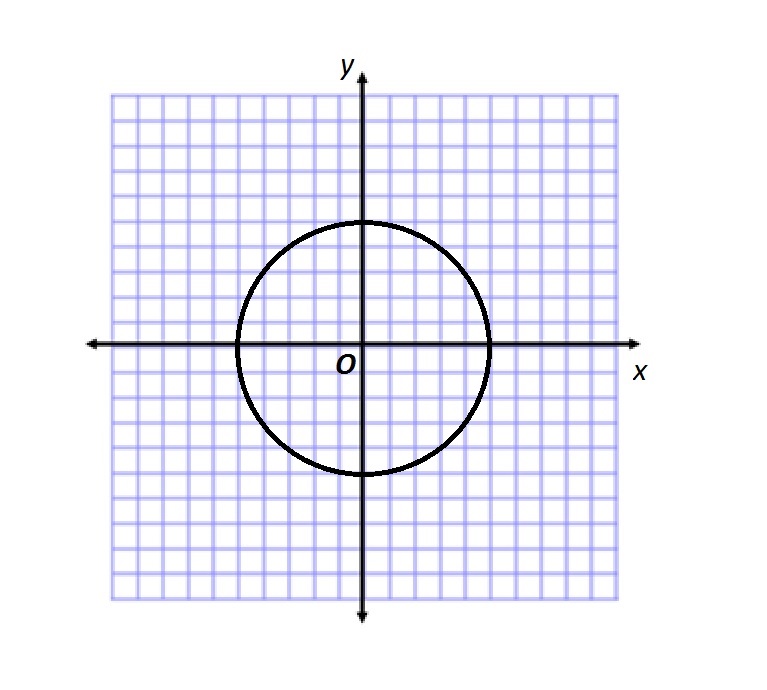
Give the circumference of the above circle. Assume each mark on each axis represents one unit.
Give the circumference of the above circle. Assume each mark on each axis represents one unit.
Tap to reveal answer
The diameter of the circle - the distance from one point to the opposite point - is 10 units, so the circumference is this multiplied by  , or
, or  .
.
The diameter of the circle - the distance from one point to the opposite point - is 10 units, so the circumference is this multiplied by
← Didn't Know|Knew It →
What is the area of a circle with a diameter of  ?
?
What is the area of a circle with a diameter of
Tap to reveal answer
Be careful on several counts for this question. First, remember that you need the radius for calculating area. Therefore, since you know that the diameter is  , you can say that the radius is
  .
.
Next, be very careful given that there is already a  in your radius. The formula for the area of a circle is:

For your data, this is:

Be careful on several counts for this question. First, remember that you need the radius for calculating area. Therefore, since you know that the diameter is
Next, be very careful given that there is already a
For your data, this is:
← Didn't Know|Knew It →
What is the area of the circle with a radius of 25?
What is the area of the circle with a radius of 25?
Tap to reveal answer
Write the formula for the area of a circle.

Substitute the radius into the equation.

Simplify the equation.

The answer is: 
Write the formula for the area of a circle.
Substitute the radius into the equation.
Simplify the equation.
The answer is:
← Didn't Know|Knew It →
Find the area of a circle with a radius of 12.
Find the area of a circle with a radius of 12.
Tap to reveal answer
Write the formula for the area of a circle.

Substitute the radius into the equation.

The answer is: 
Write the formula for the area of a circle.
Substitute the radius into the equation.
The answer is:
← Didn't Know|Knew It →
What is the area of a circle with the diameter of 18?
What is the area of a circle with the diameter of 18?
Tap to reveal answer
Write the formula for the area of a circle.

The radius is half the diameter, or 9.
Substitute the value of the radius in to the formula.

The answer is: 
Write the formula for the area of a circle.
The radius is half the diameter, or 9.
Substitute the value of the radius in to the formula.
The answer is:
← Didn't Know|Knew It →
Find the area of a circle with a radius of  .
.
Find the area of a circle with a radius of
Tap to reveal answer
Write the formula for the area of a circle.

Substitute the radius into the equation.

Simplify this equation.

The answer is: 
Write the formula for the area of a circle.
Substitute the radius into the equation.
Simplify this equation.
The answer is:
← Didn't Know|Knew It →
Find the area of a circle with a diameter of 22cm.
Find the area of a circle with a diameter of 22cm.
Tap to reveal answer
To find the area of a circle, we will use the following formula:

where r is the radius of the circle.
Now, we know the diameter of the circle is 22cm. We also know the diameter is two times the radius. Therefore, the radius is 11cm.
So, we can substitute. We get



To find the area of a circle, we will use the following formula:
where r is the radius of the circle.
Now, we know the diameter of the circle is 22cm. We also know the diameter is two times the radius. Therefore, the radius is 11cm.
So, we can substitute. We get
← Didn't Know|Knew It →
Find the area of a circle with a radius of 8in.
Find the area of a circle with a radius of 8in.
Tap to reveal answer
To find the area of a circle, we will use the following formula:

where r is the radius of the circle.
Now, we know the radius of the circle is 8in. So, we can substitute. We get



To find the area of a circle, we will use the following formula:
where r is the radius of the circle.
Now, we know the radius of the circle is 8in. So, we can substitute. We get
← Didn't Know|Knew It →
Determine the area of a circle in square feet with a radius of 12 inches.
Determine the area of a circle in square feet with a radius of 12 inches.
Tap to reveal answer
Write the formula for the area of a circle.

Convert the radius to feet. There are 12 inches in a foot.
This means the radius in feet is 1.
Substitute the radius in feet to obtain the area in feet squared.

The answer is: 
Write the formula for the area of a circle.
Convert the radius to feet. There are 12 inches in a foot.
This means the radius in feet is 1.
Substitute the radius in feet to obtain the area in feet squared.
The answer is:
← Didn't Know|Knew It →
Determine the area of a circle if the radius is  .
.
Determine the area of a circle if the radius is
Tap to reveal answer
Write the formula for the area of a circle.

Substitute the radius into the equation.

The answer is: 
Write the formula for the area of a circle.
Substitute the radius into the equation.
The answer is:
← Didn't Know|Knew It →
Find the area of a circle with a circumference of  .
.
Find the area of a circle with a circumference of
Tap to reveal answer
Write the formula for the circumference of a circle.

Substitute the circumference.

Divide by  on both sides.


Write the formula for the area of a circle.

Substitute the radius into the equation.

The answer is: 
Write the formula for the circumference of a circle.
Substitute the circumference.
Divide by
Write the formula for the area of a circle.
Substitute the radius into the equation.
The answer is:
← Didn't Know|Knew It →
What is the area of the circle with a diameter of  ?
?
What is the area of the circle with a diameter of
Tap to reveal answer
Write the formula for the area of a circle.

The radius is half the diameter.

Substitute the radius into the equation.

The answer is: 
Write the formula for the area of a circle.
The radius is half the diameter.
Substitute the radius into the equation.
The answer is:
← Didn't Know|Knew It →
Find the area of a circle if the circumference is  .
.
Find the area of a circle if the circumference is
Tap to reveal answer
Write the formula for the circumference of a circle.

Substitute the circumference.

Divide by  on both sides.


Write the formula for the area of a circle.

Substitute the radius.

The answer is: 
Write the formula for the circumference of a circle.
Substitute the circumference.
Divide by
Write the formula for the area of a circle.
Substitute the radius.
The answer is:
← Didn't Know|Knew It →
Determine the area of a circle with a radius of 15.
Determine the area of a circle with a radius of 15.
Tap to reveal answer
Write the formula for the area of a circle.

Substitute the radius into the equation.

The answer is: 
Write the formula for the area of a circle.
Substitute the radius into the equation.
The answer is:
← Didn't Know|Knew It →
Determine the area of a circle if the radius is  .
.
Determine the area of a circle if the radius is
Tap to reveal answer
Write the formula for the area of a circle.

Substitute the radius into the equation.

The answer is: 
Write the formula for the area of a circle.
Substitute the radius into the equation.
The answer is:
← Didn't Know|Knew It →
Find the area of a circle with a diameter of 26cm.
Find the area of a circle with a diameter of 26cm.
Tap to reveal answer
To find the area of a circle, we will use the following formula:

where r is the radius of the circle.
Now, we know the diameter of the circle is 26cm. We also know the diameter is two times the radius. Therefore, the radius is 13cm.
So, we can substitute. We get


To find the area of a circle, we will use the following formula:
where r is the radius of the circle.
Now, we know the diameter of the circle is 26cm. We also know the diameter is two times the radius. Therefore, the radius is 13cm.
So, we can substitute. We get
← Didn't Know|Knew It →
Find the area of a circle with a radius of 12in.
Find the area of a circle with a radius of 12in.
Tap to reveal answer
To find the area of a circle, we will use the following formula:

where r is the radius of the circle.
Now, we know the radius of the circle is 12in. So, we can substitute. We get


To find the area of a circle, we will use the following formula:
where r is the radius of the circle.
Now, we know the radius of the circle is 12in. So, we can substitute. We get
← Didn't Know|Knew It →