
Complementary Angles - GED Math
Card 1 of 280
What is the measure of an angle that is complementary to an angle measuring  ?
?
What is the measure of an angle that is complementary to an angle measuring
Tap to reveal answer
The sum of complementary angles is equal to  .
.
Set up the following equation and solve for  :
:


The sum of complementary angles is equal to
Set up the following equation and solve for
← Didn't Know|Knew It →
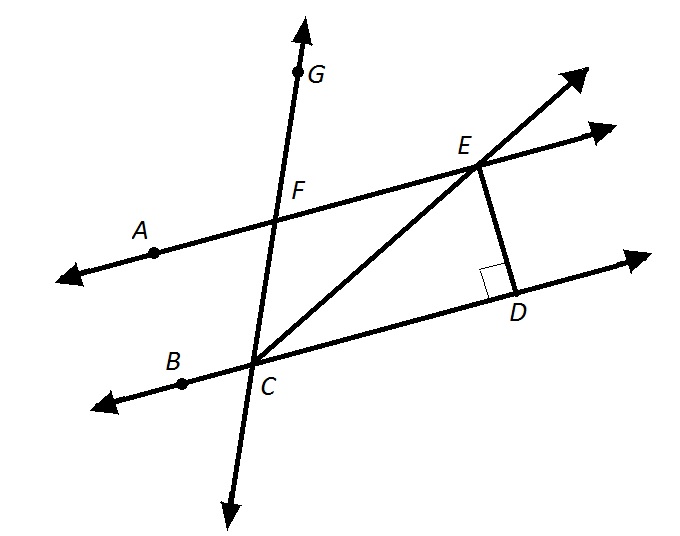
Refer to the above figure. You are given that  .
.
Which two angles must be complementary?
Refer to the above figure. You are given that
Which two angles must be complementary?
Tap to reveal answer
 and
and  form a linear pair, so their measures add up to that of a straight angle, which is
  . They must be supplementary (and cannot be complementary).
 and
and  are a pair of vertical angles - angles formed from a pair of intersecting lines which together have the lines as the union. They must be congruent, and need not be complementary.
 and
and  are a pair of same-side interior angles formed by transversal
  across the parallel lines. They must be supplementary (and cannot be complementary).
 and
and  are the acute angles of right triangle
  . They must be complementary. This is the correct pair.
← Didn't Know|Knew It →
Angles A and B are complementary angles. The measure of angle A is  . The measure of angle B is
  . Solve for
  .
.
Angles A and B are complementary angles. The measure of angle A is
Tap to reveal answer
Since angles A and B are complementary angles, their measurements add up to equal 90. Therefore, we need to set up our equation as follows:

-or-

Combine like terms:

And solve for  :
:


Since angles A and B are complementary angles, their measurements add up to equal 90. Therefore, we need to set up our equation as follows:
-or-
Combine like terms:
And solve for
← Didn't Know|Knew It →
Angles A and B are complementary angles. The measure of angle A is  , The measure of Angle B is
  . find the value of
  .
.
Angles A and B are complementary angles. The measure of angle A is
Tap to reveal answer
Since angles A and B are complementary, their measures add up to 90 degrees. Therefore we can set up our equation as such:

-or-

Combine like terms and solve for  :
:


Since angles A and B are complementary, their measures add up to 90 degrees. Therefore we can set up our equation as such:
-or-
Combine like terms and solve for
← Didn't Know|Knew It →
Angles A and B are complementary angles. The measure of angle A is  . The measure of angle B is
  . What are the measures of the two angles?
Angles A and B are complementary angles. The measure of angle A is
Tap to reveal answer
Since angles A and B are complementary, their measures add up to equal 90 degrees. Therefore we can set up an equation as follows:

-or-

Combine like terms and solve for  :
:


Now that we have found  , we need to plug that back in to the two angle measurements


Since angles A and B are complementary, their measures add up to equal 90 degrees. Therefore we can set up an equation as follows:
-or-
Combine like terms and solve for
Now that we have found
← Didn't Know|Knew It →
What angle is complementary to 55?
What angle is complementary to 55?
Tap to reveal answer
The definition of a complementary angle means that two angles must add up to 90 degrees.
To find the angle, simply subtract 55 from 90.

The answer is: 
The definition of a complementary angle means that two angles must add up to 90 degrees.
To find the angle, simply subtract 55 from 90.
The answer is:
← Didn't Know|Knew It →
What angle is complementary to 10 degrees?
What angle is complementary to 10 degrees?
Tap to reveal answer
Complementary angles must add up to ninety.
Subtract the given angle from 90 to find the other angle.

The answer is: 
Complementary angles must add up to ninety.
Subtract the given angle from 90 to find the other angle.
The answer is:
← Didn't Know|Knew It →
Suppose the angles  and
and  are complementary angles. What is the value of
  ?
?
Suppose the angles
Tap to reveal answer
Set up the equation such that both angles sum up to 90.


Add 5 on both sides.


Divide both sides by 8.

The value of  is:
is: 
The answer is: 
Set up the equation such that both angles sum up to 90.
Add 5 on both sides.
Divide both sides by 8.
The value of
The answer is:
← Didn't Know|Knew It →
Determine the value of  if the angles
  and
and  are complementary.
Determine the value of
Tap to reveal answer
Complementary angles must add up to 90 degrees.
Set up an equation so that the sum of two angles add up to 90.


Subtract 8 on both sides.

Simplify both sides.

Divide by two on both sides.


The answer is: 
Complementary angles must add up to 90 degrees.
Set up an equation so that the sum of two angles add up to 90.
Subtract 8 on both sides.
Simplify both sides.
Divide by two on both sides.
The answer is:
← Didn't Know|Knew It →
What angle is complementary to  radians?
What angle is complementary to
Tap to reveal answer
Note that this is in radians. Recall that 2 complementary angles must add up to 90 degrees.
Since  ,
,

To find the complementary angle, subtract  from
from  .
.

The answer is: 
Note that this is in radians. Recall that 2 complementary angles must add up to 90 degrees.
Since
To find the complementary angle, subtract
The answer is:
← Didn't Know|Knew It →
If the angles  and
and  are complementary angles, what must be the smallest angle?
If the angles
Tap to reveal answer
Complementary angles add up to 90 degrees.
Set up the equation such that both angles add up to 90.


Divide by 6 on both sides.


The smallest angle is  .
.
Substitute the value of  into the expression.
The answer is: 
Complementary angles add up to 90 degrees.
Set up the equation such that both angles add up to 90.
Divide by 6 on both sides.
The smallest angle is
Substitute the value of
The answer is:
← Didn't Know|Knew It →
Suppose the angles  and
and  are complementary angles. What is the value of
  ?
?
Suppose the angles
Tap to reveal answer
Complementary angles add up to 90 degrees.
Set up the equation to solve for  .
.

Combine like-terms.

Subtract 6 from both sides.

Divide by three on both sides.

This means that  .
.
The answer is: 
Complementary angles add up to 90 degrees.
Set up the equation to solve for
Combine like-terms.
Subtract 6 from both sides.
Divide by three on both sides.
This means that
The answer is:
← Didn't Know|Knew It →
What angle is complement to the angle  ?
?
What angle is complement to the angle
Tap to reveal answer
Note that complementary angles sum up to 90 degrees. There is no  after the fraction, which means that this value is in degrees, and not radians.
To determine the other angle, simply subtract the angle from 90 degrees.

The answer is: 
Note that complementary angles sum up to 90 degrees. There is no
To determine the other angle, simply subtract the angle from 90 degrees.
The answer is:
← Didn't Know|Knew It →
Which angle is complementary to the angle  ?
?
Which angle is complementary to the angle
Tap to reveal answer
Complementary angles sum up to 90 degrees.
To find the other angle, subtract 62 from the value of 90.

The answer is: 
Complementary angles sum up to 90 degrees.
To find the other angle, subtract 62 from the value of 90.
The answer is:
← Didn't Know|Knew It →

The angles above are complementary.
What is the measure of the smaller angle?
The angles above are complementary.
What is the measure of the smaller angle?
Tap to reveal answer
Since the angles are complementary, you know that they must add up to a total of  degrees. Based on our data, this means:

Simplifying, you get:


The smaller angle clearly is  :
:
 degrees
Since the angles are complementary, you know that they must add up to a total of
Simplifying, you get:
The smaller angle clearly is
← Didn't Know|Knew It →

The angles above are complementary.
What is the size of the larger angle?
The angles above are complementary.
What is the size of the larger angle?
Tap to reveal answer
Since the angles are complementary, you know that they must add up to a total of  degrees. Based on our data, this means:

Simplifying, you get:


It is best to compute both angles to be safe:
 degrees
This means that the other is  degrees
Since the angles are complementary, you know that they must add up to a total of
Simplifying, you get:
It is best to compute both angles to be safe:
This means that the other is
← Didn't Know|Knew It →
Complementary angles add up to how many degrees?
Complementary angles add up to how many degrees?
Tap to reveal answer
Two angles are complementary when they add up to  .
.
Two angles are complementary when they add up to
← Didn't Know|Knew It →
Angles a and b are complementary. If  , what is the value of b?
Angles a and b are complementary. If
Tap to reveal answer
Two angles are complementary when they add up to  . So, to find the value of complementary angles, we will use the following formula:

Now, we know

So, we will substitute and solve for b. We get


Two angles are complementary when they add up to
Now, we know
So, we will substitute and solve for b. We get
← Didn't Know|Knew It →
If two angles are complementary, and one angle is  , what is the value of the other angle?
If two angles are complementary, and one angle is
Tap to reveal answer
Two angles are complementary if they add up to  . So, to find complementary angles, we will use the following formula:

Now, we know the value of one angle is  , so we will substitute. We get

Now, we will solve for b. We get


Therefore, the value of the other angle is  .
.
Two angles are complementary if they add up to
Now, we know the value of one angle is
Now, we will solve for b. We get
Therefore, the value of the other angle is
← Didn't Know|Knew It →
What angle is complementary to  ?
?
What angle is complementary to
Tap to reveal answer
Complementary angles sum up to 90.
This means that the other angle must be the difference from 90.

Combine like-terms.
The answer is: 
Complementary angles sum up to 90.
This means that the other angle must be the difference from 90.
Combine like-terms.
The answer is:
← Didn't Know|Knew It →