
Single-Variable Algebra - GED Math
Card 1 of 840
Sixty-four coins, all dimes and nickels, total $5.15. How many of the coins are dimes?
Sixty-four coins, all dimes and nickels, total $5.15. How many of the coins are dimes?
Tap to reveal answer
Let  be the number of dimes. Then there are
  nickels.
An equation can be set up and solved for  for the amount of money:







 , the number of dimes.
Let
An equation can be set up and solved for
← Didn't Know|Knew It →
Sixty-four coins, all dimes and quarters, total $8.95. How many quarters are there?
Sixty-four coins, all dimes and quarters, total $8.95. How many quarters are there?
Tap to reveal answer
Let  be the number of quarters. Then there are
  dimes.
An equation can be set up and solved for  for the amount of money in dollars:


Let
An equation can be set up and solved for
← Didn't Know|Knew It →
Marge and William are running away from each other in opposite directions. Marge is running at a rate of  , while William is running at a rate of
  . In how many minutes will they be
  from each other?
Marge and William are running away from each other in opposite directions. Marge is running at a rate of 


Tap to reveal answer
Every second, you know that Marge and William will become a total of  or
or  . Now, you can use the simple work formula for distance:
 or, for our data,
(Remember  kilometers is
  meters.)
Thus, solving for  you get:


This is in seconds, though. You need minutes. To convert, you need to divide by  :
:


Every second, you know that Marge and William will become a total of 

(Remember 
Thus, solving for

This is in seconds, though. You need minutes. To convert, you need to divide by


← Didn't Know|Knew It →
Timmy works at a fast food chain retail store five days a week, eight hours a day. Suppose it costs him $2.00 everyday to drive to and from work. He makes $10.00 per hour. How much will Timmy have at the end of the week, before applicable taxes?
Timmy works at a fast food chain retail store five days a week, eight hours a day. Suppose it costs him $2.00 everyday to drive to and from work. He makes $10.00 per hour. How much will Timmy have at the end of the week, before applicable taxes?
Tap to reveal answer
Timmy makes ten dollars per hour for eight hours.

For five days: 
Timmy also will pay  for the week to get to work and back.
Subtract his expense from his earnings for the week.

Timmy will have  by the end of the week.
Timmy makes ten dollars per hour for eight hours.
For five days:
Timmy also will pay
Subtract his expense from his earnings for the week.
Timmy will have
← Didn't Know|Knew It →
Which of the following phrases can be written as the algebraic expression  ?
?
Which of the following phrases can be written as the algebraic expression
Tap to reveal answer
 is three decreased by
  , which is the square of a number; therefore,
  is three decreased by the square of a number.
← Didn't Know|Knew It →
Which of the following phrases can be written as the algebraic expression  ?
?
Which of the following phrases can be written as the algebraic expression
Tap to reveal answer
 is sixty-five subtracted from
  , which is the opposite of a number; therefore,
  is "sixty-five subtracted from the opposite of a number."
← Didn't Know|Knew It →
Which of the following phrases can be written as the algebraic expression  ?
?
Which of the following phrases can be written as the algebraic expression
Tap to reveal answer
 is the square of
  , which is the difference of a number and thirty-four. Therefore,
  is the difference of a number and thirty-four.
← Didn't Know|Knew It →
A broken television cost $1.25 after a 99% discount. What was the original price?
A broken television cost $1.25 after a 99% discount. What was the original price?
Tap to reveal answer
Let x be the original price. If the original price was given a discount, the value of the percent discount must be subtracted from the original price.
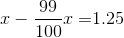

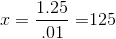
Let x be the original price. If the original price was given a discount, the value of the percent discount must be subtracted from the original price.
← Didn't Know|Knew It →
Which of the following phrases can be written as the algebraic expression  ?
?
Which of the following phrases can be written as the algebraic expression
Tap to reveal answer
 is the opposite of
  , which is the difference of a number and forty-five; therefore,
  is the opposite of the difference of a number and forty-five.
← Didn't Know|Knew It →
Which of the following phrases can be written as the algebraic expression  ?
?
Which of the following phrases can be written as the algebraic expression
Tap to reveal answer
 is twenty-four decreased by
  , which is the absolute value of a number, so
  is "twenty-four decreased by the absolute value of a number."
← Didn't Know|Knew It →
Which of the following phrases can be written as the algebraic expression  ?
?
Which of the following phrases can be written as the algebraic expression
Tap to reveal answer
 is the absolute value of
  , which is the difference of a number and fifty-four; therefore,
  is "the absolute value of the difference of a number and fifty-four."
← Didn't Know|Knew It →
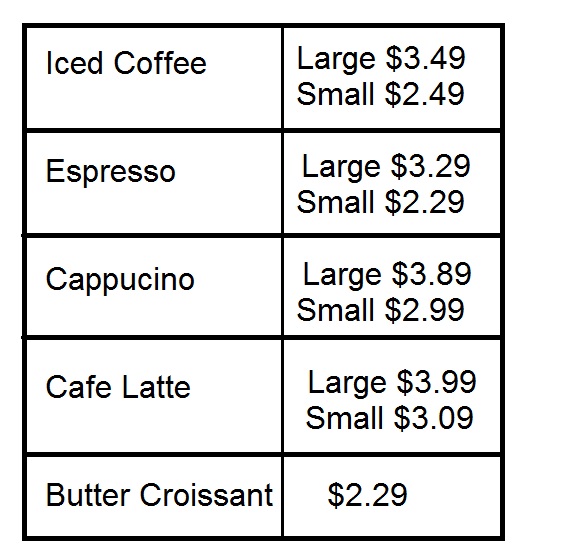
Above is the menu for a coffee shop; there is no sales tax charged on purchases.
Greg is throwing a party and wants to buy eight large cappucinos, one for each attendee. He wants to buy all the butter croissants he can without spending more than $80 total. How many croissants will he be able to buy?
Above is the menu for a coffee shop; there is no sales tax charged on purchases.
Greg is throwing a party and wants to buy eight large cappucinos, one for each attendee. He wants to buy all the butter croissants he can without spending more than $80 total. How many croissants will he be able to buy?
Tap to reveal answer
Eight large cappucinos will cost Greg
 .
.
This leaves him

to buy croissants, which cost  .
.
Let  be the number of croissants he buys. Then


Greg can buy up to 21 croissants.
Eight large cappucinos will cost Greg
This leaves him
to buy croissants, which cost
Let
Greg can buy up to 21 croissants.
← Didn't Know|Knew It →
John had 48 candies. He ate 2, and said he gave almost 25% of the remaining to charity. What is the most reasonable number of candies he had left?
John had 48 candies. He ate 2, and said he gave almost 25% of the remaining to charity. What is the most reasonable number of candies he had left?
Tap to reveal answer
After John has ate 2 candies out of his total of 48 candies, he has 46 candies left.
25% of 46 is equivalent to:

However, candies are counted in units, which means if John could have only given 11 candies to charity if he said he has given almost 25% away. The trick answer is 34 because 11.5 candies cannot be rounded to 12 candies.
Hence:

After John has ate 2 candies out of his total of 48 candies, he has 46 candies left.
25% of 46 is equivalent to:
However, candies are counted in units, which means if John could have only given 11 candies to charity if he said he has given almost 25% away. The trick answer is 34 because 11.5 candies cannot be rounded to 12 candies.
Hence:
← Didn't Know|Knew It →
Suppose a customer paid $500 for a new phone. The store had applied a 20% discount, and the tax after the discount was 8.25%. What was the approximate price of the phone before the applied discount and tax rate?
Suppose a customer paid $500 for a new phone. The store had applied a 20% discount, and the tax after the discount was 8.25%. What was the approximate price of the phone before the applied discount and tax rate?
Tap to reveal answer
Let x be the cost of the phone before applying the 20% discount. After applying the discount, the value will be equal to some amount y before applying tax.


After amount y has been taxed the 8.25%, the new value will be the price of the phone, which is $500. The equation representing this relationship is:

We have a system of equations. Substitute y in terms of x into the 2nd equation. Solving the value of x will give the original value of the phone.


Therefore, the price of the phone is approximately $577.37.
Let x be the cost of the phone before applying the 20% discount. After applying the discount, the value will be equal to some amount y before applying tax.
After amount y has been taxed the 8.25%, the new value will be the price of the phone, which is $500. The equation representing this relationship is:
We have a system of equations. Substitute y in terms of x into the 2nd equation. Solving the value of x will give the original value of the phone.
Therefore, the price of the phone is approximately $577.37.
← Didn't Know|Knew It →
Which of the following phrases can be represented by the algebraic expression  ?
?
Which of the following phrases can be represented by the algebraic expression
Tap to reveal answer
 is the reciprocal of
  , which is the difference of five and a number. Therefore,
  is "the reciprocal of the difference of five and a number".
← Didn't Know|Knew It →
Mary spent $48 for shoes. This was $14 less than twice what she spent for a shirt. How much was the shirt?
Mary spent $48 for shoes. This was $14 less than twice what she spent for a shirt. How much was the shirt?
Tap to reveal answer
Every word problem has an unknown number. In this problem, the unknown number or value is the price of the shirt. The variable  will represent the unknown number.
In this problem,  will represent how much Mary spent for the shirt. The problem states that $48 was $14 less than 2 times what she spent on for the shirt. An equation will be written in order to solve this problem.

Then solve for  .
.
The first step is to remove the subtraction of $14 by using the inverse operation, which would be addition. Remember, because it is an equation, whatever operation you choose to perform on one side of the equation must also be done to the other side of the equation. Therefore, you will add $14 to both sides of this equation.


In order to solve for , you will need to divide both sides by the coefficient, (the number next to the variable), which is 2.


Every word problem has an unknown number. In this problem, the unknown number or value is the price of the shirt. The variable
In this problem,
Then solve for
The first step is to remove the subtraction of $14 by using the inverse operation, which would be addition. Remember, because it is an equation, whatever operation you choose to perform on one side of the equation must also be done to the other side of the equation. Therefore, you will add $14 to both sides of this equation.
In order to solve for
← Didn't Know|Knew It →
Leslie has some nickels, some dimes, and some quarters. She has twice as many dimes as she has nickels, and she has four more quarters than she has dimes. If she has  dimes, how much does she have, in terms of
  , in nickels, dimes, and quarters?
Leslie has some nickels, some dimes, and some quarters. She has twice as many dimes as she has nickels, and she has four more quarters than she has dimes. If she has
Tap to reveal answer
Since Leslie has twice as many dimes as nickels, the number of nickels she has is half the number of dimes, or half of  . This means she has
  nickels. Also, since she has four more quarters than dimes, she has
  quarters.
She has
 in nickels,
 in dimes, and
 in quarters.
In total, the number of dollars Leslie has is


Leslie has  dollars.
Since Leslie has twice as many dimes as nickels, the number of nickels she has is half the number of dimes, or half of
She has
In total, the number of dollars Leslie has is
Leslie has
← Didn't Know|Knew It →
Jeff, the barista at Moonbucks Coffee, is having a problem. He needs to make fifty pounds of Premium Blend coffee by mixing together some Kona beans, which cost $24 per pound, with some Ethiopian Delight beans, which cost $10 per pound. The Premium Blend coffee will cost $14.20 per pound. Also, the coffee will sell for the same price mixed as it would separately.
Let  be the number of pounds of Kona beans and
  be the number of pounds of Ethiopian Delight beans. Which of the following systems of equations could you set up to solve this problem?
Jeff, the barista at Moonbucks Coffee, is having a problem. He needs to make fifty pounds of Premium Blend coffee by mixing together some Kona beans, which cost $24 per pound, with some Ethiopian Delight beans, which cost $10 per pound. The Premium Blend coffee will cost $14.20 per pound. Also, the coffee will sell for the same price mixed as it would separately.
Let
Tap to reveal answer
The number of pounds of coffee beans totals 50, so one of the equations would be
 .
.
The total price of the Kona beans is the unit price, $24 per pound, multiplied by the quantity,  pounds. This is
  dollars. Similarly, the total price of the Ethiopian delight beans is
  dollars, and the price of the mixture is
  dollars. Add the prices of the Kona and Ethiopian Delight beans to get the price of the mixture:

These are the equations of the system.
The number of pounds of coffee beans totals 50, so one of the equations would be
The total price of the Kona beans is the unit price, $24 per pound, multiplied by the quantity,
These are the equations of the system.
← Didn't Know|Knew It →
The French club wants to make and sell some pizzas for a fundraiser. It will cost $250 to rent the equipment to make the pizzas and $2 worth of ingredients to make each pizza. The pizzas will be sold for $4.50 apiece.
How many pizzas must be made and sold for the French club to make a profit of at least $500?
The French club wants to make and sell some pizzas for a fundraiser. It will cost $250 to rent the equipment to make the pizzas and $2 worth of ingredients to make each pizza. The pizzas will be sold for $4.50 apiece.
How many pizzas must be made and sold for the French club to make a profit of at least $500?
Tap to reveal answer
Let  be the number of pizzas made and sold. Each pizza will require $2 worth of ingredients, so the ingredients in total will cost
  . Add this to the cost to rent the equipment and the cost will be
  .
.
The pizzas will cost $4.50 each, so the money raised will be  .
.
The profit will be the difference between the revenue and the cost:

The French club wants a profit of at least $500, so we set up and solve the inequality:


At least 300 pizzas must be made and sold.
Let
The pizzas will cost $4.50 each, so the money raised will be
The profit will be the difference between the revenue and the cost:
The French club wants a profit of at least $500, so we set up and solve the inequality:
At least 300 pizzas must be made and sold.
← Didn't Know|Knew It →
Pat makes fifteen birdhouses every month, while John makes twenty. If the two men work together to make birdhouses, how long will it take them to make  of them? (Presume that they make the houses separately and do not interfere with each other's work.)
Pat makes fifteen birdhouses every month, while John makes twenty. If the two men work together to make birdhouses, how long will it take them to make
Tap to reveal answer
This kind of question is really just a basic rate problem. What it is asking is "How many months  at rate
  does it take to make
  birdhouses?" The rate is just the combination of the two men's rates:

Thus, you can set up the equation:

Thus, 
This kind of question is really just a basic rate problem. What it is asking is "How many months
Thus, you can set up the equation:
Thus,
← Didn't Know|Knew It →