
Quadratic Equations - GED Math
Card 1 of 480
Subtract:

Subtract:
Tap to reveal answer

can be determined by subtracting the coefficients of like terms. We can do this vertically as follows:

By switching the symbols in the second expression we can transform this to an addition problem, and add coefficients:

can be determined by subtracting the coefficients of like terms. We can do this vertically as follows:
By switching the symbols in the second expression we can transform this to an addition problem, and add coefficients:
← Didn't Know|Knew It →
Add:

Add:
Tap to reveal answer

can be determined by adding the coefficients of like terms. We can do this vertically as follows:

can be determined by adding the coefficients of like terms. We can do this vertically as follows:
← Didn't Know|Knew It →
Which of the following expressions is equivalent to the product?

Which of the following expressions is equivalent to the product?
Tap to reveal answer
Use the difference of squares pattern

with  and
and  :
:


Use the difference of squares pattern
with
← Didn't Know|Knew It →
Which of the following expressions is equivalent to the product?

Which of the following expressions is equivalent to the product?
Tap to reveal answer
Use the difference of squares pattern

with  and
and  :
:


Use the difference of squares pattern
with
← Didn't Know|Knew It →
Simplify:

Simplify:
Tap to reveal answer
Start by factoring the numerator. Notice that each term in the numerator has an  , so we can write the following:

Next, factor the terms in the parentheses. You will want two numbers that multiply to  and add to
  .
.

Next, factor the denominator. For the denominator, we will want two numbers that multiply to  and add to
  .
.

Now that both the denominator and numerator have been factored, rewrite the fraction in its factored form.

Cancel out any terms that appear in both the numerator and denominator.

Start by factoring the numerator. Notice that each term in the numerator has an
Next, factor the terms in the parentheses. You will want two numbers that multiply to
Next, factor the denominator. For the denominator, we will want two numbers that multiply to
Now that both the denominator and numerator have been factored, rewrite the fraction in its factored form.
Cancel out any terms that appear in both the numerator and denominator.
← Didn't Know|Knew It →
Simplify the following expression:

Simplify the following expression:
Tap to reveal answer
Start by factoring the numerator.

To factor the numerator, you will need to find  numbers that add up to
  and multiply to
  .
.

Next, factor the denominator.

To factor the denominator, you will need to find two numbers that add up to  and multiply to
  .
.

Rewrite the fraction in its factored form.

Since  is found in both numerator and denominator, they will cancel out.

Start by factoring the numerator.
To factor the numerator, you will need to find
Next, factor the denominator.
To factor the denominator, you will need to find two numbers that add up to
Rewrite the fraction in its factored form.
Since
← Didn't Know|Knew It →
Simplify:

Simplify:
Tap to reveal answer
We need to factor both the numerator and the denominator to determine what can cancel each other out.
If we factor the numerator:

Two numbers which add to 6 and multiply to give you -7.
Those numbers are 7 and -1.

If we factor the denominator:

First factor out a 2 

Two numbers which add to -4 and multiply to give you 3
Those numbers are -3 and -1

Now we can re-write our expression with a product of factors:

We can divide  and
and  to give us 1, so we are left with

We need to factor both the numerator and the denominator to determine what can cancel each other out.
If we factor the numerator:
Two numbers which add to 6 and multiply to give you -7.
Those numbers are 7 and -1.
If we factor the denominator:
First factor out a 2
Two numbers which add to -4 and multiply to give you 3
Those numbers are -3 and -1
Now we can re-write our expression with a product of factors:
We can divide
← Didn't Know|Knew It →

Tap to reveal answer
This is a quadratic equation, but it is not in standard form.

We express it in standard form as follows, using the FOIL technique:


Now factor the quadratic expression on the left. It can be factored as

where  .
.
By trial and error we find that  , so
, so

can be rewritten as
 .
.
Set each linear binomial equal to 0 and solve separately:


The solution set is  .
.
This is a quadratic equation, but it is not in standard form.
We express it in standard form as follows, using the FOIL technique:
Now factor the quadratic expression on the left. It can be factored as
where
By trial and error we find that
can be rewritten as
Set each linear binomial equal to 0 and solve separately:
The solution set is
← Didn't Know|Knew It →
Subtract:
Subtract:
Tap to reveal answer
can be determined by subtracting the coefficients of like terms. We can do this vertically as follows:
By switching the symbols in the second expression we can transform this to an addition problem, and add coefficients:
can be determined by subtracting the coefficients of like terms. We can do this vertically as follows:
By switching the symbols in the second expression we can transform this to an addition problem, and add coefficients:
← Didn't Know|Knew It →
Add:
Add:
Tap to reveal answer
can be determined by adding the coefficients of like terms. We can do this vertically as follows:
can be determined by adding the coefficients of like terms. We can do this vertically as follows:
← Didn't Know|Knew It →
Which of the following expressions is equivalent to the product?
Which of the following expressions is equivalent to the product?
Tap to reveal answer
Use the difference of squares pattern
with and :
Use the difference of squares pattern
with
← Didn't Know|Knew It →
Which of the following expressions is equivalent to the product?
Which of the following expressions is equivalent to the product?
Tap to reveal answer
Use the difference of squares pattern
with and :
Use the difference of squares pattern
with
← Didn't Know|Knew It →
Simplify:
Simplify:
Tap to reveal answer
Start by factoring the numerator. Notice that each term in the numerator has an , so we can write the following:
Next, factor the terms in the parentheses. You will want two numbers that multiply to and add to .
Next, factor the denominator. For the denominator, we will want two numbers that multiply to and add to .
Now that both the denominator and numerator have been factored, rewrite the fraction in its factored form.
Cancel out any terms that appear in both the numerator and denominator.
Start by factoring the numerator. Notice that each term in the numerator has an
Next, factor the terms in the parentheses. You will want two numbers that multiply to
Next, factor the denominator. For the denominator, we will want two numbers that multiply to
Now that both the denominator and numerator have been factored, rewrite the fraction in its factored form.
Cancel out any terms that appear in both the numerator and denominator.
← Didn't Know|Knew It →
Simplify the following expression:
Simplify the following expression:
Tap to reveal answer
Start by factoring the numerator.
To factor the numerator, you will need to find numbers that add up to and multiply to .
Next, factor the denominator.
To factor the denominator, you will need to find two numbers that add up to and multiply to .
Rewrite the fraction in its factored form.
Since is found in both numerator and denominator, they will cancel out.
Start by factoring the numerator.
To factor the numerator, you will need to find
Next, factor the denominator.
To factor the denominator, you will need to find two numbers that add up to
Rewrite the fraction in its factored form.
Since
← Didn't Know|Knew It →
Simplify:
Simplify:
Tap to reveal answer
We need to factor both the numerator and the denominator to determine what can cancel each other out.
If we factor the numerator:
Two numbers which add to 6 and multiply to give you -7.
Those numbers are 7 and -1.
If we factor the denominator:
First factor out a 2
Two numbers which add to -4 and multiply to give you 3
Those numbers are -3 and -1
Now we can re-write our expression with a product of factors:
We can divide and to give us 1, so we are left with
We need to factor both the numerator and the denominator to determine what can cancel each other out.
If we factor the numerator:
Two numbers which add to 6 and multiply to give you -7.
Those numbers are 7 and -1.
If we factor the denominator:
First factor out a 2
Two numbers which add to -4 and multiply to give you 3
Those numbers are -3 and -1
Now we can re-write our expression with a product of factors:
We can divide
← Didn't Know|Knew It →
Tap to reveal answer
This is a quadratic equation, but it is not in standard form.
We express it in standard form as follows, using the FOIL technique:
Now factor the quadratic expression on the left. It can be factored as
where .
By trial and error we find that , so
can be rewritten as
.
Set each linear binomial equal to 0 and solve separately:
The solution set is .
This is a quadratic equation, but it is not in standard form.
We express it in standard form as follows, using the FOIL technique:
Now factor the quadratic expression on the left. It can be factored as
where
By trial and error we find that
can be rewritten as
Set each linear binomial equal to 0 and solve separately:
The solution set is
← Didn't Know|Knew It →
Solve for x by using the Quadratic Formula:

Solve for x by using the Quadratic Formula:
Tap to reveal answer
We have our quadratic equation in the form 
The quadratic formula is given as:

Using 


We have our quadratic equation in the form
The quadratic formula is given as:
Using
← Didn't Know|Knew It →
Solve for  by completing the square:

Solve for
Tap to reveal answer


To complete the square, we have to add a number that makes the left side of the equation a perfect square. Perfect squares have the formula  .
.
In this case,  .
.


Add this to both sides:


To complete the square, we have to add a number that makes the left side of the equation a perfect square. Perfect squares have the formula
In this case,
Add this to both sides:
← Didn't Know|Knew It →
Solve for  :
:

Solve for
Tap to reveal answer
 can be demonstrated to be a perfect square polynomial as follows:

It can therefore be factored using the pattern

with  .
.
We can rewrite and solve the equation accordingly:


This is the only solution.
It can therefore be factored using the pattern
with
We can rewrite and solve the equation accordingly:
This is the only solution.
← Didn't Know|Knew It →
Solve the following quadratic equation for x by completing the square:

Solve the following quadratic equation for x by completing the square:
Tap to reveal answer
This quadratic equation needs to be solved by completing the square.
- Get all of the x-terms on the left side, and the constants on the right side.


- To put this equation into terms are more common with completing the square, we can make a coefficient of 1 in front of the
 term.
term.
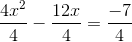
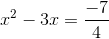
- We need to make the left side of the equation into a "perfect square trinomial." To do this, we take one-half of the coefficient in front of the x, square it, and add it to both sides.

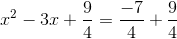
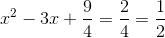
The left side is a perfect square trinomial.
- We can represent a perfect square trinomial as a binomial squared.
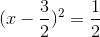
- Take the square root of both sides
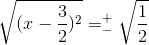
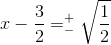
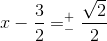
- Solve for x
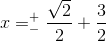

This quadratic equation needs to be solved by completing the square.
- Get all of the x-terms on the left side, and the constants on the right side.
- To put this equation into terms are more common with completing the square, we can make a coefficient of 1 in front of the
- We need to make the left side of the equation into a "perfect square trinomial." To do this, we take one-half of the coefficient in front of the x, square it, and add it to both sides.
The left side is a perfect square trinomial.
- We can represent a perfect square trinomial as a binomial squared.
- Take the square root of both sides
- Solve for x
← Didn't Know|Knew It →