
How to find differential functions - AP Calculus AB
Card 0 of 12012
Find the derivative.

Find the derivative.

Use the power rule to find the derivative.

Thus, the derivative is 
Use the power rule to find the derivative.
Thus, the derivative is
Compare your answer with the correct one above
Find the derivative.

Find the derivative.
Use the power rule to find this derivative.


Thus, the derivative is 
Use the power rule to find this derivative.
Thus, the derivative is
Compare your answer with the correct one above
Find the derivative.

Find the derivative.
Recall that the derivative of a constant is zero.

Recall that the derivative of a constant is zero.
Compare your answer with the correct one above
Find the derivative.

Find the derivative.
Use the power rule to find the derivative.


Thus, the derivative is  .
.
Use the power rule to find the derivative.
Thus, the derivative is
Compare your answer with the correct one above
What is the derivative of  ?
?
What is the derivative of
When taking the derivative, remember to multiply the exponent by the coefficient in front of the x term and then subtract one from the exponent. Therefore, after differentiating each term, you get:  .
.
When taking the derivative, remember to multiply the exponent by the coefficient in front of the x term and then subtract one from the exponent. Therefore, after differentiating each term, you get:
Compare your answer with the correct one above
Find the derivative.

Find the derivative.
Use the power rule to find the derivative.


Thus, the derivative is 
Use the power rule to find the derivative.
Thus, the derivative is
Compare your answer with the correct one above
Find the derivative of the following function:

Find the derivative of the following function:
If  , then the derivative is
  .
.
If  , then the derivative is
  .
.
If  , then the derivative is
  .
.
If  , the the derivative is
  .
.
If  , then the derivative is
  .
.
There are many other rules for the derivatives for trig functions.
If  , then the derivative is
  . This is known as the chain rule.
In this case, we must find the derivative of the following: 
That is done by doing the following: 
Therefore, the answer is: 
If
If
If
If
If
There are many other rules for the derivatives for trig functions.
If
In this case, we must find the derivative of the following:
That is done by doing the following:
Therefore, the answer is:
Compare your answer with the correct one above
Find the derivative:

Find the derivative:
If  , then the derivative is
  .
.
If  , then the derivative is
  .
.
If , then the derivative is .
If , the the derivative is .
If , then the derivative is .
There are many other rules for the derivatives for trig functions.
If , then the derivative is . This is known as the chain rule.
In this case, we must find the derivative of the following: 
That is done by doing the following: 
Therefore, the answer is: 
If
If
If
If
If
There are many other rules for the derivatives for trig functions.
If
In this case, we must find the derivative of the following:
That is done by doing the following:
Therefore, the answer is:
Compare your answer with the correct one above
Find the derivative at x=3.

Find the derivative at x=3.
First, find the derivative using the power rule:

Now, substitute 3 for x.

First, find the derivative using the power rule:
Now, substitute 3 for x.
Compare your answer with the correct one above
Let  on the interval
  . Find a value for the number(s) that satisfies the mean value theorem for this function and interval.
Let
The mean value theorem states that for a planar arc passing through a starting and endpoint  , there exists at a minimum one point,
  , within the interval
  for which a line tangent to the curve at this point is parallel to the secant passing through the starting and end points.

In other words, if one were to draw a straight line through these start and end points, one could find a point on the curve where the tangent would have the same slope as this line.

Note that the value of the derivative of a function at a point is the function's slope at that point; i.e. the slope of the tangent at said point.
First, find the two function values of  on the interval


Then take the difference of the two and divide by the interval.

Now find the derivative of the function; this will be solved for the value(s) found above.


Using a calculator, we find the solution  , which fits within the interval
  , satisfying the mean value theorem.
The mean value theorem states that for a planar arc passing through a starting and endpoint
In other words, if one were to draw a straight line through these start and end points, one could find a point on the curve where the tangent would have the same slope as this line.
Note that the value of the derivative of a function at a point is the function's slope at that point; i.e. the slope of the tangent at said point.
First, find the two function values of
Then take the difference of the two and divide by the interval.
Now find the derivative of the function; this will be solved for the value(s) found above.
Using a calculator, we find the solution
Compare your answer with the correct one above
Find the derivative.

Find the derivative.
Use the quotient rule to find the derivative.

Simplify.
The derivative is  .
.
Use the quotient rule to find the derivative.
Simplify.
The derivative is
Compare your answer with the correct one above
Find the derivative.

Find the derivative.
Use the quotient rule to find the derivative.

Use the quotient rule to find the derivative.
Compare your answer with the correct one above
Find the derivative.

Find the derivative.
Use the power rule to find the derivative.

Use the power rule to find the derivative.
Compare your answer with the correct one above
Differentiate:
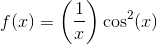
Differentiate:
To find the derivative of this function we must use the Product Rule and the Chain Rule. First we set

and

Now differentiating both of these functions gives


Applying this to the Product Rule gives us,

To find the derivative of this function we must use the Product Rule and the Chain Rule. First we set
and
Now differentiating both of these functions gives
Applying this to the Product Rule gives us,
Compare your answer with the correct one above
Let  on the interval
  . Find a value for the number(s) that satisfies the mean value theorem for this function and interval.
Let
The mean value theorem states that for a planar arc passing through a starting and endpoint , there exists at a minimum one point, , within the interval for which a line tangent to the curve at this point is parallel to the secant passing through the starting and end points.
In other words, if one were to draw a straight line through these start and end points, one could find a point on the curve where the tangent would have the same slope as this line.
Note that the value of the derivative of a function at a point is the function's slope at that point; i.e. the slope of the tangent at said point.
First, find the two function values of  on the interval


Then take the difference of the two and divide by the interval.

Now find the derivative of the function; this will be solved for the value(s) found above.
Trigonometric derivative:


Using a calculator, we find the solutions  , which fit within the interval
  , satisfying the mean value theorem.
The mean value theorem states that for a planar arc passing through a starting and endpoint
In other words, if one were to draw a straight line through these start and end points, one could find a point on the curve where the tangent would have the same slope as this line.
Note that the value of the derivative of a function at a point is the function's slope at that point; i.e. the slope of the tangent at said point.
First, find the two function values of
Then take the difference of the two and divide by the interval.
Now find the derivative of the function; this will be solved for the value(s) found above.
Trigonometric derivative:
Using a calculator, we find the solutions
Compare your answer with the correct one above
Differentiate the function

Differentiate the function
To differentiate the function properly, we must use the Chain Rule which is,

Therefore the derivative of the function is,

To differentiate the function properly, we must use the Chain Rule which is,
Therefore the derivative of the function is,
Compare your answer with the correct one above
Find the derivative.

Find the derivative.
Use the quotient rule to find this derivative.
Recall the quotient rule:


Use the quotient rule to find this derivative.
Recall the quotient rule:
Compare your answer with the correct one above
Differentiate

Differentiate
To differentiate this equation we use the Chain Rule.

Using this throughout the equation gives us,

To differentiate this equation we use the Chain Rule.
Using this throughout the equation gives us,
Compare your answer with the correct one above
Find the derivative of

Find the derivative of
To find the derivative of the function we must use the Chain Rule, which is

Applying this to the function we get,

To find the derivative of the function we must use the Chain Rule, which is
Applying this to the function we get,
Compare your answer with the correct one above
Find the slope of the function  at
at  .
.
Find the slope of the function
To consider finding the slope, let's discuss the topic of the gradient.
For a function  , the gradient is the sum of the derivatives with respect to each variable, multiplied by a directional vector:

It is essentially the slope of a multi-dimensional function at any given point
Knowledge of the following derivative rules will be necessary:
The approach to take with this problem is to simply take the derivatives one at a time. When deriving for one particular variable, treat the other variables as constant.
 at
at 
x:

y:

The slope is 
To consider finding the slope, let's discuss the topic of the gradient.
For a function
It is essentially the slope of a multi-dimensional function at any given point
Knowledge of the following derivative rules will be necessary:
The approach to take with this problem is to simply take the derivatives one at a time. When deriving for one particular variable, treat the other variables as constant.
x:
y:
The slope is
Compare your answer with the correct one above