
Points - AP Calculus AB
Card 0 of 630
Find the critical points of the following function:

Find the critical points of the following function:
To find critical points the derivative of the function must be found.


Critical points occur where the derivative equals zero.


To find critical points the derivative of the function must be found.
Critical points occur where the derivative equals zero.
Compare your answer with the correct one above
Find the critical points of the following function:
Find the critical points of the following function:
To find critical points the derivative of the function must be found.
Critical points occur where the derivative equals zero.
To find critical points the derivative of the function must be found.
Critical points occur where the derivative equals zero.
Compare your answer with the correct one above
Find the critical points of the following function:
Find the critical points of the following function:
To find critical points the derivative of the function must be found.
Critical points occur where the derivative equals zero.
To find critical points the derivative of the function must be found.
Critical points occur where the derivative equals zero.
Compare your answer with the correct one above
Find the critical points of the following function:
Find the critical points of the following function:
To find critical points the derivative of the function must be found.
Critical points occur where the derivative equals zero.
To find critical points the derivative of the function must be found.
Critical points occur where the derivative equals zero.
Compare your answer with the correct one above
Find the critical points of the following function:
Find the critical points of the following function:
To find critical points the derivative of the function must be found.
Critical points occur where the derivative equals zero.
To find critical points the derivative of the function must be found.
Critical points occur where the derivative equals zero.
Compare your answer with the correct one above
Find the critical points of the following function:
Find the critical points of the following function:
To find critical points the derivative of the function must be found.
Critical points occur where the derivative equals zero.
To find critical points the derivative of the function must be found.
Critical points occur where the derivative equals zero.
Compare your answer with the correct one above
Find the critical points of the following function:
Find the critical points of the following function:
To find critical points the derivative of the function must be found.
Critical points occur where the derivative equals zero.
To find critical points the derivative of the function must be found.
Critical points occur where the derivative equals zero.
Compare your answer with the correct one above
Find the critical points of the following function:
Find the critical points of the following function:
To find critical points the derivative of the function must be found.
Critical points occur where the derivative equals zero.
To find critical points the derivative of the function must be found.
Critical points occur where the derivative equals zero.
Compare your answer with the correct one above
Find the critical points of the following function:
Find the critical points of the following function:
To find critical points the derivative of the function must be found.
Critical points occur where the derivative equals zero.
To find critical points the derivative of the function must be found.
Critical points occur where the derivative equals zero.
Compare your answer with the correct one above
Find the critical points of the following function:
Find the critical points of the following function:
To find critical points the derivative of the function must be found.
Critical points occur where the derivative equals zero.
To find critical points the derivative of the function must be found.
Critical points occur where the derivative equals zero.
Compare your answer with the correct one above
Find the critical points of the following function:
Find the critical points of the following function:
To find critical points the derivative of the function must be found.
Critical points occur where the derivative equals zero.
To find critical points the derivative of the function must be found.
Critical points occur where the derivative equals zero.
Compare your answer with the correct one above
Find the critical points of the following function:
Find the critical points of the following function:
To find critical points the derivative of the function must be found.
Critical points occur where the derivative equals zero.
To find critical points the derivative of the function must be found.
Critical points occur where the derivative equals zero.
Compare your answer with the correct one above
Find the points of inflection for the following function:

Find the points of inflection for the following function:
To find the points of inflection, we must find the points at which the second derivative of the function changes sign.
First, we must find the second derivative:


The derivatives were found using the following rule:

Next, we must find the x value at which the second derivative is equal to zero:

Using this value, we make our intervals on which we examine the sign of the second derivative:

Note that at the endpoints of the intervals, the second derivative is neither positive nor negative.
Now, simply plug in any value on the interval into the second derivative function and check the sign. On the first interval, the second derivative is negative, while on the second interval, it is positive. Thus, a point of inflection exists at  . To get the y-coordinate, simply evaluate the function at this x value:

The point of inflection is  .
.
To find the points of inflection, we must find the points at which the second derivative of the function changes sign.
First, we must find the second derivative:
The derivatives were found using the following rule:
Next, we must find the x value at which the second derivative is equal to zero:
Using this value, we make our intervals on which we examine the sign of the second derivative:
Note that at the endpoints of the intervals, the second derivative is neither positive nor negative.
Now, simply plug in any value on the interval into the second derivative function and check the sign. On the first interval, the second derivative is negative, while on the second interval, it is positive. Thus, a point of inflection exists at
The point of inflection is
Compare your answer with the correct one above
Determine the points of inflection for the following function:

Determine the points of inflection for the following function:
To determine the points of inflection, we must determine the x values at which the second derivative changes in sign.
So, we must first find the second derivative:


The derivatives were found using the rule

Next, we must find the values at which the second derivative is equal to zero:


Now, using this zero, we can make the intervals on which we check the sign of the second derivative:

Note that at the endpoints, the second derivative is neither positive nor negative.
Plug in any value on each interval into the second derivative function and check the sign. On the first interval, the second derivative is negative, while on the second, it is positive. Because a sign change occured at  , there exists the point of inflection.
To determine the points of inflection, we must determine the x values at which the second derivative changes in sign.
So, we must first find the second derivative:
The derivatives were found using the rule
Next, we must find the values at which the second derivative is equal to zero:
Now, using this zero, we can make the intervals on which we check the sign of the second derivative:
Note that at the endpoints, the second derivative is neither positive nor negative.
Plug in any value on each interval into the second derivative function and check the sign. On the first interval, the second derivative is negative, while on the second, it is positive. Because a sign change occured at
Compare your answer with the correct one above
Determine the points of inflection for the following function:

Determine the points of inflection for the following function:
To determine the points of inflection of the function, we must determine where the second derivative of the function changes sign.
First, we find the second derivative:


The derivatives were found using the following rule:

Now, we must find where the second derivative equals zero:


Using this value, we can now create the intervals on which we check the sign of the second derivative:

Note that at the endpoints of the intervals, the second derivative is neither positive nor negative.
To check the second derivative's sign on each interval, simply plug in any point on the interval into the second derivative function. On the first interval, the second derivative is negative, while on the second interval, it is positive. Because the sign of the second derivative changes at  , there exists the point of inflection.
To determine the points of inflection of the function, we must determine where the second derivative of the function changes sign.
First, we find the second derivative:
The derivatives were found using the following rule:
Now, we must find where the second derivative equals zero:
Using this value, we can now create the intervals on which we check the sign of the second derivative:
Note that at the endpoints of the intervals, the second derivative is neither positive nor negative.
To check the second derivative's sign on each interval, simply plug in any point on the interval into the second derivative function. On the first interval, the second derivative is negative, while on the second interval, it is positive. Because the sign of the second derivative changes at
Compare your answer with the correct one above
Find the critical points (rounded to two decimal places):

Find the critical points (rounded to two decimal places):
To find the critical points, set  and solve for
  .
.

Differentiate:

Set equal to zero:

Solve for  using the quadratic formula:


To find the critical points, set
Differentiate:
Set equal to zero:
Solve for
Compare your answer with the correct one above
Find the  value of the point of inflection of the function
  .
.
Find the
First, we need to simplify the expression. Sine the numerator has more terms than the denominator, we can simply divide out both terms.
 .
.
Now, we must compute the second derivative of this function, and set it equal to zero.
 .
.

 .
.
 .
.
First, we need to simplify the expression. Sine the numerator has more terms than the denominator, we can simply divide out both terms.
Now, we must compute the second derivative of this function, and set it equal to zero.
Compare your answer with the correct one above
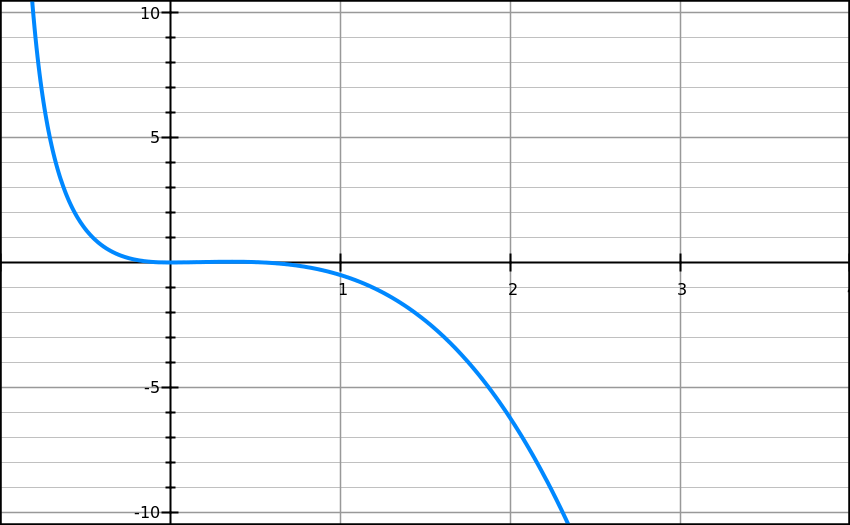
Suppose a point on the curve given above has the property that  .
.
Based solely on the graph above, which of the following is most likely the  value of the point in question?
Suppose a point on the curve given above has the property that
Based solely on the graph above, which of the following is most likely the
If then the graph must be concave up at the point. Based on the picture, we know that the curve is concave up on
  at best. The only value that falls on this interval is
  , which is
  . Since
  , this definitely falls on the interval given and we can be sure it is concave up based on the picture.
If
Compare your answer with the correct one above
What is the critical point for  ?
?
What is the critical point for
To find the critical point, you must find the derivative first. To do that, multiply the exponent by the coefficient in front of the  and then subtract the exponent by
  . Therefore, the derivative is:
  . Then, to find the critical point, set the derivative equal to
  .
.
 .
.
To find the critical point, you must find the derivative first. To do that, multiply the exponent by the coefficient in front of the
Compare your answer with the correct one above
Find the inflection point(s) of  .
.
Find the inflection point(s) of
Inflection points can only occur when the second derivative is zero or undefined. Here we have
 .
.
Therefore possible inflection points occur at  and
and  . However, to have an inflection point we must check that the sign of the second derivative is different on each side of the point. Here we have
 .
.
Hence, both are inflection points
Inflection points can only occur when the second derivative is zero or undefined. Here we have
Therefore possible inflection points occur at
Hence, both are inflection points
Compare your answer with the correct one above