
Writing Equations - AP Calculus AB
Card 0 of 3402
Inverse Function
What is the inverse function of the following:

Inverse Function
What is the inverse function of the following:
 can be written as
  with slope of
  and y-intercept of 1. So the inverse function would be
  or,
or, 
Compare your answer with the correct one above
Logarithm Functions
Solve for  ,
,

Logarithm Functions
Solve for
 implies
  implies
Compare your answer with the correct one above
Evaluate the third derivative of the following trigonometric function.

Evaluate the third derivative of the following trigonometric function.
To evaluate higher order derivative of trigonometric functions like the tangent function, we must become familiar with all of the other derivation rules; in this case we will use the Chain Rule and the Product Rule.
We begin with the identity that

Since the first derivative has now turned into a composite function in the form
 where
where  and
and 
and  and
and 
we have that the second derivative, utilizing the Chain Rule, is


To obtain the third derivative, we must derive the second derivative via the Product Rule, since there is the multiplication of u=2\[sec(x)\]^2 and v=tan(x).
Recall that the Product Rule states that for a function, f(x)=uv:

As a result we have that


To evaluate higher order derivative of trigonometric functions like the tangent function, we must become familiar with all of the other derivation rules; in this case we will use the Chain Rule and the Product Rule.
We begin with the identity that
Since the first derivative has now turned into a composite function in the form
and
we have that the second derivative, utilizing the Chain Rule, is
To obtain the third derivative, we must derive the second derivative via the Product Rule, since there is the multiplication of u=2\[sec(x)\]^2 and v=tan(x).
Recall that the Product Rule states that for a function, f(x)=uv:
As a result we have that
Compare your answer with the correct one above
Find the equation for the velocity whose position function is below:

Find the equation for the velocity whose position function is below:
To solve, simply differentiate  .
.
Remember to use the power rule.
Recall the power rule:


Apply this to our situation to get

To solve, simply differentiate
Remember to use the power rule.
Recall the power rule:
Apply this to our situation to get
Compare your answer with the correct one above
White the expression for the derivative of the following function.

White the expression for the derivative of the following function.
To solve, simply differentiate and don't forget to indicate the differentiation by the "apostrophe" between the function and dependent variable. Thus,

To solve, simply differentiate and don't forget to indicate the differentiation by the "apostrophe" between the function and dependent variable. Thus,
Compare your answer with the correct one above
Write an integral expression which will solve the area under the curve of  , bounded by
  , from
  .
.
Write an integral expression which will solve the area under the curve of
Recall that area under the curve requires integration from either top minus bottom curve, or right minus left curve.
The top curve is: 
The bottom curve is: 
The  interval indicates that the lower bound is 2 and the upper bound is 5.
Write the integral.

Recall that area under the curve requires integration from either top minus bottom curve, or right minus left curve.
The top curve is:
The bottom curve is:
The
Write the integral.
Compare your answer with the correct one above
What is the area under the curve  for
for  ?
?
What is the area under the curve
By normal exponent rules  , and so we set up the definite integral
 ,
,
which integrates to:

By normal exponent rules
which integrates to:
Compare your answer with the correct one above
The Gaussian integral formula states that
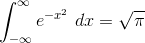 .
.
What is the integral of
 ?
?
The Gaussian integral formula states that
What is the integral of
Integrating by parts with
 ,
, 
 ,
,  ,
,
we get:


Integrating by parts with
we get:
Compare your answer with the correct one above
Determine  given that
  .
.
Determine
This problem requires you to evaluate an indefinite integral of the given function f’(x). Integrating each term of the function with respect to x, we simply divide each coefficient by (n+1), where n is the value of the exponent on x for that particular term, and then add 1 to the value of the exponent on each x. This gives us:


A correct answer must include a constant C, as the original function may have had a constant that is not reflected in the equation for its derivative.
This problem requires you to evaluate an indefinite integral of the given function f’(x). Integrating each term of the function with respect to x, we simply divide each coefficient by (n+1), where n is the value of the exponent on x for that particular term, and then add 1 to the value of the exponent on each x. This gives us:
A correct answer must include a constant C, as the original function may have had a constant that is not reflected in the equation for its derivative.
Compare your answer with the correct one above
What is the value of the following definite integral?

What is the value of the following definite integral?
We start by integrating the function in parentheses with respect to x, and we then subtract the evaluation of the lower limit from the evaluation of the upper limit:


We start by integrating the function in parentheses with respect to x, and we then subtract the evaluation of the lower limit from the evaluation of the upper limit:
Compare your answer with the correct one above
Determine the amount of work required to push a box from  meters to
  meters, given the function for force below:

Determine the amount of work required to push a box from
This problem intends to demonstrate one possible application of calculus to the field of physics. An equation for work as given in physics is as follows:

Using this equation, we simply set up a definite integral with our bounds given by the interval of interest in the problem:


 Joules
After evaluating our integral, we can see that the work required to push the box from x=2 meters to x=5 meters is 39.8 Joules.
This problem intends to demonstrate one possible application of calculus to the field of physics. An equation for work as given in physics is as follows:
Using this equation, we simply set up a definite integral with our bounds given by the interval of interest in the problem:
After evaluating our integral, we can see that the work required to push the box from x=2 meters to x=5 meters is 39.8 Joules.
Compare your answer with the correct one above
Write out the expression of the area under the following curve from  to
to  .
.

Write out the expression of the area under the following curve from
Simply use an integral expression with the given x values as your bounds.
Don't forget to add the dx!

Simply use an integral expression with the given x values as your bounds.
Don't forget to add the dx!
Compare your answer with the correct one above
Evaluate the definite integral within the interval  .
.

Evaluate the definite integral within the interval
In order to solve this problem we must know that

In this case we have:

Our first step is to integrate:

We then arrive to our solution by plugging in our values 


In order to solve this problem we must know that
In this case we have:
Our first step is to integrate:
We then arrive to our solution by plugging in our values
Compare your answer with the correct one above
Evaluate the definite integral within the interval  .
.

Evaluate the definite integral within the interval
In order to solve this problem we must remember that:

In this case we have:

Our first step is to integrate:

We then arrive at our solution by plugging in our values 


In order to solve this problem we must remember that:
In this case we have:
Our first step is to integrate:
We then arrive at our solution by plugging in our values
Compare your answer with the correct one above
Evaluate the definite integral within the interval 

Evaluate the definite integral within the interval
In order to solve this problem we must remember that:

In this case we have:

Our first step is to integrate:

We then arrive to our solution by plugging in our values 


In order to solve this problem we must remember that:
In this case we have:
Our first step is to integrate:
We then arrive to our solution by plugging in our values
Compare your answer with the correct one above
Evaluate the indefinite integral.

Evaluate the indefinite integral.
We are being asked to integrate the function.
To do this we need to remember the power rule of integrals,

Using this rule, we can evaluate the following integral:

We are being asked to integrate the function.
To do this we need to remember the power rule of integrals,
Using this rule, we can evaluate the following integral:
Compare your answer with the correct one above
Evaluate the indefinite integral.

Evaluate the indefinite integral.
In this problem we are being asked to integrate the function.
In order to do this we need to remember,
 .
.
Since

then the integral,
 .
.
In this problem we are being asked to integrate the function.
In order to do this we need to remember,
Since
then the integral,
Compare your answer with the correct one above
Evaluate the indefinite integral.

Evaluate the indefinite integral.
This problem is asking us to integrate the function.
In order to do this we need to remember,
 .
.
Therefore,

This problem is asking us to integrate the function.
In order to do this we need to remember,
Therefore,
Compare your answer with the correct one above
Which of the following integrals could be evaluated to find the area under the curve of the following function from 3 to 13?

Which of the following integrals could be evaluated to find the area under the curve of the following function from 3 to 13?
We are asked to set up an integral without solving it. We want to evaluate the function from 3 to 13, so 3 goes at the bottom of the integral and 13 goes at the top. No other options have this correct.
We are asked to set up an integral without solving it. We want to evaluate the function from 3 to 13, so 3 goes at the bottom of the integral and 13 goes at the top. No other options have this correct.
Compare your answer with the correct one above
Write the correct expression to find the area of  from
from  .
.
Write the correct expression to find the area of
This is a tricky question.
If we chose  , the region in the third quadrant of
  is negative area, since
  is no longer the top curve. Evaluating this integral will cancel out the negative area in the third quadrant with the positive area on the first quadrant. This integral will give zero area, which is incorrect.
The correct method is to split this interval into 2 separate integrations: One from  and the other from
  .
.
From interval  , the top curve is
  minus the bottom curve,
  , is
, is  .
.
From interval  , the top curve is
  minus the bottom curve,
  , is
, is  .
.
Set up the integral.

This is a tricky question.
If we chose
The correct method is to split this interval into 2 separate integrations: One from
From interval
From interval
Set up the integral.
Compare your answer with the correct one above