
Other Differential Functions - AP Calculus AB
Card 0 of 12012
Find the derivative.

Find the derivative.
Use the power rule to find the derivative.


The derivative is  .
.
Use the power rule to find the derivative.
The derivative is
Compare your answer with the correct one above
Find the derivative at x=3.

Find the derivative at x=3.
First, find the derivative using the power rule:

Now, substitute 3 for x.

First, find the derivative using the power rule:
Now, substitute 3 for x.
Compare your answer with the correct one above
Find the derivative.

Find the derivative.
Use the quotient rule to find the derivative.

Simplify.
The derivative is  .
.
Use the quotient rule to find the derivative.
Simplify.
The derivative is
Compare your answer with the correct one above
Find the derivative.

Find the derivative.
Use the quotient rule to find the derivative.

Use the quotient rule to find the derivative.
Compare your answer with the correct one above
Find the derivative.

Find the derivative.
Use the power rule to find the derivative.

Use the power rule to find the derivative.
Compare your answer with the correct one above
Differentiate 
Differentiate
The Chain Rule applies when differentiating compositions of functions. Here,  equals the composition of two functions,
  and
and  . Let
. Let  and
and  . Then
  and the Chain Rule tells us to differentiate the outside function
  and multiply the result by the derivative of the inside function
  . In other words,
  . Note that the inside function
  is left untouched when the outside function
  is differentiated. Here,
  and
and  , so
, so  which simplifies to
  .
.
 is an incomplete application of the Chain Rule which neglects to multiply the derivative of the outside function by the derivative of the inside function.
 is a misapplication of the Chain Rule which adds the derivative of the outside and inside functions rather than multiplying them.
 is a misapplication of the Chain Rule which substitutes the derivative of the inside function for the original inside function rather than multiplying the derivative of the outside function by the derivative of the inside function.
The Chain Rule applies when differentiating compositions of functions. Here,
Compare your answer with the correct one above
Differentiate the function

Differentiate the function
To differentiate the function properly, we must use the Chain Rule which is,

Therefore the derivative of the function is,

To differentiate the function properly, we must use the Chain Rule which is,
Therefore the derivative of the function is,
Compare your answer with the correct one above
Differentiate 
Differentiate
The Chain Rule applies when differentiating compositions of functions. Here,  equals the composition of two functions,
  and
and  . Let
. Let  and
and  . Then
  and the Chain Rule tells us to differentiate the outside function
  and multiply the result by the derivative of the inside function
  . In other words,
  . Note that the inside function
  is left untouched when the outside function
  is differentiated. Here,
  and
and  , so
, so  which simplifies to
  .
.
 is an incomplete application of the Chain Rule which neglects to multiply the derivative of the outside function by the derivative of the inside function.
 is a misapplication of the Chain Rule which adds the derivative of the outside and inside functions rather than multiplying them.
 is a misapplication of the Chain Rule which fails to preserve the original inside function when differentiating the outside function.
The Chain Rule applies when differentiating compositions of functions. Here,
Compare your answer with the correct one above
Differentiate 
Differentiate
The Chain Rule applies when differentiating compositions of functions. Here, equals the composition of two functions,  and
and  . Let
. Let  and
and  . Then and the Chain Rule tells us to differentiate the outside function and multiply the result by the derivative of the inside function . In other words, . Note that the inside function is left untouched when the outside function is differentiated. Here,
  and
and  , so
, so  which simplifies to
  .
.
 is an incomplete application of the Chain Rule which neglects to multiply the derivative of the outside function by the derivative of the inside function.
 is a misapplication of the Chain Rule which adds the derivative of the outside and inside functions rather than multiplying them.
 is a misapplication of the Chain Rule which adds the derivative of the outside function to an incorrect derivation of the inside function.
The Chain Rule applies when differentiating compositions of functions. Here,
Compare your answer with the correct one above
Find the derivative at  .
.

Find the derivative at
Begin by finding the derivative using the power rule.


The derivative is 
Now, substitute  for
for  .
.

Begin by finding the derivative using the power rule.
The derivative is
Now, substitute
Compare your answer with the correct one above
Find the derivative.

Find the derivative.
Find the derivative using the power rule.


The derivative is  .
.
Find the derivative using the power rule.
The derivative is
Compare your answer with the correct one above
Find the derivative at  .
.

Find the derivative at
First, find the derivative using the power rule:
Remember that the power rule is:

Apply this to our problem to get

Now, substitute  for
for  .
.

First, find the derivative using the power rule:
Remember that the power rule is:
Apply this to our problem to get
Now, substitute
Compare your answer with the correct one above
Differentiate:
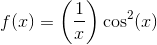
Differentiate:
To find the derivative of this function we must use the Product Rule and the Chain Rule. First we set

and

Now differentiating both of these functions gives


Applying this to the Product Rule gives us,

To find the derivative of this function we must use the Product Rule and the Chain Rule. First we set
and
Now differentiating both of these functions gives
Applying this to the Product Rule gives us,
Compare your answer with the correct one above
Find the derivative.

Find the derivative.
Use the quotient rule to find this derivative.
Remember that the quotient rule is:

Apply this to our problem to get


Use the quotient rule to find this derivative.
Remember that the quotient rule is:
Apply this to our problem to get
Compare your answer with the correct one above
Find the derivative at  .
.

Find the derivative at
First, use the power rule to find the derivative.
Remember that the power rule is:

Apply this to our problem to get

Now, substitute  for
for  .
.

First, use the power rule to find the derivative.
Remember that the power rule is:
Apply this to our problem to get
Now, substitute
Compare your answer with the correct one above
Find the derivative.

Find the derivative.
Use the product rule to find the derivative.
Remember that the product rule is:

Apply this to our problem to get

Use the product rule to find the derivative.
Remember that the product rule is:
Apply this to our problem to get
Compare your answer with the correct one above
Find the derivative.

Find the derivative.
Use the quotient rule to find this derivative.
Remember that the quotient rule is:

Apply this to our problem to get

Use the quotient rule to find this derivative.
Remember that the quotient rule is:
Apply this to our problem to get
Compare your answer with the correct one above
Find the derivative.

Find the derivative.
Use the quotient rule to find this derivative.
Recall the quotient rule:


Use the quotient rule to find this derivative.
Recall the quotient rule:
Compare your answer with the correct one above
Differentiate

Differentiate
To differentiate this equation we use the Chain Rule.

Using this throughout the equation gives us,

To differentiate this equation we use the Chain Rule.
Using this throughout the equation gives us,
Compare your answer with the correct one above
Find the derivative of

Find the derivative of
To find the derivative of the function we must use the Chain Rule, which is

Applying this to the function we get,

To find the derivative of the function we must use the Chain Rule, which is
Applying this to the function we get,
Compare your answer with the correct one above