
Normal Vectors
AP Calculus BC · Learn by Concept
Help Questions
AP Calculus BC › Normal Vectors
Determine whether the two vectors, 

The two vectors are orthogonal.
The two vectors are not orthogonal.
Explanation
Vectors can be said to be orthogonal, that is to say perpendicular or normal, if their dot product amounts to zero:

To find the dot product of two vectors given the notation
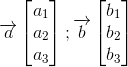
Simply multiply terms across rows:

For our vectors, 


The two vectors are orthogonal.
Determine whether the two vectors, 

The two vectors are not orthogonal.
The two vectors are orthogonal.
Explanation
Vectors can be said to be orthogonal, that is to say perpendicular or normal, if their dot product amounts to zero:
To find the dot product of two vectors given the notation
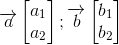
Simply multiply terms across rows:

For our vectors, 


The two vectors are not orthogonal.
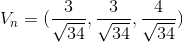
Find the Unit Normal Vector to the given plane.


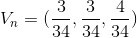
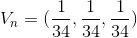
Explanation
Recall the definition of the Unit Normal Vector.

Let


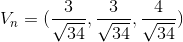
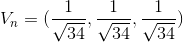
Find the Unit Normal Vector to the given plane.
Explanation
Recall the definition of the Unit Normal Vector.
Let
Determine whether the two vectors, 

The two vectors are orthogonal.
The two vectors are not orthogonal.
Explanation
Vectors can be said to be orthogonal, that is to say perpendicular or normal, if their dot product amounts to zero:
To find the dot product of two vectors given the notation
Simply multiply terms across rows:
For our vectors, 


The two vectors are orthogonal.
Determine whether the two vectors, 

The two vectors are not orthogonal.
The two vectors are orthogonal.
Explanation
Vectors can be said to be orthogonal, that is to say perpendicular or normal, if their dot product amounts to zero:

To find the dot product of two vectors given the notation
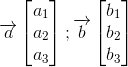
Simply multiply terms across rows:

For our vectors, 


The two vectors are not orthogonal.
Determine whether the two vectors, 

The two vectors are orthogonal.
The two vectors are not orthogonal.
Explanation
Vectors can be said to be orthogonal, that is to say perpendicular or normal, if their dot product amounts to zero:
To find the dot product of two vectors given the notation
Simply multiply terms across rows:
For our vectors, 


The two vectors are orthogonal.
Determine whether the two vectors, 

The two vectors are orthogonal.
The two vectors are not orthogonal.
Explanation
Vectors can be said to be orthogonal, that is to say perpendicular or normal, if their dot product amounts to zero:
To find the dot product of two vectors given the notation
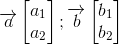
Simply multiply terms across rows:

For our vectors, 


The two vectors are orthogonal.
Determine whether the two vectors, 

The two vectors are not orthogonal.
The two vectors are orthogonal.
Explanation
Vectors can be said to be orthogonal, that is to say perpendicular or normal, if their dot product amounts to zero:
To find the dot product of two vectors given the notation
Simply multiply terms across rows:
For our vectors, 


The two vectors are not orthogonal.
Determine whether the two vectors, 

The two vectors are orthogonal.
The two vectors are not orthogonal.
Explanation
Vectors can be said to be orthogonal, that is to say perpendicular or normal, if their dot product amounts to zero:
To find the dot product of two vectors given the notation
Simply multiply terms across rows:
For our vectors, 


The two vectors are orthogonal.