
Partial Derivatives - AP Calculus BC
Card 0 of 7240
Find the differential of the following function:

Find the differential of the following function:
The differential of a function is given by

So, we must find the partial derivatives of the function. To find the given partial derivative of the function, we must treat the other variable(s) as constants.
The partial derivatives are


The derivatives were found using the following rules:
 ,
,  ,
,  ,
, 
The differential of a function is given by
So, we must find the partial derivatives of the function. To find the given partial derivative of the function, we must treat the other variable(s) as constants.
The partial derivatives are
The derivatives were found using the following rules:
Compare your answer with the correct one above
Find the differential of the function

Find the differential of the function
The differential of a function is given by

The partial derivatives of the function are


The derivatives were found using the following rules:
 ,
,  ,
,  ,
, 
The differential of a function is given by
The partial derivatives of the function are
The derivatives were found using the following rules:
Compare your answer with the correct one above


Compare your answer with the correct one above
Evaluate:
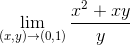
Evaluate:
Since we won't have any divided by zero problems, we can just evaluate at the point.

Since we won't have any divided by zero problems, we can just evaluate at the point.
Compare your answer with the correct one above
Calculate the following limit.

Calculate the following limit.
We can calculate the limit

by simply plugging in  because the value is defined at
  and around that point.
So we get
 .
.
We can calculate the limit
by simply plugging in
So we get
Compare your answer with the correct one above
Calculate the following limit.
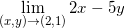
Calculate the following limit.
We can calculate the limit
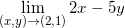
by simply plugging in  because the value is defined at
  and at every value in
  .
.
So we get
 .
.
We can calculate the limit
by simply plugging in
So we get
Compare your answer with the correct one above
Evaluate 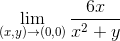
Evaluate
If we try evaluating the limit along two different paths,  , we have

And

Since evaluating along these two paths yielded diffferent values, the limit does not exist.
If we try evaluating the limit along two different paths,
And
Since evaluating along these two paths yielded diffferent values, the limit does not exist.
Compare your answer with the correct one above
Compare your answer with the correct one above
Compare your answer with the correct one above
Compare your answer with the correct one above
Compare your answer with the correct one above

Compare your answer with the correct one above
Compare your answer with the correct one above


Compare your answer with the correct one above


Compare your answer with the correct one above


Compare your answer with the correct one above


Compare your answer with the correct one above


Compare your answer with the correct one above


Compare your answer with the correct one above


Compare your answer with the correct one above