
Operations with Whole Numbers - Basic Math
Card 1 of 124
For the following questions, please select the answer that most correctly completes the equation.

For the following questions, please select the answer that most correctly completes the equation.
Tap to reveal answer

Ones digit: 
Tens digit:  (leave the two at the tens, carry the one to the hundreds digit)
Hundreds digit:  , add the one from the tens digit, so you get 5 + 1 = 6
Thousands digit: 
Ones digit:
Tens digit:
Hundreds digit:
Thousands digit:
← Didn't Know|Knew It →
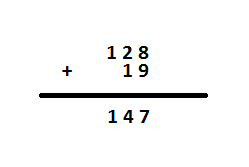
Find the sum.

Find the sum.
Tap to reveal answer
First add the digits in the ones colume, this would be  . Make sure to carry the 1 from the 17 to the tens colume.
Then add the digits in the tens colume, this would be  .
.
Lastly, add the digits in the hundrends colume, this would be 
Therefore the result is as follows:
First add the digits in the ones colume, this would be
Then add the digits in the tens colume, this would be
Lastly, add the digits in the hundrends colume, this would be
Therefore the result is as follows:
← Didn't Know|Knew It →
If I had  in the bank and deposited an additonal
  today, how much do I have in total?
If I had
Tap to reveal answer
1. Add the ones places:

2. Add the tens places:

***don't forget to put the 3 down and carry the one to the hundreds place***
3. Add the hundreds place:

This makes your total:

1. Add the ones places:
2. Add the tens places:
***don't forget to put the 3 down and carry the one to the hundreds place***
3. Add the hundreds place:
This makes your total:
← Didn't Know|Knew It →

What is the solution of the above operation?
What is the solution of the above operation?
Tap to reveal answer

We can see this because if we had 5 (represented by  ) and add another 2 objects (represented by
  ) we should get 7 objects (
 and
and  ) total.

We have 7 objects total!
We can see this because if we had 5 (represented by
We have 7 objects total!
← Didn't Know|Knew It →

What is the solution of the above equation?
What is the solution of the above equation?
Tap to reveal answer

If x represents objects.
For 5:

For 6:


We can see that 11 objects result.
If x represents objects.
For 5:
For 6:
We can see that 11 objects result.
← Didn't Know|Knew It →
Paul had  video games. On Monday, he gave
  video games to his friend Chris. On Tuesday, he sold
  of his video games to the local video game shop. On Wednesday, Paul accidentally broke
  video games and threw them away. How many video games does Paul have left?
Paul had
Tap to reveal answer
This is a simple subtraction problem.
First, subtract the number of video games Paul gave to Chris on Monday.

Now, subtract the number of video games Paul sold from the number he has left.

Finally, subtract the number of video games Paul broke and threw away.

This is a simple subtraction problem.
First, subtract the number of video games Paul gave to Chris on Monday.
Now, subtract the number of video games Paul sold from the number he has left.
Finally, subtract the number of video games Paul broke and threw away.
← Didn't Know|Knew It →

What is the solution of the above equation?
What is the solution of the above equation?
Tap to reveal answer

We can show this using objects:



We can see that only 7 objects are left.
We can show this using objects:
We can see that only 7 objects are left.
← Didn't Know|Knew It →

What is the solution of the above equation?
What is the solution of the above equation?
Tap to reveal answer

We can see that by the objects.



We can see that there is only one object left.
We can see that by the objects.
We can see that there is only one object left.
← Didn't Know|Knew It →
Timmy has  sea monkeys. At the end of the first month that he has them,
  sea monkeys die, and his parents buy him
  new ones. At the end of the second month,
  more sea monkeys die. How many sea monkeys does Timmy have at the end of the second month?
Timmy has
Tap to reveal answer
The problem can be solved as follows. First, calculate the number of sea monkeys left at the end of the first month:

Then, calculate the number of sea monkeys left at the end of the second month:

The problem can be solved as follows. First, calculate the number of sea monkeys left at the end of the first month:
Then, calculate the number of sea monkeys left at the end of the second month:
← Didn't Know|Knew It →
Solve for  :
:

Solve for
Tap to reveal answer
To solve for n we need to isolate n on one side of the equation and all of the constants on the other side.

We do this by adding 15 to both sides.

Then we add 12 to both sides to get our final answer.

To solve for n we need to isolate n on one side of the equation and all of the constants on the other side.
We do this by adding 15 to both sides.
Then we add 12 to both sides to get our final answer.
← Didn't Know|Knew It →
What is  ?
?
What is
Tap to reveal answer

If you need to break it down, you can split it into smaller pieces:
 and
and  , and then add the pieces back together:
  .
.
If you need to break it down, you can split it into smaller pieces:
← Didn't Know|Knew It →
A city bus has five stops left on its route. At the first stop,  people get off. At the second stop,
  get off. At the third, no one gets off. At the fourth,
  people get off. At the fifth, there are
  people left on the bus, and they all get off. How many people were on the bus before the first stop?
A city bus has five stops left on its route. At the first stop,
Tap to reveal answer
To solve, create a linear equation:
 represents the total number of people on the bus before the first stop.
We then subtract the amount of people that got off at each stop and set that equal to the number of people to get off at the final stop.



To solve, create a linear equation:
We then subtract the amount of people that got off at each stop and set that equal to the number of people to get off at the final stop.
← Didn't Know|Knew It →
For the following questions, please select the answer that most correctly completes the equation.
For the following questions, please select the answer that most correctly completes the equation.
Tap to reveal answer
Ones digit:
Tens digit: (leave the two at the tens, carry the one to the hundreds digit)
Hundreds digit: , add the one from the tens digit, so you get 5 + 1 = 6
Thousands digit:
Ones digit:
Tens digit:
Hundreds digit:
Thousands digit:
← Didn't Know|Knew It →
Find the sum.
Find the sum.
Tap to reveal answer
First add the digits in the ones colume, this would be . Make sure to carry the 1 from the 17 to the tens colume.
Then add the digits in the tens colume, this would be .
Lastly, add the digits in the hundrends colume, this would be
Therefore the result is as follows:
First add the digits in the ones colume, this would be
Then add the digits in the tens colume, this would be
Lastly, add the digits in the hundrends colume, this would be
Therefore the result is as follows:
← Didn't Know|Knew It →
If I had in the bank and deposited an additonal today, how much do I have in total?
If I had
Tap to reveal answer
1. Add the ones places:
2. Add the tens places:
***don't forget to put the 3 down and carry the one to the hundreds place***
3. Add the hundreds place:
This makes your total:
1. Add the ones places:
2. Add the tens places:
***don't forget to put the 3 down and carry the one to the hundreds place***
3. Add the hundreds place:
This makes your total:
← Didn't Know|Knew It →
What is the solution of the above operation?
What is the solution of the above operation?
Tap to reveal answer
We can see this because if we had 5 (represented by ) and add another 2 objects (represented by ) we should get 7 objects ( and ) total.
We have 7 objects total!
We can see this because if we had 5 (represented by
We have 7 objects total!
← Didn't Know|Knew It →
What is the solution of the above equation?
What is the solution of the above equation?
Tap to reveal answer
If x represents objects.
For 5:
For 6:
We can see that 11 objects result.
If x represents objects.
For 5:
For 6:
We can see that 11 objects result.
← Didn't Know|Knew It →
Round to the nearest hundredth:

Round to the nearest hundredth:
Tap to reveal answer
The hundredth place is the 2nd number after the decimal. Because the thousandth place is great than 5, we will need to round up to 
The hundredth place is the 2nd number after the decimal. Because the thousandth place is great than 5, we will need to round up to
← Didn't Know|Knew It →
Baseballs can only be bought in packages of  . If team needs
  balls for the season and always rounds that estimate up, how many packages do they need?
Baseballs can only be bought in packages of
Tap to reveal answer
1. Round 145 to the nearest 10:
Since there is a 5 in the ones place, 145 rounds up to 150.
2. Divide the rounded number of baseballs by 10 since they come in packages of 10:
150/10=15 packages
1. Round 145 to the nearest 10:
Since there is a 5 in the ones place, 145 rounds up to 150.
2. Divide the rounded number of baseballs by 10 since they come in packages of 10:
150/10=15 packages
← Didn't Know|Knew It →
Round  to the nearest ten.
Round
Tap to reveal answer
To round to the nearest ten, you need to take a look at the ones' place. Since the ones' place is greater than  , you will need to round the tens' place up.
So then  is rounded up to
  .
.
To round to the nearest ten, you need to take a look at the ones' place. Since the ones' place is greater than
So then
← Didn't Know|Knew It →