
How to find the length of the side of a right triangle
Geometry · Learn by Concept
Help Questions
Geometry › How to find the length of the side of a right triangle

Given the right triangle above, find the length of the missing side.


Explanation
To find the length of the side x, we must use the Pythagorean Theorem

However, this time since we are given the value of the hypotenuse, we will solve for side b rather than c.
So, when we plug the given values into the formula, the equation looks like

which can be simplified to

Next, solve for b and we get a final answer of

This particular example is a Pythagorean triple, or a right triangle with 3 whole number values, so it is a good one to remember.

Given the right triangle above, find the value of 


Explanation
To find the length of the side x, we must use the Pythagorean Theorem
However, this time since we are given the value of the hypotenuse, we will solve for side b rather than c.
So, when we plug the given values into the formula, the equation looks like

which can be simplified to

Next, solve for b and we get a final answer of

This particular example is a Pythagorean triple, or a right triangle with 3 whole number values, so it is a good one to remember.
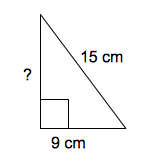
What is the length of the remaining side of the right triangle?


Explanation
Rearrange the Pythagorean Theorem to find the missing side. The Pythagorean Theorem is:

where 


Find the length of the missing side.



Explanation

Recall the Pythagorean Theorem for a right triangle:

Since the missing side corresponds to side 


Now, plug in values of 


The three sides of a triangle have lengths 0.8, 1.2, and 1.5.
True or false: the triangle is a right triangle.
False
True
Explanation
By the Pythagorean Theorem and its converse, a triangle is right if and only if

where 


Therefore, set 


The statement is false, so the Pythagorean relationship does not hold. The triangle is not right.
The hypotenuse of a right triangle is 26 in and one leg is 10 in. What is the sum of the two shortest sides?


Explanation
We use the Pythagorean Theorem so the problem to solve becomes 

So 

The sum of the two legs becomes

Given: 


Which is a true statement?


Explanation


Find the length of the missing side.


Explanation
Recall the Pythagorean Theorem for a right triangle:

Since the missing side corresponds to side 


Now, plug in values of 


Find the length of the missing side.


Explanation
Recall the Pythagorean Theorem for a right triangle:

Since the missing side corresponds to side 


Now, plug in values of 


Find the length of the missing side of the right triangle.


Explanation
To find the length of the side x, we must use the Pythagorean Theorem
However, this time since we are given the value of the hypotenuse, we will solve for side b rather than c.
So, when we plug the given values into the formula, the equation looks like

which can be simplified to

Next, solve for b and we get a final answer of
