
Statistical Patterns and Random Phenomena - AP Statistics
Card 1 of 560
Alex took a test in physics and scored a 35. The class average was 27 and the standard deviation was 5.
Noah took a chemistry test and scored an 82. The class average was 70 and the standard deviation was 8.
Show that Alex had the better performance by calculating -
-
Alex's standard normal percentile and
-
Noah's standard normal percentile
Alex took a test in physics and scored a 35. The class average was 27 and the standard deviation was 5.
Noah took a chemistry test and scored an 82. The class average was 70 and the standard deviation was 8.
Show that Alex had the better performance by calculating -
-
Alex's standard normal percentile and
-
Noah's standard normal percentile
Tap to reveal answer
Alex -
 on the z-table
Noah -
 on the z-table
Alex -
Noah -
← Didn't Know|Knew It →
Find the area under the standard normal curve between Z=1.5 and Z=2.4.
Find the area under the standard normal curve between Z=1.5 and Z=2.4.
Tap to reveal answer



← Didn't Know|Knew It →
When

and

Find
 .
.
When
and
Find
Tap to reveal answer





← Didn't Know|Knew It →
Arrivals to a bed and breakfast follow a Poisson process. The expected number of arrivals each week is 4. What is the probability that there are exactly 3 arrivals over the course of one week?
Arrivals to a bed and breakfast follow a Poisson process. The expected number of arrivals each week is 4. What is the probability that there are exactly 3 arrivals over the course of one week?
Tap to reveal answer

← Didn't Know|Knew It →
The masses of tomatoes are normally distributed with a mean of  grams and a standard deviation of
  grams. What mass of tomatoes would be the
  percentile of the masses of all the tomatoes?
The masses of tomatoes are normally distributed with a mean of
Tap to reveal answer
The Z score for a normal distribution at the  percentile is
  So
So  , which can be found on the normal distribution table. The mass of tomatoes in the
  percentile of all tomatoes is
  standard deviations below the mean, so the mass is
  .
.
The Z score for a normal distribution at the
← Didn't Know|Knew It →
Find
 .
.
Find
Tap to reveal answer
First, we use our normal distribution table to find a p-value for a z-score greater than 0.50.
Our table tells us the probability is approximately,
 .
.
Next we use our normal distribution table to find a p-value for a z-score greater than 1.23.
Our table tells us the probability is approximately,
 .
.
We then subtract the probability of z being greater than 0.50 from the probability of z being less than 1.23 to give us our answer of,
 .
.
First, we use our normal distribution table to find a p-value for a z-score greater than 0.50.
Our table tells us the probability is approximately,
Next we use our normal distribution table to find a p-value for a z-score greater than 1.23.
Our table tells us the probability is approximately,
We then subtract the probability of z being greater than 0.50 from the probability of z being less than 1.23 to give us our answer of,
← Didn't Know|Knew It →
Find
 .
.
Find
Tap to reveal answer
First, we use the table to look up a p-value for z > -1.22.
This gives us a p-value of,
 .
.
Next, we use the table to look up a p-value for z > 1.59.
This gives us a p-value of,
 .
.
Finally we subtract the probability of z being greater than -1.22 from the probability of z being less than 1.59 to arrive at our answer of,
 .
.
First, we use the table to look up a p-value for z > -1.22.
This gives us a p-value of,
Next, we use the table to look up a p-value for z > 1.59.
This gives us a p-value of,
Finally we subtract the probability of z being greater than -1.22 from the probability of z being less than 1.59 to arrive at our answer of,
← Didn't Know|Knew It →
Gabbie earned a score of 940 on a national achievement test. The mean test score was 850 with a sample standard deviation of 100. What proportion of students had a higher score than Gabbie? (Assume that test scores are normally distributed.)
Gabbie earned a score of 940 on a national achievement test. The mean test score was 850 with a sample standard deviation of 100. What proportion of students had a higher score than Gabbie? (Assume that test scores are normally distributed.)
Tap to reveal answer
When we get this type of problem, first we need to calculate a z-score that we can use in our table.
To do that, we use our z-score formula:
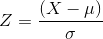
where,
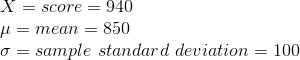
Plugging into the equation we get:

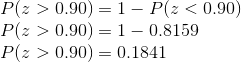
We then use our table to look up a p-value for z > 0.9. Since we want to calculate the probability of students who earned a higher score than Gabbie we need to subtract the P(z<0.9) to get our answer.
When we get this type of problem, first we need to calculate a z-score that we can use in our table.
To do that, we use our z-score formula:
where,
Plugging into the equation we get:
We then use our table to look up a p-value for z > 0.9. Since we want to calculate the probability of students who earned a higher score than Gabbie we need to subtract the P(z<0.9) to get our answer.
← Didn't Know|Knew It →
The purpose of the t test is to do which of the following?
The purpose of the t test is to do which of the following?
Tap to reveal answer
A t test is used to compare the means of different groups. A t test score describes the likelihood that the difference in means between two groups is due to chance. The null hypothesis assumes the two sets are equal however, one can reject the null hypothesis with a p value within a particular confidence level.
A t test is used to compare the means of different groups. A t test score describes the likelihood that the difference in means between two groups is due to chance. The null hypothesis assumes the two sets are equal however, one can reject the null hypothesis with a p value within a particular confidence level.
← Didn't Know|Knew It →
Suppose that the mean height of college students is 70 inches with a standard deviation of 5 inches. If a random sample of 60 college students is taken, what is the probability that the sample average height for this sample will be more than 71 inches?
Suppose that the mean height of college students is 70 inches with a standard deviation of 5 inches. If a random sample of 60 college students is taken, what is the probability that the sample average height for this sample will be more than 71 inches?
Tap to reveal answer
First check to see if the Central Limit Theorem applies. Since n > 30, it does. Next we need to calculate the standard error. To do that we divide the population standard deviation by the square-root of n, which gives us a standard error of 0.646. Next, we calculate a z-score using our z-score formula:
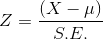

Plugging in gives us:
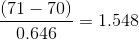
Finally, we look up our z-score in our z-score table to get a p-value.
The table gives us a p-value of,
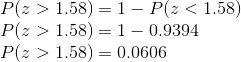
First check to see if the Central Limit Theorem applies. Since n > 30, it does. Next we need to calculate the standard error. To do that we divide the population standard deviation by the square-root of n, which gives us a standard error of 0.646. Next, we calculate a z-score using our z-score formula:
Plugging in gives us:
Finally, we look up our z-score in our z-score table to get a p-value.
The table gives us a p-value of,
← Didn't Know|Knew It →
Assume you have taken 100 samples of size 64 each from a population. The population variance is 49.
What is the standard deviation of each (and every) sample mean?
Assume you have taken 100 samples of size 64 each from a population. The population variance is 49.
What is the standard deviation of each (and every) sample mean?
Tap to reveal answer
The population standard deviation =

The sample mean standard deviation =
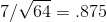
The population standard deviation =
The sample mean standard deviation =
← Didn't Know|Knew It →
A random variable has an average of  with a standard deviation of
  . What is the probability that out of the sample set the variable is less than
  . The sample set is
  . Round your answer to three decimal places.
A random variable has an average of
Tap to reveal answer
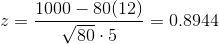
There are two keys here. One, we have a large sample size since  , meaning we can use the Central Limit Theorem even if points per game is not normally distributed.
Our  -score thus becomes...
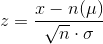
where  is the specified points or less needed this season,
 is the average points per game of the previous season,
 is the standard deivation of the previous season,
and  is the number of games.

There are two keys here. One, we have a large sample size since
Our
where
and
← Didn't Know|Knew It →
Reaction times in a population of people have a standard deviation of  milliseconds. How large must a sample size be for the standard deviation of the sample mean reaction time to be no larger than
  milliseconds?
Reaction times in a population of people have a standard deviation of
Tap to reveal answer
Use the fact that  .
.


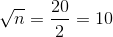

Alternately, you can use the fact that the variance of the sample mean varies inversely by the square root of the sample size, so to reduce the variance by a factor of 10, the sample size needs to be 100.
Use the fact that
Alternately, you can use the fact that the variance of the sample mean varies inversely by the square root of the sample size, so to reduce the variance by a factor of 10, the sample size needs to be 100.
← Didn't Know|Knew It →
A machine puts an average of  grams of jelly beans in bags, with a standard deviation of
  grams.
  bags are randomly chosen, what is the probability that the mean amount per bag in the sampled bags is less than
  grams.
A machine puts an average of
Tap to reveal answer
A sample size of  bags means that the central limit theorem is applicable and the distribution can be assumed to be normal. The sample mean would be
  and
and 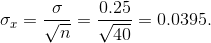
Therefore,

A sample size of
Therefore,
← Didn't Know|Knew It →
Which of the following is a sampling distribution?
Which of the following is a sampling distribution?
Tap to reveal answer
The correct answer is the distribution of average height statistics that could happen from all possible samples of college students. Remember that a sampling distribution isn't just a statistic you get form taking a sample, and isn't just a piece of data you get from doing sampling. Instead, a sampling distribution is a distribution of sample statistics you could get from all of the possible samples you might take from a given population.
The correct answer is the distribution of average height statistics that could happen from all possible samples of college students. Remember that a sampling distribution isn't just a statistic you get form taking a sample, and isn't just a piece of data you get from doing sampling. Instead, a sampling distribution is a distribution of sample statistics you could get from all of the possible samples you might take from a given population.
← Didn't Know|Knew It →
If a sampling distribution for samples of college students measured for average height has a mean of 70 inches and a standard deviation of 5 inches, we can infer that:
If a sampling distribution for samples of college students measured for average height has a mean of 70 inches and a standard deviation of 5 inches, we can infer that:
Tap to reveal answer
We can infer that roughly 68% of random samples of college students will have a sample mean of between 65 and 75 inches. Anytime we try to make an inference from a sampling distribution, we have to keep in mind that the sampling distribution is a distribution of samples and not a distribution about the thing we're trying to measure itself (in this case the height of college students). Also, remember that the empirical rules tells us that roughly 68% of the distribution will fall within one standard deviation of the mean.
We can infer that roughly 68% of random samples of college students will have a sample mean of between 65 and 75 inches. Anytime we try to make an inference from a sampling distribution, we have to keep in mind that the sampling distribution is a distribution of samples and not a distribution about the thing we're trying to measure itself (in this case the height of college students). Also, remember that the empirical rules tells us that roughly 68% of the distribution will fall within one standard deviation of the mean.
← Didn't Know|Knew It →
The standard deviation of a sampling distribution is called:
The standard deviation of a sampling distribution is called:
Tap to reveal answer
The standard error (SE) is the standard deviation of the sampling distribution.
The standard error (SE) is the standard deviation of the sampling distribution.
← Didn't Know|Knew It →
The probability that it will rain today is 0.35. What is the probability that it will not rain?
The probability that it will rain today is 0.35. What is the probability that it will not rain?
Tap to reveal answer
The answer is 0.65 because Pr(~Rain) is the complement of Pr(Rain) and both events are mutually exclusive.
When two events are mutually exclusive,  . Since probabilities must sum up to 1, this implies that
  .
.
The answer is 0.65 because Pr(~Rain) is the complement of Pr(Rain) and both events are mutually exclusive.
When two events are mutually exclusive,
← Didn't Know|Knew It →
Students collected 150 cans for a food drive. There were 23 cans of corn, 48 cans of beans, and 12 cans of tomato sauce. If a student randomly selects one can to give away, what is the probability that the can will be either tomato sauce or beans?
Students collected 150 cans for a food drive. There were 23 cans of corn, 48 cans of beans, and 12 cans of tomato sauce. If a student randomly selects one can to give away, what is the probability that the can will be either tomato sauce or beans?
Tap to reveal answer
In this case, we want to know the probability of multiple, mutually exclusive possible outcomes. The possible outcomes are mutually exclusive because one can of food could not be both beans and tomato sauce. To determine the probability of the two possible outcomes, add them together and then find the least common denominator.

In this case, we want to know the probability of multiple, mutually exclusive possible outcomes. The possible outcomes are mutually exclusive because one can of food could not be both beans and tomato sauce. To determine the probability of the two possible outcomes, add them together and then find the least common denominator.
← Didn't Know|Knew It →
150 students are athletes at the school. 65 play baseball, 15 play basketball, and 10 play both basketball and baseball.
What is the probability that a randomly selected athlete will play either baseball or basketball or both sports?
150 students are athletes at the school. 65 play baseball, 15 play basketball, and 10 play both basketball and baseball.
What is the probability that a randomly selected athlete will play either baseball or basketball or both sports?
Tap to reveal answer
We want to know the probability of multiple possible outcomes that are not mutually exclusive. To do this, we use the addition rule with one step that we would not use if the possible outcomes were mutually exclusive. Add the probabilities of each possible outcome, subtract from that sum the number counted twice, then reduce the answer to the least common denominator.

We want to know the probability of multiple possible outcomes that are not mutually exclusive. To do this, we use the addition rule with one step that we would not use if the possible outcomes were mutually exclusive. Add the probabilities of each possible outcome, subtract from that sum the number counted twice, then reduce the answer to the least common denominator.
← Didn't Know|Knew It →