Interpreting Circular Motion Diagrams
AP Physics C: Electricity and Magnetism · Learn by Concept
Help Questions
AP Physics C: Electricity and Magnetism › Interpreting Circular Motion Diagrams
1 - 1
1
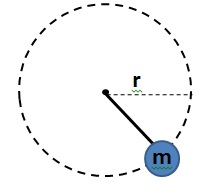
A ball of mass 


CORRECT


None of these
Explanation
This is a centripetal force problem. In this case the tension on the rope is the centripetal force that keeps the ball moving on a circle.
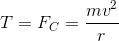
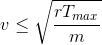
If we want for the rope not to break, then the tension should never exceed 

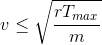
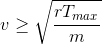
Now we just solve for velocity: