
Universal Gravitation - AP Physics 1
Card 1 of 260
A certain planet has three times the radius of Earth and nine times the mass. How does the acceleration of gravity at the surface of this planet (ag) compare to the acceleration at the surface of Earth (g)?
A certain planet has three times the radius of Earth and nine times the mass. How does the acceleration of gravity at the surface of this planet (ag) compare to the acceleration at the surface of Earth (g)?
Tap to reveal answer
The acceleration of gravity is given by the equation  , where G is constant.
For Earth, 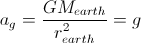 .
.
For the new planet,
 .
.
So, the acceleration is the same in both cases.
The acceleration of gravity is given by the equation
For Earth,
For the new planet,
So, the acceleration is the same in both cases.
← Didn't Know|Knew It →
Two satellites in space, each with a mass of  , are
, are  apart from each other. What is the force of gravity between them?

Two satellites in space, each with a mass of
Tap to reveal answer
To solve this problem, use Newton's law of universal gravitation:

We are given the constant, as well as the satellite masses and distance (radius). Using these values we can solve for the force.


To solve this problem, use Newton's law of universal gravitation:
We are given the constant, as well as the satellite masses and distance (radius). Using these values we can solve for the force.
← Didn't Know|Knew It →
Two satellites in space, each with a mass of  , are
, are  apart from each other. What is the force of gravity between them?

Two satellites in space, each with a mass of
Tap to reveal answer
To solve this problem, use Newton's law of universal gravitation:

We are given the constant, as well as the satellite masses and distance (radius). Using these values we can solve for the force.


To solve this problem, use Newton's law of universal gravitation:
We are given the constant, as well as the satellite masses and distance (radius). Using these values we can solve for the force.
← Didn't Know|Knew It →
Two satellites in space, each with equal mass, are  apart from each other. If the force of gravity between them is
  , what is the mass of each satellite?

Two satellites in space, each with equal mass, are
Tap to reveal answer
To solve this problem, use Newton's law of universal gravitation:

We are given the value of the force, the distance (radius), and the gravitational constant. We are also told that the masses of the two satellites are equal. Since the masses are equal, we can reduce the numerator of the law of gravitation to a single variable.

Now we can use our give values to solve for the mass.


To solve this problem, use Newton's law of universal gravitation:
We are given the value of the force, the distance (radius), and the gravitational constant. We are also told that the masses of the two satellites are equal. Since the masses are equal, we can reduce the numerator of the law of gravitation to a single variable.
Now we can use our give values to solve for the mass.

← Didn't Know|Knew It →
Two asteroids in space are in close proximity to each other. Each has a mass of  . If they are
  apart, what is the gravitational force between them?

Two asteroids in space are in close proximity to each other. Each has a mass of
Tap to reveal answer
To solve this problem, use Newton's law of universal gravitation:

We are given the constant, as well as the asteroid masses and distance (radius). Using these values we can solve for the force.


To solve this problem, use Newton's law of universal gravitation:
We are given the constant, as well as the asteroid masses and distance (radius). Using these values we can solve for the force.
← Didn't Know|Knew It →
Two asteroids in space are in close proximity to each other. Each has a mass of  . If they are
  apart, what is the gravitational acceleration that they experience?

Two asteroids in space are in close proximity to each other. Each has a mass of
Tap to reveal answer
Given that  , we already know the mass, but we need to find the force in order to solve for the acceleration.
To solve this problem, use Newton's law of universal gravitation:

We are given the constant, as well as the satellite masses and distance (radius). Using these values we can solve for the force.


Now we have values for both the mass and the force, allowing us to solve for the acceleration.


Given that
To solve this problem, use Newton's law of universal gravitation:
We are given the constant, as well as the satellite masses and distance (radius). Using these values we can solve for the force.
Now we have values for both the mass and the force, allowing us to solve for the acceleration.
← Didn't Know|Knew It →
Two asteroids, one with a mass of  and the other with mass
  , are
, are  apart. What is the gravitational force on the LARGER asteroid?

Two asteroids, one with a mass of
Tap to reveal answer
To solve this problem, use Newton's law of universal gravitation:

We are given the constant, as well as the asteroid masses and distance (radius). Using these values we can solve for the force.


It actually doesn't matter which asteroid we're looking at; the gravitational force will be the same. This makes sense because Newton's 3rd law states that the force one asteroid exerts on the other is equal in magnitude, but opposite in direction, to the force the other asteroid exerts on it.
To solve this problem, use Newton's law of universal gravitation:
We are given the constant, as well as the asteroid masses and distance (radius). Using these values we can solve for the force.
It actually doesn't matter which asteroid we're looking at; the gravitational force will be the same. This makes sense because Newton's 3rd law states that the force one asteroid exerts on the other is equal in magnitude, but opposite in direction, to the force the other asteroid exerts on it.
← Didn't Know|Knew It →
Two asteroids, one with a mass of  and the other with mass
  are
are  apart. What is the gravitational force on the SMALLER asteroid?

Two asteroids, one with a mass of
Tap to reveal answer
To solve this problem, use Newton's law of universal gravitation:

We are given the constant, as well as the asteroid masses and distance (radius). Using these values we can solve for the force.


It actually doesn't matter which asteroid we're looking at; the gravitational force will be the same. This makes sense because Newton's 3rd law states that the force one asteroid exerts on the other is equal in magnitude, but opposite in direction, to the force the other asteroid exerts on it.
To solve this problem, use Newton's law of universal gravitation:
We are given the constant, as well as the asteroid masses and distance (radius). Using these values we can solve for the force.
It actually doesn't matter which asteroid we're looking at; the gravitational force will be the same. This makes sense because Newton's 3rd law states that the force one asteroid exerts on the other is equal in magnitude, but opposite in direction, to the force the other asteroid exerts on it.
← Didn't Know|Knew It →
Two asteroids, one with a mass of  and the other with mass
  are
are  apart. What is the acceleration of the SMALLER asteroid?

Two asteroids, one with a mass of
Tap to reveal answer
Given that Newton's second law is  , we can find the acceleration by first determining the force.
To find the gravitational force, use Newton's law of universal gravitation:

We are given the constant, as well as the asteroid masses and distance (radius). Using these values we can solve for the force.


We now have values for both the mass and the force. Using the original equation, we can now solve for the acceleration.


Given that Newton's second law is
To find the gravitational force, use Newton's law of universal gravitation:
We are given the constant, as well as the asteroid masses and distance (radius). Using these values we can solve for the force.
We now have values for both the mass and the force. Using the original equation, we can now solve for the acceleration.
← Didn't Know|Knew It →
Two asteroids, one with a mass of  and the other with mass
  are
are  apart. What is the acceleration of the LARGER asteroid?

Two asteroids, one with a mass of
Tap to reveal answer
Given that Newton's second law is  , we can find the acceleration by first determining the force.
To find the gravitational force, use Newton's law of universal gravitation:

We are given the constant, as well as the asteroid masses and distance (radius). Using these values we can solve for the force.


We now have values for both the mass and the force. Using the original equation, we can now solve for the acceleration.


Given that Newton's second law is
To find the gravitational force, use Newton's law of universal gravitation:
We are given the constant, as well as the asteroid masses and distance (radius). Using these values we can solve for the force.
We now have values for both the mass and the force. Using the original equation, we can now solve for the acceleration.
← Didn't Know|Knew It →
An asteroid with a mass of  approaches the Earth. If they are
  apart, what is the gravitational force exerted by the asteroid on the Earth?


An asteroid with a mass of
Tap to reveal answer
For this question, use the law of universal gravitation:

We are given the value of each mass, the distance (radius), and the gravitational constant. Using these values, we can solve for the force of gravity.


This force will apply to both objects in question. As it turns out, it does not matter which mass we're looking at; the force of gravity on each mass will be the same. This is supported by Newton's third law.
For this question, use the law of universal gravitation:
We are given the value of each mass, the distance (radius), and the gravitational constant. Using these values, we can solve for the force of gravity.
This force will apply to both objects in question. As it turns out, it does not matter which mass we're looking at; the force of gravity on each mass will be the same. This is supported by Newton's third law.
← Didn't Know|Knew It →
An asteroid with a mass of  approaches the Earth. If they are
  apart, what is the gravitational force exerted by the Earth on the asteroid?


An asteroid with a mass of
Tap to reveal answer
For this question, use the law of universal gravitation:

We are given the value of each mass, the distance (radius), and the gravitational constant. Using these values, we can solve for the force of gravity.


This force will apply to both objects in question. As it turns out, it does not matter which mass we're looking at; the force of gravity on each mass will be the same. This is supported by Newton's third law.
For this question, use the law of universal gravitation:
We are given the value of each mass, the distance (radius), and the gravitational constant. Using these values, we can solve for the force of gravity.
This force will apply to both objects in question. As it turns out, it does not matter which mass we're looking at; the force of gravity on each mass will be the same. This is supported by Newton's third law.
← Didn't Know|Knew It →
An asteroid with a mass of  approaches the Earth. If they are
  apart, what is the asteroid's resultant acceleration?


An asteroid with a mass of
Tap to reveal answer
The relationship between force and acceleration is Newton's second law:

We know the mass, but we will need to find the force. For this calculation, use the law of universal gravitation:

We are given the value of each mass, the distance (radius), and the gravitational constant. Using these values, we can solve for the force of gravity.


Now that we know the force, we can use this value with the mass of the asteroid to find its acceleration.


The relationship between force and acceleration is Newton's second law:
We know the mass, but we will need to find the force. For this calculation, use the law of universal gravitation:
We are given the value of each mass, the distance (radius), and the gravitational constant. Using these values, we can solve for the force of gravity.
Now that we know the force, we can use this value with the mass of the asteroid to find its acceleration.
← Didn't Know|Knew It →
An asteroid with a mass of  approaches the Earth. If they are
  away, what is the Earth's resultant acceleration?


An asteroid with a mass of
Tap to reveal answer
The relationship between force and acceleration is Newton's second law:

We know the mass, but we will need to find the force. For this calculation, use the law of universal gravitation:

We are given the value of each mass, the distance (radius), and the gravitational constant. Using these values, we can solve for the force of gravity.


Now that we know the force, we can use this value with the mass of the Earth to find its acceleration.


The relationship between force and acceleration is Newton's second law:
We know the mass, but we will need to find the force. For this calculation, use the law of universal gravitation:
We are given the value of each mass, the distance (radius), and the gravitational constant. Using these values, we can solve for the force of gravity.
Now that we know the force, we can use this value with the mass of the Earth to find its acceleration.
← Didn't Know|Knew It →
Two satellites are a distance  from each other in space. If one of the satellites has a mass of
  and the other has a mass of
  , which one will have the greater acceleration?
Two satellites are a distance
Tap to reveal answer
The relationship between force and acceleration is Newton's second law:

We know the masses, but first we need to find the forces in order to draw a conclusion about the satellites' accelerations. For this calculation, use the law of universal gravitation:

We can write this equation in terms of each object:


We know that the force applied to each object will be equal, so we can set these equations equal to each other.

We know that the second object is twice the mass of the first.

We can substitute for the acceleration to simplify.


The acceleration for  is twice the acceleration for
  ; thus, the lighter mass will have the greater acceleration.
The relationship between force and acceleration is Newton's second law:
We know the masses, but first we need to find the forces in order to draw a conclusion about the satellites' accelerations. For this calculation, use the law of universal gravitation:
We can write this equation in terms of each object:
We know that the force applied to each object will be equal, so we can set these equations equal to each other.
We know that the second object is twice the mass of the first.
We can substitute for the acceleration to simplify.
The acceleration for
← Didn't Know|Knew It →
Two satellites are a distance  from each other in space. If one of the satellites has a mass of
  and the other has a mass of
  , which one will have the smaller acceleration?
Two satellites are a distance
Tap to reveal answer
The formula for force and acceleration is Newton's 2nd law:  . We know the mass, but first we need to find the force:
For this equation, use the law of universal gravitation:

We know from the first equation that a force is a mass times an acceleration. That means we can rearrange the equation for universal gravitation to look a bit more like that first equation:
 can turn into:
  and
and  , respectively.
We know that the forces will be equal, so set these two equations equal to each other:

The problem tells us that 

Let's say that  to simplify.

As you can see, the acceleration for  is twice the acceleration for
  . Therefore the mass
  will have the smaller acceleration.
The formula for force and acceleration is Newton's 2nd law:
For this equation, use the law of universal gravitation:
We know from the first equation that a force is a mass times an acceleration. That means we can rearrange the equation for universal gravitation to look a bit more like that first equation:
We know that the forces will be equal, so set these two equations equal to each other:
The problem tells us that
Let's say that
As you can see, the acceleration for
← Didn't Know|Knew It →
An astronaut lands on a new planet. She knows her own mass,  , and the radius of the planet,
  . What other value must she know in order to find the mass of the new planet?
An astronaut lands on a new planet. She knows her own mass,
Tap to reveal answer
To find the relationship described in the question, we need to use the law of universal gravitation:

The question suggests that we know the radius and one of the masses, and asks us to solve for the other mass.

Since  is a constant, if we know the mass of the astronaut and the radius of the planet, all we need is the force due to gravity to solve for the mass of the planet. According to Newton's third law, the force of the planet on the astronaut will be equal and opposite to the force of the astronaut on the planet; thus, knowing her force on the planet will allows us to solve the equation.
To find the relationship described in the question, we need to use the law of universal gravitation:
The question suggests that we know the radius and one of the masses, and asks us to solve for the other mass.
Since
← Didn't Know|Knew It →
An astronaut lands on a planet with the same mass as Earth, but twice the radius. What will be the acceleration due to gravity on this planet, in terms of the acceleration due to gravity on Earth?
An astronaut lands on a planet with the same mass as Earth, but twice the radius. What will be the acceleration due to gravity on this planet, in terms of the acceleration due to gravity on Earth?
Tap to reveal answer
For this comparison, we can use the law of universal gravitation and Newton's second law:


We know that the force due to gravity on Earth is equal to  . We can use this to set the two force equations equal to one another.

Notice that the mass cancels out from both sides.

This equation sets up the value of acceleration due to gravity on Earth.
The new planet has a radius equal to twice that of Earth. That means it has a radius of  . It has the same mass as Earth,
  . Using these variables, we can set up an equation for the acceleration due to gravity on the new planet.

Expand this equation to compare it to the acceleration of gravity on Earth.


We had previously solved for the gravity on Earth:

We can substitute this into the new acceleration equation:

The acceleration due to gravity on this new planet will be one quarter of what it would be on Earth.
For this comparison, we can use the law of universal gravitation and Newton's second law:
We know that the force due to gravity on Earth is equal to
Notice that the mass cancels out from both sides.
This equation sets up the value of acceleration due to gravity on Earth.
The new planet has a radius equal to twice that of Earth. That means it has a radius of
Expand this equation to compare it to the acceleration of gravity on Earth.
We had previously solved for the gravity on Earth:
We can substitute this into the new acceleration equation:
The acceleration due to gravity on this new planet will be one quarter of what it would be on Earth.
← Didn't Know|Knew It →
An astronaut lands on a planet with three times the mass of Earth, and the same radius. What will be the acceleration due to gravity on this planet, in terms of the acceleration due to gravity on Earth?
An astronaut lands on a planet with three times the mass of Earth, and the same radius. What will be the acceleration due to gravity on this planet, in terms of the acceleration due to gravity on Earth?
Tap to reveal answer
For this comparison, we can use the law of universal gravitation and Newton's second law:


We know that the force due to gravity on Earth is equal to  . We can use this to set the two force equations equal to one another.

Notice that the mass cancels out from both sides.

This equation sets up the value of acceleration due to gravity on Earth.
The new planet has a mass equal to three times that of Earth. That means it has a mass of  . It has the same radius as Earth,
  . Using these variables, we can set up an equation for the acceleration due to gravity on the new planet.


We had previously solved for the gravity on Earth:

We can substitute this into the new acceleration equation:

The acceleration due to gravity on this new planet will be three times what it would be on Earth.
For this comparison, we can use the law of universal gravitation and Newton's second law:
We know that the force due to gravity on Earth is equal to
Notice that the mass cancels out from both sides.
This equation sets up the value of acceleration due to gravity on Earth.
The new planet has a mass equal to three times that of Earth. That means it has a mass of
We had previously solved for the gravity on Earth:
We can substitute this into the new acceleration equation:
The acceleration due to gravity on this new planet will be three times what it would be on Earth.
← Didn't Know|Knew It →
An astronaut lands on a planet with twice the mass of Earth, and half of the radius. What will be the acceleration due to gravity on this planet, in terms of the acceleration due to gravity on Earth?
An astronaut lands on a planet with twice the mass of Earth, and half of the radius. What will be the acceleration due to gravity on this planet, in terms of the acceleration due to gravity on Earth?
Tap to reveal answer
For this comparison, we can use the law of universal gravitation and Newton's second law:


We know that the force due to gravity on Earth is equal to  . We can use this to set the two force equations equal to one another.

Notice that the mass cancels out from both sides.

This equation sets up the value of acceleration due to gravity on Earth.
The new planet has a mass equal to twice that of Earth. That means it has a mass of  . It also has half the radius of Earth,
  . Using these variables, we can set up an equation for the acceleration due to gravity on the new planet.

Expand this equation in order to combine the non-variable terms.


We had previously solved for the gravity on Earth:

We can substitute this into the new acceleration equation:

The acceleration due to gravity on this new planet will be eight times what it would be on Earth.
For this comparison, we can use the law of universal gravitation and Newton's second law:
We know that the force due to gravity on Earth is equal to
Notice that the mass cancels out from both sides.
This equation sets up the value of acceleration due to gravity on Earth.
The new planet has a mass equal to twice that of Earth. That means it has a mass of
Expand this equation in order to combine the non-variable terms.
We had previously solved for the gravity on Earth:
We can substitute this into the new acceleration equation:
The acceleration due to gravity on this new planet will be eight times what it would be on Earth.
← Didn't Know|Knew It →