
Newtonian Mechanics - AP Physics 1
Card 1 of 4456

Using the coordinate system in the graph shown, what is Boomer 's displacement between  ?
?
Using the coordinate system in the graph shown, what is Boomer 's displacement between
Tap to reveal answer
Displacement has magnitude and direction. It is found by subtracting the position at time zero from the position at time ten seconds.
Displacement has magnitude and direction. It is found by subtracting the position at time zero from the position at time ten seconds.
← Didn't Know|Knew It →
According to the graph above, Boomer has the slowest speed during which interval?
According to the graph above, Boomer has the slowest speed during which interval?
Tap to reveal answer
The smallest speed is zero which occurs during the final intervals, which have a slope of zero.
The smallest speed is zero which occurs during the final intervals, which have a slope of zero.
← Didn't Know|Knew It →

According to the graph above, when does Boomer have the smallest average speed?
According to the graph above, when does Boomer have the smallest average speed?
Tap to reveal answer
The smallest speed is zero, which occurs during the final intervals which shows no change in position.
The smallest speed is zero, which occurs during the final intervals which shows no change in position.
← Didn't Know|Knew It →
According to the graph above, Boomer has the largest positive velocity during which interval?
According to the graph above, Boomer has the largest positive velocity during which interval?
Tap to reveal answer
The largest and only positive velocity occurs during the first interval when the slope is positive.
The largest and only positive velocity occurs during the first interval when the slope is positive.
← Didn't Know|Knew It →
According to the table above, when does Boomer have the largest positive velocity?
According to the table above, when does Boomer have the largest positive velocity?
Tap to reveal answer
The largest positive velocity occurs during the period with the maximum positive change in position. This is the first period.
The largest positive velocity occurs during the period with the maximum positive change in position. This is the first period.
← Didn't Know|Knew It →
According to the graph above, Boomer has the largest negative velocity during which interval?
According to the graph above, Boomer has the largest negative velocity during which interval?
Tap to reveal answer
Negative velocities correspond to periods when the position decreases in value. The largest negative velocity occurs during the third period.
Negative velocities correspond to periods when the position decreases in value. The largest negative velocity occurs during the third period.
← Didn't Know|Knew It →
According to the table above, when does Boomer have his largest negative velocity?
According to the table above, when does Boomer have his largest negative velocity?
Tap to reveal answer
The position decline the largest amount per unit time during the third interval.
The position decline the largest amount per unit time during the third interval.
← Didn't Know|Knew It →
If a 15kg ball takes five seconds to strike the ground when released from rest, at what height was the ball dropped?
If a 15kg ball takes five seconds to strike the ground when released from rest, at what height was the ball dropped?
Tap to reveal answer
Using the equation  we can find the distance at which the ball was dropped. Notice that the mass of the ball does not matter in this problem. We are told that the ball is dropped from rest making,
  , thus we have
  . When we plug in our values, and assuming that acceleration is equal to gravity (10m/s2) we find that
  = 125m.
Using the equation
← Didn't Know|Knew It →
How far will an object travel after ten seconds if it is dropped into a bottomless pit?
How far will an object travel after ten seconds if it is dropped into a bottomless pit?
Tap to reveal answer
Since the object is dropped, the inital velocity is zero. Gravity is the only acceleration, the time is ten seconds, and the distance at which the object travels is unknown.
The equation  can be used to find the distance traveled.

Since the object is dropped, the inital velocity is zero. Gravity is the only acceleration, the time is ten seconds, and the distance at which the object travels is unknown.
The equation
← Didn't Know|Knew It →
How long does it take an object to travel a distance of 30m from rest at a constant acceleration of 2m/s2?
How long does it take an object to travel a distance of 30m from rest at a constant acceleration of 2m/s2?
Tap to reveal answer
Using the equation  , we can solve for time.
Since the object started at rest,  . Now we are left with the equation
  .
.


Plugging in the remaining values we can find that t = 5.5s.
Using the equation
Since the object started at rest,
Plugging in the remaining values we can find that t = 5.5s.
← Didn't Know|Knew It →
You are driving at a speed of  and suddenly, a tree falls down on the road blocking your path. You slam on your brakes to avoid hitting the fallen tree and thus, come to a complete stop. You were at a distance of
  away from the tree when you hit the brakes. Assuming that your vehicle does not skid, what is the minimum deceleration needed to avoid hitting the fallen tree?
You are driving at a speed of
Tap to reveal answer
Use the following kinematic equation where the initial velocity is  , final velocity is
  , and the distance traveled is
  .
.

We can use the values in the question to solve for the acceleration.

We rearrange the equation to solve for the acceleration.


Use the following kinematic equation where the initial velocity is
We can use the values in the question to solve for the acceleration.
We rearrange the equation to solve for the acceleration.
← Didn't Know|Knew It →
A person on top of a  tall building drops a rock. How long will it take for the rock to reach the ground? Ignore air resistance.
A person on top of a
Tap to reveal answer
Use the following kinematic equation:  .
.
We can choose the ground to be the zero distance so that  and
and  .
.
Also, the initial speed is zero.

The kinematic equation simplifies using these values.

Solve to isolate the time variable.

We know that the acceleration is the acceleration due to gravity. Now we can plug in the known values and solve.


Use the following kinematic equation:
We can choose the ground to be the zero distance so that
Also, the initial speed is zero.
The kinematic equation simplifies using these values.
Solve to isolate the time variable.
We know that the acceleration is the acceleration due to gravity. Now we can plug in the known values and solve.
← Didn't Know|Knew It →
A block is placed at a height of  on a ramp at an incline of
  . It slides down from rest with an acceleration of
  due to a frictional force. What is the velocity of the block when it reaches the bottom of incline?
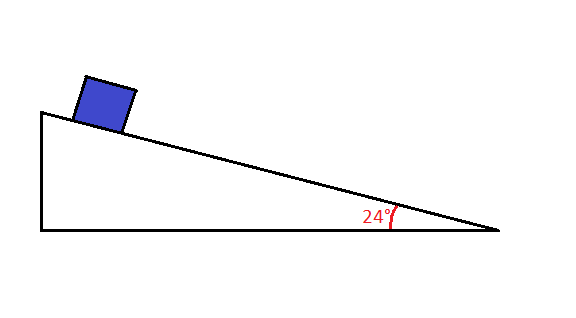
A block is placed at a height of
Tap to reveal answer
To find the final velocity we use the following kinematic equation.

The block starts from rest, so  . The incline is eighteen meters high, so we can find the distance (hypotenuse) as follows:


We know that the acceleration is  .
.
Plug in the values to find the velocity at the bottom of the incline.


To find the final velocity we use the following kinematic equation.
The block starts from rest, so
We know that the acceleration is
Plug in the values to find the velocity at the bottom of the incline.
← Didn't Know|Knew It →

A ball is thrown horizontally off a cliff of height of  with an initial velocity of
  . How far from the cliff will the ball land?
A ball is thrown horizontally off a cliff of height of
Tap to reveal answer
First we will find the time required for the ball to reach the ground. Since the ball is thrown horizontally, it has no initial vertical component. We use the following equation to solve for the total flight time:
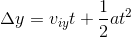
We are given the change in height, initial velocity, and acceleration. Using these values, we can solve for the time. Note that the change in height will be negative, since the ball is traveling downward.

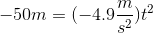
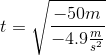

Finally, we use the horizontal velocity to find the distance traveled in  . Remember that the horizontal velocity remains constant during projectile motion.


First we will find the time required for the ball to reach the ground. Since the ball is thrown horizontally, it has no initial vertical component. We use the following equation to solve for the total flight time:
We are given the change in height, initial velocity, and acceleration. Using these values, we can solve for the time. Note that the change in height will be negative, since the ball is traveling downward.
Finally, we use the horizontal velocity to find the distance traveled in
← Didn't Know|Knew It →
A  is dropped from a height of
  . A picture is taken when the ball is
  from the ground with an exposure time of
  . If the actual diameter of the ball is
  , what will the vertical diameter of the ball appear to be in the picture?
A
Tap to reveal answer
The first step to solving this problem will be to find the velocity of the ball at the point when the picture is taken. We know the initial velocity of the ball (zero), the displacement, and the acceleration. Using the appropriate kinematics formula, we can solve for the final velocity.


Now that we know how fast the ball is traveling when the picture is taken, we can find the distance it travels while the shutter is open. This distance will become a motion blur, making the vertical diameter of the ball appear stretched.


During the exposure period, the ball will travel  , or
, or  . The diameter of the ball in the vertical direction will appear to be distorted by this distance.

The first step to solving this problem will be to find the velocity of the ball at the point when the picture is taken. We know the initial velocity of the ball (zero), the displacement, and the acceleration. Using the appropriate kinematics formula, we can solve for the final velocity.
Now that we know how fast the ball is traveling when the picture is taken, we can find the distance it travels while the shutter is open. This distance will become a motion blur, making the vertical diameter of the ball appear stretched.
During the exposure period, the ball will travel
← Didn't Know|Knew It →
A person stands on the edge of a straight  -high cliff and holds a ball over the edge. The person tosses the ball directly upward with an initial speed of
  . How long will it take the ball to hit the ground at the base of the cliff,
  below?
Assume  for gravitational acceleration.
A person stands on the edge of a straight
Assume
Tap to reveal answer
This is projectile motion in the vertical direction only, subject to the equation of motion:  .
.
For this discussion, one can define the downward direction as negative. For projectile motion,  (gravitational acceleration, or
  ).
).
In this case, the ball ends up  below where is started, so
  .
.
The initial velocity,  , is
, is  (upward, thus positive).
With all this, the projectile motion equation becomes:

This can be solved for  using the quadratic formula:

The result is:
 (or
(or  ).
).
Only the positive answer option is physically possible, and is thus our correct answer.
This is projectile motion in the vertical direction only, subject to the equation of motion:
For this discussion, one can define the downward direction as negative. For projectile motion,
In this case, the ball ends up
The initial velocity,
With all this, the projectile motion equation becomes:
This can be solved for
The result is:
Only the positive answer option is physically possible, and is thus our correct answer.
← Didn't Know|Knew It →
A hockey puck of mass  is sliding across an ice rink. If the puck loses
  of velocity over a distance of
  , what is the coefficient of kinetic friction between the ice and the puck?

A hockey puck of mass
Tap to reveal answer
Since we know the change in velocity of the puck, we can determine the work done by friction by using the work-energy theorem:

The work in this question is done by friction, so we can write:

Substituting in expressions for friction and kinetic energy, we get:

The normal force is from gravity, so we can write:

Rearranging for the coefficient of kinetic friction we get:

Since we know the change in velocity of the puck, we can determine the work done by friction by using the work-energy theorem:
The work in this question is done by friction, so we can write:
Substituting in expressions for friction and kinetic energy, we get:
The normal force is from gravity, so we can write:
Rearranging for the coefficient of kinetic friction we get:
← Didn't Know|Knew It →
A ball is dropped from a height of  . How much time will pass before the ball hits the ground?

A ball is dropped from a height of
Tap to reveal answer
The equation needed is 


The equation needed is
← Didn't Know|Knew It →
Mark, Jim, and David apply forces to an object of mass  . The object is on level ground where the coefficient of friction is
  . Mark applies a
  force to the right, Jim applies a
  force to the left, and David applies a
  force down. How far will the object travel (in meters) after
  seconds? Assume it starts at rest and the coefficient of static friction is low enough for the object to start moving with the mentioned forces.
Mark, Jim, and David apply forces to an object of mass
Tap to reveal answer
We can split this question up into the x-direction and y-direction. In the y-direction, the object's acceleration is zero since it's going to remain in contact with the ground. We now can write our  equation (let the up direction be positive). Since it's not accelerating, we have
 .
.
 denotes the normal force. We know that the mass is
  and that
  , so we can solve for the normal force, which we'll later use to find the force of friction.

The force of friction  is equal to
  (where
  denotes the coefficient of friction), so

In the x-direction, we'll denote right as positive. The forces in the x-direction are  right,
  left, and
  . Now we can write our
  equation as

Using this acceleration, we can use kinematics to solve for the distance the object will travel in  seconds. We have time and acceleration, but we need distance, so we'll use the equation:


We can split this question up into the x-direction and y-direction. In the y-direction, the object's acceleration is zero since it's going to remain in contact with the ground. We now can write our
The force of friction
In the x-direction, we'll denote right as positive. The forces in the x-direction are
Using this acceleration, we can use kinematics to solve for the distance the object will travel in
← Didn't Know|Knew It →
Suppose that an object is dropped from an initial height of 100m above the ground. Neglecting air resistance, how long will it take for this object to reach the ground?

Suppose that an object is dropped from an initial height of 100m above the ground. Neglecting air resistance, how long will it take for this object to reach the ground?
Tap to reveal answer
To solve this problem, we'll need to use a formula that can relate distance to acceleration and time. It's also worth noting that in this case, we are only considering vertical motion along the y-axis. We don't have to worry about horizontal motion along the x-axis.

 is the vertical displacement
 is the initial velocity in the vertical direction
 is time
 is the acceleration due to gravity (which is only in the vertical direction)
Since the object is starting from rest, the initial velocity will be equal to zero, which cancels out the  term and gives us:

Rearranging to solve for  , we obtain:


To solve this problem, we'll need to use a formula that can relate distance to acceleration and time. It's also worth noting that in this case, we are only considering vertical motion along the y-axis. We don't have to worry about horizontal motion along the x-axis.
Since the object is starting from rest, the initial velocity will be equal to zero, which cancels out the
Rearranging to solve for
← Didn't Know|Knew It →