
Specific Forces - AP Physics 1
Card 1 of 888
What coefficient of friction would be needed to stop a  box sliding across a level surface at
  in
in  ?
?
What coefficient of friction would be needed to stop a
Tap to reveal answer


Solving for  :
:

Plugging in values:


Solving for
Plugging in values:
← Didn't Know|Knew It →
A  crate is loaded onto a pick-up truck, and the truck speeds away without the crate sliding. If the coefficient of static friction between the truck and the crate is
  , what is the maximum acceleration that the truck can undergo without the crate slipping?
A
Tap to reveal answer
In order for the crate to not slide, the truck has to exert a frictional force on it. The force of friction is related to the normal force by the coefficient of friction.


This frictional force comes from the acceleration of the truck, based on Newton's second law.

The two forces will be equal when the truck is at maximum acceleration without the crate moving.


Solve for the acceleration.

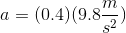

In order for the crate to not slide, the truck has to exert a frictional force on it. The force of friction is related to the normal force by the coefficient of friction.
This frictional force comes from the acceleration of the truck, based on Newton's second law.
The two forces will be equal when the truck is at maximum acceleration without the crate moving.
Solve for the acceleration.
← Didn't Know|Knew It →
A  box is initially sitting at rest on a horizontal floor with a coefficient of static friction
  . A horizontal pushing force is applied to the box. What is the maximum pushing force that can be applied without moving the box?
A
Tap to reveal answer
The maximum force that can be applied will be equal to the maximum value of the static friction force. The formula for friction is:

We also know that the normal force is equal and opposite the force of gravity.

Substituting to the original equation, we can rewrite the force of friction.

Using the given values for the coefficient of friction and mass, we can calculate the force using the acceleration of gravity.

The maximum force that can be applied will be equal to the maximum value of the static friction force. The formula for friction is:
We also know that the normal force is equal and opposite the force of gravity.
Substituting to the original equation, we can rewrite the force of friction.
Using the given values for the coefficient of friction and mass, we can calculate the force using the acceleration of gravity.
← Didn't Know|Knew It →
A man pulls a  box up a
  incline to rest at a height of
  . He exerts a total of
  of work. What is the coefficient of friction on the incline?
A man pulls a
Tap to reveal answer
Work is equal to the change in energy of the system. We are given the weight of the box and the vertical displacement, which will allow us to calculate the change in potential energy. This will be the total work required to move the box against gravity.


The remaining work that the man exerts must have been used to counter the force of friction acting against his motion.


Now we know the work performed by friction. Using this value, we can work to solve for the force of friction and the coefficient of friction. First, we will need to use a second formula for work:

In this case, the distance will be the distance traveled along the surface of the incline. We can solve for this distance using trigonometry.
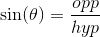
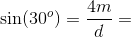
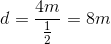
We know the work done by friction and the distance traveled along the incline, allowing us to solve for the force of friction.


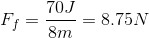
Finally, use the formula for frictional force to solve for the coefficient of friction. Keep in mind that the force on the box due to gravity will be equal to  .
.



Plug in our final values and solve for the coefficient of friction.

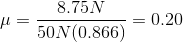
Work is equal to the change in energy of the system. We are given the weight of the box and the vertical displacement, which will allow us to calculate the change in potential energy. This will be the total work required to move the box against gravity.
The remaining work that the man exerts must have been used to counter the force of friction acting against his motion.
Now we know the work performed by friction. Using this value, we can work to solve for the force of friction and the coefficient of friction. First, we will need to use a second formula for work:
In this case, the distance will be the distance traveled along the surface of the incline. We can solve for this distance using trigonometry.
We know the work done by friction and the distance traveled along the incline, allowing us to solve for the force of friction.
Finally, use the formula for frictional force to solve for the coefficient of friction. Keep in mind that the force on the box due to gravity will be equal to
Plug in our final values and solve for the coefficient of friction.
← Didn't Know|Knew It →
A block of wood with mass 1kg is clamped to a vertical board with a force of 10N. What is the minimum vertical force needed to move the block upward?


A block of wood with mass 1kg is clamped to a vertical board with a force of 10N. What is the minimum vertical force needed to move the block upward?
Tap to reveal answer
The free body diagram of the system is shown below:

Notice how the friction is pointing downward. This is because it is fighting against the applied upward force. If there were no applied upward force, the force of friction would be pointing upward.
The moment before the block begins to move upward, all vertical forces sum to equal 0. Therefore, we can write:


 is the force of friction, and
  is the weight of the block
We know that the force of friction can be written as a function of the normal force and coefficient of friction:

Substituting, we get:

We know all the variables on the right, so we can plug in and solve:

The free body diagram of the system is shown below:
Notice how the friction is pointing downward. This is because it is fighting against the applied upward force. If there were no applied upward force, the force of friction would be pointing upward.
The moment before the block begins to move upward, all vertical forces sum to equal 0. Therefore, we can write:
We know that the force of friction can be written as a function of the normal force and coefficient of friction:
Substituting, we get:
We know all the variables on the right, so we can plug in and solve:
← Didn't Know|Knew It →
A box with mass 20kg is on a cement floor. The coefficient of static friction between the box and floor is 0.25. A man is pushing the box with a horizontal force of 35N. What is the magnitude of the force of static friction between the box and floor?
A box with mass 20kg is on a cement floor. The coefficient of static friction between the box and floor is 0.25. A man is pushing the box with a horizontal force of 35N. What is the magnitude of the force of static friction between the box and floor?
Tap to reveal answer
You need to have a firm understanding of static friction in order to answer this question correctly.
The main concept covered in this question is that static fricton between two objects has a max and a min, and can have any value between the max and min.
The max static frictional force can be calculated by the equation:

where mu is the coefficient of friction and N is the normal force
In this problem we get:

However, this is not the answer. The problem statement says that the man is pushing with a force of 35N. Since this is less than the max force calculated, the box will not move. Therefore, the force applied from friction is equal to the force applied by the man, 35N. If these forces were not balanced, then there would be a net force in the opposite direction of the man pushing and the box would accelerate due to friction; this is not possible.
You need to have a firm understanding of static friction in order to answer this question correctly.
The main concept covered in this question is that static fricton between two objects has a max and a min, and can have any value between the max and min.
The max static frictional force can be calculated by the equation:
where mu is the coefficient of friction and N is the normal force
In this problem we get:
However, this is not the answer. The problem statement says that the man is pushing with a force of 35N. Since this is less than the max force calculated, the box will not move. Therefore, the force applied from friction is equal to the force applied by the man, 35N. If these forces were not balanced, then there would be a net force in the opposite direction of the man pushing and the box would accelerate due to friction; this is not possible.
← Didn't Know|Knew It →
A popular sledding hill has an angle of  to the horizontal and has a vertical drop of
  . If a sledder begins from rest and is traveling at
  as they reach the bottom of the hill, what is the coefficient of kinetic friction between the sled and snow?

A popular sledding hill has an angle of
Tap to reveal answer
We can use the equation for conservation of energy to solve this problem:

Plugging in our expressions and canceling initial kinetic and final potential energy, we get:

Rearranging for the coeffeicient of friction:

We now need to determine expressions for the normal force and the distance the sledder travels:
Normal force:

Distance of slope:

Plugging these into the expression for the coefficient of friction, we get:

We know all of our variables, allowing us to solve:


We can use the equation for conservation of energy to solve this problem:
Plugging in our expressions and canceling initial kinetic and final potential energy, we get:
Rearranging for the coeffeicient of friction:
We now need to determine expressions for the normal force and the distance the sledder travels:
Normal force:
Distance of slope:
Plugging these into the expression for the coefficient of friction, we get:
We know all of our variables, allowing us to solve:
← Didn't Know|Knew It →
A young skier has lost control and is now traveling straight down a mountain. The skier is halfway down a  run with a slope of
  and traveling at a rate of
  . If the skier is traveling at a rate of
  at the end of the run, what is the coefficient of kinetic friction between the skis and snow?

A young skier has lost control and is now traveling straight down a mountain. The skier is halfway down a
Tap to reveal answer
We can use the equation for conservation of energy to solve this problem.

The work in this scenario is done by friction. The only term we can remove from this equaiton is final potential energy. Substituting expressions for each term, we get:

We need to determine initial height and the normal force of the skier before we can solve for the coefficient of friction.


Substitute these into the original equation:

Canceling out mass and rearranging for the coefficient of friction, we get:

Plug in our given values to solve:


We can use the equation for conservation of energy to solve this problem.
The work in this scenario is done by friction. The only term we can remove from this equaiton is final potential energy. Substituting expressions for each term, we get:
We need to determine initial height and the normal force of the skier before we can solve for the coefficient of friction.
Substitute these into the original equation:
Canceling out mass and rearranging for the coefficient of friction, we get:
Plug in our given values to solve:
← Didn't Know|Knew It →
A 5kg box slides across the floor with an initial velocity of  . If the coefficient of kinetic friction between the box and the floor is 0.1, how much time will it take for the box to come to a stop?
A 5kg box slides across the floor with an initial velocity of
Tap to reveal answer
We first draw a force diagram:

Note that since the box is originally moving with a velocity of  , it is moving to the right since its velocity is positive. This implies that friction, which always opposes motion, is directed to the left as shown in the diagram. From our diagram we have the following equations:
 and
and 
To know how much time it will take for the box to stop, we need to know the acceleration of the box. Note that the acceleration is constant since friction is a constant force acting on the box. We can fin friction using the following equation:
 , where
  is the coefficient of friction and
  the normal force. So we have;


Now that we know our acceleration, we can figure out how much time it will take the box to come to a box with the following equation:

Where the final velocity is  since the box comes to a stop.


Note that there is no such thing as negative time, so you should be able to dismiss those answer choices right away. You must be very careful with using the correct signs for every vector.
We first draw a force diagram:
Note that since the box is originally moving with a velocity of
To know how much time it will take for the box to stop, we need to know the acceleration of the box. Note that the acceleration is constant since friction is a constant force acting on the box. We can fin friction using the following equation:
Now that we know our acceleration, we can figure out how much time it will take the box to come to a box with the following equation:
Where the final velocity is
Note that there is no such thing as negative time, so you should be able to dismiss those answer choices right away. You must be very careful with using the correct signs for every vector.
← Didn't Know|Knew It →
Given that the coefficient of kinetic friction is 0.3, what is the magnitude of the frictional force exerted on an object weighing 4.5kg lying on an incline with angle  to the horizontal?

Given that the coefficient of kinetic friction is 0.3, what is the magnitude of the frictional force exerted on an object weighing 4.5kg lying on an incline with angle
Tap to reveal answer
Recall the formula to determine kinetic friction:

Here,  is the kinetic friction force,
  is the constant of friction, and
  is the magnitude of the normal force of the object in question. Recall that the formula for the normal force is given by:

Here,  is the mass of the object,
  is the gravitational constant, and
  is the angle of elevation. Since the object is lying
  to the horizontal, the normal force it feels is:


Therefore,

Recall the formula to determine kinetic friction:
Here,
Here,
Therefore,
← Didn't Know|Knew It →
What are the units of the friction coefficient  in the formula:

What are the units of the friction coefficient
Tap to reveal answer
To solve for the units, we simply have to solve for  and determine its units.

 Both friction and normal forces have units of newtons
  , which means that
  has units
  .
.
Therefore,  is a dimensionless term and has no units.
To solve for the units, we simply have to solve for
Therefore,
← Didn't Know|Knew It →
A  crate slides along a horizontal platform at
  . The coefficient of kinetic friction between the crate and the platform is
  .
.
What is the magnitude of the force of friction exerted on the crate?
A
What is the magnitude of the force of friction exerted on the crate?
Tap to reveal answer
The equation for frictional force is given by:

Because the crate is on a horizontal platform, the normal force is equal to the weight force  . Multiply the normal force by the given coefficient of kinetic friction
  and solve for the frictional force:

Note that the coefficient of friction is unitless because it is a ratio and therefore our answer comes out in Newtons. Also note that the force of friction is in a direction that opposes motion.
The equation for frictional force is given by:
Because the crate is on a horizontal platform, the normal force is equal to the weight force
Note that the coefficient of friction is unitless because it is a ratio and therefore our answer comes out in Newtons. Also note that the force of friction is in a direction that opposes motion.
← Didn't Know|Knew It →
A small child struggles to pull his heavy suitcase through an airport. He tugs it along with a rope at an angle of  to the ground. The child exerts a force of
  , which is just enough to pull the suitcase along with constant velocity. The coefficient of kinetic friction between the ground and the suitcase is
What is the mass of the child's suitcase?
A small child struggles to pull his heavy suitcase through an airport. He tugs it along with a rope at an angle of
What is the mass of the child's suitcase?
Tap to reveal answer

The diagram above shows the free body diagram for the suitcase. For this problem, we take the positive y-direction to be the direction of the normal force and the negative x-direction to be the direction of the frictional force. Then applying Newton's 2nd law in the x and y-directions gives us the following equations:


Since the child pulls the suitcase at constant velocity, we have  by Newton's first law. Also, the object is constrained to the ground, which means that
  as well. Thus we obtain:


We want to solve for  , but we need to get rid of the normal force in the first equation. We can do so by solving for
  in the second equation. Doing so, we obtain:

Substituting this value into the first equation and solving for  , we obtain:


Substituting our unknowns into the expression on the right side, we get:

Therefore, the mass of the suitcase is 
The diagram above shows the free body diagram for the suitcase. For this problem, we take the positive y-direction to be the direction of the normal force and the negative x-direction to be the direction of the frictional force. Then applying Newton's 2nd law in the x and y-directions gives us the following equations:
Since the child pulls the suitcase at constant velocity, we have
We want to solve for
Substituting this value into the first equation and solving for
Substituting our unknowns into the expression on the right side, we get:
Therefore, the mass of the suitcase is
← Didn't Know|Knew It →
A car going  locks up it's brakes and stops in
  . Determine the coefficient of friction of the tires on the road.
A car going
Tap to reveal answer

Since the car is stopped at the end:


Solve for coefficient of friction:

Plug in values:


Since the car is stopped at the end:
Solve for coefficient of friction:
Plug in values:
← Didn't Know|Knew It →
A baseball player is running with a velocity of  and slides
  to make it to the home plate. Calculate the coefficient of kinetic friction,
  between the player's clothes and the clay.
A baseball player is running with a velocity of
Tap to reveal answer
We can use one of the kinematic equations to our advantage:

We are given the player's speed and the distance the player slide into home plate. What is implied is that the player's final velocity  . We can also rewrite the acceleration
  in terms of the player's mass and the forces acting on him (which is only friction)

Substitute this into the kinematic equation and solve for the coefficient of kinetic friction, 

We can use one of the kinematic equations to our advantage:
We are given the player's speed and the distance the player slide into home plate. What is implied is that the player's final velocity
Substitute this into the kinematic equation and solve for the coefficient of kinetic friction,
← Didn't Know|Knew It →
A heavy truck and a relatively light car with tires made of identical material are driving next to each other at  . They both slam on the brakes at the exact same time. Which will stop first? Assume they each locked up the brakes and all friction was thus kinetic friction.
A heavy truck and a relatively light car with tires made of identical material are driving next to each other at
Tap to reveal answer
Use the following equations:


The force of friction will point in the opposite direction as the direction of travel, so it will have a negative sign.

Since the energy will be zero when the vehicle has stopped.
Solve for  , the stopping distance.

 , the mass is not in the solution. Indeed, the extra energy due to mass is cancelled out due to extra friction resulting from the higher mass.
Use the following equations:
The force of friction will point in the opposite direction as the direction of travel, so it will have a negative sign.
Since the energy will be zero when the vehicle has stopped.
Solve for
← Didn't Know|Knew It →

Suppose that we have zoomed in on the tire of a car touching the road, as shown in the figure. If the car moves to the right (towards A), what is the frictional force that acts on the tire due to the road?
Suppose that we have zoomed in on the tire of a car touching the road, as shown in the figure. If the car moves to the right (towards A), what is the frictional force that acts on the tire due to the road?
Tap to reveal answer
In this question, we're presented with a scenario in which we need to consider the frictional forces that occur between the tire of a moving vehicle and the road. More specifically, we'll need to determine the direction in which the frictional force acts, as well as whether the force is kinetic or static.
First, let's determine what type of force we're dealing with. Since the tire is rotating as the car itself moves forward, each point around the circumference of the tire will come into contact with the road. It's important to realize that since the surface of the tire is never moving relative to the road in which it is in contact with, this cannot be kinetic friction. Therefore, it is the static force of friction that the road provides in moving the car forward.
Next, let's see which direction the force is acting. If we imagine the car moving to the right towards A, we see that the car's tire is pushing against the road to the left. And because of Newton's third law, since the tire is pushing against the road towards the left, the road must be pushing back with an equal magnitude of force, but in the opposite direction, to the right. Thus, the frictional force of the road is both static and acting toward the right.
In this question, we're presented with a scenario in which we need to consider the frictional forces that occur between the tire of a moving vehicle and the road. More specifically, we'll need to determine the direction in which the frictional force acts, as well as whether the force is kinetic or static.
First, let's determine what type of force we're dealing with. Since the tire is rotating as the car itself moves forward, each point around the circumference of the tire will come into contact with the road. It's important to realize that since the surface of the tire is never moving relative to the road in which it is in contact with, this cannot be kinetic friction. Therefore, it is the static force of friction that the road provides in moving the car forward.
Next, let's see which direction the force is acting. If we imagine the car moving to the right towards A, we see that the car's tire is pushing against the road to the left. And because of Newton's third law, since the tire is pushing against the road towards the left, the road must be pushing back with an equal magnitude of force, but in the opposite direction, to the right. Thus, the frictional force of the road is both static and acting toward the right.
← Didn't Know|Knew It →
Consider the following scenario:

A sledder of mass  is at the stop of a sledding hill at height
  with a slope of angle
  .
.
If the sledder is traveling down the slope with  and accelerating at a rate of
  , what is the coefficient of kinetic friction between the sled and the snow? Neglect air resistance.

Consider the following scenario:
A sledder of mass
If the sledder is traveling down the slope with
Tap to reveal answer
We will begin with Newton's second law to solve this problem:

There are two forces acting on the sledder in the direction of acceleration: gravity and friction. We will begin with gravity:

However, this is a vertical force, and we need the component that is in the direction of acceleration. Therefore, we will multiply it by the sine function:

If you're wondering why sin was used, think about the situation practically. As the angle grows, the hill gets steeper, and there will be more gravitational force in the direction of acceleration. Hence, we use sine.
Moving on to the force of friction, we will use the FUN equation:

Now we need an expression for the normal force, which is the gravitational force multiplied by cos:

Once again, if you're unsure why we used cosine, think about the situation practically. As the hill gets flatter (angle decreased), the normal force grows, and cos is the function that gets larger as the angle gets smaller. Now substituting this into the FUN equation, we get:

Now combining our two forces (remember friction will be subtracted since it is in the opposite direction of movement):

Eliminating mass from the expression:

And rearranging for the coefficient of friction:

We have each of these values, so we can solve:


We will begin with Newton's second law to solve this problem:
There are two forces acting on the sledder in the direction of acceleration: gravity and friction. We will begin with gravity:
However, this is a vertical force, and we need the component that is in the direction of acceleration. Therefore, we will multiply it by the sine function:
If you're wondering why sin was used, think about the situation practically. As the angle grows, the hill gets steeper, and there will be more gravitational force in the direction of acceleration. Hence, we use sine.
Moving on to the force of friction, we will use the FUN equation:
Now we need an expression for the normal force, which is the gravitational force multiplied by cos:
Once again, if you're unsure why we used cosine, think about the situation practically. As the hill gets flatter (angle decreased), the normal force grows, and cos is the function that gets larger as the angle gets smaller. Now substituting this into the FUN equation, we get:
Now combining our two forces (remember friction will be subtracted since it is in the opposite direction of movement):
Eliminating mass from the expression:
And rearranging for the coefficient of friction:
We have each of these values, so we can solve:
← Didn't Know|Knew It →
Consider the following scenario:
A sledder of mass is at the stop of a sledding hill at height with a slope of angle .
The hill has a height of  and a slope
  . If a 75-kilogram sledder is initially at rest at the top of the hill and reaches the bottom of the hill with a final velocity
  , what is the average frictional force applied to the sledder? Neglect air resistance and any other frictional forces.

Consider the following scenario:
A sledder of mass
The hill has a height of
Tap to reveal answer
We can use the expression for conservation of energy to solve this problem:

The problem statement tells us that the sledder is initially at rest, so we can eliminate initial kinetic energy. Also, if we assume that the bottom of the hill has a height of 0, we can eliminate final potential energy to get:
 (1)
(1)
From here we need to determine what is going to contribute to work. The only extra piece of information we have in this problem is that there is an average frictional force. Therefore that will be the only source of work. Let's began expanding each term, going from left to right:
 (2)
(2)
Note that we didn't mark the height as an initial height because we assumed that the bottom of the hill has a height of 0.

Where d is the length of the hill. We can calculate this distance using the height and angle of the hill.

Rearranging for distance:

Substituting this back into our expression for work, we get:
 (3)
(3)
Now our final term:
 (4)
(4)
Now substituting expression 2, 3, and 4 into expression 1, we get:

The reason we are subtracting friction is because it is removing energy from the system. Another way we could have written our initial expression would be to have work on the final state and then friction would be positive.
Rearranging for the frictional force:


We have all of these values, so time to plug and chug:


We can use the expression for conservation of energy to solve this problem:
The problem statement tells us that the sledder is initially at rest, so we can eliminate initial kinetic energy. Also, if we assume that the bottom of the hill has a height of 0, we can eliminate final potential energy to get:
From here we need to determine what is going to contribute to work. The only extra piece of information we have in this problem is that there is an average frictional force. Therefore that will be the only source of work. Let's began expanding each term, going from left to right:
Note that we didn't mark the height as an initial height because we assumed that the bottom of the hill has a height of 0.
Where d is the length of the hill. We can calculate this distance using the height and angle of the hill.
Rearranging for distance:
Substituting this back into our expression for work, we get:
Now our final term:
Now substituting expression 2, 3, and 4 into expression 1, we get:
The reason we are subtracting friction is because it is removing energy from the system. Another way we could have written our initial expression would be to have work on the final state and then friction would be positive.
Rearranging for the frictional force:
We have all of these values, so time to plug and chug:
← Didn't Know|Knew It →
Consider the following scenario:
A sledder of mass is at the stop of a sledding hill at height with a slope of angle .
The sledder has a mass of  and the hill has a slope of
  . If the sledder has a velocity of
  when he reaches the bottom of the hill, which becomes flat, and comes to a stop after
  , what is the coefficient of kinetic friction and the height of the hill? Neglect air resistance and any other frictional forces.

Consider the following scenario:
A sledder of mass
The sledder has a mass of
Tap to reveal answer
This will be a two step problem. We need to calculate the coefficient of friction and height of hill. These will be calculated separately. So first, stop and think about which one we can calculate with the information we're given, and which one is dependent on the other.
From the problem statement, we can directly calculate the coefficient of kinetic friction using the velocity of the sledder at the bottom of the hill and the distance it takes for the sledder to come to rest. Since there is no height change, we know that all kinetic energy is dissipated as friction. Therefore, we can say:

Expanding these terms:

Eliminating mass:

Rearranging for the coefficient of friction:

Plugging in the values given in the problem statement:


Now that we have our coefficient of friction, we can move on calculating the height of the hill. For this we can use the expression for conservation of energy:

The sledder is at rest at the top of the hill, so we can eliminate initial kinetic energy. Also, if we assume that the bottom of the hill has a height of 0, we can eliminate final potential energy to get:

Expanding each term one at a time from left to right:


We need to substitute expression for the normal force and distance that the frictional force is applied. For the normal force we get:

And for distance, we begin with the sine function:

Rearranging for d, we get:

Substituting these into the expression for work, we get:

Cleaning up the equation a bit:
 (4)
(4)
Now substituting the expanded expressions back into the first expression, we get:

We can eliminate mass to get:

Now we need to rearrange for height:


We have all of these values, so time to plug and chug:


This will be a two step problem. We need to calculate the coefficient of friction and height of hill. These will be calculated separately. So first, stop and think about which one we can calculate with the information we're given, and which one is dependent on the other.
From the problem statement, we can directly calculate the coefficient of kinetic friction using the velocity of the sledder at the bottom of the hill and the distance it takes for the sledder to come to rest. Since there is no height change, we know that all kinetic energy is dissipated as friction. Therefore, we can say:
Expanding these terms:
Eliminating mass:
Rearranging for the coefficient of friction:
Plugging in the values given in the problem statement:
Now that we have our coefficient of friction, we can move on calculating the height of the hill. For this we can use the expression for conservation of energy:
The sledder is at rest at the top of the hill, so we can eliminate initial kinetic energy. Also, if we assume that the bottom of the hill has a height of 0, we can eliminate final potential energy to get:
Expanding each term one at a time from left to right:
We need to substitute expression for the normal force and distance that the frictional force is applied. For the normal force we get:
And for distance, we begin with the sine function:
Rearranging for d, we get:
Substituting these into the expression for work, we get:
Cleaning up the equation a bit:
Now substituting the expanded expressions back into the first expression, we get:
We can eliminate mass to get:
Now we need to rearrange for height:
We have all of these values, so time to plug and chug:
← Didn't Know|Knew It →