
Fundamentals of Force and Newton's Laws - AP Physics 1
Card 1 of 476
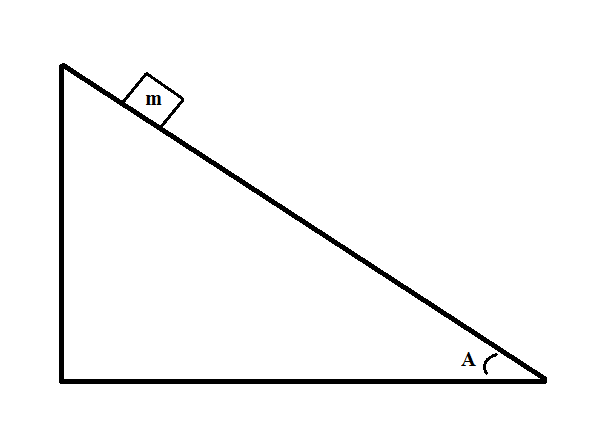
A block of mass  moves down an inclined plane of angle
  with a constant velocity
  as shown below. The coefficient of friction between the block and the inclined plane is given by
  .
.

What is the value of  in terms of
  ,
,  ,
,  , and
, and  ?
?
A block of mass
What is the value of
Tap to reveal answer

The free body diagram of the block is given above. This block has three forces acting on it. First, it's weight under the influence of gravity, which is given as  . Second, the normal force of the plane, which is given as
  . Third, the friction force, which acts opposite to its direction of motion and is given as
  . We choose a coordinate system so that our x-axis aligns with the motion of the block down the plane, and the y-axis aligns with the direction of the normal force. Thus the friction force points in the negative direction of the x-axis, and the normal force is aligned with the positive direction of the y-axis. However, the weight
  is not along either of these axes, so we resolve the
  force into its components,
  along the negative y-axis, and
  along the positive x-axis.
Now we can use Newton's 2nd law to relate the given forces above. Newton's 2nd law gives us two equations:
 and
and 
Because the block is constrained to move along the surface of the inclined plane, there should be no acceleration in the y direction, and so  . Also, because the block moves at constant velocity down the plane, Newton's 1st law assures us that there is no acceleration in the x direction as well, therefore
  . Plugging these accelerations in, we find that
  and
and 
Summing all the forces in the x-direction gives us

Summing all the forces in the y-direction gives us

Plugging these values into the force equations above gives us the following equations:


Solving for  in the second equation gives us
  . Thus the normal force is equal to the cosine component of the weight. Substituting
  in for
  in the first equation will give us the following:

Now we solve the equation for  . Adding
  to each side gives us:

Now we divide each side by  to obtain:

The final result is obtained by canceling the  factor and using the triginometric identity:

Therefore we arrive at the conclusion that 
The free body diagram of the block is given above. This block has three forces acting on it. First, it's weight under the influence of gravity, which is given as
Now we can use Newton's 2nd law to relate the given forces above. Newton's 2nd law gives us two equations:
Because the block is constrained to move along the surface of the inclined plane, there should be no acceleration in the y direction, and so
Summing all the forces in the x-direction gives us
Summing all the forces in the y-direction gives us
Plugging these values into the force equations above gives us the following equations:
Solving for
Now we solve the equation for
Now we divide each side by
The final result is obtained by canceling the
Therefore we arrive at the conclusion that
← Didn't Know|Knew It →
Consider the following system:
If the mass accelerates down the plane at a rate of  and the angle
  , what is the coefficient of kinetic friction between the mass and slope?

Consider the following system:
If the mass accelerates down the plane at a rate of
Tap to reveal answer
Before we start using equations, we need to determine what forces are acting on the block in this system. The only relevant forces in this situation are gravity and friction. We are given the acceleration of the block, giving us the tools to find the net force.
Using Newton's second law, we can write:


The force of friction is subtracted because it is in the opposite direction of the movement of the block. Substituting in expressions for each variable, we get:

Canceling out mass and rearranging for the coefficient of kinetic friction, we get:

We have values for each variable, allowing us to solve:


Before we start using equations, we need to determine what forces are acting on the block in this system. The only relevant forces in this situation are gravity and friction. We are given the acceleration of the block, giving us the tools to find the net force.
Using Newton's second law, we can write:
The force of friction is subtracted because it is in the opposite direction of the movement of the block. Substituting in expressions for each variable, we get:
Canceling out mass and rearranging for the coefficient of kinetic friction, we get:
We have values for each variable, allowing us to solve:
← Didn't Know|Knew It →
Consider the following system:
This system is set on a different planet, which has a gravitational constant different from that on Earth. If the angle measures  , the coefficient of kinetic friction is
  , and the block is accelerating at a rate of
  , what is the gravitational acceleration on this planet?
Consider the following system:
This system is set on a different planet, which has a gravitational constant different from that on Earth. If the angle measures
Tap to reveal answer
There are two relevant forces acting on the block in this scenario: gravity and friction. We can use Newton's second law to solve this problem:


Substituting in expressions for each force, we get:

Eliminating mass and rearranging for  , we get:

At this point, we can plug in values for each variable and solve:


There are two relevant forces acting on the block in this scenario: gravity and friction. We can use Newton's second law to solve this problem:
Substituting in expressions for each force, we get:
Eliminating mass and rearranging for
At this point, we can plug in values for each variable and solve:
← Didn't Know|Knew It →

In the diagram, a massless string connects two blocks of mass 30 kg and 50 kg that are on a flat, frictionaless surface. A force  pulls on the 50 kg block, as shown. If the force
  pulling on the 50 kg block is 100 N, what is the tension in the string connecting the two blocks?
In the diagram, a massless string connects two blocks of mass 30 kg and 50 kg that are on a flat, frictionaless surface. A force
Tap to reveal answer
Start by drawing in the forces acting on each block. You could also draw in the force of gravity and the normal force for each block, but they have been omitted from the image because they cancel each other out for each block and because there is no friction in this problem.

We are given in the question that the force  is 100 N. Since the blocks are connected by a string, they will therefore accelerate at the same rate, and we can treat them as a system that moves as if it were one object of total mass 80 kg (30 kg plus 50 kg). Use Newton's second law:

In this problem, the two tension forces form an action/reaction pair and therefore are equal in magnitude but opposite in direction (Newton's third law). So:

We can solve for acceleration, since the tensions cancel out.

Now that we have acceleration, we need to write a new equation in which the tension force does not cancel out so that we can solve for the tension  .
.
Do this by using Newton's second law again, except for only one of the blocks:

Lets consider the 30 kg block. The only force acting on the 30 kg block is the tension  , and the acceleration is what we found above.

Start by drawing in the forces acting on each block. You could also draw in the force of gravity and the normal force for each block, but they have been omitted from the image because they cancel each other out for each block and because there is no friction in this problem.
We are given in the question that the force
In this problem, the two tension forces form an action/reaction pair and therefore are equal in magnitude but opposite in direction (Newton's third law). So:
We can solve for acceleration, since the tensions cancel out.
Now that we have acceleration, we need to write a new equation in which the tension force does not cancel out so that we can solve for the tension
Do this by using Newton's second law again, except for only one of the blocks:
Lets consider the 30 kg block. The only force acting on the 30 kg block is the tension
← Didn't Know|Knew It →
A ball with mass  is on a ramp as illustrated below:

Find the magnitude of the ball's normal force.
A ball with mass
Find the magnitude of the ball's normal force.
Tap to reveal answer
The normal force is perpendicular to the plane:

First, we need to find  .
.
We can solve for  using the trigonometric equation that applies in this instance. We know the length of the side opposite of
  (5 m) and the length of the side adjacent to
  (10 m), so we can use the following equation to solve for
  :
:

Rearranging to solve this equation for  , you get

Substituting in the side lengths of the given triangle, we can solve for  .
.

Note that the normal force is one of the legs of another right triangle. The other leg is the parallel force, and the hypotenuse is the force of gravity.
Using trigonometry, we know that

because  , or, in terms of this problem,
  .
.
Substituting in the known values into this equation, we can solve for the normal force:

The normal force is perpendicular to the plane:
First, we need to find
We can solve for
Rearranging to solve this equation for
Substituting in the side lengths of the given triangle, we can solve for
Note that the normal force is one of the legs of another right triangle. The other leg is the parallel force, and the hypotenuse is the force of gravity.
Using trigonometry, we know that
because
Substituting in the known values into this equation, we can solve for the normal force:
← Didn't Know|Knew It →


What is the acceleration of the block above if its mass is  and the coefficient of kinetic friction is
  ?
?

What is the acceleration of the block above if its mass is
Tap to reveal answer

The component of  perpendicular to the slope is
  , where
  is the angle between the ground and the incline.
 where
where  is the normal force.
The force of friction, which is in the direction opposing motion is:

 is the coefficient of kinetic friction.
The component of  parallel to the slope is:

The net force on the block is:


The component of
The force of friction, which is in the direction opposing motion is:
The component of
The net force on the block is:
← Didn't Know|Knew It →


A mass is suspended by two cables. What is the magnitude of the tension in the left cable?
A mass is suspended by two cables. What is the magnitude of the tension in the left cable?
Tap to reveal answer
Begin by diagraming the forces acting on the mass in the problem:

The mass itself creates a force due to gravity in the downward direction:


For the mass to remain stationary, the forces must be in equilibrium. Therefore the sum of forces in the x and y directions each must be zero:


The x and y tensions can be written in terms of the magnitude of the tension in each cable. Begin with the x direction:


Because the angle is the same for each, the tension in each angle must be equivalent. Use this property when performing the force balance in the y direction:


Begin by diagraming the forces acting on the mass in the problem:
The mass itself creates a force due to gravity in the downward direction:
For the mass to remain stationary, the forces must be in equilibrium. Therefore the sum of forces in the x and y directions each must be zero:
The x and y tensions can be written in terms of the magnitude of the tension in each cable. Begin with the x direction:
Because the angle is the same for each, the tension in each angle must be equivalent. Use this property when performing the force balance in the y direction:
← Didn't Know|Knew It →


A mass is supported by two cables. What is the magnitude of tension in the right cable?
A mass is supported by two cables. What is the magnitude of tension in the right cable?
Tap to reveal answer
Begin by drawing a force diagram of forces acting on the mass:

The mass itself creates a force due to gravity in the downward direction.
For the mass to remain stationary, the forces must be in equilibrium. Therefore the sum of forces in the x and y directions each must be zero:
The x and y tensions can be written in terms of the magnitude of the tension in each cable. Begin with the x direction:

Because the angle is the same for each, the tension in each angle must be equivalent. Use this property when performing the force balance in the y direction:


Begin by drawing a force diagram of forces acting on the mass:
The mass itself creates a force due to gravity in the downward direction.
For the mass to remain stationary, the forces must be in equilibrium. Therefore the sum of forces in the x and y directions each must be zero:
The x and y tensions can be written in terms of the magnitude of the tension in each cable. Begin with the x direction:
Because the angle is the same for each, the tension in each angle must be equivalent. Use this property when performing the force balance in the y direction:
← Didn't Know|Knew It →


A 50kg mass is supported by two cables. Find the magnitude of tension in the left cable.
A 50kg mass is supported by two cables. Find the magnitude of tension in the left cable.
Tap to reveal answer
Begin by diagraming the forces acting on the mass:

The mass itself creates a force due to gravity in the downward direction.
For the mass to remain stationary, the forces must be in equilibrium. Therefore the sum of forces in the x and y directions each must be zero:
The x and y tensions can be written in terms of the magnitude of the tension in each cable. Begin with the x direction:


Because the angle is the same for each, the tension in each angle must be equivalent. Use this property when performing the force balance in the y direction:


Begin by diagraming the forces acting on the mass:
The mass itself creates a force due to gravity in the downward direction.
For the mass to remain stationary, the forces must be in equilibrium. Therefore the sum of forces in the x and y directions each must be zero:
The x and y tensions can be written in terms of the magnitude of the tension in each cable. Begin with the x direction:
Because the angle is the same for each, the tension in each angle must be equivalent. Use this property when performing the force balance in the y direction:
← Didn't Know|Knew It →
Two forces are exerted on the center of an object. What angle between the two forces would provide the largest resultant force?
Two forces are exerted on the center of an object. What angle between the two forces would provide the largest resultant force?
Tap to reveal answer
Imagine two men of equal strength pulling on ropes that are connected to a crate. In order to obtain the largest resulting force the two men should pull in the same direction at  . Pulling on opposite ends at
  would result in zero resultant force and anything besides
  would cause the force to act in an unneeded direction.
Imagine two men of equal strength pulling on ropes that are connected to a crate. In order to obtain the largest resulting force the two men should pull in the same direction at
← Didn't Know|Knew It →
Which of the following is true when an object has reached terminal velocity?
Which of the following is true when an object has reached terminal velocity?
Tap to reveal answer
During terminal velocity:

Thus, by Newton's second law:


During terminal velocity:
Thus, by Newton's second law:
← Didn't Know|Knew It →
Suppose that an object with a mass of  is free-falling in the air. If we neglect the influence of friction, what upward force must be applied to the falling object if we want it to reach a constant velocity?
Suppose that an object with a mass of
Tap to reveal answer
In this question, we're told that an object of a given mass is free-falling in the air with no air resistance. We're asked to determine the amount of upward force necessary to cause this object's velocity to become constant.
In order for an object's velocity to be maintained at a constant value, that object must not be accelerating. Therefore, we'll need to determine what force will allow this object to have a net acceleration of zero.
Looking at the falling object's motion in the downward direction, we know that it is falling due to the influence of gravity. Since we know its mass, we can calculate this downward force:


We've stated that in order to have a constant velocity, we need to have a net acceleration of zero. And since we know that the object is accelerating by  in the downward direction, we will need it to accelerate upward by
  to cancel it to zero.


To conclude, we'll have to match the downward force by presenting an equal upward force in order to cancel out the object's acceleration and bring its velocity to a constant value.
In this question, we're told that an object of a given mass is free-falling in the air with no air resistance. We're asked to determine the amount of upward force necessary to cause this object's velocity to become constant.
In order for an object's velocity to be maintained at a constant value, that object must not be accelerating. Therefore, we'll need to determine what force will allow this object to have a net acceleration of zero.
Looking at the falling object's motion in the downward direction, we know that it is falling due to the influence of gravity. Since we know its mass, we can calculate this downward force:
We've stated that in order to have a constant velocity, we need to have a net acceleration of zero. And since we know that the object is accelerating by
To conclude, we'll have to match the downward force by presenting an equal upward force in order to cancel out the object's acceleration and bring its velocity to a constant value.
← Didn't Know|Knew It →
If  people lift a
  car, how much force would each person have to apply to hold the car steady off the ground?
If
Tap to reveal answer
Using definition of force and superposition of Forces

Each person is apply the same amount of force against gravity. The car is holding still so it has no acceleration.


Solving for  and plugging in values, remembering that gravity points downwards and thus is negative.


Using definition of force and superposition of Forces
Each person is apply the same amount of force against gravity. The car is holding still so it has no acceleration.
Solving for
← Didn't Know|Knew It →
If three locomotives are pulling a  train, how much force does each locomotive need to apply to accelerate the train at
  from rest?
If three locomotives are pulling a
Tap to reveal answer
Using

Converting  to
to  and plugging in values.


Using
Converting
← Didn't Know|Knew It →
Suppose that there are three forces acting on an object. Out of these three forces, two of them are equal in strength; one of them points east and the other points south. In order to make the acceleration of the object zero, then in which direction must the third force act?
Suppose that there are three forces acting on an object. Out of these three forces, two of them are equal in strength; one of them points east and the other points south. In order to make the acceleration of the object zero, then in which direction must the third force act?
Tap to reveal answer
In the question stem, we're told that two forces of equal magnitude are pointing south and the other east. We're then asked to find which way the third force must be oriented in order to cancel out the other two forces. To figure this out, it's best to draw a force diagram.

Looking at this force diagram, we actually don't even need to do any math in order to realize that the resultant force from these two forces will point in the southeast direction. Consequently, the third force will need to point in the opposite direction in order to balance things out; the third force must be oriented in the northwest direction.
In the question stem, we're told that two forces of equal magnitude are pointing south and the other east. We're then asked to find which way the third force must be oriented in order to cancel out the other two forces. To figure this out, it's best to draw a force diagram.
Looking at this force diagram, we actually don't even need to do any math in order to realize that the resultant force from these two forces will point in the southeast direction. Consequently, the third force will need to point in the opposite direction in order to balance things out; the third force must be oriented in the northwest direction.
← Didn't Know|Knew It →
A  woman is standing on a rigid plastic sheet. Underneath her, there is an adjustable platform. The platform is lifted at one end until it reaches an angle with the horizontal of
  , at which point, the woman and the plastic sheet slide off. What is the coefficient of friction between the sheet and the platform?
A
Tap to reveal answer

As can be seen in the diagram, the force pushing down the ramp is equal to

The force pushing the object into the ramp is

The force into the ramp will be equal to the normal force, thus

The net force pushing the woman down the ramp is

At the moment she starts slipping, the net force is equal to zero

Solving for  :
:


As can be seen in the diagram, the force pushing down the ramp is equal to
The force pushing the object into the ramp is
The force into the ramp will be equal to the normal force, thus
The net force pushing the woman down the ramp is
At the moment she starts slipping, the net force is equal to zero
Solving for
← Didn't Know|Knew It →
A  woman has a jet pack that has a mass of
  . She ignites the jet pack and it accelerates her upwards at a rate of
  . Determine the force due to the jet pack.
A
Tap to reveal answer


← Didn't Know|Knew It →
Jennifer and Jessica are lifting a heavy box. If the box has a mass of  , and Jennifer is applying a force of
  , determine the force Jessica is applying if the box is accelerating upward at
  .
.
Jennifer and Jessica are lifting a heavy box. If the box has a mass of
Tap to reveal answer

Solving for 

Plugging in values


Solving for
Plugging in values
← Didn't Know|Knew It →
If a  block is resting on a ramp with a
  incline, what is the magnitude of the normal force between the block and ramp?
If a
Tap to reveal answer
Because the block is resting on an inclined surface, only a component of the gravitational force will contribute to the normal force between block and ramp. It can be assumed that the only relevant force acting on this block is due to gravity.
Since the normal force only acts in the direction perpendicular to the contact surface, the correct gravitational force component to take is the perpendicular component. This gives  . By plugging in the known values for
  , and
, and  , we get
Because the block is resting on an inclined surface, only a component of the gravitational force will contribute to the normal force between block and ramp. It can be assumed that the only relevant force acting on this block is due to gravity.
Since the normal force only acts in the direction perpendicular to the contact surface, the correct gravitational force component to take is the perpendicular component. This gives
← Didn't Know|Knew It →
A  bucket of water is held up by two ropes tied around it. Rope 1 is inclined at an angle
  from vertical to the right of the bucket, and Rope 2 is inclined at
  from vertical to the left. Rope 1 has a tension of 10N on it. What is the tension in Rope 2?
A
Tap to reveal answer
The tensions in both ropes are caused by the bucket being pulled down by gravity, hence the only relevant forces acting in this scenario are those in the y-direction. Since the bucket is being held up against gravity, the upward forces should balance exactly with the downward forces. The forces in the y-direction can be balanced like this:
 , where
  is the tension in rope 1. Thus we find that:

The tensions in both ropes are caused by the bucket being pulled down by gravity, hence the only relevant forces acting in this scenario are those in the y-direction. Since the bucket is being held up against gravity, the upward forces should balance exactly with the downward forces. The forces in the y-direction can be balanced like this:
← Didn't Know|Knew It →