
Price - AP Microeconomics
Card 1 of 66
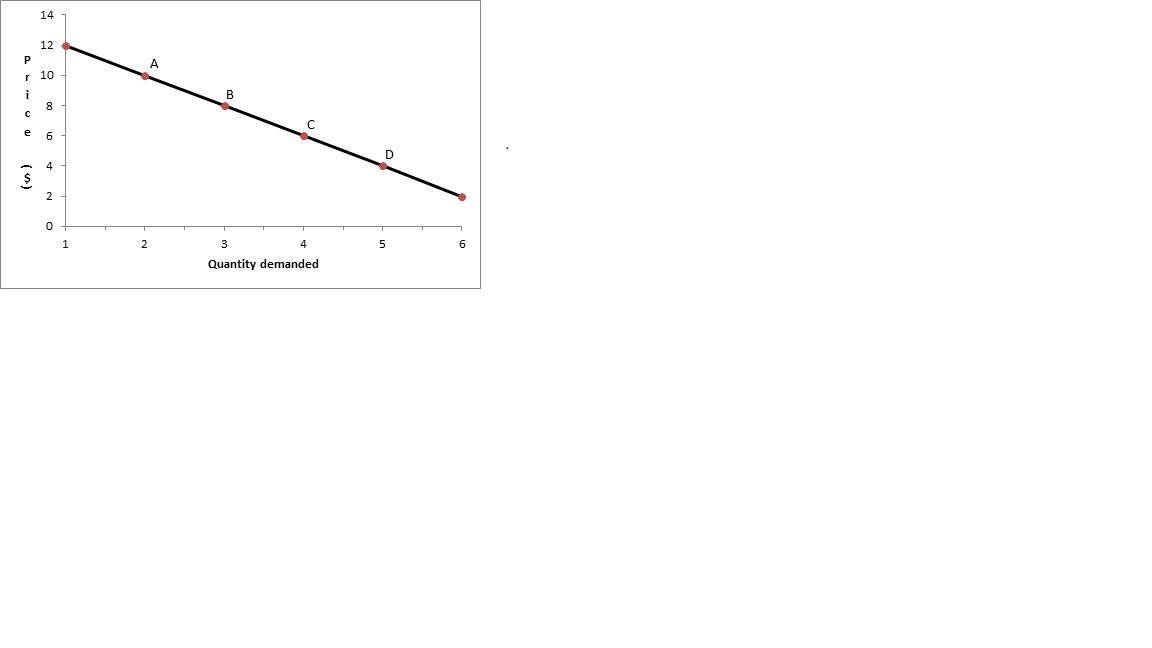
The demand for oranges at point D is:
The demand for oranges at point D is:
Tap to reveal answer
For a demand curve, the upper left portion is elastic, the middle portion is unit elastic and the lower right portion is inelastic. You can confirm by calculating E = percent change in quantity/ percent change in price between the points on the lower right portion of the demand curve. If E < 1, then demand is inelastic.
For a demand curve, the upper left portion is elastic, the middle portion is unit elastic and the lower right portion is inelastic. You can confirm by calculating E = percent change in quantity/ percent change in price between the points on the lower right portion of the demand curve. If E < 1, then demand is inelastic.
← Didn't Know|Knew It →
Suppose that as result of a 10% increase in income, the quantity demanded of Good X increases by 20%. Which of the following is true?
Suppose that as result of a 10% increase in income, the quantity demanded of Good X increases by 20%. Which of the following is true?
Tap to reveal answer
Remember that incomce elasticity of demand refers to the percent change in the quantity demanded of a good divided by the percent change in income. Since the percent change in the quantity demanded of Good X was 20% and the percent change in income was 10%, the income elasticity of demand for Good X is 20%/10% = 2. Thus, the income elasticity of demand for Good X is greater than 1.
Good X would be classified as an inferior good only if it had income elasticity of demand less than 0.
Remember that incomce elasticity of demand refers to the percent change in the quantity demanded of a good divided by the percent change in income. Since the percent change in the quantity demanded of Good X was 20% and the percent change in income was 10%, the income elasticity of demand for Good X is 20%/10% = 2. Thus, the income elasticity of demand for Good X is greater than 1.
Good X would be classified as an inferior good only if it had income elasticity of demand less than 0.
← Didn't Know|Knew It →
Which of the following statements describes price discrimination?
Which of the following statements describes price discrimination?
Tap to reveal answer
Price discrimination occurs when a firm sets two different price levels for different consumers buying the same product. For example, a firm may sell a particular pharmaceutical drug for one price in the US and another price in Europe.
Answer choice "The price of a particular product is less than the marginal cost of producing that product" refers to the rare situation in which a firm sells a good for less than it costs to make it. This may happen in the case of promotions, but is not an example of price discrimination.
The other answer choices represent distortions of the definition of price discrimination and are therefore incorrect.
Price discrimination occurs when a firm sets two different price levels for different consumers buying the same product. For example, a firm may sell a particular pharmaceutical drug for one price in the US and another price in Europe.
Answer choice "The price of a particular product is less than the marginal cost of producing that product" refers to the rare situation in which a firm sells a good for less than it costs to make it. This may happen in the case of promotions, but is not an example of price discrimination.
The other answer choices represent distortions of the definition of price discrimination and are therefore incorrect.
← Didn't Know|Knew It →
Which of the following is true of the relationship between the demand curve and the marginal revenue curve in a monopolistic structure?
Which of the following is true of the relationship between the demand curve and the marginal revenue curve in a monopolistic structure?
Tap to reveal answer
A monopolist faces a downward sloping demand curve, indicating market power, in contrast to the horizontal demand curve faced by perfectly competitive firms. A monopolist faces a downward sloping marginal revenue curve as well.
The monopolist's marginal revenue curve has the same y-intercept (intercept on the price-axis) as the demand curve, but has a steeper slope. Therefore, the demand curve is always equal to (at the intercept) or greater than (everywhere after the intercept) the marginal revenue curve. Answer choice "The demand curve is always greater than or equal to the marginal revenue curve" is correct.
The other answer choices are distortions of this relationship.
A monopolist faces a downward sloping demand curve, indicating market power, in contrast to the horizontal demand curve faced by perfectly competitive firms. A monopolist faces a downward sloping marginal revenue curve as well.
The monopolist's marginal revenue curve has the same y-intercept (intercept on the price-axis) as the demand curve, but has a steeper slope. Therefore, the demand curve is always equal to (at the intercept) or greater than (everywhere after the intercept) the marginal revenue curve. Answer choice "The demand curve is always greater than or equal to the marginal revenue curve" is correct.
The other answer choices are distortions of this relationship.
← Didn't Know|Knew It →
Suppose a consumer finds that her total expenditure on good X increases after her income decreases. Which of the following is true?
Suppose a consumer finds that her total expenditure on good X increases after her income decreases. Which of the following is true?
Tap to reveal answer
When a consumer buys less of a product after a rise in income, the good is said to be an "inferior good." (Consider, for example ramen noodles--for most consumers, when income rises, they purchase fewer ramen noodles).
Another way to think about inferior goods it that the income elasticity is negative. The formula for income elasticity is change in quantity demanded divided by change in income. In the scenario in question, income rose (so the denominator, change in income, is positive), and the quantity demanded fell (so the numerator, change in quantity demanded, is negative). Thus, the income elasticity would be negative, making good X an inferior good.
Good X is not a normal good, because for normal goods, income elasticity is between 0 and 1 (not negative).
Good X is not a luxury good, because for luxury goods, income elasticity is greater than 1 (not negative).
The income elasticity of good X for the consumer is not 1, because we know from the explanation above that income elasticity for good X must be negative.
When a consumer buys less of a product after a rise in income, the good is said to be an "inferior good." (Consider, for example ramen noodles--for most consumers, when income rises, they purchase fewer ramen noodles).
Another way to think about inferior goods it that the income elasticity is negative. The formula for income elasticity is change in quantity demanded divided by change in income. In the scenario in question, income rose (so the denominator, change in income, is positive), and the quantity demanded fell (so the numerator, change in quantity demanded, is negative). Thus, the income elasticity would be negative, making good X an inferior good.
Good X is not a normal good, because for normal goods, income elasticity is between 0 and 1 (not negative).
Good X is not a luxury good, because for luxury goods, income elasticity is greater than 1 (not negative).
The income elasticity of good X for the consumer is not 1, because we know from the explanation above that income elasticity for good X must be negative.
← Didn't Know|Knew It →
Assume that a consumer is willing and able to pay $5 for a latte and that the price of the latte is $3. Which of the following is equal to the consumer surplus?
Assume that a consumer is willing and able to pay $5 for a latte and that the price of the latte is $3. Which of the following is equal to the consumer surplus?
Tap to reveal answer
Consumer surplus is calculated as the amount a buyer is willing and able to pay for a good or service minus the actual cost of the good or service. Thus, if the consumer is willing and able to pay $5, but the good costs only $3, consumer surplus is $5 - $3 = $2.
Consumer surplus is calculated as the amount a buyer is willing and able to pay for a good or service minus the actual cost of the good or service. Thus, if the consumer is willing and able to pay $5, but the good costs only $3, consumer surplus is $5 - $3 = $2.
← Didn't Know|Knew It →
The demand for oranges at point D is:
The demand for oranges at point D is:
Tap to reveal answer
For a demand curve, the upper left portion is elastic, the middle portion is unit elastic and the lower right portion is inelastic. You can confirm by calculating E = percent change in quantity/ percent change in price between the points on the lower right portion of the demand curve. If E < 1, then demand is inelastic.
For a demand curve, the upper left portion is elastic, the middle portion is unit elastic and the lower right portion is inelastic. You can confirm by calculating E = percent change in quantity/ percent change in price between the points on the lower right portion of the demand curve. If E < 1, then demand is inelastic.
← Didn't Know|Knew It →
Suppose that as result of a 10% increase in income, the quantity demanded of Good X increases by 20%. Which of the following is true?
Suppose that as result of a 10% increase in income, the quantity demanded of Good X increases by 20%. Which of the following is true?
Tap to reveal answer
Remember that incomce elasticity of demand refers to the percent change in the quantity demanded of a good divided by the percent change in income. Since the percent change in the quantity demanded of Good X was 20% and the percent change in income was 10%, the income elasticity of demand for Good X is 20%/10% = 2. Thus, the income elasticity of demand for Good X is greater than 1.
Good X would be classified as an inferior good only if it had income elasticity of demand less than 0.
Remember that incomce elasticity of demand refers to the percent change in the quantity demanded of a good divided by the percent change in income. Since the percent change in the quantity demanded of Good X was 20% and the percent change in income was 10%, the income elasticity of demand for Good X is 20%/10% = 2. Thus, the income elasticity of demand for Good X is greater than 1.
Good X would be classified as an inferior good only if it had income elasticity of demand less than 0.
← Didn't Know|Knew It →
Which of the following statements describes price discrimination?
Which of the following statements describes price discrimination?
Tap to reveal answer
Price discrimination occurs when a firm sets two different price levels for different consumers buying the same product. For example, a firm may sell a particular pharmaceutical drug for one price in the US and another price in Europe.
Answer choice "The price of a particular product is less than the marginal cost of producing that product" refers to the rare situation in which a firm sells a good for less than it costs to make it. This may happen in the case of promotions, but is not an example of price discrimination.
The other answer choices represent distortions of the definition of price discrimination and are therefore incorrect.
Price discrimination occurs when a firm sets two different price levels for different consumers buying the same product. For example, a firm may sell a particular pharmaceutical drug for one price in the US and another price in Europe.
Answer choice "The price of a particular product is less than the marginal cost of producing that product" refers to the rare situation in which a firm sells a good for less than it costs to make it. This may happen in the case of promotions, but is not an example of price discrimination.
The other answer choices represent distortions of the definition of price discrimination and are therefore incorrect.
← Didn't Know|Knew It →
Which of the following is true of the relationship between the demand curve and the marginal revenue curve in a monopolistic structure?
Which of the following is true of the relationship between the demand curve and the marginal revenue curve in a monopolistic structure?
Tap to reveal answer
A monopolist faces a downward sloping demand curve, indicating market power, in contrast to the horizontal demand curve faced by perfectly competitive firms. A monopolist faces a downward sloping marginal revenue curve as well.
The monopolist's marginal revenue curve has the same y-intercept (intercept on the price-axis) as the demand curve, but has a steeper slope. Therefore, the demand curve is always equal to (at the intercept) or greater than (everywhere after the intercept) the marginal revenue curve. Answer choice "The demand curve is always greater than or equal to the marginal revenue curve" is correct.
The other answer choices are distortions of this relationship.
A monopolist faces a downward sloping demand curve, indicating market power, in contrast to the horizontal demand curve faced by perfectly competitive firms. A monopolist faces a downward sloping marginal revenue curve as well.
The monopolist's marginal revenue curve has the same y-intercept (intercept on the price-axis) as the demand curve, but has a steeper slope. Therefore, the demand curve is always equal to (at the intercept) or greater than (everywhere after the intercept) the marginal revenue curve. Answer choice "The demand curve is always greater than or equal to the marginal revenue curve" is correct.
The other answer choices are distortions of this relationship.
← Didn't Know|Knew It →
Suppose a consumer finds that her total expenditure on good X increases after her income decreases. Which of the following is true?
Suppose a consumer finds that her total expenditure on good X increases after her income decreases. Which of the following is true?
Tap to reveal answer
When a consumer buys less of a product after a rise in income, the good is said to be an "inferior good." (Consider, for example ramen noodles--for most consumers, when income rises, they purchase fewer ramen noodles).
Another way to think about inferior goods it that the income elasticity is negative. The formula for income elasticity is change in quantity demanded divided by change in income. In the scenario in question, income rose (so the denominator, change in income, is positive), and the quantity demanded fell (so the numerator, change in quantity demanded, is negative). Thus, the income elasticity would be negative, making good X an inferior good.
Good X is not a normal good, because for normal goods, income elasticity is between 0 and 1 (not negative).
Good X is not a luxury good, because for luxury goods, income elasticity is greater than 1 (not negative).
The income elasticity of good X for the consumer is not 1, because we know from the explanation above that income elasticity for good X must be negative.
When a consumer buys less of a product after a rise in income, the good is said to be an "inferior good." (Consider, for example ramen noodles--for most consumers, when income rises, they purchase fewer ramen noodles).
Another way to think about inferior goods it that the income elasticity is negative. The formula for income elasticity is change in quantity demanded divided by change in income. In the scenario in question, income rose (so the denominator, change in income, is positive), and the quantity demanded fell (so the numerator, change in quantity demanded, is negative). Thus, the income elasticity would be negative, making good X an inferior good.
Good X is not a normal good, because for normal goods, income elasticity is between 0 and 1 (not negative).
Good X is not a luxury good, because for luxury goods, income elasticity is greater than 1 (not negative).
The income elasticity of good X for the consumer is not 1, because we know from the explanation above that income elasticity for good X must be negative.
← Didn't Know|Knew It →
Assume that a consumer is willing and able to pay $5 for a latte and that the price of the latte is $3. Which of the following is equal to the consumer surplus?
Assume that a consumer is willing and able to pay $5 for a latte and that the price of the latte is $3. Which of the following is equal to the consumer surplus?
Tap to reveal answer
Consumer surplus is calculated as the amount a buyer is willing and able to pay for a good or service minus the actual cost of the good or service. Thus, if the consumer is willing and able to pay $5, but the good costs only $3, consumer surplus is $5 - $3 = $2.
Consumer surplus is calculated as the amount a buyer is willing and able to pay for a good or service minus the actual cost of the good or service. Thus, if the consumer is willing and able to pay $5, but the good costs only $3, consumer surplus is $5 - $3 = $2.
← Didn't Know|Knew It →
The demand for oranges at point D is:
The demand for oranges at point D is:
Tap to reveal answer
For a demand curve, the upper left portion is elastic, the middle portion is unit elastic and the lower right portion is inelastic. You can confirm by calculating E = percent change in quantity/ percent change in price between the points on the lower right portion of the demand curve. If E < 1, then demand is inelastic.
For a demand curve, the upper left portion is elastic, the middle portion is unit elastic and the lower right portion is inelastic. You can confirm by calculating E = percent change in quantity/ percent change in price between the points on the lower right portion of the demand curve. If E < 1, then demand is inelastic.
← Didn't Know|Knew It →
Suppose that as result of a 10% increase in income, the quantity demanded of Good X increases by 20%. Which of the following is true?
Suppose that as result of a 10% increase in income, the quantity demanded of Good X increases by 20%. Which of the following is true?
Tap to reveal answer
Remember that incomce elasticity of demand refers to the percent change in the quantity demanded of a good divided by the percent change in income. Since the percent change in the quantity demanded of Good X was 20% and the percent change in income was 10%, the income elasticity of demand for Good X is 20%/10% = 2. Thus, the income elasticity of demand for Good X is greater than 1.
Good X would be classified as an inferior good only if it had income elasticity of demand less than 0.
Remember that incomce elasticity of demand refers to the percent change in the quantity demanded of a good divided by the percent change in income. Since the percent change in the quantity demanded of Good X was 20% and the percent change in income was 10%, the income elasticity of demand for Good X is 20%/10% = 2. Thus, the income elasticity of demand for Good X is greater than 1.
Good X would be classified as an inferior good only if it had income elasticity of demand less than 0.
← Didn't Know|Knew It →
Which of the following statements describes price discrimination?
Which of the following statements describes price discrimination?
Tap to reveal answer
Price discrimination occurs when a firm sets two different price levels for different consumers buying the same product. For example, a firm may sell a particular pharmaceutical drug for one price in the US and another price in Europe.
Answer choice "The price of a particular product is less than the marginal cost of producing that product" refers to the rare situation in which a firm sells a good for less than it costs to make it. This may happen in the case of promotions, but is not an example of price discrimination.
The other answer choices represent distortions of the definition of price discrimination and are therefore incorrect.
Price discrimination occurs when a firm sets two different price levels for different consumers buying the same product. For example, a firm may sell a particular pharmaceutical drug for one price in the US and another price in Europe.
Answer choice "The price of a particular product is less than the marginal cost of producing that product" refers to the rare situation in which a firm sells a good for less than it costs to make it. This may happen in the case of promotions, but is not an example of price discrimination.
The other answer choices represent distortions of the definition of price discrimination and are therefore incorrect.
← Didn't Know|Knew It →
Which of the following is true of the relationship between the demand curve and the marginal revenue curve in a monopolistic structure?
Which of the following is true of the relationship between the demand curve and the marginal revenue curve in a monopolistic structure?
Tap to reveal answer
A monopolist faces a downward sloping demand curve, indicating market power, in contrast to the horizontal demand curve faced by perfectly competitive firms. A monopolist faces a downward sloping marginal revenue curve as well.
The monopolist's marginal revenue curve has the same y-intercept (intercept on the price-axis) as the demand curve, but has a steeper slope. Therefore, the demand curve is always equal to (at the intercept) or greater than (everywhere after the intercept) the marginal revenue curve. Answer choice "The demand curve is always greater than or equal to the marginal revenue curve" is correct.
The other answer choices are distortions of this relationship.
A monopolist faces a downward sloping demand curve, indicating market power, in contrast to the horizontal demand curve faced by perfectly competitive firms. A monopolist faces a downward sloping marginal revenue curve as well.
The monopolist's marginal revenue curve has the same y-intercept (intercept on the price-axis) as the demand curve, but has a steeper slope. Therefore, the demand curve is always equal to (at the intercept) or greater than (everywhere after the intercept) the marginal revenue curve. Answer choice "The demand curve is always greater than or equal to the marginal revenue curve" is correct.
The other answer choices are distortions of this relationship.
← Didn't Know|Knew It →
Suppose a consumer finds that her total expenditure on good X increases after her income decreases. Which of the following is true?
Suppose a consumer finds that her total expenditure on good X increases after her income decreases. Which of the following is true?
Tap to reveal answer
When a consumer buys less of a product after a rise in income, the good is said to be an "inferior good." (Consider, for example ramen noodles--for most consumers, when income rises, they purchase fewer ramen noodles).
Another way to think about inferior goods it that the income elasticity is negative. The formula for income elasticity is change in quantity demanded divided by change in income. In the scenario in question, income rose (so the denominator, change in income, is positive), and the quantity demanded fell (so the numerator, change in quantity demanded, is negative). Thus, the income elasticity would be negative, making good X an inferior good.
Good X is not a normal good, because for normal goods, income elasticity is between 0 and 1 (not negative).
Good X is not a luxury good, because for luxury goods, income elasticity is greater than 1 (not negative).
The income elasticity of good X for the consumer is not 1, because we know from the explanation above that income elasticity for good X must be negative.
When a consumer buys less of a product after a rise in income, the good is said to be an "inferior good." (Consider, for example ramen noodles--for most consumers, when income rises, they purchase fewer ramen noodles).
Another way to think about inferior goods it that the income elasticity is negative. The formula for income elasticity is change in quantity demanded divided by change in income. In the scenario in question, income rose (so the denominator, change in income, is positive), and the quantity demanded fell (so the numerator, change in quantity demanded, is negative). Thus, the income elasticity would be negative, making good X an inferior good.
Good X is not a normal good, because for normal goods, income elasticity is between 0 and 1 (not negative).
Good X is not a luxury good, because for luxury goods, income elasticity is greater than 1 (not negative).
The income elasticity of good X for the consumer is not 1, because we know from the explanation above that income elasticity for good X must be negative.
← Didn't Know|Knew It →
Assume that a consumer is willing and able to pay $5 for a latte and that the price of the latte is $3. Which of the following is equal to the consumer surplus?
Assume that a consumer is willing and able to pay $5 for a latte and that the price of the latte is $3. Which of the following is equal to the consumer surplus?
Tap to reveal answer
Consumer surplus is calculated as the amount a buyer is willing and able to pay for a good or service minus the actual cost of the good or service. Thus, if the consumer is willing and able to pay $5, but the good costs only $3, consumer surplus is $5 - $3 = $2.
Consumer surplus is calculated as the amount a buyer is willing and able to pay for a good or service minus the actual cost of the good or service. Thus, if the consumer is willing and able to pay $5, but the good costs only $3, consumer surplus is $5 - $3 = $2.
← Didn't Know|Knew It →
The demand for oranges at point D is:
The demand for oranges at point D is:
Tap to reveal answer
For a demand curve, the upper left portion is elastic, the middle portion is unit elastic and the lower right portion is inelastic. You can confirm by calculating E = percent change in quantity/ percent change in price between the points on the lower right portion of the demand curve. If E < 1, then demand is inelastic.
For a demand curve, the upper left portion is elastic, the middle portion is unit elastic and the lower right portion is inelastic. You can confirm by calculating E = percent change in quantity/ percent change in price between the points on the lower right portion of the demand curve. If E < 1, then demand is inelastic.
← Didn't Know|Knew It →
Suppose that as result of a 10% increase in income, the quantity demanded of Good X increases by 20%. Which of the following is true?
Suppose that as result of a 10% increase in income, the quantity demanded of Good X increases by 20%. Which of the following is true?
Tap to reveal answer
Remember that incomce elasticity of demand refers to the percent change in the quantity demanded of a good divided by the percent change in income. Since the percent change in the quantity demanded of Good X was 20% and the percent change in income was 10%, the income elasticity of demand for Good X is 20%/10% = 2. Thus, the income elasticity of demand for Good X is greater than 1.
Good X would be classified as an inferior good only if it had income elasticity of demand less than 0.
Remember that incomce elasticity of demand refers to the percent change in the quantity demanded of a good divided by the percent change in income. Since the percent change in the quantity demanded of Good X was 20% and the percent change in income was 10%, the income elasticity of demand for Good X is 20%/10% = 2. Thus, the income elasticity of demand for Good X is greater than 1.
Good X would be classified as an inferior good only if it had income elasticity of demand less than 0.
← Didn't Know|Knew It →