
Perfectly Competitive Output Markets - AP Microeconomics
Card 1 of 1001
Energy can be generated using either coal or natural gas as an input. If the supply of coal is interrupted, what are the most likely effects on the price and quantity of natural gas traded on the open market? Assume a perfectly competitive market with no government policy intervention.
Energy can be generated using either coal or natural gas as an input. If the supply of coal is interrupted, what are the most likely effects on the price and quantity of natural gas traded on the open market? Assume a perfectly competitive market with no government policy intervention.
Tap to reveal answer
Coal and natural gas are substitutes for each other based on the description given in the question. Therefore, an interruption in the supply of coal will lead to an increase in the demand for natural gas. This will increase both the price and quantity of natural gas.
Coal and natural gas are substitutes for each other based on the description given in the question. Therefore, an interruption in the supply of coal will lead to an increase in the demand for natural gas. This will increase both the price and quantity of natural gas.
← Didn't Know|Knew It →
Which of the following pairs of goods are most likely NOT complementary goods?
Which of the following pairs of goods are most likely NOT complementary goods?
Tap to reveal answer
Some, or even many, people may love both music and art, but that does not suggest that music books and artwork are regularly purchased together. The other examples are goods that clearly work better together.
Some, or even many, people may love both music and art, but that does not suggest that music books and artwork are regularly purchased together. The other examples are goods that clearly work better together.
← Didn't Know|Knew It →
Iron ore is an important input in steelmaking. If the cost of iron ore increases, what are the likely effects on the equilibrium price and quantity in the market for steel? Assume a perfectly competitive market.
Iron ore is an important input in steelmaking. If the cost of iron ore increases, what are the likely effects on the equilibrium price and quantity in the market for steel? Assume a perfectly competitive market.
Tap to reveal answer
An increase in the cost of iron ore will make steel production more expensive.
Because production costs increase, steelmakers will be less willing to produce steel at any given price. Therefore, the market price of steel will increase, and less steel will be traded on the market.
An increase in the cost of iron ore will make steel production more expensive.
Because production costs increase, steelmakers will be less willing to produce steel at any given price. Therefore, the market price of steel will increase, and less steel will be traded on the market.
← Didn't Know|Knew It →
Which of the following scenarios will result in an increase in the market price for iron ore?
Which of the following scenarios will result in an increase in the market price for iron ore?
Tap to reveal answer
We need to choose the scenario that results in a higher equilibrium price. This will result from an increase in demand and a decrease in supply. Only one answer choice matches this scenario. The other choices create a lower equilibrium price or an ambiguous change.
We need to choose the scenario that results in a higher equilibrium price. This will result from an increase in demand and a decrease in supply. Only one answer choice matches this scenario. The other choices create a lower equilibrium price or an ambiguous change.
← Didn't Know|Knew It →
Which of the following is NOT a characteristic of a perfectly competitive market?
Which of the following is NOT a characteristic of a perfectly competitive market?
Tap to reveal answer
Perfectly competitive markets are characterized by their LACK of entry and exit barriers, which makes it easy for firms to enter or leave the market as conditions change.
Perfectly competitive markets are characterized by their LACK of entry and exit barriers, which makes it easy for firms to enter or leave the market as conditions change.
← Didn't Know|Knew It →
The following are characteristics of a perfectly competitive market. Among these, which is most clearly lacking in the market for used cars?
The following are characteristics of a perfectly competitive market. Among these, which is most clearly lacking in the market for used cars?
Tap to reveal answer
Although few real-life markets meet the characteristics of perfect competition exactly, the lack of perfect (or even equal) information about the goods being traded stands out in the used car market. When dealing in used cars, the seller typically has much more information about the quality of the car than the buyer.
The other answers more or less fit the perfect competition model. There are many buyers and sellers, the property rights of the buyer and seller are well defined, there are limited returns to scale (i.e. small used car sellers have not been competed out of existence), and factors of production (labor, land) can be put to other uses.
Although few real-life markets meet the characteristics of perfect competition exactly, the lack of perfect (or even equal) information about the goods being traded stands out in the used car market. When dealing in used cars, the seller typically has much more information about the quality of the car than the buyer.
The other answers more or less fit the perfect competition model. There are many buyers and sellers, the property rights of the buyer and seller are well defined, there are limited returns to scale (i.e. small used car sellers have not been competed out of existence), and factors of production (labor, land) can be put to other uses.
← Didn't Know|Knew It →
A food safety issue causes a temporary halt in the production of hot dogs at a significant number of firms. What is the expected effect on the equilibrium price and quantity for hot dog buns, assuming a perfectly competitive marketplace?
A food safety issue causes a temporary halt in the production of hot dogs at a significant number of firms. What is the expected effect on the equilibrium price and quantity for hot dog buns, assuming a perfectly competitive marketplace?
Tap to reveal answer
Hot dogs and hot dog buns are a model pair of complementary goods. Few people buy one without buying the other. You can graph the situation described using supply and demand curves for each market.
In the hot dog market, a significant decrease in supply will result in an inward shift of the supply curve which results in a higher price and fewer hot dogs being bought and sold.
The resulting effect in the market for hot dog buns, with fewer hot dogs being sold, is an inward shift in the demand curve, which results in a decrease in both the market price and quantity sold of hot dog buns.
Hot dogs and hot dog buns are a model pair of complementary goods. Few people buy one without buying the other. You can graph the situation described using supply and demand curves for each market.
In the hot dog market, a significant decrease in supply will result in an inward shift of the supply curve which results in a higher price and fewer hot dogs being bought and sold.
The resulting effect in the market for hot dog buns, with fewer hot dogs being sold, is an inward shift in the demand curve, which results in a decrease in both the market price and quantity sold of hot dog buns.
← Didn't Know|Knew It →
Which of the following breakdowns in the rules of perfect competition is likely to result in a market externality?
Which of the following breakdowns in the rules of perfect competition is likely to result in a market externality?
Tap to reveal answer
Among the available choices, only poorly defined property rights is likely to result in an externality. For example, poorly defined intellectual property rights could result in firms not reaping the full benefit of their research and development and therefore doing less than is socially optimal.
Among the available choices, only poorly defined property rights is likely to result in an externality. For example, poorly defined intellectual property rights could result in firms not reaping the full benefit of their research and development and therefore doing less than is socially optimal.
← Didn't Know|Knew It →
If there is a bumper crop in cotton the same year that it becomes very fashionable and consumers begin to demand it over other fabrics, what is the likely effect on the market price and quantity traded?
If there is a bumper crop in cotton the same year that it becomes very fashionable and consumers begin to demand it over other fabrics, what is the likely effect on the market price and quantity traded?
Tap to reveal answer
Graph supply and demand curves to represent the market for cotton. The changes described would result in an outward shift of both the supply and demand curves. The new equilibrium would clearly have an increase in the quantity traded, but the equilibrium price would depend on the slope of the curves. Therefore, without more information, the effect on the market price is indeterminate.
Graph supply and demand curves to represent the market for cotton. The changes described would result in an outward shift of both the supply and demand curves. The new equilibrium would clearly have an increase in the quantity traded, but the equilibrium price would depend on the slope of the curves. Therefore, without more information, the effect on the market price is indeterminate.
← Didn't Know|Knew It →
Which of these actions most obviously produces a positive externality?
Which of these actions most obviously produces a positive externality?
Tap to reveal answer
Keeping your yard clean and maintained is a positive quality that residents and visitors in your neighborhood will also benefit from. Some of the other answers are also positive, but they only have a private benefits, not public ones.
Keeping your yard clean and maintained is a positive quality that residents and visitors in your neighborhood will also benefit from. Some of the other answers are also positive, but they only have a private benefits, not public ones.
← Didn't Know|Knew It →
Which of these actions most obviously produces a negative externality?
Which of these actions most obviously produces a negative externality?
Tap to reveal answer
Trashing your room really only affects you. Only littering, which affects the general public, is clearly a negative externality.
Trashing your room really only affects you. Only littering, which affects the general public, is clearly a negative externality.
← Didn't Know|Knew It →
Reference this chart for the question below:
Output Total Cost ($) 1 10 2 15 3 19 4 24 5 30 6 38 7 49
The marginal cost of producing the 7th unit of output is:
Reference this chart for the question below:
| Output | Total Cost ($) |
|---|---|
| 1 | 10 |
| 2 | 15 |
| 3 | 19 |
| 4 | 24 |
| 5 | 30 |
| 6 | 38 |
| 7 | 49 |
The marginal cost of producing the 7th unit of output is:
Tap to reveal answer
The total cost of producing 7 units is $49. Since the total cost of producing 6 units is $38, the marginal cost of producing the 7th unit must be $11.
The total cost of producing 7 units is $49. Since the total cost of producing 6 units is $38, the marginal cost of producing the 7th unit must be $11.
← Didn't Know|Knew It →
Reference this chart for the question below:
Output Total Cost ($) 1 10 2 15 3 19 4 24 5 30 6 38 7 49
If the market is perfectly competitive, and the market price of the good is $6, how many units should this supplier produce and sell on the market?
Reference this chart for the question below:
| Output | Total Cost ($) |
|---|---|
| 1 | 10 |
| 2 | 15 |
| 3 | 19 |
| 4 | 24 |
| 5 | 30 |
| 6 | 38 |
| 7 | 49 |
If the market is perfectly competitive, and the market price of the good is $6, how many units should this supplier produce and sell on the market?
Tap to reveal answer
Marginal revenue equals marginal cost at $6 for the 5th unit produced. Total revenue equals total cost at both the 4th and 5th unit, but this is not the determining factor.
Marginal revenue equals marginal cost at $6 for the 5th unit produced. Total revenue equals total cost at both the 4th and 5th unit, but this is not the determining factor.
← Didn't Know|Knew It →
Sugar can be refined from either sugar cane or sugar beets. Which of the following would result in an increase in the market price of sugar cane, assuming perfect competition?
Sugar can be refined from either sugar cane or sugar beets. Which of the following would result in an increase in the market price of sugar cane, assuming perfect competition?
Tap to reveal answer
A sugar beet crop failure would result in an inward shift of the supply curve in the market for sugar beets, resulting in a higher equilibrium price.
Since sugar beets and sugar cane are substitutes, this would result in greater demand for sugar cane, which would result in a higher price for sugar cane as well.
A sugar beet crop failure would result in an inward shift of the supply curve in the market for sugar beets, resulting in a higher equilibrium price.
Since sugar beets and sugar cane are substitutes, this would result in greater demand for sugar cane, which would result in a higher price for sugar cane as well.
← Didn't Know|Knew It →
Sugar can be refined from either sugar cane or sugar beets. If there is a larger-than-expected harvest in BOTH sugar cane and sugar beets, what is the effect on the equilibrium price and quantity in the market for sugar cane?
Sugar can be refined from either sugar cane or sugar beets. If there is a larger-than-expected harvest in BOTH sugar cane and sugar beets, what is the effect on the equilibrium price and quantity in the market for sugar cane?
Tap to reveal answer
First, an increase in the supply of sugar beet results in a lower market price, and therefore lower demand for sugar cane, since they are substitutes. This translates into a lower market price and lower quantity traded for sugar cane.
Second, the increased supply of sugar cane would result in a lower market price and higher quantity traded in sugar cane. Therefore, the market price would definitely decrease, but the direction of the change in quantity cannot be determined.
First, an increase in the supply of sugar beet results in a lower market price, and therefore lower demand for sugar cane, since they are substitutes. This translates into a lower market price and lower quantity traded for sugar cane.
Second, the increased supply of sugar cane would result in a lower market price and higher quantity traded in sugar cane. Therefore, the market price would definitely decrease, but the direction of the change in quantity cannot be determined.
← Didn't Know|Knew It →
Compared to a perfectly competitive market, a monopolist produces...
Compared to a perfectly competitive market, a monopolist produces...
Tap to reveal answer
As seen in the graph below, the monopolist faces a downward sloping marginal revenue curve that is steeper than the demand curve. The monopolist produces where MC = MR which results in a higher price and lower output compared to where the marginal cost curve meets the demand curve, which is where equilibrium would be in a perfectly competitive market.
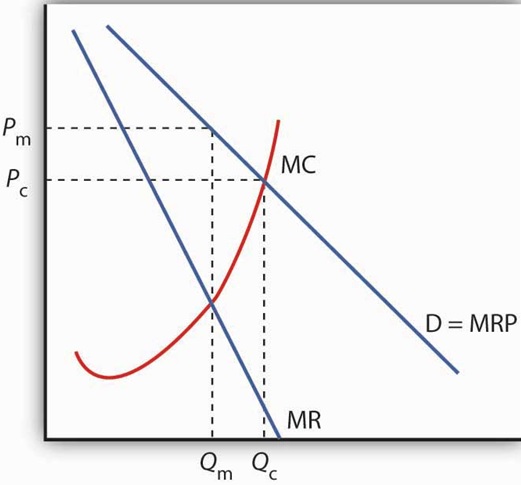
As seen in the graph below, the monopolist faces a downward sloping marginal revenue curve that is steeper than the demand curve. The monopolist produces where MC = MR which results in a higher price and lower output compared to where the marginal cost curve meets the demand curve, which is where equilibrium would be in a perfectly competitive market.
← Didn't Know|Knew It →
If a monopolist's marginal cost curve shifts down, what is the expected effect on price and quantity of the monopolist's output?
If a monopolist's marginal cost curve shifts down, what is the expected effect on price and quantity of the monopolist's output?
Tap to reveal answer
Although the monopolist will not end up producing at the socially optimal level, the effect of the change described is very similar to a shift in the supply curve in a perfectly competitive market.
Starting with the graph below as a baseline, you can see that if the marginal cost curve shifts down, the monopolist will produce at a point further along the marginal revenue curve, which would correspond to a greater output at a lower market price.
Although the monopolist will not end up producing at the socially optimal level, the effect of the change described is very similar to a shift in the supply curve in a perfectly competitive market.
Starting with the graph below as a baseline, you can see that if the marginal cost curve shifts down, the monopolist will produce at a point further along the marginal revenue curve, which would correspond to a greater output at a lower market price.
← Didn't Know|Knew It →
A natural monopoly arises when which of the following characteristics of a perfectly competitive market are not met?
A natural monopoly arises when which of the following characteristics of a perfectly competitive market are not met?
Tap to reveal answer
A natural monopoly is defined by an industry where production is most efficient (i.e. lowest long-run average cost) when it is concentrated in a single firm. This implies increasing returns to scale, which is not characteristic of perfect competition. In other words, the natural monopolist will have a significant cost advantage over smaller competitors that try to enter the market.
A natural monopoly is defined by an industry where production is most efficient (i.e. lowest long-run average cost) when it is concentrated in a single firm. This implies increasing returns to scale, which is not characteristic of perfect competition. In other words, the natural monopolist will have a significant cost advantage over smaller competitors that try to enter the market.
← Didn't Know|Knew It →
A natural monopoly differs from a traditional monopoly in what way?
A natural monopoly differs from a traditional monopoly in what way?
Tap to reveal answer
A natural monopoly is very similar to and experiences the same inefficiencies as a traditional monopoly. The difference is that these inefficiencies cannot be corrected by increasing competition, as a single seller can produce more efficiently than many sellers in a market that is a natural monopoly.
A natural monopoly is very similar to and experiences the same inefficiencies as a traditional monopoly. The difference is that these inefficiencies cannot be corrected by increasing competition, as a single seller can produce more efficiently than many sellers in a market that is a natural monopoly.
← Didn't Know|Knew It →
Assume that each of the following producers operates as a monopolist. Which one is most likely NOT a natural monopoly?
Assume that each of the following producers operates as a monopolist. Which one is most likely NOT a natural monopoly?
Tap to reveal answer
The electric company, railway, and telecoms operator are all examples of industries with very high fixed costs where the lowest average cost could only be achieved at a high level output, which discourages competition and is characteristic of natural monopoly.
The drug-maker operates as a monopoly due to the legal barrier (patent) that prevents entry into the market (for that specific drug). Therefore, it is NOT a natural monopoly.
The electric company, railway, and telecoms operator are all examples of industries with very high fixed costs where the lowest average cost could only be achieved at a high level output, which discourages competition and is characteristic of natural monopoly.
The drug-maker operates as a monopoly due to the legal barrier (patent) that prevents entry into the market (for that specific drug). Therefore, it is NOT a natural monopoly.
← Didn't Know|Knew It →