
Endothermic and Exothermic Reactions
AP Chemistry · Learn by Concept
Help Questions
AP Chemistry › Endothermic and Exothermic Reactions
If a reaction has a negative entropy and a negative enthalpy value, which of the following terms describes the energy of this reaction?
Exergonic
Endergonic
Exothermic
Endothermic
Constant
Explanation
Endergonic and exergonic are terms used to describe the free energy of a reaction, so they do not apply in this case since there is not enough information to determine the free energy produced by this reaction without knowing the temperature (delta G = delta H - T delta S). The negative enthalpy allows us to definitively say that the reaction is exothermic.
If the decomposition of 2 moles of gaseous 


The answer cannot be determined without additional information
Explanation
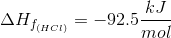
From the question stem, we are told that the breakdown of 2 moles of gaseous 



By definition, the heat of formation of a compound is the enthalpy change that occurs for the formation (




Notice that by reversing the reaction, we are also reversing the sign for the enthalpy of the reaction. Now, to calculate the 



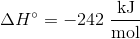
The reaction shown is __________, and heat is __________ by the reaction.
exothermic . . . released
exothermic . . . absorbed
endothermic . . . released
endothermic . . . absorbed
Explanation
Negative enthalpy change(
The 
Consider the following equation:

Use a standard enthalpy of formation table to calculate the 
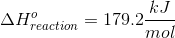
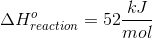
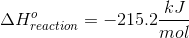
Explanation
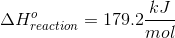
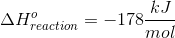
We can calculate the standard change in enthalpy for the reaction using the following equation:



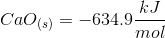
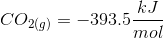
Plug in known values and solve.

A negative 
A positive 
Therefore, this overall reaction is endothermic.
If a reaction is endothermic and occurs spontaneously, which of the following is not true?
K = 0
ΔH > 0
ΔG < 0
ΔS > 0
Explanation
ΔH is always positive for an endothermic reaction, and ΔG is always negative for a spontaneous reaction. Given the equation delta G = ΔH – T(ΔS), T(ΔS) is positive, so ΔS is positive. We do not know anything about the equilibrium of the reaction.
What type of energy conversion occurs during an endothermic reaction?
Kinetic energy to chemical energy
Temperature to chemical energy
Chemical energy to kinetic energy
Kinetic energy to potential energy
Nuclear energy to chemical energy
Explanation
In an endothermic reaction, heat is absorbed and converted into chemical energy. Heat is the sum of molecular kinetic energy in a sample, so kinetic energy is converted into chemical energy. Note that temperature is a measure of heat, and is not a type of energy in itself.
What will happen to the rate of an exothermic reaction if the temperature is increased?
It will increase
It will decrease
It will be unaffected
It depends on the initial concentrations of the reactants
Explanation
The rate of a reaction will always increase with temperature.
Do not confuse the rate at which a reaction proceeds with the final equilibrium of the reaction. Yes, increasing the temperature of an exothermic reaction will push the equilibrium towards the reactant's side, but this equilibrium will be achieved much more quickly at higher temperatures. Kinetics and thermodynamics are two completely different ways to observe a reaction.
Consider the following reversible, exothermic reaction:

The temperature of the vessel in which the reaction is taking place is increased from 300K to 350K. This leads the rate of the reverse reaction to __________.
increase
decrease
stay the same
The change cannot be determined
Explanation
In exothermic and endothermic reactions, heat can be considered to be either a product or reactant, respectively. Increasing the temperature of the an exothermic reaction is effectively the same as adding heat as a product, causing the reaction to shift to the left. This will cause the reverse reaction to increase in rate.