
Kinetics and Energy - AP Chemistry
Card 1 of 754
If the activation energy of a forward reaction is greater than the activation energy of a reverse reaction, what must be true of the reaction?
If the activation energy of a forward reaction is greater than the activation energy of a reverse reaction, what must be true of the reaction?
Tap to reveal answer
If the activation energy of the forward reaction is greater than that of the reverse reaction, the products must have a higher enthalpy than the reactants. The net enthalpy change is therefore positive, meaning that it is endothermic.
If the activation energy of the forward reaction is greater than that of the reverse reaction, the products must have a higher enthalpy than the reactants. The net enthalpy change is therefore positive, meaning that it is endothermic.
← Didn't Know|Knew It →
If the activation energy of the forward reaction is greater than the activatoin energy of the reverse reaction, then this reaction is .
If the activation energy of the forward reaction is greater than the activatoin energy of the reverse reaction, then this reaction is .
Tap to reveal answer
If the activation energy of a forward reaction is greater than that of the reverse reaction, thenthe products must have a higher enthalpy than the reactants (draw a potential energy diagram to visualize).
If the activation energy of a forward reaction is greater than that of the reverse reaction, thenthe products must have a higher enthalpy than the reactants (draw a potential energy diagram to visualize).
← Didn't Know|Knew It →
Which of the following is true regarding activation energy?
I. Activation energy depends on the pressure of the system
II. The reaction rate decreases as the activation energy increases
III. Catalysts increase the activation energy of a reaction
Which of the following is true regarding activation energy?
I. Activation energy depends on the pressure of the system
II. The reaction rate decreases as the activation energy increases
III. Catalysts increase the activation energy of a reaction
Tap to reveal answer
Activation energy is the energy barrier that needs to be overcome for a reaction to proceed; the higher the activation energy, the slower the reaction. Activation energy can only be altered via a catalyst. Catalysts are chemical substances that lower the activation energy, allowing reactions to proceed faster. Other physical quantities such as temperature and pressure don’t alter the activation energy.
Reaction rate is a direct measure of the speed of a reaction. As mentioned, increasing activation energy will increase the barrier and, therefore, slow down the reaction.
Catalysts are chemical substances that decrease the activation energy, thereby increasing the reaction rate. They are commonly used in chemical reactions to drastically speed up reactions that might otherwise take hours or days to complete. Enzymes are biological catalysts that facilitate most of the biological reactions happening in our bodies.
Activation energy is the energy barrier that needs to be overcome for a reaction to proceed; the higher the activation energy, the slower the reaction. Activation energy can only be altered via a catalyst. Catalysts are chemical substances that lower the activation energy, allowing reactions to proceed faster. Other physical quantities such as temperature and pressure don’t alter the activation energy.
Reaction rate is a direct measure of the speed of a reaction. As mentioned, increasing activation energy will increase the barrier and, therefore, slow down the reaction.
Catalysts are chemical substances that decrease the activation energy, thereby increasing the reaction rate. They are commonly used in chemical reactions to drastically speed up reactions that might otherwise take hours or days to complete. Enzymes are biological catalysts that facilitate most of the biological reactions happening in our bodies.
← Didn't Know|Knew It →
the activation energy of a reaction will the amount of products produced.
the activation energy of a reaction will the amount of products produced.
Tap to reveal answer
This question is asking about the relationship between activation energy of a reaction (kinetics) and the amount of products produced (equilibrium). Remember that altering the speed of a reaction (kinetics) does not change the equilibrium of the reaction. Increasing or decreasing activation energy (which alters the speed of reaction) will simply allow for the reaction to proceed slower or faster, respectively. It will not change the amount of products produced at the end.
This question is asking about the relationship between activation energy of a reaction (kinetics) and the amount of products produced (equilibrium). Remember that altering the speed of a reaction (kinetics) does not change the equilibrium of the reaction. Increasing or decreasing activation energy (which alters the speed of reaction) will simply allow for the reaction to proceed slower or faster, respectively. It will not change the amount of products produced at the end.
← Didn't Know|Knew It →
Which of the following is the correct way to calculate the activation energy of a reaction?
Which of the following is the correct way to calculate the activation energy of a reaction?
Tap to reveal answer
Activation energy is the difference between the energy of the transition state and the energy of the reactant. Recall that activation energy is the energy barrier that needs to be overcome by a reaction. The transition state is a higher-energy, intermediary molecule that lies in between the reactants and products. It is created when reactants are in the process of becoming products. Therefore, to get to products, it is necessary to go through this high-energy transition state.
Activation energy is the energy needed to climb this energy “hill” (energy needed to go from reactants to transition state); therefore, the activation energy is the energy of the transition state (top of the energy hill/barrier) minus the energy of the reactant.
Activation energy is the difference between the energy of the transition state and the energy of the reactant. Recall that activation energy is the energy barrier that needs to be overcome by a reaction. The transition state is a higher-energy, intermediary molecule that lies in between the reactants and products. It is created when reactants are in the process of becoming products. Therefore, to get to products, it is necessary to go through this high-energy transition state.
Activation energy is the energy needed to climb this energy “hill” (energy needed to go from reactants to transition state); therefore, the activation energy is the energy of the transition state (top of the energy hill/barrier) minus the energy of the reactant.
← Didn't Know|Knew It →
Consider the following reaction:

The conversion of  to
to  releases
  of energy and has an activation energy of
  .
.
What is the activation energy of the reverse reaction?
Consider the following reaction:
The conversion of
What is the activation energy of the reverse reaction?
Tap to reveal answer
To answer this question, we have to consider an energy diagram for an exothermic reaction. We know the forward reaction is exothermic because the question states that energy is released. We are given the activation energy of the reaction (the energy difference between the activated complex, or transition state, and the reactants) and the energy released (the energy difference between the products and the reactants). In the reverse reaction we will be going from products to reactants as follows:

This means that the activation energy for reverse reaction will be higher (has to climb a higher hill from “products” to “activated complex”). Using the given information we can deduce that the activation energy ( ) of the reverse reaction is the SUM of the activation energy of the forward reaction AND the energy released from the forward reaction.

The closest answer is  . Note that the forward reaction is exothermic, whereas the reverse reaction is endothermic (energy is being consumed). The reverse reaction is endothermic because the reactant (
 ) has lower energy than the product (
 ).
).
To answer this question, we have to consider an energy diagram for an exothermic reaction. We know the forward reaction is exothermic because the question states that energy is released. We are given the activation energy of the reaction (the energy difference between the activated complex, or transition state, and the reactants) and the energy released (the energy difference between the products and the reactants). In the reverse reaction we will be going from products to reactants as follows:
This means that the activation energy for reverse reaction will be higher (has to climb a higher hill from “products” to “activated complex”). Using the given information we can deduce that the activation energy (
The closest answer is
← Didn't Know|Knew It →
Which of the following is true regarding activation energy?
Which of the following is true regarding activation energy?
Tap to reveal answer
Recall that the only thing that can alter the activation energy of a reaction is the addition of a catalyst. Factors such as enthalpy, entropy, temperature, and pressure don’t change the activation energy.
Catalysts decrease the activation energy and increase the rate of reaction. They have no effect on the energy of the reactants. As mentioned, temperature will not alter the activation energy; however, increasing the temperature will speed up the reaction. This occurs because adding energy in the form of heat will increase the energy of individual molecules in the reaction and will allow more molecules to overcome the energy barrier. Note, however, that temperature does not change the energy barrier (activation energy). Recall that changing activation energy has no effect on the equilibrium of the reaction; therefore, equilibrium constant does not depend on the activation energy.
Recall that the only thing that can alter the activation energy of a reaction is the addition of a catalyst. Factors such as enthalpy, entropy, temperature, and pressure don’t change the activation energy.
Catalysts decrease the activation energy and increase the rate of reaction. They have no effect on the energy of the reactants. As mentioned, temperature will not alter the activation energy; however, increasing the temperature will speed up the reaction. This occurs because adding energy in the form of heat will increase the energy of individual molecules in the reaction and will allow more molecules to overcome the energy barrier. Note, however, that temperature does not change the energy barrier (activation energy). Recall that changing activation energy has no effect on the equilibrium of the reaction; therefore, equilibrium constant does not depend on the activation energy.
← Didn't Know|Knew It →
The following diagram shows how the energy changes as the chemical reaction
 progresses.
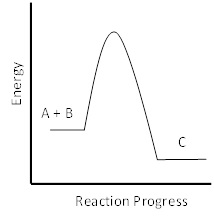
A chemical engineer wants to, both, increase yield and accelerate this reaction rate. He should .
The following diagram shows how the energy changes as the chemical reaction
A chemical engineer wants to, both, increase yield and accelerate this reaction rate. He should .
Tap to reveal answer
"Increase the temperature" is incorrect because we have an exothermic reaction and by increasing the temperature the equilibrium constant will become smaller. An increase in temperature will shift the equilibrium toward reagents. According to the Le Chatelier's principle, by extracting  continuously from the reactor the equilibrium shifts toward the product,
  . Furthermore, the use of a catalyst increases the reaction rate. The Haber process to synthesize ammonia is an example of this kind of reaction.
"Increase the temperature" is incorrect because we have an exothermic reaction and by increasing the temperature the equilibrium constant will become smaller. An increase in temperature will shift the equilibrium toward reagents. According to the Le Chatelier's principle, by extracting
← Didn't Know|Knew It →
Which of the following is not an assumption of the kinetic molecular theory of gases?
Which of the following is not an assumption of the kinetic molecular theory of gases?
Tap to reveal answer
The kinetic molecular theory of gases states that the average kinetic energy of gas particles is proportional to temperature, and it is the same for all gases at a given temperature. This is the opposite of what is stated in the answer choice.
The kinetic molecular theory of gases states that the average kinetic energy of gas particles is proportional to temperature, and it is the same for all gases at a given temperature. This is the opposite of what is stated in the answer choice.
← Didn't Know|Knew It →
Two moles of nitrogen gas are kept in a glass container. The temperature of the gas is 400K.
What is the kinetic energy of the gas?
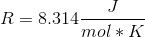
Two moles of nitrogen gas are kept in a glass container. The temperature of the gas is 400K.
What is the kinetic energy of the gas?
Tap to reveal answer
Using the equation 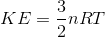 , n being the number of moles, R being 8.314, and T being the temperature in Kelvin, we can find the kinetic energy of two moles of gas in a container.


Using the equation
← Didn't Know|Knew It →
Why does a higher temperature result in a faster reaction?
Why does a higher temperature result in a faster reaction?
Tap to reveal answer
The temperature of a system can be manipulated to increase the reaction rate. The temperature affects the rate of the reaction because as temperature increases, so does the average kinetic energy. This means that molecules (reactants) are moving around more quickly, resulting in more frequent molecular collisions, resulting in an increased rate of product formation.
The temperature of a system can be manipulated to increase the reaction rate. The temperature affects the rate of the reaction because as temperature increases, so does the average kinetic energy. This means that molecules (reactants) are moving around more quickly, resulting in more frequent molecular collisions, resulting in an increased rate of product formation.
← Didn't Know|Knew It →
Which of the following statements in not an assumption made in kinetic molecular theory?
Which of the following statements in not an assumption made in kinetic molecular theory?
Tap to reveal answer
The average kinetic energy is considered to be a sole function of temperature; pressure is not a factor. All of the other statements are assumptions of kinetic molecular theory.
The average kinetic energy is considered to be a sole function of temperature; pressure is not a factor. All of the other statements are assumptions of kinetic molecular theory.
← Didn't Know|Knew It →
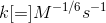
The reaction  obeys the rate law
What are the units of the rate constant,  ?
?
The reaction
What are the units of the rate constant,
Tap to reveal answer
Recall that  and that
  and
and  are both molar concentrations. Then,

Dividing both sides by  gives
gives
Recall that
Dividing both sides by
← Didn't Know|Knew It →
Consider the following first order reaction

Where k is the rate constant.

and the initial concentrations of A and B are


What is the percent conversion after 500 seconds? Round to the nearest percent.
Consider the following first order reaction
Where k is the rate constant.
and the initial concentrations of A and B are
What is the percent conversion after 500 seconds? Round to the nearest percent.
Tap to reveal answer
For a first order reaction,
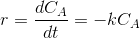

Integrating both sides gives

Where  is an integration constant.
Solving for  gives
gives

Initially  there are 3 mols of
  . Using this we find that


At  ,
,

Percent conversion is calculated as follows:

For a first order reaction,
Integrating both sides gives
Where
Solving for
Initially
At
Percent conversion is calculated as follows:
← Didn't Know|Knew It →
Which of the following is true?
Which of the following is true?
Tap to reveal answer
All of the above describe elementary reactions and how they give an overall mechanism.
All of the above describe elementary reactions and how they give an overall mechanism.
← Didn't Know|Knew It →
A possible mechanism for the overall reaction Br2 (g) + 2 NO (g) -> 2 NOBr(g) is
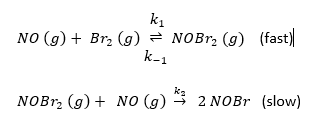
The rate law for the formation of NOBr based on this mechanism is rate = .
A possible mechanism for the overall reaction Br2 (g) + 2 NO (g) -> 2 NOBr(g) is
The rate law for the formation of NOBr based on this mechanism is rate = .
Tap to reveal answer
Based on the slowest step the rate law would be: Rate = k2 \[NOBr2\] \[NO\], but one cannot have a rate law in terms of an intermediate (NOBr2).
Because the first reaction is at equilibrium the rate in the forward direction is equal to that in the reverse, thus:
 and:
and: 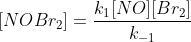
Substitution yields: 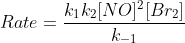
Based on the slowest step the rate law would be: Rate = k2 \[NOBr2\] \[NO\], but one cannot have a rate law in terms of an intermediate (NOBr2).
Because the first reaction is at equilibrium the rate in the forward direction is equal to that in the reverse, thus:
Substitution yields:
← Didn't Know|Knew It →
For the reaction NO2 (g) + CO (g) -> NO (g) + CO2 (g), the reaction was experimentally determined to be Rate = k\[NO2\]2. If the reaction has the following mechanism, what is the rate limiting step, and why?
Step 1: 2 NO2 -> NO3 + NO (slow)
Step 2: NO3 + CO -> NO2 + CO2 (fast)
For the reaction NO2 (g) + CO (g) -> NO (g) + CO2 (g), the reaction was experimentally determined to be Rate = k\[NO2\]2. If the reaction has the following mechanism, what is the rate limiting step, and why?
Step 1: 2 NO2 -> NO3 + NO (slow)
Step 2: NO3 + CO -> NO2 + CO2 (fast)
Tap to reveal answer
The reaction can never go faster than its slowest step.
The reaction can never go faster than its slowest step.
← Didn't Know|Knew It →
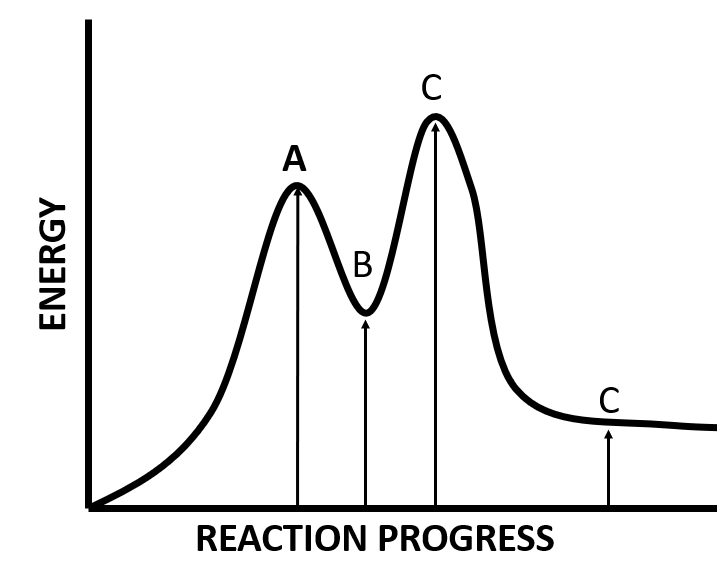
Based on the figure above, what arrows corresponds to the activation energy of the rate limiting step and the energy of reaction? Is the reaction endo- or exothermic?
Based on the figure above, what arrows corresponds to the activation energy of the rate limiting step and the energy of reaction? Is the reaction endo- or exothermic?
Tap to reveal answer
Since the products are higher in energy than the reactions, the reaction is endothermic.
Since the products are higher in energy than the reactions, the reaction is endothermic.
← Didn't Know|Knew It →
Consider the following mechanism:
A + B -> R + C (slow)
A + R -> C (fast)
Consider the following mechanism:
A + B -> R + C (slow)
A + R -> C (fast)
Tap to reveal answer
R is the intermediate. It is formed in Step 1 and consumed in Step 2.
R is the intermediate. It is formed in Step 1 and consumed in Step 2.
← Didn't Know|Knew It →
Chaning which of the following factors can alter the rate of a zero-order reaction?
Chaning which of the following factors can alter the rate of a zero-order reaction?
Tap to reveal answer
A zero-order reaction has a rate of formation of product that is independent of changes in concentrations of any of the reactants; however, since the rate constant itself is dependent on temperture, changing the temperature can alter the rate.
A zero-order reaction has a rate of formation of product that is independent of changes in concentrations of any of the reactants; however, since the rate constant itself is dependent on temperture, changing the temperature can alter the rate.
← Didn't Know|Knew It →