
Thermochemistry and Kinetics - AP Chemistry
Card 1 of 2017

Suppose that 1.5 moles of potassium reacts completely with an excess of chlorine gas. What is the enthalpy change of the reaction?

Suppose that 1.5 moles of potassium reacts completely with an excess of chlorine gas. What is the enthalpy change of the reaction?
Tap to reveal answer
First, note that heat is a product of the reaction. This means that the reaction releases heat and is exothermic, so the enthalpy change must be negative. Next, consider that 2 moles of sodium would react to produce 640 kJ. Thus, 1.5 moles of sodium would react to produce
 .
.
Hence, the enthalpy change is  .
.
First, note that heat is a product of the reaction. This means that the reaction releases heat and is exothermic, so the enthalpy change must be negative. Next, consider that 2 moles of sodium would react to produce 640 kJ. Thus, 1.5 moles of sodium would react to produce

Hence, the enthalpy change is 
← Didn't Know|Knew It →
The second law of thermodynamics states which of the following is true regarding an isolated system?
The second law of thermodynamics states which of the following is true regarding an isolated system?
Tap to reveal answer
The entropy cannot decrease in an isolated system because the energy can only be degraded. Since the system is isolated, no higher-grade energy—or any energy at all—is being introduced into the system. As a result, the entropy cannot decrease. The other answer choices relate to the other laws of thermodynamics.
The entropy cannot decrease in an isolated system because the energy can only be degraded. Since the system is isolated, no higher-grade energy—or any energy at all—is being introduced into the system. As a result, the entropy cannot decrease. The other answer choices relate to the other laws of thermodynamics.
← Didn't Know|Knew It →
Which of the following statements is true of standard states?
Which of the following statements is true of standard states?
Tap to reveal answer
Standard states are defined as a specific set of conditions, such as when a gas is at  ,
,  concentration, and
  .
.
Standard enthalpy of formation, the energy required for form 1 mole of a compound from its constituent elements, occurs when elements are in their standard states.
Standard states are defined as a specific set of conditions, such as when a gas is at
Standard enthalpy of formation, the energy required for form 1 mole of a compound from its constituent elements, occurs when elements are in their standard states.
← Didn't Know|Knew It →
How much heat is required to raise the temperature of  of water from
  to
to  ? (Specific heat capacity of water is
  )
)
How much heat is required to raise the temperature of
Tap to reveal answer

 is positive because heat flows into the system to raise the temperature of the water.
← Didn't Know|Knew It →
How much heat is required to raise the temperature of  of water from
  to
to  ? Specific heat capacity of water is
How much heat is required to raise the temperature of
Tap to reveal answer

← Didn't Know|Knew It →
Calculating heat
How much heat is absorbed by a copper penny as it warms from  to
to  assuming the penny is pure copper with a mass of
  ?
?  of copper is
  .
.
Calculating heat
How much heat is absorbed by a copper penny as it warms from
Tap to reveal answer
Use the equation that relates heat, mass, specific heat, and change in temperature:



Use the equation that relates heat, mass, specific heat, and change in temperature:
← Didn't Know|Knew It →
"In a natural thermodynamic process, the sum of the entropies of the interacting systems increases." Which law of thermodynamics does this statement refer to?
"In a natural thermodynamic process, the sum of the entropies of the interacting systems increases." Which law of thermodynamics does this statement refer to?
Tap to reveal answer
There are four main laws of thermodynamics, which describe how temperature, energy, and entropy behave under various circumstances. The zeroth law of thermodynamics helps to define temperature; it states that if two systems are each in thermal equilibrium with a third system, they must be in thermal equilibrium with each other. The first law of thermodynamics negates the possibility of perpetual motion; it states that when energy passes into or out of a system, the system's internal energy changes in accord with the law of conservation of energy. The second law of thermodynamics also negates the possibility of perpetual motion; it states that in a natural thermodynamic process, the sum of the entropies of the interacting systems increases. Lastly, the third law of thermodynamics states that the entropy of a system approaches a constant value as the temperature nears absolute zero.
There are four main laws of thermodynamics, which describe how temperature, energy, and entropy behave under various circumstances. The zeroth law of thermodynamics helps to define temperature; it states that if two systems are each in thermal equilibrium with a third system, they must be in thermal equilibrium with each other. The first law of thermodynamics negates the possibility of perpetual motion; it states that when energy passes into or out of a system, the system's internal energy changes in accord with the law of conservation of energy. The second law of thermodynamics also negates the possibility of perpetual motion; it states that in a natural thermodynamic process, the sum of the entropies of the interacting systems increases. Lastly, the third law of thermodynamics states that the entropy of a system approaches a constant value as the temperature nears absolute zero.
← Didn't Know|Knew It →
Which of the following is true of catalysts?
Which of the following is true of catalysts?
Tap to reveal answer
Catalysts are substances that increase reaction rates without being consumed in the reaction. They decrease the activation energy needed, and they do not always need to be in the same phase as the reactants. In heterogeneous catalysis, the catalyst is in a different phase than the reactants. Equilibrium concentrations of both reactants and products are unchanged by the addition of a catalyst.
Catalysts are substances that increase reaction rates without being consumed in the reaction. They decrease the activation energy needed, and they do not always need to be in the same phase as the reactants. In heterogeneous catalysis, the catalyst is in a different phase than the reactants. Equilibrium concentrations of both reactants and products are unchanged by the addition of a catalyst.
← Didn't Know|Knew It →
Which of the following is not true of catalysts?
Which of the following is not true of catalysts?
Tap to reveal answer
All of the choices are true, except that catalysts can be in distinct phases than the reactants. These are known as heterogenous catalysts.
All of the choices are true, except that catalysts can be in distinct phases than the reactants. These are known as heterogenous catalysts.
← Didn't Know|Knew It →
How does adding a catalyst affect a reaction?
How does adding a catalyst affect a reaction?
Tap to reveal answer
A catalyst is a substance that increases the rate of a reaction, typically by lowering the activation energy required to initiate a reaction. The catalyst does not affect the equilibrium of a reaction, and is not consumed during the reaction.
A catalyst is a substance that increases the rate of a reaction, typically by lowering the activation energy required to initiate a reaction. The catalyst does not affect the equilibrium of a reaction, and is not consumed during the reaction.
← Didn't Know|Knew It →
A catalyst increases the rate of a reaction by which of the following mechanisms?
A catalyst increases the rate of a reaction by which of the following mechanisms?
Tap to reveal answer
A catalyst has no effect on the relative stability of the reactants or products, nor does it effect the temperature of a reaction.
Instead, catalysts lower the energy of transition states, increasing their stability, to lower the overall activation energy of the reaction. When the reaction requires less energy, it proceeds at a faster rate.
A catalyst has no effect on the relative stability of the reactants or products, nor does it effect the temperature of a reaction.
Instead, catalysts lower the energy of transition states, increasing their stability, to lower the overall activation energy of the reaction. When the reaction requires less energy, it proceeds at a faster rate.
← Didn't Know|Knew It →
Name the catalyst in each reaction.
I. 
II. 
Name the catalyst in each reaction.
I.
II.
Tap to reveal answer
A catalyst will not be consumed during a reaction, so the catalyst will be whichever chemical is found both on the reactant side of the equation and on the product side.


For equation 1 that is compound Z; for equation 2 that is compound A.
A catalyst will not be consumed during a reaction, so the catalyst will be whichever chemical is found both on the reactant side of the equation and on the product side.
For equation 1 that is compound Z; for equation 2 that is compound A.
← Didn't Know|Knew It →
What is the function of a catalyst in a chemical reaction?
What is the function of a catalyst in a chemical reaction?
Tap to reveal answer
Catalysts increase the reaction rate without being consumed during the reaction. They don't cause the reaction to make more product, but since the catalyst won't be used up in the reaction.
Catalysts increase the reaction rate without being consumed during the reaction. They don't cause the reaction to make more product, but since the catalyst won't be used up in the reaction.
← Didn't Know|Knew It →
Enzymes are very physiologically and industrially important molecules. From cheese-making to the metabolism of toxins, we need enzymes for life and society as we know it.
Which of the following is not true of enzymes?
Enzymes are very physiologically and industrially important molecules. From cheese-making to the metabolism of toxins, we need enzymes for life and society as we know it.
Which of the following is not true of enzymes?
Tap to reveal answer
Enzymes function by forming complexes with their substrates at active sites. This interaction is often thought of as a lock and key mechanism, in the sense that the active site is shaped to fit a substrate.
Enzymes are biological catalysts and therefore they work to lower the energy barrier or activation energy that prevents a reaction from proceeding to equilibrium. In other words: enzymes and catalysts in general make a reaction reach equilibrium faster.
Therefore enzymes do not change the equilibrium product concentration, just the time it takes to get to equilibrium.
Enzymes function by forming complexes with their substrates at active sites. This interaction is often thought of as a lock and key mechanism, in the sense that the active site is shaped to fit a substrate.
Enzymes are biological catalysts and therefore they work to lower the energy barrier or activation energy that prevents a reaction from proceeding to equilibrium. In other words: enzymes and catalysts in general make a reaction reach equilibrium faster.
Therefore enzymes do not change the equilibrium product concentration, just the time it takes to get to equilibrium.
← Didn't Know|Knew It →
Which of the following statements regarding catalysts is true?
Which of the following statements regarding catalysts is true?
Tap to reveal answer

Note that when catalyst decreases the activation energy (Ea),  will not be affected. The step in a reaction with the largest activation energy usually is the slow step, which catalysts facilitate. Catalysts do not affect the thermodynamic quantities
  . Since catalysts are not consumed in the reaction, they do not appear in the net equation of the reaction.
Note that when catalyst decreases the activation energy (Ea),
← Didn't Know|Knew It →
The rate constant for a second-order reaction is 0.15 M-1s-1. If the initial concentration of the reactant is 0.30 M, how long does it take for the concentration to decrease to 0.15 M?
The rate constant for a second-order reaction is 0.15 M-1s-1. If the initial concentration of the reactant is 0.30 M, how long does it take for the concentration to decrease to 0.15 M?
Tap to reveal answer


← Didn't Know|Knew It →
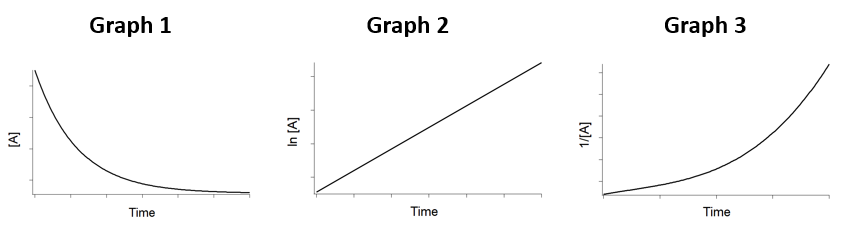
Based on the figure above, what is the order of reaction?
Based on the figure above, what is the order of reaction?
Tap to reveal answer
For a first order reaction, the ln \[A\]t is linear with t.
For a first order reaction, the ln \[A\]t is linear with t.
← Didn't Know|Knew It →
A compound decomposes by a first-order process. If 25.0% of the compound decomposes in 60 minutes, the half-life of the compound is?
A compound decomposes by a first-order process. If 25.0% of the compound decomposes in 60 minutes, the half-life of the compound is?
Tap to reveal answer


← Didn't Know|Knew It →
Cyclopentane is unstable and decomposes by a first order reaction. The rate constant for this reaction is 9.5 s-1. What is the half life of the reaction?
Cyclopentane is unstable and decomposes by a first order reaction. The rate constant for this reaction is 9.5 s-1. What is the half life of the reaction?
Tap to reveal answer

← Didn't Know|Knew It →
The half life of a first order reaction is 1.5 hours. What is the rate constant of this reaction?
The half life of a first order reaction is 1.5 hours. What is the rate constant of this reaction?
Tap to reveal answer


← Didn't Know|Knew It →