
Solutions and States of Matter - AP Chemistry
Card 1 of 2320
Which of the following aqueous solutions is the most concentrated?
Which of the following aqueous solutions is the most concentrated?
Tap to reveal answer
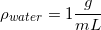
In order to answer this question, it helps to know that 1 kilogram of water is equal to 1 liter of water, due to its density. Two of the above options refer to a 1m solution of hydrochloric acid. The other is a 1M solution.
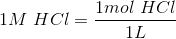


All three of the options have the same amount of hydrochloric acid (one mole). For molarity, the hydrochloric acid is diluted with water until one liter of solution is created. For molality, one mole of HCl is added to one kilogram of water. Since one kilogram of water is one liter, this becomes the same concentration.
One a very small level, the 1M HCl solution will be slightly more concentrated. Creating a molal solution does not take into account the volume of the solute. If, for example, 100 cubic centimeters of HCl were added to one kilogram of water, the resulting volume would be more than one liter, making the concentration slightly less than 1M. This discrepancy is usually not accounted for in basic chemistry, but you should be familiar with the concept.
In order to answer this question, it helps to know that 1 kilogram of water is equal to 1 liter of water, due to its density. Two of the above options refer to a 1m solution of hydrochloric acid. The other is a 1M solution.
All three of the options have the same amount of hydrochloric acid (one mole). For molarity, the hydrochloric acid is diluted with water until one liter of solution is created. For molality, one mole of HCl is added to one kilogram of water. Since one kilogram of water is one liter, this becomes the same concentration.
One a very small level, the 1M HCl solution will be slightly more concentrated. Creating a molal solution does not take into account the volume of the solute. If, for example, 100 cubic centimeters of HCl were added to one kilogram of water, the resulting volume would be more than one liter, making the concentration slightly less than 1M. This discrepancy is usually not accounted for in basic chemistry, but you should be familiar with the concept.
← Didn't Know|Knew It →
A chemist wants to turn a 50.0mL solution of  into a
  solution. How much water should she add?
A chemist wants to turn a 50.0mL solution of
Tap to reveal answer
To solve this problem, we may use the following equation relating the molarity and volume of two solutions:

Recall:

Plug in known values and solve.


However, this is not the final answer. The whole volume of the second, 0.4M solution is 85mL. Thus the chemist needs to add 25mL of water to the original solution to obtain the desired concentration.
To solve this problem, we may use the following equation relating the molarity and volume of two solutions:
Recall:
Plug in known values and solve.
However, this is not the final answer. The whole volume of the second, 0.4M solution is 85mL. Thus the chemist needs to add 25mL of water to the original solution to obtain the desired concentration.
← Didn't Know|Knew It →
In order to dilute a 1mL solution that is 0.01M so that the solution is diluted to  , how many milliliters does this solution need to be diluted to?
In order to dilute a 1mL solution that is 0.01M so that the solution is diluted to
Tap to reveal answer
Use the dilution formula:

Rearranging this equation gives:

Plugging in the values gives:

Use the dilution formula:
Rearranging this equation gives:
Plugging in the values gives:
← Didn't Know|Knew It →
What concentration would you have prepared if you diluted 30mL of a 0.350M salt solution to 50mL?
What concentration would you have prepared if you diluted 30mL of a 0.350M salt solution to 50mL?
Tap to reveal answer
Use the dilution formula:

Rearranging this equation gives:

Plugging in the values gives:

Therefore, after diluting the solution to 50mL, the solution concentration would be lowered from 0.35M to 0.21M.
Use the dilution formula:
Rearranging this equation gives:
Plugging in the values gives:
Therefore, after diluting the solution to 50mL, the solution concentration would be lowered from 0.35M to 0.21M.
← Didn't Know|Knew It →
How many moles are in a 0.010L solution with a concentration that is  ?
?
How many moles are in a 0.010L solution with a concentration that is
Tap to reveal answer
By using the concentration as a conversion factor, the number of moles can calculated by multiplying the concentration by the number of liters.

Therefore, there are  in
in  of a
of a  solution.
By using the concentration as a conversion factor, the number of moles can calculated by multiplying the concentration by the number of liters.
Therefore, there are
← Didn't Know|Knew It →
In order to prepare a needed solution for an experiment, 0.082 grams of  was dissolved in water to give a 35mL solution. What is the molarity of this solution?
In order to prepare a needed solution for an experiment, 0.082 grams of
Tap to reveal answer
In order to calculate the concentration, we must use molarity formula:

We must use the molecular weight of sodium chloride to calculate the moles of solute:


Therefore, the concentration in molarity of this solution is 0.040M.
In order to calculate the concentration, we must use molarity formula:
We must use the molecular weight of sodium chloride to calculate the moles of solute:
Therefore, the concentration in molarity of this solution is 0.040M.
← Didn't Know|Knew It →
How many moles are in 1000mL solution with a concentration that is  ?
?
How many moles are in 1000mL solution with a concentration that is
Tap to reveal answer
By simply using the concentration as a conversion factor, the number of moles can be calculated by multiplying the concentration by the number of liters. Before calculating the number of moles, the number of milliliters must be converted to liters using the fact that  .
.

Therefore, there are  in
in  of a
of a  solution.
By simply using the concentration as a conversion factor, the number of moles can be calculated by multiplying the concentration by the number of liters. Before calculating the number of moles, the number of milliliters must be converted to liters using the fact that
Therefore, there are
← Didn't Know|Knew It →
A solution on NaCl has a denisty of 1.075 g/mL. If there are 0.475 L of solution present, what is the mass?
A solution on NaCl has a denisty of 1.075 g/mL. If there are 0.475 L of solution present, what is the mass?
Tap to reveal answer
1.075 g / mL * 0.475 L
First, convert to mL
1.075 g / mL * 475 mL = 510.6 g
1.075 g / mL * 0.475 L
First, convert to mL
1.075 g / mL * 475 mL = 510.6 g
← Didn't Know|Knew It →
5L of 0.1M NaCl and 10L of 0.2M NaI are combined in a single vessel.
What is the final concentration of sodium ions in solution?
5L of 0.1M NaCl and 10L of 0.2M NaI are combined in a single vessel.
What is the final concentration of sodium ions in solution?
Tap to reveal answer
NaCl and NaI are both highly soluble; thus both solutions can be treated as containing separate ions of sodium, chloride, and iodide.The final concentration can be found by finding the total number of moles of sodium ions and the total volume from both solutions.

We can find the moles of sodium ions from each solution by multiplying the volume by the molar concentration.


The total moles of sodium ions is:

Divide this by the total solution volume to find the final concentration:

NaCl and NaI are both highly soluble; thus both solutions can be treated as containing separate ions of sodium, chloride, and iodide.The final concentration can be found by finding the total number of moles of sodium ions and the total volume from both solutions.
We can find the moles of sodium ions from each solution by multiplying the volume by the molar concentration.
The total moles of sodium ions is:
Divide this by the total solution volume to find the final concentration:
← Didn't Know|Knew It →
Given that the pKa of acetic acid is 4.76, what is the percentage of the protonated form of acetic acid in a solution where the pH is 6?
Given that the pKa of acetic acid is 4.76, what is the percentage of the protonated form of acetic acid in a solution where the pH is 6?
Tap to reveal answer
In order to solve this problem, we first must use the Henderson-Hasselbalch equation:

Since we are given the pH of the solution and the pKa of acetic acid, we are able to solve for the ratio of conjugate base to acid:


Now that we have the ratio of conjugate base to acid, we need to calculate the percentage of the acid, or protonated form, in solution. To do this, it's important to realize that for every 17.38 moles of conjugate base, there is 1 mol of acid. Therefore, the total amount of acetic acid + acetate is equal to 18.38.


In order to solve this problem, we first must use the Henderson-Hasselbalch equation:
Since we are given the pH of the solution and the pKa of acetic acid, we are able to solve for the ratio of conjugate base to acid:
Now that we have the ratio of conjugate base to acid, we need to calculate the percentage of the acid, or protonated form, in solution. To do this, it's important to realize that for every 17.38 moles of conjugate base, there is 1 mol of acid. Therefore, the total amount of acetic acid + acetate is equal to 18.38.
← Didn't Know|Knew It →
Suppose that two containers,  and
and  , contain equal amounts of water. If 5 moles of
  is added to solution
  and 5 moles of glucose is added to solution
  , which solution will experience a greater increase in boiling point?
Suppose that two containers,
Tap to reveal answer
In the question stem, we are told that equal molar amounts of  and glucose are added to containers
  and
and  , respectively. The change in boiling point of water is a colligative property that is dependent on the number of dissolved solute particles, regardless of their identity. The addition of 5 moles of
  will result in approximately 10 moles of dissolved solute, since each mol of
  can dissociate into two ions, according to the following reaction:

Glucose, on the other hand, does not dissociate and simply remains as intact molecules. Thus, the addition of 5 moles of glucose to container  results in 5 moles of dissolved solute. Since solution
  contains approximately twice as many dissolved solute particles as does solution
  , it will experience a greater increase in the boiling point of water.
In the question stem, we are told that equal molar amounts of
Glucose, on the other hand, does not dissociate and simply remains as intact molecules. Thus, the addition of 5 moles of glucose to container
← Didn't Know|Knew It →
Approximately what is the pH of a  solution of
  at
at  ?
?
Approximately what is the pH of a
Tap to reveal answer
We are given the concentration of  in solution and asked to find the pH. To do this, we must make use of the following equation:

It is also important to realize that  is a strong base and will thus dissociate completey according to the following reaction:

Thus, for every one mol of  that reacts, an equal number of moles of
  will be produced. And since there are
 to begin with, then
 will be produced.

Remember that this calculated value so far is the pOH, not the pH! To calculate the pH, it is vital to remember that  at
at  . Thus,

We are given the concentration of
It is also important to realize that
Thus, for every one mol of
Remember that this calculated value so far is the pOH, not the pH! To calculate the pH, it is vital to remember that
← Didn't Know|Knew It →
What is the pH of a 0.025M solution of hydrochloric acid ( )?
)?
What is the pH of a 0.025M solution of hydrochloric acid (
Tap to reveal answer
Since  is a strong acid, calculations should be carried out assuming that the compound dissociates completely:

 and
and  are produced in a 1:1 ratio to total dissolved
  , so the concentration of
  in solution is the same as the concentration of
  :
:

pH is related to the concentration of  :
:


Since
pH is related to the concentration of
← Didn't Know|Knew It →
What volume of water must be added to 750mL of 0.050M sodium chloride ( ) in order to achieve a final concentration of 0.015M?
What volume of water must be added to 750mL of 0.050M sodium chloride (
Tap to reveal answer
For a solution of known volume and concentration (molarity in this case), the volume needed to dilute the solution to a desired concentration may be found using the formula:

Where  and
and  are the initial and final concentrations, and
  and
and  are the initial and final volumes. So, for 750mL (0.750L) of a 0.050M solution diluted to 0.015M:

Solving for  :
:

Now that we know the total volume needed, we may find the volume that must be added by subtracting the initial volume ( ) from the final volume (
 ):
):

1.75L of water must be added to 750mL of 0.050M  in order to achieve a final concentration of 0.015M
For a solution of known volume and concentration (molarity in this case), the volume needed to dilute the solution to a desired concentration may be found using the formula:
Where
Solving for
Now that we know the total volume needed, we may find the volume that must be added by subtracting the initial volume (
1.75L of water must be added to 750mL of 0.050M
← Didn't Know|Knew It →
What is the osmotic pressure of a 5.0M solution of  at
at  ?
?
What is the osmotic pressure of a 5.0M solution of
Tap to reveal answer
Osmotic pressure is represented by:

Where  Van’t hoff factor,
  ,
,  gas constant
  ,
,  temperature in
  . The Van’t hoff factor is a unitless number that represents the amount of ionic species that the compound
  will dissociate in solution.
  is part of a large group of molecules classified as hydrocarbons which normally do not dissociate at all in solution. Therefore,
  .
.
Plug in known values and solve.


Osmotic pressure is represented by:
Where
Plug in known values and solve.
← Didn't Know|Knew It →
A solution was prepared by dissolving 22.0 grams of  in water to give a 110mL solution. What is the concentration in molarity of this solution?
A solution was prepared by dissolving 22.0 grams of
Tap to reveal answer
In order to calculate the concentration, we must use molarity formula:

We must use the molecular weight of  to calculate the moles of solute:


In order to calculate the concentration, we must use molarity formula:
We must use the molecular weight of
← Didn't Know|Knew It →
A solution was prepared by dissolving 40.0 grams of  in water to give a 50mL solution. What is the concentration in molarity of this solution?
A solution was prepared by dissolving 40.0 grams of
Tap to reveal answer
In order to calculate the concentration, we must use molarity formula:

We must use the molecular weight of to calculate the moles of solute:


In order to calculate the concentration, we must use molarity formula:
We must use the molecular weight of
← Didn't Know|Knew It →
How many milliliters of solution is needed to dissolve 5 grams of  to prepare a solution of concentration 10M?
How many milliliters of solution is needed to dissolve 5 grams of
Tap to reveal answer
In order to calculate the number of milliliters, we must first determine the number of moles in 5 grams of  using its molecular weight as a conversion factor:


Using the concentration units as a conversion factor and the number of moles calculated, the number of milliliters can be calculated:

In order to calculate the number of milliliters, we must first determine the number of moles in 5 grams of
Using the concentration units as a conversion factor and the number of moles calculated, the number of milliliters can be calculated:
← Didn't Know|Knew It →
A solution was prepared by diluting 10mL of a 0.500M salt solution to 20mL. What would be the final concentration of this solution?
A solution was prepared by diluting 10mL of a 0.500M salt solution to 20mL. What would be the final concentration of this solution?
Tap to reveal answer
Use the dilution formula:
Rearranging this equation gives:
Plugging in the values gives:

Therefore, after diluting the solution to 20mL, the solution concentration would be lowered from 0.50M to 0.25M.
Use the dilution formula:
Rearranging this equation gives:
Plugging in the values gives:
Therefore, after diluting the solution to 20mL, the solution concentration would be lowered from 0.50M to 0.25M.
← Didn't Know|Knew It →
Which of the following is a weak electrolyte?
Which of the following is a weak electrolyte?
Tap to reveal answer
Solutes that dissociate completely in a solution are called strong electrolytes. Weak electrolytes stay paired to some extent in solutions. As a result, strong electrolytes include ionic compounds and strong acid and bases.
Solutes that dissociate completely in a solution are called strong electrolytes. Weak electrolytes stay paired to some extent in solutions. As a result, strong electrolytes include ionic compounds and strong acid and bases.
← Didn't Know|Knew It →