
Reactions and Equilibrium - AP Chemistry
Card 1 of 2660

What is an expression for the equilibrium constant for the above equation?
What is an expression for the equilibrium constant for the above equation?
Tap to reveal answer
The formula for the equilibrium constant is the product of the concentration of the products divided by the product of the concentration of the reactants. Since none of the reactants or products have coefficients, no exponents are needed in the expression. The phases do not affect the equilibrium constant in this example.
The formula for the equilibrium constant is the product of the concentration of the products divided by the product of the concentration of the reactants. Since none of the reactants or products have coefficients, no exponents are needed in the expression. The phases do not affect the equilibrium constant in this example.
← Didn't Know|Knew It →
A scientist makes a solution by adding 0.2 grams of  to enough water so that the resulting solution has a volume of 10 liters. What, approximately, is the pH of this solution?
A scientist makes a solution by adding 0.2 grams of
Tap to reveal answer
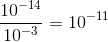
 has a molar mass of approximately 40 g/mol, meaning that there is 0.01 mol of it in the solution. Sodium hydroxide is a strong base and completely dissociates in water. Its concentration in the solution is
 . This means that the concentration of
  ions is
  and
and  . Thus, the pH of the solution is 11.
← Didn't Know|Knew It →
What is the oxidation number of nitrogen in  ?
?
What is the oxidation number of nitrogen in
Tap to reveal answer
First, note that the molecule does not have a charge, meaning that the oxidation numbers of each atom must add up to zero. Hydrogen has an oxidation number of  and oxygen has an oxidation number of
  . Thus, if we call the oxidation number of nitrogen
  , we can get the equation
  . Solving this gives
  , so the oxidation number of nitrogen is
  in this molecule.
First, note that the molecule does not have a charge, meaning that the oxidation numbers of each atom must add up to zero. Hydrogen has an oxidation number of 


← Didn't Know|Knew It →
The following is a modified true/false question. In it, you must decide if each individual statement is true (T) or false (F). If both are true, then you must also decide if the second statement is a correct explanation (CE) of the first statement.
I: An  ion would undergo reduction to form
  metal
metal
BECAUSE
II: reduction is a loss of electrons
The following is a modified true/false question. In it, you must decide if each individual statement is true (T) or false (F). If both are true, then you must also decide if the second statement is a correct explanation (CE) of the first statement.
I: An 

BECAUSE
II: reduction is a loss of electrons
Tap to reveal answer
Statement II is false: reduction is a gain of electrons. Looking at statement I, the ion's charge would decrease by 3 in becoming a metal, which suggests that the ion gains 3 electrons. Thus, it is undergoing reduction.
Statement II is false: reduction is a gain of electrons. Looking at statement I, the ion's charge would decrease by 3 in becoming a metal, which suggests that the ion gains 3 electrons. Thus, it is undergoing reduction.
← Didn't Know|Knew It →
What is the coefficient on sulfur dioxide if the following redox reaction is balanced in an acidic solution?

What is the coefficient on sulfur dioxide if the following redox reaction is balanced in an acidic solution?
Tap to reveal answer
Balancing redox reactions involves the following steps:
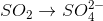
1. Divide the reaction into oxidation and reduction half reactions and balance all atoms that are not oxygen and hydrogen:

2. Balance the oxygens by adding water molecules on the opposite side of the reactions:


3. Balance the hydrogens by adding protons to the opposite side of the equation:


4. Add electrons in order to equal the charges on both sides of the equation:


5. In order to make the electron exchange equal in each half step, we must multiply the top half reaction by 3:


6. Add up the reactants and products while cancelling out substances on opposite sides of the reactions. For example: we will cancel the 6 water molecules as reactants and be left with only one water molecule as a product. In addition, only 2 protons will be left on the reactant's side after canceling the 12 from the product's side.

In the balanced redox reaction, the coefficient on sulfur dioxide is 3.
Balancing redox reactions involves the following steps:
1. Divide the reaction into oxidation and reduction half reactions and balance all atoms that are not oxygen and hydrogen:
2. Balance the oxygens by adding water molecules on the opposite side of the reactions:
3. Balance the hydrogens by adding protons to the opposite side of the equation:
4. Add electrons in order to equal the charges on both sides of the equation:
5. In order to make the electron exchange equal in each half step, we must multiply the top half reaction by 3:
6. Add up the reactants and products while cancelling out substances on opposite sides of the reactions. For example: we will cancel the 6 water molecules as reactants and be left with only one water molecule as a product. In addition, only 2 protons will be left on the reactant's side after canceling the 12 from the product's side.
In the balanced redox reaction, the coefficient on sulfur dioxide is 3.
← Didn't Know|Knew It →
For the following unbalanced redox reaction, how many electrons are transferred and which chemical species is being oxidized?

For the following unbalanced redox reaction, how many electrons are transferred and which chemical species is being oxidized?
Tap to reveal answer
To begin, we will need to separate the given reaction into the two half-reactions by identifying changes in oxidation number. In this case, mercury (Hg) and phosphorus (P) show a change in oxidation number. Mercury begins with an oxidation number of zero, and ends with an oxidation number of  . Phosphorus begins with an oxidation number of
  and ends with an oxidation number of
  . Note that the oxidation numbers for fluorine and iodine reamain constant at
  for each.
Now we can begin to look at the half-reactions.


Balance the atoms.


Now balance the electrons. We know that each mercury atom loses one electron and each fluorine atom gains one electron.


We can see that two electrons are tranferred. To identify the element being oxidized, we must find the element that is losing electrons. In this case, mercury is being oxidized.
To begin, we will need to separate the given reaction into the two half-reactions by identifying changes in oxidation number. In this case, mercury (Hg) and phosphorus (P) show a change in oxidation number. Mercury begins with an oxidation number of zero, and ends with an oxidation number of
Now we can begin to look at the half-reactions.
Balance the atoms.
Now balance the electrons. We know that each mercury atom loses one electron and each fluorine atom gains one electron.
We can see that two electrons are tranferred. To identify the element being oxidized, we must find the element that is losing electrons. In this case, mercury is being oxidized.
← Didn't Know|Knew It →
Oxidation is the of electrons, reduction is the of electrons.
Oxidation is the of electrons, reduction is the of electrons.
Tap to reveal answer
An oxidation-reduction (redox) reaction is a reaction where electrons are transferred between two substances. When an atom is oxidized, it is called the reducing agent, and it loses a number of electrons. Similarly, a reduced atom is called the oxidizing agent, and gains the same number of electrons. A popular mnemonic to help remember is OIL RIG, or Oxidation is Loss of electrons, Reduction is Gain of electrons.
An oxidation-reduction (redox) reaction is a reaction where electrons are transferred between two substances. When an atom is oxidized, it is called the reducing agent, and it loses a number of electrons. Similarly, a reduced atom is called the oxidizing agent, and gains the same number of electrons. A popular mnemonic to help remember is OIL RIG, or Oxidation is Loss of electrons, Reduction is Gain of electrons.
← Didn't Know|Knew It →
Determine the pH of an aqueous solution of 0.01 M acetic acid,  . The pKa of acetic acid is 4.75.
Determine the pH of an aqueous solution of 0.01 M acetic acid,
Tap to reveal answer
Since acetic acid is a weak acid, it has a Ka that is rather small, we have to do a RICE table to determine the equilibrium amount of hydronium, H3O+ to then determine the pH.
R 
I 0.1 M - 0 0
C -x +x +x
E 0.1 -x x x
So first we need to change our pKa to a Ka
where  therefore

 =
= 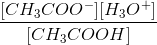 =
= 
If we assume that x is very small compared to 0.1...
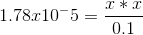
Where 
(note: when solving using the quadratic we come up with the same answer)
So if 

Since acetic acid is a weak acid, it has a Ka that is rather small, we have to do a RICE table to determine the equilibrium amount of hydronium, H3O+ to then determine the pH.
R
I 0.1 M - 0 0
C -x +x +x
E 0.1 -x x x
So first we need to change our pKa to a Ka
where
If we assume that x is very small compared to 0.1...
Where
(note: when solving using the quadratic we come up with the same answer)
So if
← Didn't Know|Knew It →
Which combination(s) would create a buffer solution?
I. Weak acid
II. Weak acid's conjugate base
III. Strong acid
IV. Strong base
V. Weak base
VI. Weak base's conjugate acid
Which combination(s) would create a buffer solution?
I. Weak acid
II. Weak acid's conjugate base
III. Strong acid
IV. Strong base
V. Weak base
VI. Weak base's conjugate acid
Tap to reveal answer
A buffer solution is formed from the equilibrium of a weak acid and its conjugate base, or from a weak base and its conjugate acid. It's ability to "buffer" the pH or keep it from changing in large amounts in from the switching between these two forms weak and its conjugate.
A buffer solution is formed from the equilibrium of a weak acid and its conjugate base, or from a weak base and its conjugate acid. It's ability to "buffer" the pH or keep it from changing in large amounts in from the switching between these two forms weak and its conjugate.
← Didn't Know|Knew It →
You are in chemistry lab performing a titration. You were given 15 mL of an aqueous solution with an unknown concentration of acetic acid,  to solve through titration with concentrated sodium hydroxide,
  . You know that the pKa of acetic acid is 4.75 and that your titrant is 0.1 M sodium hydroxide,
  .
.
The endpoint was determined at 10 mL of sodium hydroxide,  . What is the pH after 5 mL of
  was added?
You are in chemistry lab performing a titration. You were given 15 mL of an aqueous solution with an unknown concentration of acetic acid,
The endpoint was determined at 10 mL of sodium hydroxide,
Tap to reveal answer
At the half end point, the  . This can be determined by the Henderson-Hasselbalch equation if it is not clear.
Since the endpoint of the titration is that there are 10 mL of 0.1 M NaOH added, that means that there are 0.001 moles of acetic acid.
When 5 mL of NaOH is added, there are 0.0005 moles of acetic acid and 0.0005 moles of acetate formed.


Therefore pH= pKa
At the half end point, the
Since the endpoint of the titration is that there are 10 mL of 0.1 M NaOH added, that means that there are 0.001 moles of acetic acid.
When 5 mL of NaOH is added, there are 0.0005 moles of acetic acid and 0.0005 moles of acetate formed.
Therefore pH= pKa
← Didn't Know|Knew It →
Determine which of these solution combinations form a buffer.
Determine which of these solution combinations form a buffer.
Tap to reveal answer
First to go through why the other ones are wrong:
Strong base + strong acid neutralizes and does not form a buffer solution
Strong base + weak base does not form a buffer - would need an acid
Strong base + weak acid = all weak acid converted to conjugate base
The correct answer is:
Strong base + weak acid = half converted to conjugate base with half leftover as weak acid, with all the components for a buffer
First to go through why the other ones are wrong:
Strong base + strong acid neutralizes and does not form a buffer solution
Strong base + weak base does not form a buffer - would need an acid
Strong base + weak acid = all weak acid converted to conjugate base
The correct answer is:
Strong base + weak acid = half converted to conjugate base with half leftover as weak acid, with all the components for a buffer
← Didn't Know|Knew It →
Determine which combination of solutions would create a buffer solution.
Determine which combination of solutions would create a buffer solution.
Tap to reveal answer
For all the other options there is no ammonium leftover with which to serve as the weak acid in the buffer system, the ammonium is all used up and converted to ammonia. However in the correct answer choice, there is enough ammonium leftover after the reaction with the sodium hydroxide.
For all the other options there is no ammonium leftover with which to serve as the weak acid in the buffer system, the ammonium is all used up and converted to ammonia. However in the correct answer choice, there is enough ammonium leftover after the reaction with the sodium hydroxide.
← Didn't Know|Knew It →
Determine which solution(s) will yield a buffer solution.
I. 10 mL of 0.5 M HCl + 20 mL of 0.5 M acetate
II. 10 mL of 0.5 M HCl + 10 mL of 0.5 M acetate
III. 10 mL of 0.5 M HCl + 10 mL of 1.0 M acetate
IV. 10 mL of 0.5 M HCl + 10 mL of 1.5 M acetate
Determine which solution(s) will yield a buffer solution.
I. 10 mL of 0.5 M HCl + 20 mL of 0.5 M acetate
II. 10 mL of 0.5 M HCl + 10 mL of 0.5 M acetate
III. 10 mL of 0.5 M HCl + 10 mL of 1.0 M acetate
IV. 10 mL of 0.5 M HCl + 10 mL of 1.5 M acetate
Tap to reveal answer
These answers are correct because the two components needed to create a buffer solution are a weak acid and its conjugate base, or a weak base and its conjugate acid. In these cases, the first reaction to occur upon addition of the strong acid is the formation of the conjugate acid, acetic acid.

If the amount of initial  is greater than HCl, then we will have some
  left over to act as a buffer with the created conjugate acid. This can be through a greater volume, or through a higher concentration as shown in the correct answers.
These answers are correct because the two components needed to create a buffer solution are a weak acid and its conjugate base, or a weak base and its conjugate acid. In these cases, the first reaction to occur upon addition of the strong acid is the formation of the conjugate acid, acetic acid.
If the amount of initial
← Didn't Know|Knew It →
Which of the following acid and base pairs are capable of acting as a buffer?
Which of the following acid and base pairs are capable of acting as a buffer?
Tap to reveal answer
In this question, we're presented with a variety of acid/base pairs and we're asked to identify which one could act as a buffer.
Remember that a buffer is a pair of acid and its conjugate base that acts to resist substantial changes in pH. In order for a buffer to work, the acid base pair needs to exist in equilibrium. This way, when the pH of the solution changes, the equilibrium of the acid/base reaction will shift, such that the pH will not change drastically.
To have an acid/base pair in equilibrium, we'll need to look for a pair that contains a weak acid. Acids like  and
and  are so strong that they will dissociate completely. Of the answer choices shown, only the carbonic acid/bicarbonate system (
 and
and  ) exists in equilibrium. Thus, this is the correct answer.
In this question, we're presented with a variety of acid/base pairs and we're asked to identify which one could act as a buffer.
Remember that a buffer is a pair of acid and its conjugate base that acts to resist substantial changes in pH. In order for a buffer to work, the acid base pair needs to exist in equilibrium. This way, when the pH of the solution changes, the equilibrium of the acid/base reaction will shift, such that the pH will not change drastically.
To have an acid/base pair in equilibrium, we'll need to look for a pair that contains a weak acid. Acids like
← Didn't Know|Knew It →
Which of the following techniques will decrease the pH of a solution?
Which of the following techniques will decrease the pH of a solution?
Tap to reveal answer
Increasing the concentration of protons of a solution will make the solution more acidic; therefore, it lowers the solution’s pH. Decreasing the concentration of protons will make the solution more basic, raising the pH. Adding more acid of the same molarity of the original solution will not increase the concentration of protons and will not increase acidity or lower the pH. Increasing the amount of hydroxide ions will make the solution more basic and raise the pH. Increasing the amount of solvent will lower the concentration, affecting molarity and not lowering the pH.
Increasing the concentration of protons of a solution will make the solution more acidic; therefore, it lowers the solution’s pH. Decreasing the concentration of protons will make the solution more basic, raising the pH. Adding more acid of the same molarity of the original solution will not increase the concentration of protons and will not increase acidity or lower the pH. Increasing the amount of hydroxide ions will make the solution more basic and raise the pH. Increasing the amount of solvent will lower the concentration, affecting molarity and not lowering the pH.
← Didn't Know|Knew It →
Determine the pH of a solution that is  .
.
Determine the pH of a solution that is
Tap to reveal answer
Since  is a strong acid, the concentration of
  is equal to the concentration of the acid itself.
Thus,  .
.
Recall how to find the pH of a solution:

Plug in the given hydronium ion concentration to find the pH of the given solution.

Remember to maintain the correct number of significant figures.
Since
Thus,
Recall how to find the pH of a solution:
Plug in the given hydronium ion concentration to find the pH of the given solution.
Remember to maintain the correct number of significant figures.
← Didn't Know|Knew It →
Find the pH for a solution that is 
 by mass. Assume a density of
  for the solution.
Find the pH for a solution that is
Tap to reveal answer
Start by assuming that there is  liter of the solution. From this, we can use the given density to find the mass of the solution.

Next, find the mass of  that is present in the solution.

Now, find the number of moles of  that is present in the solution.

Since we initially assumed that we had  liter of the solution, we now also know the concentration of
  in this solution.

Since  is a strong acid, the concentration of hydronium ions in the solution will be the same as the concentration of
  .
.

Recall how to find the pH of a solution.


Start by assuming that there is
Next, find the mass of
Now, find the number of moles of
Since we initially assumed that we had
Since
Recall how to find the pH of a solution.
← Didn't Know|Knew It →
Find the pH of a solution that is  by mass. Assume a density of
  for the solution.
Find the pH of a solution that is
Tap to reveal answer
Start by assuming that there is  liter of the solution. From this, we can use the given density to find the mass of the solution.

Next, find the mass of  that is present in the solution.

Now, find the number of moles of  that is present in the solution.

Since we initially assumed that we had  liter of the solution, we now also know the concentration of
  in this solution.

Since  is a strong acid, the concentration of hydronium ions in the solution will be the same as the concentration of
  .
.

Recall how to find the pH of a solution.


Start by assuming that there is
Next, find the mass of
Now, find the number of moles of
Since we initially assumed that we had
Since
Recall how to find the pH of a solution.
← Didn't Know|Knew It →
Consider the following equation at equilibrium:

What would happen if more  were added into the equation?
Consider the following equation at equilibrium:
What would happen if more
Tap to reveal answer
Recall Le Chatelier's principle: A chemical system at equilibrium will shift in the direction that minimizes the disturbance to the system.
Before the addition of  , the system is in equilibrium, meaning the reaction quotient is equal to the equilibrium constant;
  .
.
However, after the addition of  , a reactant, the reaction quotient is now less than the equilibrium constant;
  .
.
In order to maintain equilibrium, the reaction will then shift right of favor the formation of more products.
Recall Le Chatelier's principle: A chemical system at equilibrium will shift in the direction that minimizes the disturbance to the system.
Before the addition of
However, after the addition of
In order to maintain equilibrium, the reaction will then shift right of favor the formation of more products.
← Didn't Know|Knew It →
Consider the following equation at equilibrium:

What would happen if more  were added to the system?
Consider the following equation at equilibrium:
What would happen if more
Tap to reveal answer
Recall Le Chatelier's principle: A chemical system at equilibrium will shift in the direction that minimizes the disturbance to the system.
Before the addition of  , the system is in equilibrium, meaning the reaction quotient is equal to the equilibrium constant;
  .
.
However, after the addition of  , a product, the reaction quotient is now less than the equilibrium constant;
  .
.
In order to maintain equilibrium, the reaction will then shift left to favor the reactants in this chemical system.
Recall Le Chatelier's principle: A chemical system at equilibrium will shift in the direction that minimizes the disturbance to the system.
Before the addition of
However, after the addition of
In order to maintain equilibrium, the reaction will then shift left to favor the reactants in this chemical system.
← Didn't Know|Knew It →