
Acid-Base Reactions - AP Chemistry
Card 1 of 1336
Which of the following will increase the pH of an  buffer solution?
I. Removing carbonic acid
II. Adding sodium bicarbonate
Which of the following will increase the pH of an
I. Removing carbonic acid
II. Adding sodium bicarbonate
Tap to reveal answer
To answer this question we need to look at the reaction below:

An increase in the pH will result in a decrease in the concentration of hydrogen ions ( ). Using Le Chatelier’s principle we can find out which answer choices will decrease
  .
.
Removing carbonic acid will decrease the concentration of  . To maintain equilibrium, the reaction will shift to the left and make more reactants from products; therefore, there will be a decrease in the
  and an increase in pH.
Recall that salts like sodium bicarbonate, or  , will dissociate in water and form ions. Sodium bicarbonate will form sodium (
 ) and bicarbonate (
 ) ions. This side reaction will result in an increase in the bicarbonate ion concentration. Le Chatelier’s principle will shift the equilibrium of the given reaction to the left and, therefore, decrease the
  . Adding sodium bicarbonate will increase the pH.
To answer this question we need to look at the reaction below:
An increase in the pH will result in a decrease in the concentration of hydrogen ions (
Removing carbonic acid will decrease the concentration of
Recall that salts like sodium bicarbonate, or
← Didn't Know|Knew It →
Which of the following would best buffer a solution from a pH of 4 to 6?
Which of the following would best buffer a solution from a pH of 4 to 6?
Tap to reveal answer
A weak acid/base best buffers about 1 pH point above and below its pKa. The pKA closest to the middle of 4 and 6 (so want as close to 5) is acetic acid at 4.7.
A weak acid/base best buffers about 1 pH point above and below its pKa. The pKA closest to the middle of 4 and 6 (so want as close to 5) is acetic acid at 4.7.
← Didn't Know|Knew It →
A buffer using acetic acid (pKa=4.76) is titrated with NaOH. What is the pH at half the equivalence point?
A buffer using acetic acid (pKa=4.76) is titrated with NaOH. What is the pH at half the equivalence point?
Tap to reveal answer
The pH at half the equivalence point is equal to the pKa of the acid.
The pH at half the equivalence point is equal to the pKa of the acid.
← Didn't Know|Knew It →
Which of the following solutions has the greatest buffering capacity?
Which of the following solutions has the greatest buffering capacity?
Tap to reveal answer
Nitric Acid is a strong acid and can't buffer. Rubidium Hydroxide is a strong base and thus can't buffer. Of the remaining, both are weak acids, but the one with a greater concentration has a greater buffering capacity.
Nitric Acid is a strong acid and can't buffer. Rubidium Hydroxide is a strong base and thus can't buffer. Of the remaining, both are weak acids, but the one with a greater concentration has a greater buffering capacity.
← Didn't Know|Knew It →
To create a buffer solution, you can use a weak acid and .
To create a buffer solution, you can use a weak acid and .
Tap to reveal answer
The definition of a buffer solution is that it contains a weak acid and its conjugate base, or a weak base and its conjugate acid. Since we are starting with a weak acid in this case, we need its conjugate base.
The definition of a buffer solution is that it contains a weak acid and its conjugate base, or a weak base and its conjugate acid. Since we are starting with a weak acid in this case, we need its conjugate base.
← Didn't Know|Knew It →
Which of the following can be used in a buffer solution?
Which of the following can be used in a buffer solution?
Tap to reveal answer
For a buffer solution, you need a weak acid and its conjugate base, or a weak base and its conjugate acid. HCO3 from the NaHCO3 and CO3– from K2CO3 are this pair.
For a buffer solution, you need a weak acid and its conjugate base, or a weak base and its conjugate acid. HCO3 from the NaHCO3 and CO3– from K2CO3 are this pair.
← Didn't Know|Knew It →
Which of the following combinations cannot be used to produce a buffer solution?
Which of the following combinations cannot be used to produce a buffer solution?
Tap to reveal answer
Buffer solutions can be made via two methods. The first method involves adding equal amounts of a weak acid and a salt of its weak conjugate base (or vice versa). The second methods involves adding a weak acid and a half equivalent of a strong base (or vice versa).
 is a weak acid and
  is a salt of its weak conjugate base; therefore, this can form a buffer.
 is a weak base and
  is a salt of its weak conjugate acid; this can also form a buffer. Note that this is the converse of the first method (weak base with salt of weak acid), but it can still form a buffer solution.
 is a strong acid and
  is a weak base; therefore, adding
  and a half equivalent of
  will create a buffer solution. This is the converse of the second method (adding a weak base to a half equivalent of strong acid).
 and
and  are both strong reagents (acid and base, respectively); therefore, they cannot form a buffer solution.
Buffer solutions can be made via two methods. The first method involves adding equal amounts of a weak acid and a salt of its weak conjugate base (or vice versa). The second methods involves adding a weak acid and a half equivalent of a strong base (or vice versa).
← Didn't Know|Knew It →
Blood is a physiological buffer. The carbonic acid/bicarbonate system maintains blood’s pH at around 7.35. Carbon dioxide in blood undergoes a complex equilibrium reaction as follows:

Alterations to carbon dioxide levels can change the blood pH.
A patient has abnormally low levels of carbon dioxide in the blood. What can you conclude about this patient?
Blood is a physiological buffer. The carbonic acid/bicarbonate system maintains blood’s pH at around 7.35. Carbon dioxide in blood undergoes a complex equilibrium reaction as follows:
Alterations to carbon dioxide levels can change the blood pH.
A patient has abnormally low levels of carbon dioxide in the blood. What can you conclude about this patient?
Tap to reveal answer
The question states that the patient has low levels of carbon dioxide. If we look at the given reaction, we will notice that the reaction will compensate for this by shifting the reaction equilibrium to the left. This phenomenon is called Le Chatelier’s principle and occurs to maintain the equilibrium of the reaction; therefore, the reaction will create more carbon dioxide by utilizing bicarbonate and hydrogen ions in the blood. A decrease in hydrogen ion concentration in blood will increase the pH and cause alkalosis (basicity in the blood). Since carbon dioxide is the cause of alkalosis, this patient will experience respiratory alkalosis. If he experienced alkalosis due to a change in bicarbonate ion concentration, the patient will have metabolic alkalosis.
The ratio of carbonic acid to bicarbonate will stay the same because both will be used in equal amounts (1:1 ratio) to produce carbon dioxide. Increasing respiratory rate, or hyperventilation, will result in an increase in the amount of carbon dioxide expelled by the patient; this will decrease the carbon dioxide concentration in the blood and will worsen the respiratory alkalosis. Recall that we are utilizing the bicarbonate ion (in conjunction with hydrogen ions) to create carbonic acid. The carbonic acid will be further broken down to replenish the carbon dioxide. A decrease in the bicarbonate concentration will slow down this process.
The question states that the patient has low levels of carbon dioxide. If we look at the given reaction, we will notice that the reaction will compensate for this by shifting the reaction equilibrium to the left. This phenomenon is called Le Chatelier’s principle and occurs to maintain the equilibrium of the reaction; therefore, the reaction will create more carbon dioxide by utilizing bicarbonate and hydrogen ions in the blood. A decrease in hydrogen ion concentration in blood will increase the pH and cause alkalosis (basicity in the blood). Since carbon dioxide is the cause of alkalosis, this patient will experience respiratory alkalosis. If he experienced alkalosis due to a change in bicarbonate ion concentration, the patient will have metabolic alkalosis.
The ratio of carbonic acid to bicarbonate will stay the same because both will be used in equal amounts (1:1 ratio) to produce carbon dioxide. Increasing respiratory rate, or hyperventilation, will result in an increase in the amount of carbon dioxide expelled by the patient; this will decrease the carbon dioxide concentration in the blood and will worsen the respiratory alkalosis. Recall that we are utilizing the bicarbonate ion (in conjunction with hydrogen ions) to create carbonic acid. The carbonic acid will be further broken down to replenish the carbon dioxide. A decrease in the bicarbonate concentration will slow down this process.
← Didn't Know|Knew It →
A researcher is trying to make a buffer solution from a weak acid and its weak conjugate base. The pKa of the acid is 5.9 and the desired pH of the buffer solution is 3.5. Which of the following is the best way to make this buffer solution?
A researcher is trying to make a buffer solution from a weak acid and its weak conjugate base. The pKa of the acid is 5.9 and the desired pH of the buffer solution is 3.5. Which of the following is the best way to make this buffer solution?
Tap to reveal answer
One way to make a buffer is by adding equal amounts of a weak acid to its weak conjugate base. For example, you can add 1M acetic acid to 1M acetate to create a buffer solution (note that both acetic acid and its conjugate base (acetate) are weak). However, when using this method you have to remember that the desired pH of the buffer solution has to equal the pKa of the weak acid. The question states that the pKa of the acid is 5.9 and the desired pH of the buffer is 3.5; therefore, it is not possible to make the buffer with the given acid. The researcher would have to find another acid that has a pKa near 3.5.
One way to make a buffer is by adding equal amounts of a weak acid to its weak conjugate base. For example, you can add 1M acetic acid to 1M acetate to create a buffer solution (note that both acetic acid and its conjugate base (acetate) are weak). However, when using this method you have to remember that the desired pH of the buffer solution has to equal the pKa of the weak acid. The question states that the pKa of the acid is 5.9 and the desired pH of the buffer is 3.5; therefore, it is not possible to make the buffer with the given acid. The researcher would have to find another acid that has a pKa near 3.5.
← Didn't Know|Knew It →
There are many solution systems which can only function as desired when the pH of that solution stays within a narrow range. Maintaining a stable pH in an unstable environment is most often achieved by the use of a buffer system, which is composed of a conjugate acid-base pair. One physiologically important buffer system is the bicarbonate buffer system that resists changes in blood pH.

The acid dissociation constant of carbonic acid 

The normal blood pH is tightly regulated between 7.35 and 7.45
When blood pH falls below 7.35 a person is said to have acidosis. Depending upon how far the pH drops, this condition could lead to nervous system impairment, coma, and death.
What is the ratio of bicarbonate ion concentration to carbonic acid concentration at which an individual will be at the threshold of experiencing acidosis 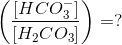
There are many solution systems which can only function as desired when the pH of that solution stays within a narrow range. Maintaining a stable pH in an unstable environment is most often achieved by the use of a buffer system, which is composed of a conjugate acid-base pair. One physiologically important buffer system is the bicarbonate buffer system that resists changes in blood pH.
The acid dissociation constant of carbonic acid
The normal blood pH is tightly regulated between 7.35 and 7.45
When blood pH falls below 7.35 a person is said to have acidosis. Depending upon how far the pH drops, this condition could lead to nervous system impairment, coma, and death.
What is the ratio of bicarbonate ion concentration to carbonic acid concentration at which an individual will be at the threshold of experiencing acidosis
Tap to reveal answer
When performing acid/base calculations, the Henderson-Hasselbalch equation is useful:
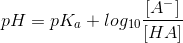
To use this equation we need to convert the  to the
  , and can use the following definition to do so:


Since an individual will begin experiencing acidosis when the blood falls below 7.35 we can use 7.35 as the pH in the Henderson-Hasselbalch equation. Adding in the  of 6.10 calculated from the
  gives the equation below:
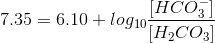
Plug in known values and solve:

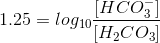
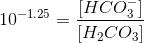
Correct Answer:
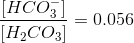
The answer is unitless because  all units cancel out.
When performing acid/base calculations, the Henderson-Hasselbalch equation is useful:
To use this equation we need to convert the
Since an individual will begin experiencing acidosis when the blood falls below 7.35 we can use 7.35 as the pH in the Henderson-Hasselbalch equation. Adding in the
Plug in known values and solve:
Correct Answer:
The answer is unitless because
← Didn't Know|Knew It →
If you have a solution that consist of a weak monoprotic acid (HA), with a pKA of 5.3 and a pH of 3.2, what is the predominant species present?
If you have a solution that consist of a weak monoprotic acid (HA), with a pKA of 5.3 and a pH of 3.2, what is the predominant species present?
Tap to reveal answer
Since pH < pKa the undissociated acid is the predominant form.
Since pH < pKa the undissociated acid is the predominant form.
← Didn't Know|Knew It →
If you have a solution that consists of a monoprotic acid (HA), with a pKa of 4.1 and at a pH of 5.8, what is the predominant species present?
If you have a solution that consists of a monoprotic acid (HA), with a pKa of 4.1 and at a pH of 5.8, what is the predominant species present?
Tap to reveal answer
Since pH > pKA, the deprotonated form of the acid is predominant.
Since pH > pKA, the deprotonated form of the acid is predominant.
← Didn't Know|Knew It →
Carbonic acid as a pKa1 = 6.35 and a pKa2=10.33. If the pH is 3.52, what is the predominant species present.
Carbonic acid as a pKa1 = 6.35 and a pKa2=10.33. If the pH is 3.52, what is the predominant species present.
Tap to reveal answer
Since pH < pKa1, the undissociated form of carbonic acid (H2CO3) is predominant.
Since pH < pKa1, the undissociated form of carbonic acid (H2CO3) is predominant.
← Didn't Know|Knew It →
Sulphurous acid (H2SO3) has a pKa1 = 1.92 and a pKa2 = 7.18, if the pH = 5.3, what is the predominant species present?
Sulphurous acid (H2SO3) has a pKa1 = 1.92 and a pKa2 = 7.18, if the pH = 5.3, what is the predominant species present?
Tap to reveal answer
Since pH > pKa1 but pH < pKa2 the predominant form is one with a single hydrogen dissociated.
Since pH > pKa1 but pH < pKa2 the predominant form is one with a single hydrogen dissociated.
← Didn't Know|Knew It →
Phosphoric acid has a pKa1 = 2.15, a pKa2 = 7.20, and a pKa3 = 12.35. If the pH = 13.0, what is the predominant species present?
Phosphoric acid has a pKa1 = 2.15, a pKa2 = 7.20, and a pKa3 = 12.35. If the pH = 13.0, what is the predominant species present?
Tap to reveal answer
Since pH > pKa1, pKa2, and pKa3 the predominant form of the acid is the fully deprotonated form.
Since pH > pKa1, pKa2, and pKa3 the predominant form of the acid is the fully deprotonated form.
← Didn't Know|Knew It →
If you have a solution that consist of a weak monoprotic acid (HA), with a pKA of 5.3 and a pH of 3.2, what is the predominant species present?
If you have a solution that consist of a weak monoprotic acid (HA), with a pKA of 5.3 and a pH of 3.2, what is the predominant species present?
Tap to reveal answer
Since pH < pKa the undissociated acid is the predominant form.
Since pH < pKa the undissociated acid is the predominant form.
← Didn't Know|Knew It →
If you have a solution that consists of a monoprotic acid (HA), with a pKa of 4.1 and at a pH of 5.8, what is the predominant species present?
If you have a solution that consists of a monoprotic acid (HA), with a pKa of 4.1 and at a pH of 5.8, what is the predominant species present?
Tap to reveal answer
Since pH > pKA, the deprotonated form of the acid is predominant.
Since pH > pKA, the deprotonated form of the acid is predominant.
← Didn't Know|Knew It →
Carbonic acid as a pKa1 = 6.35 and a pKa2=10.33. If the pH is 3.52, what is the predominant species present.
Carbonic acid as a pKa1 = 6.35 and a pKa2=10.33. If the pH is 3.52, what is the predominant species present.
Tap to reveal answer
Since pH < pKa1, the undissociated form of carbonic acid (H2CO3) is predominant.
Since pH < pKa1, the undissociated form of carbonic acid (H2CO3) is predominant.
← Didn't Know|Knew It →
Sulphurous acid (H2SO3) has a pKa1 = 1.92 and a pKa2 = 7.18, if the pH = 5.3, what is the predominant species present?
Sulphurous acid (H2SO3) has a pKa1 = 1.92 and a pKa2 = 7.18, if the pH = 5.3, what is the predominant species present?
Tap to reveal answer
Since pH > pKa1 but pH < pKa2 the predominant form is one with a single hydrogen dissociated.
Since pH > pKa1 but pH < pKa2 the predominant form is one with a single hydrogen dissociated.
← Didn't Know|Knew It →
Phosphoric acid has a pKa1 = 2.15, a pKa2 = 7.20, and a pKa3 = 12.35. If the pH = 13.0, what is the predominant species present?
Phosphoric acid has a pKa1 = 2.15, a pKa2 = 7.20, and a pKa3 = 12.35. If the pH = 13.0, what is the predominant species present?
Tap to reveal answer
Since pH > pKa1, pKa2, and pKa3 the predominant form of the acid is the fully deprotonated form.
Since pH > pKa1, pKa2, and pKa3 the predominant form of the acid is the fully deprotonated form.
← Didn't Know|Knew It →