
Introductory Topics - AP Chemistry
Card 0 of 900
Which of the following is true of Valence Bond theory and Molecular Orbital theory?
Which of the following is true of Valence Bond theory and Molecular Orbital theory?
The Valence Bond theory states that covalent bonds are formed from atomic orbital overlap while the Molecular Orbital theory is the mathematical combination of atomic orbitals to produce anti bonding and bonding orbitals.
Hybridization occurs through combining atomic orbitals, a concept consistent with Valence Bond theory. Common bonds found in Valence Bond hybridization are sigma and pi bonds which overlap end-to-end or side-to-side respectively. Orbitals are combined in Molecular Orbital theory, producing either bonding or anti bonding orbitals. Molecular Orbital theory shows the destructive or constructive interference of sigma and pi bonds (displayed through bonding and anti bonding orbitals).
The Valence Bond theory states that covalent bonds are formed from atomic orbital overlap while the Molecular Orbital theory is the mathematical combination of atomic orbitals to produce anti bonding and bonding orbitals.
Hybridization occurs through combining atomic orbitals, a concept consistent with Valence Bond theory. Common bonds found in Valence Bond hybridization are sigma and pi bonds which overlap end-to-end or side-to-side respectively. Orbitals are combined in Molecular Orbital theory, producing either bonding or anti bonding orbitals. Molecular Orbital theory shows the destructive or constructive interference of sigma and pi bonds (displayed through bonding and anti bonding orbitals).
Compare your answer with the correct one above
Think about quantum numbers. If  , which of these values cannot possibly correspond to
  ?
?
Think about quantum numbers. If
This question refers to quantum numbers, which describe the distribution of electrons in an atom. There are three quantum numbers:  ,
,  , and
, and  .
.
The principal quantum number,  , describes the size of the orbital in which the electron lies. The value of
  can be any integer except zero. In this case,
  .
.
The angular quantum number,  , describes the shape of the orbital. The value of
  can be any integer from zero to
  . If
. If  , l can be
  ,
,  ,
,  , or
, or  .
.
The magnetic quantum number,  , describes the orientation in space of the orbital. The value of
  can be any integer from
  to
to  . For example, if
  ,
,  can be
  ,
,  ,
,  ,
,  , or
, or  .
.
This question refers to quantum numbers, which describe the distribution of electrons in an atom. There are three quantum numbers:
The principal quantum number,
The angular quantum number,
The magnetic quantum number,
Compare your answer with the correct one above
 undergoes 2
  decays to produce which of the following?
In  decay a
  nucleus is emitted, and 2
  decays can be written as
  so knowing this we can now write out the decay equation.


Where  is the element name of the product.
 is the atomic number of the product.
and  is the mass number of the product.
We can quickly determine the atomic number/element name by making an equation with an unknown with all the atomic numbers. This would be:


therefore the atomic number is  and the element polonium.
We can do the same for mass numbers to get the equation:

 , so the final answer is
  .
.
In
Where
and
We can quickly determine the atomic number/element name by making an equation with an unknown with all the atomic numbers. This would be:
therefore the atomic number is
We can do the same for mass numbers to get the equation:
Compare your answer with the correct one above
What is the daughter nuclide when  undergoes alpha decay?
What is the daughter nuclide when
Recall that when a particle undergoes alpha decay, the particle is emitting an alpha particle, which is the same as  .
.
Now, write the following equation of the alpha decay:

Thus,  is the daughter nucleus.
Recall that when a particle undergoes alpha decay, the particle is emitting an alpha particle, which is the same as
Now, write the following equation of the alpha decay:
Thus,
Compare your answer with the correct one above
What is the daughter nuclide after  undergoes alpha decay?
What is the daughter nuclide after
Recall what an alpha particle is:  .
.
Now, write the equation for the alpha decay of polonium-214. The polonium will be emitting an alpha particle.

Make sure that the masses and the atomic numbers on both sides of the equation will add up.
Recall what an alpha particle is:
Now, write the equation for the alpha decay of polonium-214. The polonium will be emitting an alpha particle.
Make sure that the masses and the atomic numbers on both sides of the equation will add up.
Compare your answer with the correct one above
What is the daughter nuclide when  undergoes beta decay?
What is the daughter nuclide when
Recall that beta decay occurs when the nucleus of the parent atom emits an electron. We can then write the following equation to illustrate the beta decay of thorium.

Make sure that the atomic numbers and masses add up to the same on both sides of the equation.
Recall that beta decay occurs when the nucleus of the parent atom emits an electron. We can then write the following equation to illustrate the beta decay of thorium.
Make sure that the atomic numbers and masses add up to the same on both sides of the equation.
Compare your answer with the correct one above
When a  atom undergoes bombardment with an
  particle,
  neutrons, and an isotope of phosphorus are produced. What is the mass number of phosphorus?
When a
In order to begin determination of the mass number of phosphorus, we must first write out the equation and then solve for the mass number of phosphorus.
We know there is  present and it is bombarded by an
  particle. An alpha particle is equivalent to
  . Next by reading the results of the bombardment we can see that

 , which are our reactants, produce
  neutrons and an isotope of phosphorus. A neutron is an uncharged particle that has a "Z" value is equal to
  , and its atomic mass number is equal to
  . This gives us
  since there are two neutrons. Next, we must look at the periodic table to find the atomic number of Phosphorus, which is
  . Since we must calculate its mass number, for now we mark it as unknown '
 ', so for phosphorus we have
  . This means our products are


Now let's write out the reaction that occurs and all of its reactants and products, so we can solve for X:


Now we can solve for the unknown mass number of phosphorus by adding up the mass numbers on each side of the equation and solving for the unknown.
On the reactants side we have  (from Al)
  (from the alpha particle), and we set that equal to the products sum of mass numbers which are
  (from the neutrons)
  .
.
This leaves us: 


Therefore the mass number of phosphorus is  . This answer can be checked by plugging it into the bombardment equation and seeing if a true result is obtained.
In order to begin determination of the mass number of phosphorus, we must first write out the equation and then solve for the mass number of phosphorus.
We know there is
Now let's write out the reaction that occurs and all of its reactants and products, so we can solve for X:
Now we can solve for the unknown mass number of phosphorus by adding up the mass numbers on each side of the equation and solving for the unknown.
On the reactants side we have
This leaves us:
Therefore the mass number of phosphorus is
Compare your answer with the correct one above
What is the orbital hybridization for nitrogen in the molecule  ?
?
What is the orbital hybridization for nitrogen in the molecule
Start by drawing the Lewis structure of  .
.  has
has  valence electrons.
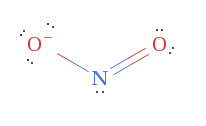
Since the nitrogen has  oxygen atoms bonded to it and a lone pair, the steric number must be
  . From that, we know that it must have sp2 hybridization.
Start by drawing the Lewis structure of
Since the nitrogen has
Compare your answer with the correct one above
 undergoes three
  decays to form which of these?
In order to solve this problem we first must setup an equation representing the decay of  particles. We know that an
  particle is equivalent to
  , so we can write our radioactive decay equation as:

where  is the unknown element
 is the atomic number
and  is the mass number. We can create two equations. One to solve for the mass number and one to solve for the atomic number.
Let's start with the atomic number:
Since we have an atomic number of  on the reactants side of the equation we can set that equal to
  (the combined atomic number of three
  particles +
  .
.
As an equation this is written as:

This simplifies to  . This means that is the atomic number, and we can identify the element by looking at the periodic table for element number
  as the atomic number identifies the element. The element is Platinum also written as
  .
.
Now we must solve for the mass number similarly:
Following the instructions above except for the mass number we create an equation with one unknown to solve for the mass number of  produced by this decay.:

therefore 
This means our final answer is  .
.
This can be double-checked by plugging the mass number and atomic number into the decay equation and simplifying it.
In order to solve this problem we first must setup an equation representing the decay of
where
and
Let's start with the atomic number:
Since we have an atomic number of
As an equation this is written as:
This simplifies to
Now we must solve for the mass number similarly:
Following the instructions above except for the mass number we create an equation with one unknown to solve for the mass number of
therefore
This means our final answer is
This can be double-checked by plugging the mass number and atomic number into the decay equation and simplifying it.
Compare your answer with the correct one above
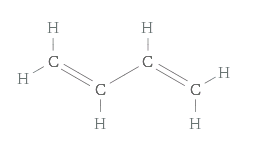
Which of the following types of hybridization is found in the molecule shown below?
Which of the following types of hybridization is found in the molecule shown below?
Look at each of the carbon atoms in the chain. Each carbon atom has  other atoms bonded to it. This means that the steric number of each carbon is
  . Thus, the only type of hybridization found in this molecule is sp2.
Look at each of the carbon atoms in the chain. Each carbon atom has
Compare your answer with the correct one above
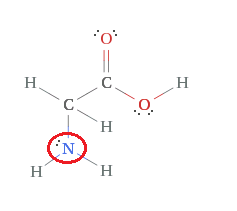
What is the hybridization for the atom circled in red?
What is the hybridization for the atom circled in red?
Start by counting the number of atoms the nitrogen is bonded to. It has  bonded atoms. The nitrogen also has a lone pair. This means the steric number of the nitrogen is
  . Thus, it must have
  hybridization.
Start by counting the number of atoms the nitrogen is bonded to. It has
Compare your answer with the correct one above
Which of the following sequences describe the decay process from  to
to  ?
?
Which of the following sequences describe the decay process from
In order to determine the decay process that occurs we should check if the mass number charges or not in the decay. Since the mass number doesn't change we can eliminate any answer with  decay in it.
Now we can write out our decay equation. Since the atomic numbers aren't written in the question we must find them on the periodic table, where elements are ordered by their atomic number. In the case of Thallium, we find that it is element number  and in the case of Polonium we find that it is element
  .
.
So our equation is as follows:

where  is the element/particle name
 is the mass number
and  is the atomic number.
Since the mass number is the same on both sides of the equation we know that it is equal to  .
.
Now we see that the atomic number increases by  , which is the equivalent of a
  on the product side of the equation. The only particle in the answer choices that is capable of having a negative atomic number value is a
  particle, which is written as
  . In order to produce an atomic number change of
  there must be
 decays, which is the right answer.
In order to determine the decay process that occurs we should check if the mass number charges or not in the decay. Since the mass number doesn't change we can eliminate any answer with
Now we can write out our decay equation. Since the atomic numbers aren't written in the question we must find them on the periodic table, where elements are ordered by their atomic number. In the case of Thallium, we find that it is element number
So our equation is as follows:
where
and
Since the mass number is the same on both sides of the equation we know that it is equal to
Now we see that the atomic number increases by
Compare your answer with the correct one above
The compound hydrazine is given by the molecular formula  . What type of intermolecular forces will govern the behavior of neighboring hydrazine molecules?
The compound hydrazine is given by the molecular formula
Hydrazine is a polar compound that possesses the requirements for hydrogen bonding: an "acidic hydrogen" (a hydrogen bonded to a highly electronegative atom such as oxygen, nitrogen or fluorine) and the presence of a lone pair. Both Nitrogen atoms in hydrazine have lone (unshared) electron pairs, and all four hydrogen atoms are "acidic," making hydrazine a candidate for intermolecular hydrogen bonding.
Hydrazine is a polar compound that possesses the requirements for hydrogen bonding: an "acidic hydrogen" (a hydrogen bonded to a highly electronegative atom such as oxygen, nitrogen or fluorine) and the presence of a lone pair. Both Nitrogen atoms in hydrazine have lone (unshared) electron pairs, and all four hydrogen atoms are "acidic," making hydrazine a candidate for intermolecular hydrogen bonding.
Compare your answer with the correct one above
The unique properties of water, namely its incredibly high heat capacity and surface tension, can be attributed to which of the following kinds of intermolecular/intramolecular forces?
The unique properties of water, namely its incredibly high heat capacity and surface tension, can be attributed to which of the following kinds of intermolecular/intramolecular forces?
The partial negative and positive charges on a water molecule allow it to be attracted to other polar water molecules, which creates the cohesive nature of water and contributes to its high surface tension and heat capacity. London dispersion and Van der Waals forces are significantly weaker than hydrogen bonding. Additionally, ionic bonding only occurs intramolecularly, so it has little effect on the intermolecular properties of water.
The partial negative and positive charges on a water molecule allow it to be attracted to other polar water molecules, which creates the cohesive nature of water and contributes to its high surface tension and heat capacity. London dispersion and Van der Waals forces are significantly weaker than hydrogen bonding. Additionally, ionic bonding only occurs intramolecularly, so it has little effect on the intermolecular properties of water.
Compare your answer with the correct one above
Which of the following atoms in the largest?
Which of the following atoms in the largest?
The atomic radii is the size of an atom when it is not bonded to any other atoms. The periodic table can be used to estimate the size of the atomic radii of atoms. As you move down the periodic table the atomic radii increase, but as you move from left to right on the periodic table, the size of the atomic radii decrease.
Sodium, aluminium, phosphorus, sulfur, and chlorine are all in the same row of the periodic table. Since the size of the atomic radii decreases as you move from left to right on the periodic table, the element furthest to the left will be the largest. Therefore, sodium is the largest atom out of the group.
The atomic radii is the size of an atom when it is not bonded to any other atoms. The periodic table can be used to estimate the size of the atomic radii of atoms. As you move down the periodic table the atomic radii increase, but as you move from left to right on the periodic table, the size of the atomic radii decrease.
Sodium, aluminium, phosphorus, sulfur, and chlorine are all in the same row of the periodic table. Since the size of the atomic radii decreases as you move from left to right on the periodic table, the element furthest to the left will be the largest. Therefore, sodium is the largest atom out of the group.
Compare your answer with the correct one above
Which of these atoms is the smallest?
Which of these atoms is the smallest?
The atomic radii is the size of an atom when it is not bonded to any other atoms. The periodic table can be used to estimate the size of the atomic radii of atoms. As you move down the periodic table the atomic radii increase, but as you move from left to right on the periodic table, the size of the atomic radii decrease.
Beryllium, magnesium, calcium, strontium, and barium are all in the same group on the periodic table, so the smallest element is the element closest to the top of the periodic table since the atoms become larger as you go down the periodic table. Therefore, the smallest atom of this group is beryllium.
The atomic radii is the size of an atom when it is not bonded to any other atoms. The periodic table can be used to estimate the size of the atomic radii of atoms. As you move down the periodic table the atomic radii increase, but as you move from left to right on the periodic table, the size of the atomic radii decrease.
Beryllium, magnesium, calcium, strontium, and barium are all in the same group on the periodic table, so the smallest element is the element closest to the top of the periodic table since the atoms become larger as you go down the periodic table. Therefore, the smallest atom of this group is beryllium.
Compare your answer with the correct one above
Which of the following is a characteristic of covalent bonds?
Which of the following is a characteristic of covalent bonds?
A covalent bond is one between two nonmetals, while an ionic bond is formed between a metal and a nonmetal. Covalent bonds also do not dissociate in aqueous solution to form cations and anions; this is a characteristic of ionic bonds. For example,  represents a bond between a metal (
 ) and a nonmetal (
 ), and it dissociates in aqueous solution to form a cation (
 ) and an anion (
 ). In contrast,
  represents a bond between two nonmetals, and it does not dissociate in aqueous solution. Ionic compounds are also good conductors of electricity, while covalent compounds are not. This is because moving electrons are required in order to conduct electricity. When dissolved in aqueous solution, ions are free to move and thus conduct electricity. Covalent bonds have localized electrons, which cannot move and thus cannot conduct electricity well.
A covalent bond is one between two nonmetals, while an ionic bond is formed between a metal and a nonmetal. Covalent bonds also do not dissociate in aqueous solution to form cations and anions; this is a characteristic of ionic bonds. For example,
Compare your answer with the correct one above
Which of the following is an example of a nonpolar covalent bond?
Which of the following is an example of a nonpolar covalent bond?
A covalent bond is a bond between two nonmetals, in which electrons are shared. This means that  cannot be the correct answer, as sodium is a metal. In fact,
  is a classic example of an ionic compound.
A polar covalent bond is a bond between two nonmetals in which one nonmetal is more electronegative than the other, pulling the shared electrons toward itself. This occurs in  ; chlorine is much more electronegative than hydrogen and pulls the shared electrons toward itself. This gives chlorine a partial negative charge and hydrogen a partial positive charge.
  is also an example of a polar covalent bond; oxygen is much more electronegative than hydrogen, and each oxygen in a water molecule pulls the shared electrons toward itself. This gives oxygen a partial negative charge and hydrogen a partial positive charge.
A nonpolar covalent bond is a bond between two nonmetals in which electrons are shared equally between the nonmetals. This occurs when the two nonmetals are of equal electronegativity. As the atoms of  have the same identity (chlorine), they have the same electronegativity. Thus, electrons are shared equally between the two chlorine atoms--in a nonpolar covalent bond.
A covalent bond is a bond between two nonmetals, in which electrons are shared. This means that
A polar covalent bond is a bond between two nonmetals in which one nonmetal is more electronegative than the other, pulling the shared electrons toward itself. This occurs in
A nonpolar covalent bond is a bond between two nonmetals in which electrons are shared equally between the nonmetals. This occurs when the two nonmetals are of equal electronegativity. As the atoms of
Compare your answer with the correct one above
Which of these following diatomic molecules is joined by a double covalent bond?
Which of these following diatomic molecules is joined by a double covalent bond?
Oxygen has a valence of 6, meaning it is looking to form two covalent bonds to complete its octet. Thus,  exists as a diatomic molecule joined by a double covalent bond.
  and
and  are held together by single covalent bonds, and
  is held together by a triple covalent bond.
Oxygen has a valence of 6, meaning it is looking to form two covalent bonds to complete its octet. Thus,
Compare your answer with the correct one above
Which of the following lists bond strength in order of weakest to strongest?
Which of the following lists bond strength in order of weakest to strongest?
Dipole-dipole interactions are the weakest because they are the result of attractions between weak partial charges
Hydrogen bonds are a special type of dipole-dipole interaction, but they are much stronger.
An ionic bond is the result of the complete transfer of electrons from on atom to another. This results in a positive charge on one atom and a negative charge on the other. The charges on these ions are much stronger than in dipoles. The two oppositely charged atoms are held together by electrostatic attraction.
Atoms that are part of a covalent bond share electrons. This makes the atoms harder to separate and, therefore, the bond is very strong.
Dipole-dipole interactions are the weakest because they are the result of attractions between weak partial charges
Hydrogen bonds are a special type of dipole-dipole interaction, but they are much stronger.
An ionic bond is the result of the complete transfer of electrons from on atom to another. This results in a positive charge on one atom and a negative charge on the other. The charges on these ions are much stronger than in dipoles. The two oppositely charged atoms are held together by electrostatic attraction.
Atoms that are part of a covalent bond share electrons. This makes the atoms harder to separate and, therefore, the bond is very strong.
Compare your answer with the correct one above