
Elements and Atoms - AP Chemistry
Card 1 of 1244
What is the de Broglie wavelength (in meters) of a person walking? Assume a person walks at 4 mph and has a mass of 80 kg.
What is the de Broglie wavelength (in meters) of a person walking? Assume a person walks at 4 mph and has a mass of 80 kg.
Tap to reveal answer
de Broglie suggested that all matter has both wave-like and particle-like properties. His
equation states that λ= h/mv , where λ is the wavelength, m is mass, h is Planck’s constant,
and v is velocity. 4 mph is 1.8 m s−1 and Planck’s constant is 6.626e-34 kg m2 s−1 , giving
us a wavelength (λ) 4.6e-36 m ! A very small wavelength, indeed.
de Broglie suggested that all matter has both wave-like and particle-like properties. His
equation states that λ= h/mv , where λ is the wavelength, m is mass, h is Planck’s constant,
and v is velocity. 4 mph is 1.8 m s−1 and Planck’s constant is 6.626e-34 kg m2 s−1 , giving
us a wavelength (λ) 4.6e-36 m ! A very small wavelength, indeed.
← Didn't Know|Knew It →
Ernest Rutherford's famous gold foil experiment demonstrated which of the following principles?
Ernest Rutherford's famous gold foil experiment demonstrated which of the following principles?
Tap to reveal answer
Rutherfords experiment focused a beam of alpha particles on a piece of gold foil. The result showed that most of the alpha particles passed through the foil, while a small fraction of particles were significantly deflected. This suggested the presence of a small, dense, positively charged nucleus. Most of the alpha particles passed through the electron clouds of the gold atoms, without impacting the nuclei, while those that did impact the nuclei were deflected by the positive charge of the nucleus.
Rutherford's experiment does not give us any concrete information about neutrons, nor does it allow us to assume that the number of protons and neutrons in the nucleus are equal.
Rutherfords experiment focused a beam of alpha particles on a piece of gold foil. The result showed that most of the alpha particles passed through the foil, while a small fraction of particles were significantly deflected. This suggested the presence of a small, dense, positively charged nucleus. Most of the alpha particles passed through the electron clouds of the gold atoms, without impacting the nuclei, while those that did impact the nuclei were deflected by the positive charge of the nucleus.
Rutherford's experiment does not give us any concrete information about neutrons, nor does it allow us to assume that the number of protons and neutrons in the nucleus are equal.
← Didn't Know|Knew It →
What did the Rutherford gold foil experiment show?
What did the Rutherford gold foil experiment show?
Tap to reveal answer
In the Rutherford experiment, a beam of alpha particles was shot through a gold foil, with most of the particles flying straight through and a few scattering at angles greater than  . These results suggest that most of the volume of foil was "empty" space, with small concentrations of positive charge, which we now know is the nucleus.
In the Rutherford experiment, a beam of alpha particles was shot through a gold foil, with most of the particles flying straight through and a few scattering at angles greater than
← Didn't Know|Knew It →
Which scientist conducted an experiment studying the structure of the atom by firing alpha particles at a thin gold foil?
Which scientist conducted an experiment studying the structure of the atom by firing alpha particles at a thin gold foil?
Tap to reveal answer
Ernest Rutherford made great advances in current understanding of atomic structure through his gold foil experiment. When firing positively-charged alpha particles at a thin film of gold atoms, most particles were found to pass straight through the film with little to no deflection, indicating that atoms were mostly composed of empty space. A few particles were deflected at large angles, indicating direct collisions with the positively charged nuclei of the atoms.
Ernest Rutherford made great advances in current understanding of atomic structure through his gold foil experiment. When firing positively-charged alpha particles at a thin film of gold atoms, most particles were found to pass straight through the film with little to no deflection, indicating that atoms were mostly composed of empty space. A few particles were deflected at large angles, indicating direct collisions with the positively charged nuclei of the atoms.
← Didn't Know|Knew It →
Which of the following statements regarding the discovery of the electron are true?
Which of the following statements regarding the discovery of the electron are true?
Tap to reveal answer
Recall that J.J. Thomson conducted the cathode ray tube experiment that proved the existence of a small negatively charged particle. Thomson was also able to determine the charge-to-mass ratio of an electron. Robert Millikan is the scientist who conducted the oil drop experiment, from which he was able to find the charge of the electron and deduce its mass using the electron's charge-to-mass ratio. Dalton was not involved in the discovery of the electron.
Recall that J.J. Thomson conducted the cathode ray tube experiment that proved the existence of a small negatively charged particle. Thomson was also able to determine the charge-to-mass ratio of an electron. Robert Millikan is the scientist who conducted the oil drop experiment, from which he was able to find the charge of the electron and deduce its mass using the electron's charge-to-mass ratio. Dalton was not involved in the discovery of the electron.
← Didn't Know|Knew It →
From Robert Millikan's oil drop experiment, the charge of the electron was observed to be  . Which of the following charges could not have been observed from the oil drop experiment?
From Robert Millikan's oil drop experiment, the charge of the electron was observed to be
Tap to reveal answer
All the oil drops must have a charge that is a multiple of  . If an oil drop is observed to have a charge of
  , that means the oil drop has three electrons. If an oil drop is observed to have a charge of
  , that means the oil drop has twelve electrons. If an oil drop is observed to have a charge of
  , that means the oil drop has two electrons.
All the oil drops must have a charge that is a multiple of
← Didn't Know|Knew It →
From Robert Millikan's oil drop experiment, the charge of the electron was observed to be  . Suppose that one of the oil drops has a charge of
  . How many electrons does this oil drop contain?
From Robert Millikan's oil drop experiment, the charge of the electron was observed to be
Tap to reveal answer
To find the number of electrons this oil drop contains, divide the observed charge by the charge of a single electron.
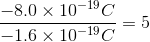
This oil drop contains  electrons.
To find the number of electrons this oil drop contains, divide the observed charge by the charge of a single electron.
This oil drop contains
← Didn't Know|Knew It →
Which of the following statements concerning the discovery of the electron are false?
Which of the following statements concerning the discovery of the electron are false?
Tap to reveal answer
Recall that J.J. Thomson conducted the cathode ray tube experiment that proved the existence of a small negatively charged particle. Thomson was also able to determine the charge-to-mass ratio of an electron. Robert Millikan is the scientist who conducted the oil drop experiment, from which he was able to find the charge of the electron and deduce its mass using the electron's charge-to-mass ratio.
Recall that J.J. Thomson conducted the cathode ray tube experiment that proved the existence of a small negatively charged particle. Thomson was also able to determine the charge-to-mass ratio of an electron. Robert Millikan is the scientist who conducted the oil drop experiment, from which he was able to find the charge of the electron and deduce its mass using the electron's charge-to-mass ratio.
← Didn't Know|Knew It →
Which of the following is a result of J.J. Thomson's cathode ray tube experiment?
Which of the following is a result of J.J. Thomson's cathode ray tube experiment?
Tap to reveal answer
From the cathode ray tube experiment, J.J. Thomson was only able to prove the existence of the negatively charged electron. From the results of the experiment, he also postulated that an atom was made up of a large spherical cloud of positive charge with negatively charged electrons embedded within. This model is also known as the plum pudding model.
From the cathode ray tube experiment, J.J. Thomson was only able to prove the existence of the negatively charged electron. From the results of the experiment, he also postulated that an atom was made up of a large spherical cloud of positive charge with negatively charged electrons embedded within. This model is also known as the plum pudding model.
← Didn't Know|Knew It →
What kind of radiation has no charge or mass?
What kind of radiation has no charge or mass?
Tap to reveal answer
This is the definition of gamma radiation.
This is the definition of gamma radiation.
← Didn't Know|Knew It →
Uranium-238 undergoes alpha decay. Which nucleus is formed as a result of this decay?
Uranium-238 undergoes alpha decay. Which nucleus is formed as a result of this decay?
Tap to reveal answer
In alpha decay, an element loses the equivalent of a helium nucleus, or 2 protons and 2 neutrons. Uranium-238 has an atomic number of 92 and a mass of 238 units, so the product of alpha decay will have an atomic number of 90 and a mass of 234 units. This corresponds to thorium-234.
In alpha decay, an element loses the equivalent of a helium nucleus, or 2 protons and 2 neutrons. Uranium-238 has an atomic number of 92 and a mass of 238 units, so the product of alpha decay will have an atomic number of 90 and a mass of 234 units. This corresponds to thorium-234.
← Didn't Know|Knew It →
Am-242 undergoes beta-decay at a half-life of 16 hours. If a chemist starts with a sample of  of Am-242 and allows it to undergo beta-decay, how much of the original sample remains after 4 days?
Am-242 undergoes beta-decay at a half-life of 16 hours. If a chemist starts with a sample of
Tap to reveal answer
With each half-life, the amount of Am-242 is halved. 4 days is 96 hours, which is 6 half-lives. For half-life questions use the formula:

Where  is the number of half lives.
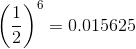

Thus  of Am-242 is left after 4 days.
With each half-life, the amount of Am-242 is halved. 4 days is 96 hours, which is 6 half-lives. For half-life questions use the formula:
Where
Thus
← Didn't Know|Knew It →
Consider the following isotope of thorium:

What is the identity of the product following three alpha decay reactions?
Consider the following isotope of thorium:
What is the identity of the product following three alpha decay reactions?
Tap to reveal answer
During alpha decay, an element emits a helium nucleus with 2 neutrons and 2 protons. Thus, the atomic mass of the new element is decreased by four, and the atomic number is decreased by two.
Three subsequent alpha decays result in a new element with an atomic mass of 232 - 3(4) = 220, and a new atomic number of 90 - 3(2) = 84.
Using the periodic table, we find the element with this atomic number is polonium (Po).
During alpha decay, an element emits a helium nucleus with 2 neutrons and 2 protons. Thus, the atomic mass of the new element is decreased by four, and the atomic number is decreased by two.
Three subsequent alpha decays result in a new element with an atomic mass of 232 - 3(4) = 220, and a new atomic number of 90 - 3(2) = 84.
Using the periodic table, we find the element with this atomic number is polonium (Po).
← Didn't Know|Knew It →
Consider the following isotope:

What is the identity of the product after the following series of decay reactions?
alpha decay, alpha decay, electron emission, positron emission, positron emission
Consider the following isotope:
What is the identity of the product after the following series of decay reactions?
alpha decay, alpha decay, electron emission, positron emission, positron emission
Tap to reveal answer
In alpha decay, a helium nucleus is emitted, and thus the isotope loses 2 protons and 2 neutrons.
In electron emission, a neutron in the nucleus is converted into a proton and an emitted electron.
In positron emission, a proton in the nucleus is converted into a neutron and an emitted positron.
The given isotope will lose 4 protons and 4 neutrons via alpha emission, gain 1 proton and lose 1 neutron via electron emission, and lose 2 protons and gain 2 neutrons via positron emission. The result is a loss of 5 protons and 8 mass units.
Accounting for the changes in atomic mass and number, we find that the final element is 141-praseodymium.
In alpha decay, a helium nucleus is emitted, and thus the isotope loses 2 protons and 2 neutrons.
In electron emission, a neutron in the nucleus is converted into a proton and an emitted electron.
In positron emission, a proton in the nucleus is converted into a neutron and an emitted positron.
The given isotope will lose 4 protons and 4 neutrons via alpha emission, gain 1 proton and lose 1 neutron via electron emission, and lose 2 protons and gain 2 neutrons via positron emission. The result is a loss of 5 protons and 8 mass units.
Accounting for the changes in atomic mass and number, we find that the final element is 141-praseodymium.
← Didn't Know|Knew It →
The isotope  of potassium is used to date geological materials. One of the decay reactions this isotope undergoes is:

In order for the nuclear reaction to be balanced  can be:
The isotope
In order for the nuclear reaction to be balanced
Tap to reveal answer
A beam of electrons is known also as β radiation. An electron has atomic number of  and zero mass number. Hence, the reaction can be written:

Where  can be either, an electron or β radiation. The mass number is balanced because
  and the atomic number is balanced because
  . This kind of nuclear reactions are called beta decay reactions.
A beam of electrons is known also as β radiation. An electron has atomic number of
Where
← Didn't Know|Knew It →
An alpha particle can also be written as which of the following?
An alpha particle can also be written as which of the following?
Tap to reveal answer
An alpha particle can be written as  or
or  . The latter is used frequently in nuclear physics because it is more helpful when calculating resulting nuclei after radioactive decay. In alpha emission, the nucleus loses two protons and two neutrons.
An alpha particle can be written as
← Didn't Know|Knew It →
Suppose that a radioactive isotope whose half-life is equal to  is allowed to decay. After waiting
  , how much of this compound would be expected to exist compared to the initial amount?
Suppose that a radioactive isotope whose half-life is equal to
Tap to reveal answer
In order to answer this question, we'll need to employ the equation for first-order decay. The reason we know that this is a first order decay process is because we are told that the compound in question is radioactive. It's important to recall that all radioactive decay processes occur via a first order decay mechanism.
Before jumping into the math, let's first make a quick ballpark prediction of where our answer should be. We know that the half-life for any compound is the amount of time it takes for half of that compound to decay. Furthermore, we're given the value for a compound's half-life. Since the amount of time that has passed in the question is less than the half-life, we would expect to still have over half of the compound left. Thus, our answer should be above  .
.

Where  is the amount of compound that exists at a specified time
 is the amount of compound that exists initially
 is the decay constant for the compound
 is the specified amount of time that has passed
To solve for the fraction of compound that exists at a given time relative to the initial amount, we can make the following changes to the above equation.

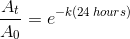
Thus far, we have everything we need except for the decay constant. However, as long as we know the half life of the compound, we can calculate the decay constant using the following formula that applies to all first order reactions.


Notice that the above decay constant has units of inverse-time. This is what we would expect, since all first order reactions have rate constants with these units.
Now, we are ready to plug in the value we calculated for the decay constant into the rate equation to find our answer.

Going back to the quick prediction we made, we can see that this calculated value agrees with our prediction.
In order to answer this question, we'll need to employ the equation for first-order decay. The reason we know that this is a first order decay process is because we are told that the compound in question is radioactive. It's important to recall that all radioactive decay processes occur via a first order decay mechanism.
Before jumping into the math, let's first make a quick ballpark prediction of where our answer should be. We know that the half-life for any compound is the amount of time it takes for half of that compound to decay. Furthermore, we're given the value for a compound's half-life. Since the amount of time that has passed in the question is less than the half-life, we would expect to still have over half of the compound left. Thus, our answer should be above
Where
To solve for the fraction of compound that exists at a given time relative to the initial amount, we can make the following changes to the above equation.
Thus far, we have everything we need except for the decay constant. However, as long as we know the half life of the compound, we can calculate the decay constant using the following formula that applies to all first order reactions.
Notice that the above decay constant has units of inverse-time. This is what we would expect, since all first order reactions have rate constants with these units.
Now, we are ready to plug in the value we calculated for the decay constant into the rate equation to find our answer.
Going back to the quick prediction we made, we can see that this calculated value agrees with our prediction.
← Didn't Know|Knew It →
What kind of radiation has no charge or mass?
What kind of radiation has no charge or mass?
Tap to reveal answer
This is the definition of gamma radiation.
This is the definition of gamma radiation.
← Didn't Know|Knew It →
Uranium-238 undergoes alpha decay. Which nucleus is formed as a result of this decay?
Uranium-238 undergoes alpha decay. Which nucleus is formed as a result of this decay?
Tap to reveal answer
In alpha decay, an element loses the equivalent of a helium nucleus, or 2 protons and 2 neutrons. Uranium-238 has an atomic number of 92 and a mass of 238 units, so the product of alpha decay will have an atomic number of 90 and a mass of 234 units. This corresponds to thorium-234.
In alpha decay, an element loses the equivalent of a helium nucleus, or 2 protons and 2 neutrons. Uranium-238 has an atomic number of 92 and a mass of 238 units, so the product of alpha decay will have an atomic number of 90 and a mass of 234 units. This corresponds to thorium-234.
← Didn't Know|Knew It →
Am-242 undergoes beta-decay at a half-life of 16 hours. If a chemist starts with a sample of of Am-242 and allows it to undergo beta-decay, how much of the original sample remains after 4 days?
Am-242 undergoes beta-decay at a half-life of 16 hours. If a chemist starts with a sample of
Tap to reveal answer
With each half-life, the amount of Am-242 is halved. 4 days is 96 hours, which is 6 half-lives. For half-life questions use the formula:
Where is the number of half lives.
Thus of Am-242 is left after 4 days.
With each half-life, the amount of Am-242 is halved. 4 days is 96 hours, which is 6 half-lives. For half-life questions use the formula:
Where
Thus
← Didn't Know|Knew It →