
Compounds and Molecules - AP Chemistry
Card 1 of 1964
Which of the following is an intrinsic physical property of a chemical substance?
Which of the following is an intrinsic physical property of a chemical substance?
Tap to reveal answer
Intrinsic properties do not depend on the amount of a substance present. Mass, heat, and enthalpy are all dependent on the amount of substance.
Intrinsic properties do not depend on the amount of a substance present. Mass, heat, and enthalpy are all dependent on the amount of substance.
← Didn't Know|Knew It →
Which of the following is NOT true of the law of constant composition?
Which of the following is NOT true of the law of constant composition?
Tap to reveal answer
The law of constant composition can't be applied to solutions because it only applies to pure samples. Solutions are not pure samples, since they contain more than just 1 compound.
The law of constant composition can't be applied to solutions because it only applies to pure samples. Solutions are not pure samples, since they contain more than just 1 compound.
← Didn't Know|Knew It →
A compound that is formed in the mechanism of a reaction but does not appear in the overall reaction is referred to as a(n) .
A compound that is formed in the mechanism of a reaction but does not appear in the overall reaction is referred to as a(n) .
Tap to reveal answer
This is the very definition of an intermediate. It is formed in one step within the mechanism of the reaction, but then something else happens to it as the reaction continues to completion; thus, it does not show up in the overall reaction.
This is the very definition of an intermediate. It is formed in one step within the mechanism of the reaction, but then something else happens to it as the reaction continues to completion; thus, it does not show up in the overall reaction.
← Didn't Know|Knew It →
A compound is  hydrogen and
  oxygen by mass. What is the name and molecular formula of this compound?
A compound is
Tap to reveal answer
Knowing there is at least one hydrogen atom and one oxygen atom in this compound means the total molar mass must be at least  . If we first assume
  is equivalent to only 1 mole of hydrogen, we get a total molar mass of
  . This number is too low to make logical sense.
Therefore, we must next assume there are 2 moles of hydrogen. Using this assumption, we can find the hypothetical molecular mass.


Use this molecular mass to calculate the mass of oxygen.

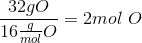
Therefore, there must be 2 moles of hydrogen and 2 moles of oxygen, making the molecular formula  .
.
This compound is called peroxide.
Knowing there is at least one hydrogen atom and one oxygen atom in this compound means the total molar mass must be at least
Therefore, we must next assume there are 2 moles of hydrogen. Using this assumption, we can find the hypothetical molecular mass.
Use this molecular mass to calculate the mass of oxygen.
Therefore, there must be 2 moles of hydrogen and 2 moles of oxygen, making the molecular formula
This compound is called peroxide.
← Didn't Know|Knew It →
A compound is comprised only of carbon and hydrogen. The molar mass of the compound is  and the compound is
  carbon by mass. What is the empirical formula?
A compound is comprised only of carbon and hydrogen. The molar mass of the compound is
Tap to reveal answer
Use the molar mass and percent by mass of carbon to find the moles of carbon in the compound.

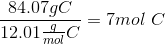
We know that the compound is made solely of carbon and hydrogen. This allows us to find the percent by mass of hydrogen.

Use the molar mass and the percent by mass of hydrogen to find moles of hydrogen in the compound.

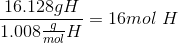
The molecular formula is  .
.
Because 7 and 16 have no common factors, the compound cannot be further reduced (in a numerical, not chemical sense).  is also the empirical formula.
Use the molar mass and percent by mass of carbon to find the moles of carbon in the compound.
We know that the compound is made solely of carbon and hydrogen. This allows us to find the percent by mass of hydrogen.
Use the molar mass and the percent by mass of hydrogen to find moles of hydrogen in the compound.
The molecular formula is
Because 7 and 16 have no common factors, the compound cannot be further reduced (in a numerical, not chemical sense).
← Didn't Know|Knew It →
A compound is comprised of sulfur and element X. The compound has a molar mass of  and is
  sulfur. Analysis shows the compound has twice as much sulfur as element X. Find the molecular and empirical formulas for the compound, including the identity of element X.
A compound is comprised of sulfur and element X. The compound has a molar mass of
Tap to reveal answer
Use the molar mass and percent by mass of sulfur to find the moles of sulfur in the compound.

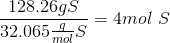
Since the compound consists of only sulfur and element X, we can subtract to find the percent by mass of element X.

Use the percent by mass to find the mass per mole of compound of element X.

Because we are told there are one-half as many moles of X as there are of sulfur, we know there are 2 moles of X (as compared to the 4 moles of sulfur). Divide the mass of element X by the moles of element X to find its atomic mass and its identity.

By consulting a periodic table, we can find that element X is silicon.
Therefore, the molecular formula is  and the empirical formula is
  .
.
Use the molar mass and percent by mass of sulfur to find the moles of sulfur in the compound.
Since the compound consists of only sulfur and element X, we can subtract to find the percent by mass of element X.
Use the percent by mass to find the mass per mole of compound of element X.
Because we are told there are one-half as many moles of X as there are of sulfur, we know there are 2 moles of X (as compared to the 4 moles of sulfur). Divide the mass of element X by the moles of element X to find its atomic mass and its identity.
By consulting a periodic table, we can find that element X is silicon.
Therefore, the molecular formula is
← Didn't Know|Knew It →
A compound is comprised of sodium and element X. The compound has a molar mass of  and is
  sodium by mass. The compound consists of a 1:1 ratio between sodium and element X. Find the molecular and empirical formulas of the compound, including the identity of element X.
A compound is comprised of sodium and element X. The compound has a molar mass of
Tap to reveal answer
Use the molar mass and percent by mass of sodium to find the moles of sodium in the compound.

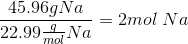
Since the compound consists of only sodium and element X, we can subtract to find the percent by mass of element X.

Use the percent by mass to find the mass per mole of compound of element X.

Because there is a 1:1 ratio, between sodium and element X, they must have an equal number of moles in the compound. Since there are 2 moles of sodium, there must also be 2 moles of element X. Divide the mass of element X by the moles of element X to find its atomic mass and its identity.
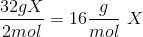
By consulting a periodic table, we can find that element X is oxygen.
Therefore element X is Oxygen.
Therefore, the molecular formula is  and the empirical formula is
  .
.
Use the molar mass and percent by mass of sodium to find the moles of sodium in the compound.
Since the compound consists of only sodium and element X, we can subtract to find the percent by mass of element X.
Use the percent by mass to find the mass per mole of compound of element X.
Because there is a 1:1 ratio, between sodium and element X, they must have an equal number of moles in the compound. Since there are 2 moles of sodium, there must also be 2 moles of element X. Divide the mass of element X by the moles of element X to find its atomic mass and its identity.
By consulting a periodic table, we can find that element X is oxygen.
Therefore element X is Oxygen.
Therefore, the molecular formula is
← Didn't Know|Knew It →
What is the most acidic functional group on the amino acid cysteine? Cysteine has the chemical formula  .
.
What is the most acidic functional group on the amino acid cysteine? Cysteine has the chemical formula
Tap to reveal answer
We know that by definition, all amino acids contain a carboxylic acid functional group ( ), and an amino functional group (
 ). Therefore the additional functional group can only contain sulfur and hydrogen.
The amino functional group is slightly basic, and the carboylic acid functional group is slightly acidic. The -SH functional group will also be acidic, but because sulfur and oxygen are in the same group on the periodic table, the -SH group will have similar acidic properties to an -OH group, and alcohols are less acidic than carboxylic acids.
We know that by definition, all amino acids contain a carboxylic acid functional group (
The amino functional group is slightly basic, and the carboylic acid functional group is slightly acidic. The -SH functional group will also be acidic, but because sulfur and oxygen are in the same group on the periodic table, the -SH group will have similar acidic properties to an -OH group, and alcohols are less acidic than carboxylic acids.
← Didn't Know|Knew It →
Which of the following is the alcohol functional group?
Which of the following is the alcohol functional group?
Tap to reveal answer
The alcohol functional group is -OH
The alcohol functional group is -OH
← Didn't Know|Knew It →
Which of the following functional groups is an amide?
Which of the following functional groups is an amide?
Tap to reveal answer
Amides contain both oxygen and nitrogen in the functional group. The oxygen forms a double bond with a carbon, and the carbon bonds to a nitrogen. This forms the structure  , where the nitrogen is also bound to the carbon.
 is an alcohol functional group.
 is an amine functional group.
 is a carboxylic acid functional group.
 is an aldehyde functional group.
Amides contain both oxygen and nitrogen in the functional group. The oxygen forms a double bond with a carbon, and the carbon bonds to a nitrogen. This forms the structure
← Didn't Know|Knew It →
Which one of the following organic functional groups does not contain a carbon-oxygen double bond?
Which one of the following organic functional groups does not contain a carbon-oxygen double bond?
Tap to reveal answer
A nitrile group contains a carbon-nitrogen triple bond, while all of the other groups contain a carbon-oxygen double bond.
Nitrile: 
Ester: 
Ketone: 
Carboxylic acid: 
Aldehyde: 
A nitrile group contains a carbon-nitrogen triple bond, while all of the other groups contain a carbon-oxygen double bond.
Nitrile:
Ester:
Ketone:
Carboxylic acid:
Aldehyde:
← Didn't Know|Knew It →
Which of the following is an organic compound?
Which of the following is an organic compound?
Tap to reveal answer
An organic compound is typically defined as one that contains carbon. Though there some small exceptions to this rule (for example, cyanide is not considered organic), in general most compounds follow it.
Though water, oxygen, and sodium chloride, may seem organic, they are not for they do not contain any covalent bonds to carbon. The only gievn compound that contains carbon is glucose, a sugar.
An organic compound is typically defined as one that contains carbon. Though there some small exceptions to this rule (for example, cyanide is not considered organic), in general most compounds follow it.
Though water, oxygen, and sodium chloride, may seem organic, they are not for they do not contain any covalent bonds to carbon. The only gievn compound that contains carbon is glucose, a sugar.
← Didn't Know|Knew It →
A chemist is trying to find the identity of a compound. She knows that the compound has a molecular weight of  , and also that it consists of
  carbon,
  hydrogen, and
  oxygen by mass. What are the empirical and molecular formulas, respectively, for this compound?
A chemist is trying to find the identity of a compound. She knows that the compound has a molecular weight of
Tap to reveal answer
The simplest way to begin these types of problems is to assume that we are starting out with 100 grams of the sample compound. This allows us to simplify things, since we know the mass percentages of the elements that make up out unknown compound.



Next, we must convert amount of each element from grams into moles.



This gives us a formula of 
Now, we need to simplify this formula by dividing each of the terms by the greatest common denominator, 3.33, which gives us:

This is our empirical formula. To obtain the molecular formula, we must first find the mass of our empirical formula, which is  .
.
Next, we need to divide the molecular weight of the compound by the empirical weight to obtain an integer of  . Finally, we multiply the empirical formula by this integer in order to obtain the molecular formula, which is:

The simplest way to begin these types of problems is to assume that we are starting out with 100 grams of the sample compound. This allows us to simplify things, since we know the mass percentages of the elements that make up out unknown compound.
Next, we must convert amount of each element from grams into moles.
This gives us a formula of
Now, we need to simplify this formula by dividing each of the terms by the greatest common denominator, 3.33, which gives us:
This is our empirical formula. To obtain the molecular formula, we must first find the mass of our empirical formula, which is
Next, we need to divide the molecular weight of the compound by the empirical weight to obtain an integer of
← Didn't Know|Knew It →
Which of the following is an organic compound?
Which of the following is an organic compound?
Tap to reveal answer
An organic compound is typically defined as one that contains carbon. Though there some small exceptions to this rule (for example, cyanide is not considered organic), in general most compounds follow it.
Though water, oxygen, and sodium chloride, may seem organic, they are not for they do not contain any covalent bonds to carbon. The only gievn compound that contains carbon is glucose, a sugar.
An organic compound is typically defined as one that contains carbon. Though there some small exceptions to this rule (for example, cyanide is not considered organic), in general most compounds follow it.
Though water, oxygen, and sodium chloride, may seem organic, they are not for they do not contain any covalent bonds to carbon. The only gievn compound that contains carbon is glucose, a sugar.
← Didn't Know|Knew It →
Which one of the following organic functional groups does not contain a carbon-oxygen double bond?
Which one of the following organic functional groups does not contain a carbon-oxygen double bond?
Tap to reveal answer
A nitrile group contains a carbon-nitrogen triple bond, while all of the other groups contain a carbon-oxygen double bond.
Nitrile:
Ester:
Ketone:
Carboxylic acid:
Aldehyde:
A nitrile group contains a carbon-nitrogen triple bond, while all of the other groups contain a carbon-oxygen double bond.
Nitrile:
Ester:
Ketone:
Carboxylic acid:
Aldehyde:
← Didn't Know|Knew It →
Which of the following is the alcohol functional group?
Which of the following is the alcohol functional group?
Tap to reveal answer
The alcohol functional group is -OH
The alcohol functional group is -OH
← Didn't Know|Knew It →
What is the most acidic functional group on the amino acid cysteine? Cysteine has the chemical formula .
What is the most acidic functional group on the amino acid cysteine? Cysteine has the chemical formula
Tap to reveal answer
We know that by definition, all amino acids contain a carboxylic acid functional group (), and an amino functional group (). Therefore the additional functional group can only contain sulfur and hydrogen.
The amino functional group is slightly basic, and the carboylic acid functional group is slightly acidic. The -SH functional group will also be acidic, but because sulfur and oxygen are in the same group on the periodic table, the -SH group will have similar acidic properties to an -OH group, and alcohols are less acidic than carboxylic acids.
We know that by definition, all amino acids contain a carboxylic acid functional group (
The amino functional group is slightly basic, and the carboylic acid functional group is slightly acidic. The -SH functional group will also be acidic, but because sulfur and oxygen are in the same group on the periodic table, the -SH group will have similar acidic properties to an -OH group, and alcohols are less acidic than carboxylic acids.
← Didn't Know|Knew It →
Which of the following functional groups is an amide?
Which of the following functional groups is an amide?
Tap to reveal answer
Amides contain both oxygen and nitrogen in the functional group. The oxygen forms a double bond with a carbon, and the carbon bonds to a nitrogen. This forms the structure , where the nitrogen is also bound to the carbon.
is an alcohol functional group.
is an amine functional group.
is a carboxylic acid functional group.
is an aldehyde functional group.
Amides contain both oxygen and nitrogen in the functional group. The oxygen forms a double bond with a carbon, and the carbon bonds to a nitrogen. This forms the structure
← Didn't Know|Knew It →
A chemist is trying to find the identity of a compound. She knows that the compound has a molecular weight of , and also that it consists of carbon, hydrogen, and oxygen by mass. What are the empirical and molecular formulas, respectively, for this compound?
A chemist is trying to find the identity of a compound. She knows that the compound has a molecular weight of
Tap to reveal answer
The simplest way to begin these types of problems is to assume that we are starting out with 100 grams of the sample compound. This allows us to simplify things, since we know the mass percentages of the elements that make up out unknown compound.
Next, we must convert amount of each element from grams into moles.
This gives us a formula of
Now, we need to simplify this formula by dividing each of the terms by the greatest common denominator, 3.33, which gives us:
This is our empirical formula. To obtain the molecular formula, we must first find the mass of our empirical formula, which is .
Next, we need to divide the molecular weight of the compound by the empirical weight to obtain an integer of . Finally, we multiply the empirical formula by this integer in order to obtain the molecular formula, which is:
The simplest way to begin these types of problems is to assume that we are starting out with 100 grams of the sample compound. This allows us to simplify things, since we know the mass percentages of the elements that make up out unknown compound.
Next, we must convert amount of each element from grams into moles.
This gives us a formula of
Now, we need to simplify this formula by dividing each of the terms by the greatest common denominator, 3.33, which gives us:
This is our empirical formula. To obtain the molecular formula, we must first find the mass of our empirical formula, which is
Next, we need to divide the molecular weight of the compound by the empirical weight to obtain an integer of
← Didn't Know|Knew It →
Which of the following is an intrinsic physical property of a chemical substance?
Which of the following is an intrinsic physical property of a chemical substance?
Tap to reveal answer
Intrinsic properties do not depend on the amount of a substance present. Mass, heat, and enthalpy are all dependent on the amount of substance.
Intrinsic properties do not depend on the amount of a substance present. Mass, heat, and enthalpy are all dependent on the amount of substance.
← Didn't Know|Knew It →